
| Saving Private Ryan | |
|---|---|

Theatrical release poster |
|
| Directed by | Steven Spielberg |
| Written by | Robert Rodat |
| Produced by |
|
| Starring |
|
| Cinematography | Janusz Kamiński |
| Edited by | Michael Kahn |
| Music by | John Williams |
|
Production |
|
| Distributed by |
|
|
Release date |
|
|
Running time |
170 minutes |
| Country | United States |
| Language | English |
| Budget | $65–$70 million |
| Box office | $481.8 million |
Saving Private Ryan is a 1998 American war film directed by Steven Spielberg and written by Robert Rodat. Set in 1944 during the Normandy landings of World War II, it follows a group of soldiers, led by Captain John Miller (Tom Hanks), on their mission to extricate Private James Ryan (Matt Damon) from the war effort after all of his brothers are killed in battle. The cast includes Edward Burns, Tom Sizemore, Barry Pepper, Giovanni Ribisi, Vin Diesel, Adam Goldberg, and Jeremy Davies.
Inspired by the WWII books of Stephen E. Ambrose and historical war casualties of members of the same families, such as the Niland brothers, Rodat wrote the script, which was purchased by Paramount Pictures. The project came to the attention of Hanks and Spielberg, who both held an interest in WWII, and their previous successes secured the project’s further development. Based on research and interviews with veterans, Spielberg wanted to make Saving Private Ryan as authentic as possible, and hired Frank Darabont and Scott Frank to perform uncredited rewrites. The main cast undertook a week-long boot camp to understand the experiences of actual soldiers. Filming took place from June to September 1997, on a $65–$70 million budget, and almost entirely on location in England and Ireland. The opening Omaha Beach battle was the most involved scene, costing $12 million to film over four weeks with 1,500 extras.
Despite concerns about releasing a serious war drama in a time normally reserved for escapist blockbuster entertainment, Saving Private Ryan became one of the year’s most successful films, receiving critical acclaim for its graphic and realistic portrayal of combat. WWII veterans described Saving Private Ryan‘s combat scenes as the most realistic portrayal of their own experiences, some being unable to finish watching it due to their traumatic memories. The film earned $481.1 million, making it the second highest-grossing film of 1998, and went on to win many accolades including Golden Globe, Academy, BAFTA, and Saturn awards.
Saving Private Ryan is considered one of the greatest films ever made. The filming techniques innovated to portray its battle scenes have influenced many war, action, and superhero films released since, with many directors naming Saving Private Ryan as influential upon their own styles. It is also credited with helping renew interest in WWII at the turn of the century, leading to other films, television shows, and video games set during the war. In 2014, the film was selected for preservation in the United States National Film Registry by the Library of Congress as «culturally, historically, or aesthetically significant».
Plot[edit]
On June 6, 1944, the U.S. Army lands at Omaha Beach as part of the Normandy invasion, incurring major losses against the artillery and mortar fire of the entrenched German forces. Initially dazed by the chaotic massacre, 2nd Ranger Battalion Captain John H. Miller, takes command of a surviving group and leads a successful infiltration behind the enemy lines to secure victory. The United States Department of War receives communication that three of four brothers have been killed in action; the last, James Ryan of the 101st Airborne Division, is missing. General George C. Marshall orders that Ryan be found and sent home, to spare his family losing all of its sons. Miller is tasked with recovering Ryan and assembles a detachment of soldiers to accompany him: technical sergeant Mike Horvath, privates Richard Reiben, Adrian Caparzo, Stanley Mellish, and Daniel Jackson, medic Irwin Wade, and interpreter Timothy Upham, who lacks any combat experience.
The group tracks Ryan to the town of Neuville-au-Plain where Caparzo is killed by a German sniper while trying to rescue a young girl. Mourning their friend, the men grow resentful at being forced to risk their lives for one man. They later find James Ryan but realize he is the wrong man with the same name. That evening, the men rest in a chapel, where Miller tells Horvath that his hands began uncontrollably shaking after he joined the war. They are directed to a rallying point where the 101st Airborne might be after landing off course. There, they find masses of wounded and displaced soldiers, one of whom recounts how his aircraft crashed, killing his crew, because of heavy reinforcements added without his knowledge to protect a single general on board. Wade admonishes Reiben, Mellish, and Jackson for callously searching through a pile of recovered dog tags in front of passing troops, hoping to find Ryan’s among them and conclude their mission. Remorseful for ignoring their behavior, Miller shouts for anyone that knows Ryan; one deafened soldier tells him that Ryan was reassigned to defend a vital bridge in the town of Ramelle.
On the way, Miller decides to neutralize a German gun nest they discover, against the advice of his men, and although they are successful, Wade is killed. The men decide to execute a surrendered German soldier in revenge, but Upham intervenes, believing they should follow the rules of war for prisoners. Miller releases the soldier, nicknamed «Steamboat Willie», ordering that he surrender to the next Allied patrol. Frustrated, Reiben threatens to desert, leading to a standoff between the men, which Miller defuses by revealing his civilian background as a teacher and baseball coach, something he has always refused to disclose. Miller muses that civilians often accurately assumed his career before he became a soldier, but that none of his men have implies his experiences of war and killing have changed him so much that he is unsure he is still the man he was or that his wife will recognize him.
In Ramelle, Miller’s detachment finds Ryan and informs him of their mission, but he refuses to abandon his post or his fellow soldiers, believing he does not deserve to go home more than anyone else. Horvath convinces Miller that saving Ryan might be the only truly decent thing they can accomplish during the war. Miller takes command of Ryan’s group as the only officer present and prepares the soldiers for an incoming German siege. Jackson and Horvath are killed during the battle, and Upham stands by paralysed with fear as Mellish is stabbed to death. Willie returns and shoots Miller before reinforcements arrive to defeat the Germans. Upham confronts Willie who attempts to surrender again; now aware of the difficult choices soldiers face during war, Upham kills Willie. Upham and Reiben observe as the mortally wounded Miller tells Ryan to earn the sacrifices made to send him home.
Decades later, an elderly Ryan and his family visits Miller’s grave at the Normandy Cemetery. Ryan expresses that he remembers Miller’s words every day, lived his life the best he could, and hopes he has earned their sacrifices.
Cast[edit]
- Tom Hanks as John H. Miller: A determined U.S Captain suffering from post-traumatic stress disorder[1][2][3]
- Edward Burns as Richard Reiben: A rebellious Private First Class[4][5]
- Tom Sizemore as Mike Horvath: Miller’s long-time friend, second-in-command, and Technical Sergeant[4]
- Jeremy Davies as Timothy Upham: A Corporal lacking any combat experience, recruited by Miller as a French and German interpreter[5][4]
- Vin Diesel as Adrian Caparzo: A battle-hardened and compassionate Private First Class[5][4]
- Adam Goldberg as Stanley «Fish» Mellish: A wisecracking Jewish Private, and Caparzo’s close friend[5][4]
- Barry Pepper as Daniel Jackson: A religious Private and sniper[5][4]
- Giovanni Ribisi as Irwin Wade: The team’s diligent and caring Technician Fourth Grade Medic[5][4]
- Matt Damon as James Francis Ryan: A young Private First Class from Iowa[5][6]
- Dennis Farina as Walter Anderson: A U.S. Lieutenant Colonel who tasks Miller with finding Ryan[7]
- Ted Danson as Fred Hamill: Captain of the 101st Pathfinders unit[4][7]
- Harve Presnell as George C. Marshall: A U.S. General who orders the mission to recover Ryan.[7]
- Bryan Cranston as Mac: A Colonel in the War Department[4][7]
- David Wohl as T. E. Sanders: A Captain in the War Department[8]
- Nathan Fillion as James Frederick Ryan: A soldier mistaken for James Francis Ryan (credited as Minnesota Ryan)[4][5][7]
- Paul Giamatti as William Hill: A war-weary Sergeant in Neuville[7][5]
- Ryan Hurst as Mandelsohn: A hearing-impaired paratrooper[7]
- Max Martini as Henderson: A Corporal in Ryan’s company[7][8]
- Leland Orser as DeWindt: A U.S. Lieutenant from the 99th Troop Carrier Squadron[8][7]
Saving Private Ryan‘s cast includes Glenn Wrage as Doyle, Corey Johnson as Radioman, John Sharian as Corporal Loeb, and Rolf Saxon as Lieutenant Briggs, Allied soldiers at the Omaha beach landing.[8][7] Demetri Goritsas and Dylan Bruno portray Parker and Private First Class Toynbe, respectively, who aid in the battle of Ramelle.[7] Joerg Stadler appears as Steamboat Willie, a German prisoner.[4][8] Kathleen Byron portrays Ryan’s mother,[7] while Harrison Young and Amanda Boxer portray, respectively, the elderly James Ryan and his wife, Margaret.[7] Technical advisor and Marine veteran, Dale Dye, makes a cameo appearance as a War Department Colonel.[7]
Production[edit]
Concept[edit]
Producer, Mark Gordon, was a fan of writer Robert Rodat’s previous work on films such as Tall Tale (1995) and Fly Away Home (1996). The pair met in early 1995 to discuss potential projects and ideas. Within a few weeks, Rodat conceived of Saving Private Ryan.[9][10] He was inspired by a gift from his wife, the historical book, «D-Day June 6, 1944: The Climactic Battle of World War II» (1994), by Stephen E. Ambrose, recounting the events of the Normandy landings. Rodat also visited a monument in Keene, New Hampshire dedicated to American soldiers killed in combat; he noticed the losses included brothers. He said, «the idea of losing a son to war is painful beyond description … the idea of losing more than one son is inconceivable.»[10][9][11] The Ryan family was based on the four Niland brothers detailed in Ambrose’s book, who were deployed during World War II (WWII); two were killed and a third thought dead, leading to the fourth being removed from the war per the Sole Survivor Policy.[9][12][13]
Development[edit]
To develop Saving Private Ryan, Gordon founded the independent film studio, Mutual Film Company, alongside fellow producer, Gary Levinsohn.[9] Gordon brought Rodat’s draft to Paramount Pictures executives; they responded positively and hired Rodat who wrote the script over the following 12 months.[14][9][10] Michael Bay was hired as director, but left the project because he could not determine how to approach the material.[15][16] Carin Sage, a junior agent at the Creative Artists Agency representing Tom Hanks, gave him the script and he was immediately interested, meeting with Gordon and Levinsohn.[14][9][10] Hanks shared the script with Steven Spielberg as the pair had wanted to work together for some time; having a personal interest in WWII, Spielberg agreed to direct.[9][14] Rodat thought that Paramount would cancel the project after the studio purchased two other WWII-era scripts, Combat and With Wings as Eagles, with popular actors Bruce Willis and Arnold Schwarzenegger attached respectively.[9] Having secured the involvement of two of the highest-paid and most successful Hollywood actors and directors, Gordon recounted telling Paramount executives, «OK, you have [Schwarzenegger] on one project and [Willis] on the other. How about [Hanks] and [Spielberg]? Ha, ha, ha!»[9]
Describing what interested him about the project, Spielberg said, «so what you’re doing is sending eight people out, all of whom have parents, to rescue one boy and send him back to his mom when any or all of these kids, along the mission route, could be killed. That was the central tug that made me want to tell the story.»[17] Spielberg had a lifelong interest in WWII, having made war films as a teenager because «growing up, it was the seminal conversation inside my family. My parents talked about the Holocaust and they talked about combat and war. And I was born knowing this. My dad was a veteran … he had many veterans over to the house, and I became absolutely obsessed … based on my father’s stories, recollections, and also based on all the WWII movies.»[18][13][19] He described the project as a tribute to his father.[20]
With Spielberg involved, DreamWorks Pictures, which he co-founded, became involved as a financier, and his company, Amblin Entertainment, as a production company.[10][21][22] Although thoroughly involved on previous projects, Spielberg’s clout meant Gordon and Levinsohn were effectively removed from the production, having no creative input, equity, or rights in Saving Private Ryan, but receiving a produce credit and one-off payment. Levinsohn said, «you just know going in what the score is … I guess it’s unspoken that when you hire [Spielberg] you’re not going to be on the set making decisions.» Ian Bryce was hired to replace them by DreamWorks.[9] In April 1997, Sumner Redstone, chairman of Paramount’s parent company Viacom, had Spielberg flip a coin to determine the film’s distribution rights. Spielberg won the toss, giving DreamWorks the favored North American distribution rights and Paramount the international rights; all earnings were held collectively and split evenly between the studios. In exchange, Paramount received the North American distrubtion rights to DreamWorks’ Deep Impact (1998).[23][10][14][9] To keep the budget low, Spielberg and Hanks took minimal upfront salaries in exchange for a guaranteed 17.5% of the gross profits, equivalent to 35 cents of every dollar earned.[14][9]
Rewrite[edit]

The Niland brothers (1940s) were an influence on Saving Private Ryan‘s plot
Spielberg’s initial concept for Saving Private Ryan was a Boys’ Own-style adventure film in which the search for Ryan was a public relations effort by the war department. However, after interviewing WWII veterans for research he found this idea inappropriate, and decided to focus on realistically recreating the events that happened while portraying the conflicted morality of sending several men into life-threatening situations to save one man.[24][13][17][25] He said, «I cannot tell you how many veterans came up to me … and said: ‘Please be honest about it. Please don’t make another Hollywood movie about WWII. Please tell our stories.’ To a person, they said: ‘We’ll support you if you support us and at least show people—if you’ve got the guts to do it—how it actually happened.‘«[13] The Nilands were interviewed, but the Ryan family was also influenced by other substantial family war losses, including the five Sullivan brothers killed during WWII, and the Bixby brothers during the American Civil War; the resulting letter by Abraham Lincoln is quoted in Saving Private Ryan.[13]
Spielberg described existing WWII films as «sanitized» and sentimentalized, focused on depicting honor and the glory of serving ones country in a manner that was «very safe and wholly untrue.»[13][19][17][25] He said, «I remember one of the [veterans] telling me the entire charge up the beach was a blur—not a blur to his memory, because he still remembered every single grain of sand when he had his face buried in it from that fusillade raining down on them from above. But he described how everything was not in focus for him. And he described the sounds, and he described the vibrations of every concussion of every 88 shell that hit the beach, which gave some of them bloody noses, rattled their ears. The ground would come up and slam into their faces from the concussions.»[18][26] Spielberg said he wanted to reflect the courage of the soldiers in the face of «palpable terror, almost blind terror.»[25] Ambrose served as a historical consultant. He disliked glorified depictions of the Normandy landings that ignored the reality of soldiers slowly dying in mud and water, wanting «their mothers, they wanted morphine. It took a long time.»[27][28][9] Spielberg believed the legacy of the Vietnam War had made his generation less interested in glorifying combat in film. Even so, he was influenced by early war films such as Battleground (1949), The Steel Helmet (1951), and Hell Is for Heroes (1962).[19]
Although Rodat’s script came close to the ideal WWII project he had been waiting for, he believed it had » a few problems.»[29] He hired Frank Darabont and Scott Frank to perform uncredited script rewrites.[28][30][31][32] Darabont suggested the Normandy scenes opening with the soldiers landing on the beach.[24] The scene begins with the second wave of soldiers arriving so they would be walking into «Hell on Earth» instead of empty beaches.[33] Frank performed rewrites based on transcriptions of Spielberg’s recorded ideas and two folders of historical facts about the Normandy landings; these gave Frank ideas but he found parsing historical facts into original ideas.[34] The opening with the elderly Ryan in the Normandy cemetery was based on Spielberg’s own experience visiting the area as a youth; he witnessed a family accompanying a man who fell to his knees and began to cry at a grave marker.[13]
Casting[edit]
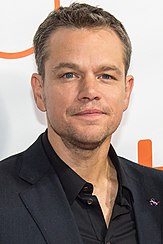

Spielberg wanted older actors for his main cast, based on young WWII soldiers looking older than their true age following the stresses of war.[17] Miller is the «adult in the story,» intended to project a calmness and feeling of safety that is undermined by the character’s uncontrollable hand shaking.[18] Spielberg wanted Hanks to play Miller because he was the only actor he thought of that would not «want to use his teeth to pull out a pin from a hand grenade.»[17] Hanks informed Miller’s character based on the war history of the 2nd Ranger Battalion prior to Omaha beach, saying he believed Miller was «horribly afraid» of getting more of his men killed.[18] Mel Gibson and Harrison Ford were considered for the role.[35] Miller’s detatchment is a diverse group, including a Jew and Italian, reminiscent of earlier WWII films; this was not a deliberate choice but Spielberg believed he had subconsciously drawn on the war films of his youth.[36] Burns describing Reiben as a «wise guy» in the script, but the experience of filming the Omaha Beach landing inspired him to give the character a «much harder edge.»[25] Sizemore was cast in The Thin Red Line (1998) when Spielberg offered him an alternative role as Horvath, Miller’s friend and confidant.[18][36] The actor had a history of drug addiction, and Spielberg mandated that he pass regular drug tests to keep his part, or the role would be recast and his scenes re-shot.[37][12] Describing his character, Sizemore said, «he was a quiet man; he was taciturn; he followed orders, and he loved the captain … if he had a tragic flaw, it was that he didn’t know when he had had enough, when it was time to say, ‘I can’t do this anymore.'»[38]
Diesel was cast after Spielberg saw his self-starring directorial efforts, Multi-Facial (1995) and Strays (1997). The actor was working as a telemarketer at the time, having struggled to secure acting jobs.[18] Goldberg’s role did not exist in the script until his casting.[18] Spielberg wanted a relatively unknown actor to portray private Ryan. While filming Amistad, Spielberg visited Robin Williams on the nearby set of Good Will Hunting (1997), who introduced him to Damon. Spielberg cast him shortly after, believing he possessed a «great American everyboy look,» unaware that Good Will Hunting‘s success would significantly raise Damon’s profile.[5][4][17][12] Neil Patrick Harris was considered for the role, and Edward Norton turned it down for American History X (1998).[39][40][35] Pete Postlethwaite, Tony Shalhoub, and Garth Brooks were considered for unspecified roles.[41][42][43]
At Hanks’s and Dye’s suggestion, Spielberg had the principal cast take part in a six day training boot camp training, wanting them to experience the same cold, wet, and exhaustive conditions of WWII soldiers.[12][17][19][13][33] Overseen by Dye and retired U.S. marines, the actors remained in character while simulating attacks, performing five-mile runs with full backpacks, weapons training, military exercises, and push-ups after making mistakes, on three hours of sleep per night in cold and rainy conditions.[12][17][11] The men wanted to quit, but Hanks conviced them otherwise, saying they would regret not following through and the experience would help them understand their characters and motivations.[25][27] Diesel said, «at that moment we got this huge respect for him in real life, we were all exhausted, we all wanted to leave and here was this guy who was a superstar, who doesn’t have to be here, voting to stay.»[33] Dye was present throughout filming to remind the actors of their training.[25] Spielberg did not let Damon take part in the boot camp because he wanted the other actors to hold resentment towards him and his character.[5][4]
Pre-production[edit]
The pre-production for Saving Private Ryan was truncated because Spielberg chose to film Amistad (1997) immediately after finishing work on The Lost World: Jurassic Park (1997). Cinematographer, Janusz Kamiński, spent several weeks performing camera tests to define the film’s visual aesthetic. The pair considered filming monochromatically as Spielberg had with his Holocaust film, Schindler’s List (1993). However, they considered this would seem «pretentious,» and were interested in emulating the colored WWII footage from their research. Kamiński let his interpretation of the narrative dictate how to light scenes and narrowed down visual styles by identifying which films he did not want Saving Private Ryan to emulate.[11] He and Spielberg were visually influenced by WWII documentaries, such as Memphis Belle: A Story of a Flying Fortress (1941), The Battle of Midway (1942), Why We Fight (1942–1945), and the Nazi propaganda films of Leni Riefenstahl. They also looked at various books, paintings, and photographs of the Omaha Beach invasion taken by famed war photographer Robert Capa.[19] Kamiński wanted it look like a major production «shot on [16 mm film] by a bunch of combat cameramen.»[11]
A variety of camera techniques were used to emulate the experience of being on a battlefield: Kamiński removed the protective coating on some lenses, creating a «flatter», degraded image akin to WWII-era cameras, and mismatched lenses when using multiple cameras for an inconsistent result; alternating shutter angles and speeds; and desynchronizing the camera shutter which created a «streaking» effect. Kamiński considered this a risky option because if it failed there was no way to fix the image in post-production.[19][11][26] A Clairmont Camera Image Shaker vibrated the camera to emulate the effects of a nearby explosion or rolling tank.[11] Spielberg chose to film in 1.85:1 aspect ratio because he believed it was more lifelike and closer to «the way the human eye really sees,» and found widescreen formats to be artificial.[19]
Three months were spent scouting for a location to portray the Normandy coast. The real location was too developed for their needs, and many other French beaches were restricted by military or wildlife use; Spielberg believed officials were difficult because they did not want him filming there.[11][12][25] Beaches researched in England and Scotland lacked either the aesthetics or amenities required, such as housing for the crew, and the filmmakers needed a specific depth for the cast to leap from the landing crafts into the water.[25] Associate producer, Kevin De La Noy’s earlier work on Braveheart (1995) in Ireland had developed contacts with the Irish Army and knowledge of local beaches. One such location, the 7 mi (11 km) long Curracloe Beach, near Curracloe, County Wexford, offered the desired golden sands and sheer cliffs and nearby amenities.[25][44][12][11] Spielberg selected a 1 km (0.62 mi) segment of the beach, known as Ballinesker.[45][44][46] He said, «I was a bit disappointed that the beach we used wasn’t as broad as the real Omaha Beach … I tried to use certain wide-angle lenses to extend the length of the flats on the sandy beach before the soldiers reach the shingle. I used wider lenses for geography and tighter lenses for the compression of action.[19] A segment adjacent to Blackwater, County Wexford, was considered, but the local nuns could not make the land available in time.[44] Service roads were built for vehicles to reach Ballinesker.[44][46] Production designer, Thomas E. Sanders, led construction of the concrete battlements, bunkers, Czech hedgehogs, and barbed wire, much of which was made by local metalworkers.[44][46][11] Over eleven weeks were spent preparing Ballinesker for filming.[46] A storm destroyed some of the props just before filming, and were rebuilt overnight.[25] The main crew arrived on location on June 25, 1997.[44]
Commencement in Ireland[edit]

Ballinesker Beach (pictured in 2015), a segment of Curracloe strand in Ireland, was used to portray Omaha Beach
Principal photography began on June 27, 1997.[47][48] Filming was done at a rapid pace, producing up to 50 shots per day. Spielberg wanted the actors to get little rest, «A war is fought fast, and I really wanted to keep all of the actors off-balance. I didn’t want them to be able to read 75 pages of a novel … I wanted to work fast enough so that they always felt as if they were in combat … I had to keep them on the set, which meant shooting the film even faster than I normally do. War doesn’t give you a break.»[13][19] Saving Private Ryan was shot almost entirely in continuity order, although some of the crew found this a «a mentally demoralizing experience» because the cast started together and left as their characters died.[17][13][19]
The Omaha Beach battle was filmed over three to four weeks, and at a cost of $12 million.[25][46][11][39][19][13][46][37] The scene involved about 1,500 people including 400 crew, 1,000 Fórsa Cosanta Áitiúil (FCA) and Irish army members, and dozens of extras and about 30 amputees and paraplegics fitted with prosthetic limbs to portray disfigured soldiers.[44][46][45][37][25] Their numbers were supplemented with over one thousand detailed mannequins.[46] The extras were divided into platoons with a designated leader, allowing Dye to control their action via four different radios with aid from three non-commissioned officers.[25] Costume designer, Joanna Johnston, contracted an American company responsible for making boots for soldiers during WWII to create about 2,000 pairs, using the last batch of dye from that period.[25][11] Soldiers in the ocean wore wet suits beneath their uniforms to stay mostly dry.[46][45] Armorer, Simon Atherton, was responsible for supplying authentic period weapons.[11]
Two Higgins Boats used in the landings were used in the scene; additional boats from the 1950s were brought from California, Donegal, and Southampton.[11][46] Hanks recalled, «the first day of shooting … I was in the back of the landing craft, and that ramp went down and I saw the first 1-2-3-4 rows of guys just getting blown to bits. In my head, of course, I knew it was special effects, but I still wasn’t prepared for how tactile it was. The air literally went pink and the noise was deafening and there’s bits and pieces of stuff falling all on top of you and it was horrifying.»[27] Soldiers vomiting from the boats was achieved using Milk of magnesia.[35] A crane shot moving from beneath the ocean surface to above the battlefield was achieved by placing the crane on a flatbed trailer and reversing it into the sea.[46]
The Omaha Beach sequence was extensively choreographed by stunt coordinator Simon Crane, with squibs and explosives managed by Neil Corbould. The only serious accident resulted from an extra’s foot being run over by a car.[11][25] Thousands of gallons of fake blood were used in Saving Private Ryan, mainly to turn the ocean and shoreline red.[46][37] Based on his interviews with veterans, Spielberg had dead fish strewn in the water and around the battlefield, as well as a bible floating on the surface.[25] Bullet impacts were emulated using air pipes concealed beneath the sand and ocean surface.[45] Drums of diesel fuel were burned to create black smoke, while a series of pickup trucks carried systems to disperse white smoke.[11]
During filming, the weather was cold, rainy, and overcast; Kamiński said this matched the weather during the Normandy landings, enhancing the film’s accuracy.[19][11] Artificial light was used sparingly apart from on the boats to highlight the actors’ eyes under their helmets.[11] Spielberg had the camera stay close to the ground to appear as if it was the view of a soldier avoiding being shot or a combat cameraman. He intended for the audience to feel like they were a part of the battle rather than watching voyeuristically.[13][17] Most of Saving Private Ryan was filmed with handheld cameras. This was physically demanding on camera operator, Mitch Dubin, and steadicam operator, Chris Haarhoff, due to both the closeness to the ground and movement through exploding scenery. The camera was close enough that fake blood, water, and sand would stick to the camera lens, but the filmmakers believed this made the footage more authentic.[11][19]
Kamiński considered the extensive setup of explosives, smoke, and choreography of over a thousand characters to be demanding as it could take half a day to reset if something went wrong, but the majority of scenes in the sequence were captured in less than four takes using up to three cameras simultaneously. Spielberg said, «I rarely walked away from a scene until I got what I wanted, and I’d say that I got what I wanted from those complex setups about 80 percent of the time.»[11][19] He would review the days footage each night in a local parish hall.[6][46] Production crew remained after filming to restore the beach to its original state over the following month, per an ecological protection order agreed with local authorities.[44][46][11]
Conclusion of filming[edit]
Filming relocated to the Hatfield Aerodrome in Hertfordshire, England at the end of August, for the remaining scenes and the battle of Ramelle.[44][46][11][6][25] French towns and rivers were scouted where a partial set could be built, but there were too many environmental concerns of filming contaminating the water. Instead, Sanders and his team built the fictional Ramelle on the grounds of the Aerodrome, based on five towns where Normandy fighting took place. Nearly three city blocks, the set included fully built buildings, some facades, and a custom built, 900 ft (270 m) long river. The river was lined because they «had to control the height of the water very carefully.» Explosives were used to create bomb craters and damage around Ramelle.[25][11][49][50]
Though the battle involved fewer extras than the Omaha Beach scene, several weeks were spent developing the complex choreography based on a battle plan devised by Dye.[25] Spielberg did not storyboard Saving Private Ryan because he wanted to position the camera spontaneously in reaction to what was taking place in each scene and he often relied on Dye and other WWII consultants for advice on staging the combat scenes.[51][19] Dale also advised on technical aspects of weapons; where Spielberg wanted to use larger explosions typically found in Hollywood action films, Dye would generally advise him to «go half that size, they were never that big.»[19] The production was estimated to have spent about £8 million in the local area.[49]
Spielberg’s spontaneous approach to filming carried into other aspects of Saving Private Ryan; about halfway through filming, he decided to depict the remainder of the film from Upham’s perspective, believing he represented himself and the audiences inexperience of war.[18] Goldberg’s character was only going to be shot dead until Dye suggested a hand-to-hand combat sequence on the day of filming, leading to Mellish being stabbed through the heart.[18] A separate scene of Ryan talking about his brothers was ad-libbed by Damon.[35]
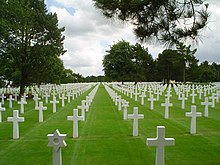
The German machine-gun nest and following ambush of a half-track vehicle were filmed on the grounds of Thame Park, Thame, in Oxfordshire; the chapel interior were Miller’s men rest was also filmed in the Thame Park chapel.[52] The Iowa cornfields where Ryan’s mother lives in a house built for filming was set near West Kennet, Wiltshire.[53] The American war office was filmed in the Hatfield Aerodrome, Hertfordshire. Kamiński wanted scenes in America to be more colorful and a relief from the muted tones of the combat scenes, so he positioned very bright lighting outside the windows.[11][49][6] Scenes featuring the elderly Ryan were filmed at the Normandy American Cemetery and Memorial in Colleville-sur-Mer, France, adjacent to Omaha beach.[54]
Filming concluded ahead of schedule on September 13, 1997, after 12 weeks, with the French church interior scenes.[47][6][39][19] The estimated total budget was $65–$70 million.[10][11][9][14][a]
Post-production[edit]
Kamiński chose to render his footage using Technicolor’s proprietary ENR process (similar to a bleach bypass) which retained more silver in the film stock which produced deeper blacks. He used «70 percent ENR» for a desaturated image which added a blue hue. Concerned this would change make the fake blood appear inauthentic, the effects department mixed blue coloring into it, giving it a dark red appearance.[11] Special effects studio, Industrial Light & Magic, provided digital enhancements; many bullet wounds and blood splatter were computer-generated imagery.[24]
Michael Kahn edited the final 170 minute cut of Saving Private Ryan.[19][55][56][57] Spielberg said that Kahn’s style was intended to defy audience expectations and not make every scene or transition clear.[19] Some scenes were cut because of their graphic imagery, such as Miller’s unit encounter burnt out tanks with charred bodies. Mellish’s death was also trimmed, removing parts with the character screaming in pain, after Spielberg’s projectionist said «It’s too painful to watch.»[18][24]
Spielberg said Saving Private Ryan had to be «ugly» but was worried the violent content could be seen as exploitative and earn it a restrictive NC-17 rating from the Motion Picture Association of America, meaning only those over 17 years of age could view it.[26] He anticipated that the «historical importance» of the content would be taken into consideration; it received an R rating, meaning children could see it when accompanied by an adult.[14][26]
Music[edit]
Long-time Spielberg collaborator, John Williams, produced the score for Saving Private Ryan.[58][59] Spielberg intended for little music accompaniment, wanting the sounds of battle and death to be prominent. Using a spotting process, he and Williams watched a rough cut of the film to agree on which scenes would feature music.[59][60] Williams deliberately avoided «anything grandiose or operatic.»[59] Williams recorded the 55-minute score over three days at Symphony Hall in Boston, with the Boston Symphony Orchestra and vocals provided by the Tanglewood Festival Chorus.[60][59][61] The recording cost about $100,000 per hour.[59] Spielberg chose the Orchestra: «This is a movie about a company of soldiers, and it seemed appropriate to use an experienced company of musicians who are all virtuosos. Also we really wanted the sound of this room, Symphony Hall. On a soundstage you can get acoustically correct sound, but you don’t hear the air. Here you get a rich, warm sound off the walls and ceiling, and you do hear the air; Symphony Hall is an instrument too.»[59]
Release[edit]
Context[edit]
The summer theatrical season began in early May with the release of Deep Impact, which became a surprise box office success.[62][63] Studio executives saw its performance as a positive indication that audiences were eager for the upcoming 100 film releases.[63] The heavily promoted Godzilla and Armageddon were expected to be the biggest successes, while executives were hopeful for their more modestly-budgeted films (costing less than $60 million), such as Small Soldiers, The Negotiator, The Parent Trap, and There’s Something About Mary to be sleeper hits. Far fewer sequels were scheduled for release than in previous years; one executive explained, «everyone started to realize that a certain amount of originality was required, and if you make a sequel it should be better than the last one.»[63][62] There was also less escapist entertainment, and more films targeted at older audiences, such as The Horse Whisperer, The Truman Show, and the highly-anticipated Saving Private Ryan.[63][62][9] Analysis suggested the film’s commercial potential could be harmed by its long runtime, limiting the number of times it could be screened daily, in addition to its violent content.[9] DreamWorks’ marketing chief, Terry Press, said it was risky to release a serious drama such as Saving Private Ryan in the summer, a time generally reserved for family and escapist entertainment, but this was offset by the popularity of Spielberg and Hanks.[14] A screening for DreamWorks and Paramount executives was highly praised,[10] but Spielberg had low expectations, believing the film was too violent to attract broad audiences.[64]
Box office[edit]
The premiere of Saving Private Ryan took place on July 21, 1998. The event was low-profile without a party or many celebrities as Press said «it would have been inappropriate.»[65] Saving Private Ryan was released in the United States and Canada on July 24, 1998.[9][66] During its opening weekend, Saving Private Ryan earned $30.6 million across 2,463 theaters—an average of $12,414 per theater.[66][9] This figure made it the number 1 film of the weekend, ahead of The Mask of Zorro ($13.4 million), in its second week of release, and Lethal Weapon 4 ($13.1 million), in its third.[67][14] The audience was split evenly between women and men, and skewed towards those aged over 25 years old. The New York Times described it as unusual for a near three-hour long drama to perform so well on its opening weekend, crediting positive reviews as an influence. DreamWorks believed the box office figure would have been higher if not for a delay in film prints arriving in hundreds of theaters across California and Arizona until late in the afternoon.[14]
In its second weekend, Saving Private Ryan remained the number 1 film with $23.6 million, ahead of the debuting The Parent Trap ($11.1 million) and There’s Something About Mary ($10.9 million) in its third.[68] Saving Private Ryan retained the number 1 position in its third weekend with ($17.4 million), ahead of the debuts of Snake Eyes ($16.3 million) and Halloween H20: 20 Years Later ($16.1 million), and its fourth with $13.2 million, ahead of the debuts of How Stella Got Her Groove Back ($11.3 million) and The Avengers ($10.3 million).[69][70] In its fifth weekend, Saving Private Ryan fell to number 2 with $10.1 million, behind the debut of Blade ($17.1 million).[71] Saving Private Ryan did not regain the number 1 position, but remained in the top-ten-highest grossing films for a total of 12 weeks.[66] By the end of its theatrical run, Saving Private Ryan earned a total box office gross of $216.5 million, making it the highest-grossing film of the year, ahead of Armageddon ($201.6 million) and There’s Something About Mary ($176.5 million).[72][26] This also made it only the third R-rated film to earn more than $200 million, after 1984’s Beverly Hills Cop ($235 million) and 1991’s Terminator 2: Judgment Day ($205 million).[73]
Outside of the U.S. and Canada, Saving Private Ryan is estimated to have earned a further $265.3 million. This gave the film a cumulative worldwide gross of $481.8 million, making it the second-highest grossing film of 1998, behind Armageddon ($553.7 million).[74][26][b]
Saving Private Ryan was seen as the biggest success of the theatrical summer. The New York Times wrote that the success of a «prestige film» during a time of blockbuster entertainment with broad appeal was evidence that audiences were accepting of serious dramas alongside action films, such as Armageddon and Godzilla, and «gross-out comedy» like There’s Something About Mary. The publication wrote that the popularity of Saving Private Ryan was, in part, because it depicted a «nobler, cleaner era» promoting values of heroism and «patriotic duty.»[75] The 1998 box office broke records with over $7 billion earned. Despite expectations, the biggest successes had modest budgets, such as Saving Private Ryan, There’s Something About Mary, Rush Hour, and The Waterboy, while the anticipated blockbusters, such as Godzilla and Armageddon were so expensive to make that they were less profitable.[76] Hanks’s pay agreement earned him an estimated $30–$40 million of the box office.[77]
Reception[edit]
Critical response[edit]

Saving Private Ryan received critical acclaim,[26][78] and audiences polled by CinemaScore gave the film an average grade of «A» on an A+ to F scale.[79]
Critics generally agreed that Saving Private Ryan presented the grim and brutal reality of the «Good War» in a way previously unseen on film.[80][81][57][56][82] Kenneth Turan described the film as darker and more pessimistic than any of Spielberg’s previous works, dispelling the mythos of WWII as staunchly good heroes fighting against evil forces to depict the reality of combat where, «American soldiers mock virtue and shoot surrendering Germans, where decent and altruistic actions tend to be fatal, where death is random, stupid and redeems hardly anything at all.»[80][83] Some reviewers said this exploration of the limitations of morality in combat asked audiences to consider that the lives lost during the conflict were as valuable as those saved by their sacrifices. Gene Siskel lauded the film’s ability to discuss the «brutality and madness» of war while «believably» celebrating the sacrifices and courage of those fighting it.[82][57][84] Salon.com concluded, «it will forever change the way people imagine the most important event in 20th century history. That is no small achievement.»[80] Stephen Holden said «it’s a safe bet that Saving Private Ryan, a powerful but flawed movie, will be revered as a classic decades hence.»[75]
Many reviewers focused on the film’s two major combat sequences, particularly the opening on Omaha Beach.[14][57][81][85][80][83] Focus was on the «horrifying,» «visceral,» «brutal,» «shocking,» and «fierce» violence present in the opening battle, described by Owen Gleiberman and Schickel as one of the most revolutionary film sequences ever made.[85][84][57][80] Ebert and Schickel compared it with the energy and dread of similar scenes in the Vietnam war film, Platoon (1986), but with a grander scope depicting masses of men killing each other from afar, drawing the «horror» out of a lengthy, sustained sequence, without the audience being allowed to become desensitized.[57][86][56] Some reviewers believed that the scene was so impactful and thought-provoking that it overshadowed the rest of the film.[84][80] Although there was some criticism toward the realistic violence and gore, Turan believed it was done purposely and dispassionately, conveying the chaos and despair experienced by the soldiers, and not done for the sake of entertainment.[83] Spielberg rejected this criticism, affirming he wanted the audience to understand what real combat was like and what the soldiers experienced, not observe it from afar as spectators.[37][81] Some reviewers believed the concluding battle in Ramelle was more violent than Omaha Beach, particularly the slow death of Mellish as he is stabbed through the chest.[80][85] Andrew Sarris criticized the «pornography of violence and cruelty» depicted in severed limbs and rivers of blood.[87]
Some reviewers found that, outside of the combat, the script was effective but uninspired and derivative of war films by other directors, such as Oliver Stone, Stanley Kubrick, and Francis Ford Coppola.[83][80][88][87] Others criticized «manipulative» over sentimentality, particularly in the modern day framing device featuring the elderly Ryan.[83][87] Even so, Salon.com described it as «enormously moving, it serves as a kind of redemption, a necessary if eternally fragile answer to the hell hell witnessed.»[80]
Hanks’s performance was generally praised, with some reviewers calling it the best of his career to date.[80][84][82][56] Many reviewers agreed that his everyman persona allowed him to portray Miller with a gentle weariness, empathy, and vulnerability beneath a surface of strength and decency, but also cynicism toward the war.[80][82][83][84] Ebert and Schickel wrote that he offered a quiet reserve «hinting at unspoken competencies» that convince his men and the audience to follow along with him.[82] Turan believed that Hanks’s «indelible» performance represented how the audience would hope to be when confronted by the same situations.[83] The other main cast also generally received positive reviews, particularly Davies, with Ebert saying that his transformation from inexperienced interpreter to soldier being the conclusion to «Spielberg’s unspoken philosophical argument.»[56][85][57][80][82][84] Gleiberman and Turan also highlighted the performances of Pepper, Ribisi, and Sizemore, who Turan believed delivered his career’s «best, most controlled» performance.[83] Salon.com and Ebert praised the cast for not devolving into cliché or «zany» archetypes and effectively portraying the bonds between them.[80][57] However, Salon.com wrote that Damon’s performance was «jarring», believing both his more cinematic aesthetic and speech about his brothers to be overly artificial. The review concluded that Ryan was not very compelling, which made it difficult to care about the mission to save him.[80]
Accolades[edit]
At the 56th Golden Globe Awards in 1999, Saving Private Ryan won awards for Best Drama and Best Director (Spielberg), and was nominated for Best Drama Actor (Hanks), Best Original Score (Williams), and Best Screenplay (Rodat).[89][90] At the 71st Academy Awards, Saving Private Ryan won awards for Best Director (Spielberg), Best Cinematography (Kamiński), Best Film Editing (Kahn), Best Sound (Gary Rydstrom, Gary Summers, Andy Nelson, Ronald Judkins), and Best Sound Effects Editing (Rydstrom and Richard Hymns). The film was nominated for Best Actor (Hanks), Best Original Screenplay (Rodat), Best Music (Williams), Best Production Design (Sanders and Lisa Dean Kavanaugh), and Best Makeup (Lois Burwell, Conor O’Sullivan, Daniel C. Striepeke).[91] Saving Private Ryan‘s unexpected loss of Best Picture to Shakespeare in Love is seen as one of the biggest upsets in the awards history and led to DreamWorks executives accusing its producers, Miramax, of «overly aggressive campaigning.»[c] A 2015 poll of Academy voters suggested that, given another opportunity, they would have voted Saving Private Ryan as Best Picture.[97]
For the 52nd British Academy Film Awards, Saving Private Ryan won Best Special Effects and Best Sound, and was nominated for Best Film, Best Direction (Spielberg), and Best Actor (Hanks).[98] At the 25th Saturn Awards, it won Best Action, Adventure, or Thriller Film.[99] The 3rd Golden Satellite Awards also earned the film Best Editing (Kahn), and a nomination for Best Supporting Actor (Sizemore),[100] as well as Best Director (Spielberg) and Best Actor (Hanks) at the Empire Awards .[101][102]
Saving Private Ryan also won awards for Outstanding Directorial Achievement (Directors Guild of America, Spielberg), [103] Motion Picture Producer of the Year (PGA Awards, Spielberg, Bryce, Gordon, and Levinsohn),[104] Best Casting (Casting Society of America, Denise Chamian)[105] Best Instrumental Composition Written for a Motion Picture (Grammy Awards, Williams),[106] Best Sound Editing for Dialogue (Motion Picture Sound Editors, Hymns, Rydstrom, Sandina Bailo-Lape, Ethan Van der Ryn, Teresa Eckton, Frank Eulner Karen Wilson, Larry Oatfield, and Bruce Lacey) and Sound Effects (Hymns, Rydstrom, Gwendolyn Yates Whittle, Larry Singer, Ewa Sztompke Oatfield, Sara Bolder, Denise Whiting, and Thomas Whiting)[107] and Best of Show — Audiovisual (Key Art Awards).[108]
Post-release[edit]
Historical accuracy and World War II veteran responses[edit]

Several publications have highlighted the accuracy of the Omaha Beach assault, down to the sound of gunfire, although some minor elements were singled out, such as bullets killing soldiers underwater, the absence of British coxswain steering the boats, and the truncated duration of the battle.[12][92][109][110] Historical curator, John Delaney, said «It’s accurate for that unit on that bit of that beach on that day … but you can’t say, ‘That’s what D-Day was like’, because it wasn’t. Omaha beach is about three and a half miles long. What’s happening at one end of the beach isn’t what’s happening at the other end.»[111] Discussing the core narrative, Ambrose said, «It’s a stretch that they would send eight soldiers, but it could have been hard to find him … the paratroopers were scattered everywhere.»[28]
Many World War II veterans described Saving Private Ryan as depicting the most realistic representation of combat. Another veteran, interviewed by Time, said «I remember when I walked out into the lobby of the moviehouse, not a single person coming out of that showing said one word … everybody was stunned by it. I was too. I wasn’t about to talk to anyone either. It just brought back so many memories that your mind was racing through all the things that happened to you.»[109][112] There were various reports of some veterans being unable to finish watching Saving Private Ryan because it brought back memories for them.[12][14][26][113][44] The United States Department of Veterans Affairs created a dedicated phoneline for viewers affected by the film, and there was an increase in veterans visiting councillors for post traumatic stress disorder.[26][14][114]
The rest of the film was less historically accurate, the town of Ramelle and its associated battle being fictitious, and tactical errors being deliberately made by the American and German soldiers for dramatic effect, as well as some of the dialogue, and the methods used to locate Ryan.[92][109] Total Film and some non U.S. veterans were critical of the lack of other Allied forces throughout the film.[110][115] British broadcaster, Channel 4, said that these critics had missed the point of the film, in that it was «unashamedly an American story.»[116]
Home media[edit]
Saving Private Ryan was released on VHS in May 1999.[117] It became the most successful rental debut of its time, earning $9.6 million in its first week and $44 million by July 1999.[118][26] A limited edition two-VHS version was released in November 1999, featuring a making-of documentary about the film including interviews with the cast and crew, as well as a message from Spielberg about D-Day and the National D-Day Museum.[118]
A DVD version was released alongside the limited edition VHS, with the same extra features.[119][120] A two-disc Special Collector’s Edition DVD set was released in May 2004 to coincide with the 60th anniversary of D-Day.[121] This edition included additional content including behind-the-scenes content recorded during filming, Spielberg discussing his interest in WWII, the Nilaand brothers, the story and character development, the cast’s boot camp experience, the involvement of the Irish army and locations, the recreation of Omaha Beach, the music, sound effects, and a farewell from Spielberg.[121] This was released alongside a four-disc deluxe «The World War II Collection» DVD package that included a collecable book and two documentaries: «Price for Peace» (directed by James Moll) about the use of dogs in WWII, and «Shooting War» (directed by Richard Schickel) about combat photographers, with narration by Hanks.[120][122]
Saving Private Ryan was released on as a two-disc Blu-ray in May 2010, including all previously released special features apart from «Price for Peace».[123][124] Paramount Home Entertainment issued a recall of the Blu-rays after discovering that some versions featured an audio synchronization issue. The defect was fixed in versions re-released later that month.[125] For the film’s 20th anniversary in 2018, a three-disc «Commemorative 20th Anniversary» Blu-ray set was released, including a 4K Ultra HD Blu-ray and all previously released features.[126]
Other media[edit]
A novelization, written by Max Allan Collins and Rodat, was released alongside the film.[127][128] Saving Private Ryan: The Men, the Mission, the Movie : A Film by Steven Spielberg was also released in 1998. It features illustrations, color plates, extracts from the screenplay and Ambrose’s works, as well as commentary bycrew including Spielberg, Hanks, and Damon.[129][130]
Thematic analysis[edit]
Patriotism[edit]
Leading into the 21st century, there was a cultural shift in America toward the glorification of the generation that had fought in WWII, depicted in films such as Saving Private Ryan and The Thin Red Line, the miniseries Band of Brothers (2001), books, including The Greatest Generation (1998), and a controversial World War II Memorial in Washington, D.C.[131][75][86][132][133] Many publications believed this renewed interest in the war to be a response to decades of American cynicism toward the nations failure in the Vietnam War (1955–1975), and anticlimatic victories in the Cold and Gulf wars that resulted in little diplomatic success or celebration.[131][75][86][132][133][134]
Many films about the Vietnam War depicted its American combatants as self-hating, «deeply troubled, or even psychotic,» being offered little respect, and the conflict itself as one mired in dread, anxiety, and general negativity.[131][75][86][132] Literature professor, Marzena Sokołowska-Paryż, said the worship of WWII as «the last Good War» and its veterans as «the greatest generation» represented a «therapeutic [form of] patriotism» designed to rehabilitate the modern image of combatants as the enduring legacy of WWII soldiers and the core American national identity while forgetting any lingering guilt over the Vietnam War.[132][75] Film scholar, Albert Auster, described this reappraisal as a reversal of attitudes up to the early 1990s where historical wars, including WWII, were not beyond criticism and, particularly in response to the Vietnam War, literary critics aimed to undo the impression of WWII as the «Good War.»[133] Saving Private Ryan is «unashamedly» American, beginning and ending with an image of the nations flag fluttering in the wind, a desaturated image suggesting a nostalgic image of «the deep pride we once felt in our flag.»[86][135][116] Stephen Holden described it as «a wholehearted celebration of American pluck and virtue and honor.»[75]
Holden and Ebert disagreed with the view of some critics that Saving Private Ryan‘s «harrowing» and realistic combat scenes were a statement against war. They wrote that it accepts war as a necessity and portrays its main characters not as symbols, but as real people trying to kill the enemy without getting themselves killed.[75][17][27][136] The WWII sequences are bookended by scenes of the elderly Ryan visiting Miller’s grave with his family. These scenes received some criticism for being overly sentimental.[75][135] Author, John Biguenet, queried how such a «savage and unsentimental film» could conclude with a scene so sentimentalized. Spielberg said in making the film he was meant to «wave the flag and be patriotic,» but that the reality of his father’s own war experiences made him want to also convey the harsh reality.[135] The Omaha Beach landing establishes the distance between the commanders safe at home who order Ryan be rescued, and the soldiers endangered in doing so.[57][137] It is a sentimental mission intended to spare one family the grief of losing all of its sons, but Miller refers to it as a public relations scheme designed to boost civilian morale.[27][135] General Marshall quotes a letter by Abraham Lincoln to a similarly affected family, but where Lincoln’s letter expresses sentiment and patriotic sacrifice to the mother, it is not sentimental nor does it claim that her grief is greater than any other mother who lost her child at war.[138][135] Biguenet said Marshall, in comparison, confuses sentimentality for morality.[135]
Despite the patriotic American imagery, the characters of Saving Private Ryan do not discuss their home country or protecting democracy from fascism. The soldiers are only concerned with returning home to their loved ones. Miller’s men openly state that they do not care about Ryan, but Miller says that he will go into the metaphorical Hell to save him, if it means Miller can return to his wife. The soldiers actively fighting are not sentimental about what they are doing or why.[135]
Turan and Biguenet said Saving Private Ryan «feels like an official act of atonement» for modern generations failing to acknowledge the «courage and sacrifice» of WWII soldiers. When Miller tells Ryan to «earn this,» he is effectively speaking about the debt owed to veterans who made «the ultimate sacrifice» for their country.[75][135][18][139] Biguenet called this a «terrible, impossible order», a moral burden that Ryan will carry until his own death because there is no way to compensate the high price paid by Miller’s men. Spielberg suggested the answer was in the living paying homage to the fallen soldiers and the freedom for which they fought.[135] History professor, John Bodnar, described the image of the Normandy American Cemetery and Memorial as depicting a national unity with row after row of white grave markers, serving as a permanent reminder of the sacrifices made exclusively by the United States.[137]
Morality and humanity[edit]
Unlike older WWII films that portrayed the soldiers as classical, infallible heroes, Saving Private Ryan offers the reality that the battles were fought by brave but frightened civilians, the majority of whom at Omaha Beach were not combat veterans.[135][27] Ebert believed much of the audience, including himself, would identify with Upham, someone completely unprepared for the realities of war but who must fight regardless.[57] Miller is the opposite, an experienced soldier who is scared and anxious because he knows exactly what to expect and is haunted by his responsibility for the lives of his men.[135][27][83][3] Although 94 men have died under his command, Miller rationalizes that he can prioritize his mission over his men because each sacrifice was responsible for saving many more lives. However, his mission to rescue Ryan demands he risk the lives of several men to save just one.[135] Turan said Miller’s trembling hands were a sign that he is «dangerously close to coming apart.»[83] Far Out magazine wrote that the focus on Miller’s ailment acknowledges the side-effects of war such as post-traumatic stress disorder, something he supresses to fulfil his duty.[3]
Spielberg said the mission to rescue Ryan cannot be morally or patriotically justified, risking eight lives to save one. This theme is reinforced when they encounter the sole survivor of a plane crash caused by heavy steel shielding added to protect a single general onboard, resulting in 22 deaths. No character claims that the mission of Miller and his men is heroic, and the men express the grief their own mothers will feel should they be killed on this endavor. The «toughest» soldier, Horvath, gives it meaning when he tells Miller that saving Ryan could be the one decent thing they can accomplish in «this whole godawful, shitty mess.» Biguenet said that Spielberg is explicitly condemning their mission as an immoral act to force upon soldiers.[135] Ebert considered the decision to deviate from the mission to attack the German gun nest on the way to Ramelle to be a deliberate rebellion against their orders. The action is not part of their mission and it is possible to avoid the situation entirely, but it grants the soldiers the opportunity to do what they came to Europe for; to fight a war.[57] Hanks said the decision to stay with Ryan and defend Ramelle was the characters «bringing meaning to a situation that until then had been absurd.»[27]
While the Observer found the German characters to be similar evil archetypes found in older WWII films, concluding with Upham’s lesson that Steamboat Willie should have been killed earlier, Saving Private Ryan does not portray the Allied soldiers as unimpeachable heroes.[87][140][135] Following Omaha Beach, two Allied soldiers laugh as they execute two pleading German soldiers, but the soldiers are speaking Czech, indicating they are potentially from German-conquered Czechoslovakia, forcibly conscripted into the war effort.[140][135] Biguenet wrote that the Germans are not portrayed as any worse than the Americans as they are similarly affected by the hororrs of war and casually execute downed American soldiers. In Saving Private Ryan, allegiances do not matter, all men are equal, and rules only matter until it conflicts with the mission objective.[141][142]
Upham’s transformation from cowardly interpreter to coldly executing Willie shows the transformative realities of combat.[135] Professor William J. Prior and Auster wrote that Upham represents respect for human life and moral decency when he interferes to prevent Steamboat Willie’s execution, despite neutralizing him being the most practical and pragmatic method of ensuring the safety of Miller and his men. He offers the intellectual perspective of a civilian but his lack of combat experience makes him unable to perform the basic function of killing the enemy, which results in the deaths of many of his allies.[141][142] Miller’s experience means he is conscious of the risk involved in releasing Willie, but he is simultaneously struggling to cling to his own humanity and decency, believing that every time he kills he is moving «farther from home.» Although Willie is the enemy, he is also a human with his own thoughts and morality, and summarily executing him would further distance Miller from the self he and his wife knew.[143] His decision to spare Willie incites a mutiny among his men who are eager to avenge Wade’s death, which Miller quells by revealing his civilian background, returning to him a semblance of his humanity instead of remaining a link in the chain of command.[142]
Legacy[edit]
Modern reception[edit]
Saving Private Ryan is now considered one of the greatest war films ever made.[d] In a 2018 interview, Spielberg said, «I didn’t anticipate the success of the movie … in very early screenings, certain associates and other people in my life were saying that I made it too tough. I feared that almost nobody would see it because the word of mouth would spread quickly after the first 25 minutes.»[18]
In 2007, the American Film Institute (AFI) listed Saving Private Ryan as the number 71 greatest American film made.[155] The AFI also listed it among the most Thrilling, Inspiring, and Epic American films.[156][157][158] A 2014 poll of 2,120 entertainment industry professionals by The Hollywood Reporter ranked Saving Private Ryan as the forty-sixth-best film of all time.[159] Publications such as Parade and Variety have also named it one of the greatest films of all time.[160][161][162][163] Saving Private Ryan is included in the 2013 film reference book, 1001 Movies You Must See Before You Die,[164] and is listed on Rotten Tomatoes’ 300 essential movies.[165] The film is generally considered to be among the best of Spielberg’s works,[e] and of Hanks’s credits.[f]
On Rotten Tomatoes, the film holds a 94% approval rating from the aggregated reviews of 146 critics, with an average score of 8.7/10. The consensus reads; «anchored by another winning performance from Tom Hanks, Steven Spielberg’s unflinchingly realistic war film virtually redefines the genre».[179] The film has a score of 91 out of 100 on Metacritic based on 38 critics, indicating «universal acclaim».[180] Saving Private Ryan has remained popular with audiences, with different reader and viewer ranked polling listing it as one of the greatest war films,[181][182] among the greatest films of all time, and greatest films of the 1990s.[183][184]
Cultural influence[edit]
Saving Private Ryan was credited with generating renewed interest in World War II.[185][26][186] NBC wrote that in presenting audiences with its «stomach-churning violence and soul-shaking intensity of that pivotal chapter in the war», the film had reshaped the United States’ «cultural memory».[187] It is regarded as one of the most accurate and realistic war films ever made, particularly for the opening Omaha Beach battle.[188][187] Film historian, Steven Jay Rubin, said, «It was a game-changer … it was devastatingly dramatic, visceral, immersive. I didn’t touch my popcorn because it felt sacrilegious to eat while I’m watching it.»[187] Even so, director Oliver Stone believed that Saving Private Ryan depicts a «worship» of WWII as «the good war» that, alongside films such as Gladiator (2000) and Black Hawk Down, made audiences more in favor of war: «By the time of the Iraq War, we were ready to go back».[189] American academic, Paul Fussell, similarly decried Saving Private Ryan for providing an «honest, harrowing, 15-minute opening» of Omaha Beach before descending into more broadly acceptable action-adventure fare for younger audiences. He said, «Its genre was pure cowboys and Indians, with the virtuous cowboys of course victorious.»[190] In 2014, the United States Library of Congress selected Saving Private Ryan to be preserved in the National Film Registry for being «culturally, historically, or aesthetically significant».[191]
The film is considered to have had a lasting influence on filmmaking, particularly due to the opening battle scenes.[g] Vanity Fair wrote, «no films about combat made since would look the way they do without the de-saturated, handheld, blood-splatters-and-all horror of cinema that is this extended sequence … it’s a terrifying scene, either honorable or exploitative in its all vérité, depending on whom you ask. Regardless of any moral assessment, it’s easily one of the most aped and referenced scenes of the late 20th century».[192][185] Saving Private Ryan has been named by other directors as an influence on their work, such as Quentin Tarantino (Inglourious Basterds, 2009), Christopher Nolan (Dunkirk, 2017), and Robert Altman.[h] The Los Angeles Times wrote that Saving Private Ryan‘s stylistic choices, such as placing the audience close to the on-screen action, can be seen in war and action media that followed. This includes films such as Gladiator (2000), Enemy at the Gates, Pearl Harbor (both 2001), Flags of Our Fathers (2006), and Hacksaw Ridge (2016), the «psychological anguish» of American Sniper (2014), and modern superhero films.[18][187] This influence extends to television, with shows such as Game of Thrones («The Spoils of War», 2017) and The Pacific (2010).[18][196] Saving Private Ryan is also seen as having influenced video games.[192][187] Medal of Honor (1999) was an effort to translate aspects of the film to video games, being developed by DreamWorks Interactive with involvement from Spielberg. Its success launched a series of Medal of Honor games, which contributed to the creation of the Call of Duty series as well as a surge in WWII based games.[197][198][199]
Notes and references[edit]
Notes[edit]
- ^ The 1998 budget of $65–$70 million is equivalent to $108 million–$116 million in 2021.
- ^ The 1998 theatrical box office gross of $481.8 million is equivalent to $801 million in 2021.
- ^ Attributed to multiple references:[92][93][94][95][96]
- ^ Attributed to multiple references:[5][144][145][146][147][148][149][150][151][152][153][92][154][11]
- ^ Attributed to multiple references:[166][167][168][169][170][171][172]
- ^ Attributed to multiple references:[173][174][175][176][177][178]
- ^ Attributed to multiple references:[187][185][192][193][92][18][194][195]
- ^ Attributed to multiple references:[193][92][18][194][195][187]
Citations[edit]
- ^ Melendez, Marcos (September 13, 2022). «Tom Hanks’ Saving Private Ryan Performance Was Centered Around One Emotion». /Film. Archived from the original on September 14, 2022. Retrieved December 2, 2022.
- ^ Miranda, Nathan (January 5, 2021). «Saving Private Ryan: Why Captain Miller’s Hands Shake». Screen Rant. Archived from the original on June 23, 2022. Retrieved December 2, 2022.
- ^ a b c Ferrier, Aimee (January 29, 2022). «Why Do Tom Hanks’ Hands Shake In Saving Private Ryan?». Far Out. Archived from the original on May 17, 2022. Retrieved December 6, 2022.
- ^ a b c d e f g h i j k l m Gaughan, Liam (September 27, 2021). «Saving Private Ryan Cast & Character Guide». Collider. Archived from the original on October 9, 2021. Retrieved December 2, 2022.
- ^ a b c d e f g h i j k l Kaye, Don (April 21, 2021). «How The Saving Private Ryan Cast Launched A New Generation Of Stars». Den of Geek. Archived from the original on May 27, 2022. Retrieved December 2, 2022.
- ^ a b c d e Phillips, Caryl (September 7, 1997). «Another Course Change Toward Seriousness». The New York Times. Archived from the original on December 10, 2022. Retrieved December 10, 2022.
- ^ a b c d e f g h i j k l m n Hough, Quinn (April 12, 2021). «Saving Private Ryan Cast Guide: Every Famous Actor In Spielberg’s Movie». Screen Rant. Archived from the original on November 21, 2022. Retrieved December 4, 2022.
- ^ a b c d e «Saving Private Ryan (1998)». British Film Institute. Archived from the original on May 16, 2022. Retrieved December 2, 2022.
- ^ a b c d e f g h i j k l m n o p q r Eller, Claudia (July 24, 1998). «Producing Partners Step Aside for Spielberg With Saving Grace». Los Angeles Times. Archived from the original on May 29, 2016. Retrieved December 5, 2022.
- ^ a b c d e f g h Weinraub, Bernard (May 19, 1998). «Reel 1, Dazzling Hope; Reel 2, Dimmer Results; DreamWorks Disappoints Hollywood By Being Merely Successful». The New York Times. p. 2. Archived from the original on May 27, 2015. Retrieved December 10, 2022.
- ^ a b c d e f g h i j k l m n o p q r s t u v w x y z Probst, Christopher (June 7, 2017). «The Last Great War: Saving Private Ryan«. American Cinematographer. Archived from the original on May 17, 2022. Retrieved December 6, 2022.
- ^ a b c d e f g h i Reid-Cleveland, Keith (October 16, 2015). «Why Everyone But Matt Damon Went To Boot Camp And Other Saving Private Ryan Facts». Uproxx. Archived from the original on December 7, 2022. Retrieved December 8, 2022.
- ^ a b c d e f g h i j k l «Guts And Glory With Saving Private Ryan, Steven Spielberg Reinvents The War Movie». The Buffalo News. July 19, 2018. Archived from the original on December 7, 2022. Retrieved December 8, 2022.
- ^ a b c d e f g h i j k l m Weinraub, Bernard (July 27, 1998). «Ryan Lands With Impact in Theaters Across U.S.» The New York Times. Archived from the original on September 3, 2018. Retrieved December 5, 2022.
- ^ Weintraub, Steve (April 20, 2022). «Exclusive: Michael Bay Breaks Down The Making Of Ambulance In 60-minute Q&A And Answers Tons Of Fan Questions». Collider. Archived from the original on November 30, 2022. Retrieved December 6, 2022.
- ^ Bumbray, Chris (May 30, 2022). «Saving Private Ryan (1998) Revisited: Steven Spielberg Movie Review». JoBlo.com. Archived from the original on November 6, 2022. Retrieved December 6, 2022.
- ^ a b c d e f g h i j k Ebert, Roger (July 19, 1998). «Private Spielberg». RogerEbert.com. Archived from the original on August 7, 2020. Retrieved December 7, 2022.
- ^ a b c d e f g h i j k l m n o p Rubin, Steven Jay (July 24, 2018). «Saving Private Ryan At 20: How Spielberg’s Vivid D-Day Story Changed War Movies Forever». Los Angeles Times. Archived from the original on November 29, 2022. Retrieved December 2, 2022.
- ^ a b c d e f g h i j k l m n o p q r s
- «Five Star General». American Cinematographer. p. 1. Archived from the original on May 30, 2022. Retrieved December 6, 2022.
- «Five Star General». American Cinematographer. p. 2. Archived from the original on January 6, 2009. Retrieved December 6, 2022.
- «Five Star General». American Cinematographer. p. 3. Archived from the original on January 6, 2009. Retrieved December 6, 2022.
- «Five Star General». American Cinematographer. p. 4. Archived from the original on January 6, 2009. Retrieved December 6, 2022.
- ^ Schickel 2012, p. 183.
- ^ Atalie, Hillel (July 22, 1998). «At the Movies: Saving Private Ryan«. Associated Press. Archived from the original on January 17, 2023. Retrieved January 18, 2022.
- ^ Dubner, Stephen J. (March 21, 1999). «Inside The Dream Factory». The Guardian. Archived from the original on January 12, 2018. Retrieved January 18, 2022.
- ^ Masters, Kim (April 7, 1997). «Steven Spielberg’s Winning Direction: Call Tails». Time. Archived from the original on November 6, 2022. Retrieved December 6, 2022.
- ^ a b c d Freer, Ian (January 1, 2000). «Empire Essay: Saving Private Ryan Review». Empire. Archived from the original on January 3, 2023. Retrieved January 3, 2023.
- ^ a b c d e f g h i j k l m n o p q r s Lyman, Rick (July 19, 1998). «Film; True To The Timeless Fact That War Is Hell». The New York Times. Archived from the original on February 17, 2018. Retrieved December 10, 2022.
- ^ a b c d e f g h i j k Ferrier, Aimee (February 14, 2022). «Steven Spielberg’s True Intentions Behind Saving Private Ryan«. Far Out. Archived from the original on December 2, 2022. Retrieved December 2, 2022.
- ^ a b c d e f g h Ebert, Roger (July 23, 1998). «Tom Hanks Recalls ‘Private Ryan’ Shoot». RogerEbert.com. Archived from the original on August 10, 2020. Retrieved December 10, 2022.
- ^ a b c Hartl, John (July 24, 1998). «Saving Private Ryan Wins High Marks For Accuracy». The Seattle Times. Archived from the original on January 3, 2023. Retrieved January 3, 2023.
- ^ Schickel 2012, p. 182.
- ^ Busch, Anita M. (January 23, 1997). «A Piece Of The Rock». Variety. Archived from the original on January 3, 2023. Retrieved January 3, 2023.
- ^ Cullum, Paul (March 18, 2007). «His Time To Call The Shots». Los Angeles Times. Archived from the original on February 23, 2021. Retrieved December 10, 2022.
- ^ Frank, Scott; Salisbury, Mark (October 2012). «Scott Frank — Screenwriters’ Lecture». British Academy of Film and Television Arts. Archived from the original on November 6, 2022. Retrieved December 7, 2022.
- ^ a b c Nathan, Ian (June 6, 2004). «Classic Feature: The Making Of Saving Private Ryan». Empire. Archived from the original on December 26, 2022. Retrieved January 17, 2023.
- ^ Wehner, Christopher (February 24, 2015). ««What I Did Was Ignore The Hardware» – Scott Frank On Minority Report«. Creative Screenwriting. Archived from the original on April 12, 2021. Retrieved December 10, 2022.
- ^ a b c d Moore, Paul (2018). «Saving Private Ryan At 20: How Ireland And The Defence Forces Helped Create A Truly Iconic Scene». Joe. Archived from the original on December 7, 2022. Retrieved December 8, 2022.
- ^ a b Schickel 2012, p. 187.
- ^ a b c d e Wolfe, Natalie (October 15, 2016). «Things You Didn’t Know About Saving Private Ryan«. news.com.au. Archived from the original on December 7, 2022. Retrieved December 8, 2022.
- ^ Weinraub, Bernard (January 22, 1999). «At The Movies; A Hanks Figure, Before And After». The New York Times. Archived from the original on September 18, 2017. Retrieved January 17, 2023.
- ^ a b c Schedeen, Jesse (June 21, 2018). «13 Things You Never Knew About Saving Private Ryan On Its 20th Anniversary». Moviefone. Archived from the original on December 7, 2022. Retrieved December 8, 2022.
- ^ Hampson, Sarah (January 6, 2007). «The Reluctant Celebrity». The Globe and Mail. Archived from the original on December 7, 2022. Retrieved December 8, 2022.
- ^ Bradshaw, Peter (June 23, 2011). «A Spectacle of Dust by Pete Postlethwaite – Review». The Guardian. Archived from the original on June 13, 2021. Retrieved December 7, 2022.
- ^ Guidry, Ken (April 18, 2013). «Lawsuit Claims Garth Brooks Turned Down Roles In Twister & Saving Private Ryan Because He Wasn’t The Star». IndieWire. Archived from the original on November 29, 2022. Retrieved September 17, 2021.
- ^ Weinraub, Bernard (June 26, 1998). «At The Movies». The New York Times. Archived from the original on January 31, 2018. Retrieved December 10, 2022.
- ^ a b c d e f g h i j «Ryan’s Slaughter». Irish Independent. August 3, 1998. Archived from the original on December 8, 2022. Retrieved December 10, 2022.
- ^ a b c d Harrison, Shane (July 15, 2022). «Tom Hanks Learned Saving Private Ryan Lines From Helmet On Irish Beach». BBC. Archived from the original on December 10, 2022. Retrieved December 10, 2022.
- ^ a b c d e f g h i j k l m n o Feehan, Conor (June 7, 2006). «How We Made The Best Movie Battle Scene Ever». Irish Independent. Archived from the original on September 17, 2008. Retrieved December 10, 2022.
- ^ a b «Saving Private Ryan (1998) — Turner Classic Movies». Turner Classic Movies. Archived from the original on December 2, 2021. Retrieved December 10, 2022.
- ^ «Private Ryan’ Expo». Wexford People. June 6, 2007. Archived from the original on November 20, 2007. Retrieved December 10, 2022.
- ^ a b c Garner, Clare (December 11, 1999). «Hatfield Prepares For Invasion Of Spielberg Brigade». The Independent. Archived from the original on December 10, 2022. Retrieved December 10, 2022.
- ^ Scott, Greg (November 30, 2022). «Memories Of The Saving Private Ryan Film Set». Our Hatfield. Archived from the original on December 10, 2022. Retrieved December 10, 2022.
- ^ «Steven Spielberg Goes to War». Empire. Archived from the original on October 6, 2015. Retrieved December 10, 2022.
- ^ Baddeley, Nicole (July 25, 2020). «The Best Films Ever Made In Oxfordshire». Oxford Mail. Archived from the original on December 10, 2022. Retrieved December 10, 2022.
- ^ «Can You Guess Where In The Uk These Scenes Were Shot?». Vue International. April 22, 2020. Archived from the original on December 10, 2022. Retrieved December 10, 2022.
- ^ Martin, Jim (June 6, 2019). «The American Battle Monuments Commission And The Commemoration Of America’s D-Day Fallen». Library of Congress. Archived from the original on December 10, 2022. Retrieved December 10, 2022.
- ^ Gleiberman, Owen (July 24, 1998). «Saving Private Ryan: EW review». Entertainment Weekly. Archived from the original on November 29, 2022. Retrieved January 15, 2023.
- ^ a b c d e Maslin, Janet (July 24, 1998). «Film Review; Panoramic and Personal Visions of War’s Anguish». The New York Times. Archived from the original on July 25, 2018. Retrieved July 25, 2018.
- ^ a b c d e f g h i j k Ebert, Roger (July 24, 1998). «Saving Private Ryan«. Archived from the original on December 18, 2022. Retrieved September 22, 2021.
- ^ Harrington, Richard (September 6, 1998). «Summertime, And The Movies Spawn CDs». The Washington Post. Archived from the original on December 9, 2018. Retrieved January 14, 2022.
- ^ a b c d e f Dyer 1998, p. C1.
- ^ a b «John Williams: Saving Private Ryan«. Classic FM. Archived from the original on March 5, 2016. Retrieved February 12, 2015.
- ^ Clemmensen, Christian (July 21, 1998). «Saving Private Ryan«. Filmtracks.com. Archived from the original on February 16, 2018. Retrieved January 14, 2022.
- ^ a b c Weinraub, Bernard (May 19, 1998). «Filmmakers Optimistic On Summer». The New York Times. Archived from the original on May 27, 2015. Retrieved December 10, 2022.
- ^ a b c d Weinraub, Bernard (May 11, 1998). «Filmmakers Optimistic On Summer». The New York Times. Archived from the original on May 27, 2015. Retrieved December 10, 2022.
- ^ Schickel 2012, p. 189.
- ^ Weinraub, Bernard (July 24, 1998). «At The Movies; Ryan Headed For an Oscar?». The New York Times. Archived from the original on May 27, 2015. Retrieved January 17, 2023.
- ^ a b c «Saving Private Ryan Domestic Weekend». Box Office Mojo. Archived from the original on November 29, 2022. Retrieved January 8, 2023.
- ^ «Domestic 1998 Weekend 30 July 24-26, 1998». Box Office Mojo. Archived from the original on December 13, 2022. Retrieved January 8, 2023.
- ^ «Domestic 1998 Weekend 31 July 31-August 2, 1998». Box Office Mojo. Archived from the original on December 13, 2022. Retrieved January 8, 2023.
- ^ «Domestic 1998 Weekend 32 August 7-9, 1998». Box Office Mojo. Archived from the original on January 8, 2023. Retrieved January 8, 2023.
- ^ «Domestic 1998 Weekend 33 August 14-16, 1998». Box Office Mojo. Archived from the original on January 8, 2023. Retrieved January 8, 2023.
- ^ «Domestic 1998 Weekend 34 August 21-23, 1998». Box Office Mojo. Archived from the original on January 8, 2023. Retrieved January 8, 2023.
- ^ «Domestic Box Office For 1998». Box Office Mojo. Archived from the original on July 14, 2022. Retrieved January 8, 2023.
- ^ Eller, Claudia (May 13, 2003). «Matrix Reloaded And Set To Shatter Records». Los Angeles Times. Archived from the original on December 7, 2022. Retrieved January 8, 2023.
- ^ «1998 Worldwide Box Office». Box Office Mojo. Archived from the original on December 21, 2022. Retrieved January 8, 2023.
- ^ a b c d e f g h i j
- Holden, Stephen (September 4, 1998). «Critic’s Notebook; In Summer’s Popcorn Season, Appreciating The Champagne». The New York Times. Archived from the original on May 27, 2015. Retrieved December 10, 2022.
- Holden, Stephen (May 19, 1998). «Reel 1, Dazzling Hope; Reel 2, Dimmer Results; DreamWorks Disappoints Hollywood By Being Merely Successful». The New York Times. p. 2. Archived from the original on May 27, 2015. Retrieved December 10, 2022.
- ^ Sterngold, James (December 4, 1998). «At The Movies; Bug’s Word: Yaddanyafoo». The New York Times. Archived from the original on April 9, 2022. Retrieved December 10, 2022.
- ^ Hochman, David (March 3, 2000). «The Biggest Movie Payoffs». Entertainment Weekly. Archived from the original on January 2, 2023. Retrieved January 17, 2023.
- ^ Aquilina, Tyler (July 24, 2018). «The Cast Of Saving Private Ryan, Then And Now». The Hollywood Reporter. Archived from the original on January 7, 2023. Retrieved January 8, 2023.
- ^ «Cinemascore». CinemaScore. Archived from the original on December 20, 2018. Retrieved September 11, 2019.
- ^ a b c d e f g h i j k l m n Kamiya, Gary (June 30, 1998). «Total War». Salon.com. Archived from the original on January 27, 2022. Retrieved January 14, 2022.
- ^ a b c Siskel, Gene. «Heroic Ryan Rings True». Chicago Tribune. Archived from the original on September 26, 2018. Retrieved December 13, 2018.
- ^ a b c d e f Schickel, Richard (July 27, 1998). «Cinema: Steven Spielberg: Reel War». Time. p. 3. Archived from the original on December 10, 2022. Retrieved January 14, 2022.
- ^ a b c d e f g h i j Turan, Kenneth (July 24, 1998). «Soldiers of Misfortune». Los Angeles Times. Archived from the original on December 7, 2017. Retrieved January 14, 2022.
- ^ a b c d e f Wilmington, Michael (July 24, 1998). «Apocalypse Then». Chicago Tribune. Archived from the original on September 22, 2022. Retrieved January 14, 2022.
- ^ a b c d Gleiberman, Owen (July 24, 1998). «Saving Private Ryan«. Entertainment Weekly. Archived from the original on December 15, 2018. Retrieved January 13, 2022.
- ^ a b c d e Schickel, Richard (July 27, 1998). «Cinema: Steven Spielberg: Reel War». Time. p. 1. Archived from the original on September 28, 2022. Retrieved January 14, 2022.
- ^ a b c d Sarris, Andrew (July 27, 1998). «Who Is Spielberg to Claim His Is the Real War?». The New York Observer. Archived from the original on December 15, 2018. Retrieved January 14, 2023.
- ^ Rosenbaum, Jonathan (July 14, 1998). «Saving Private Ryan«. Chicago Reader. Archived from the original on December 15, 2018. Retrieved January 14, 2022.
- ^ Higgins, Bill; Hontz, Jenny (December 17, 1998). «Truman, Bard Win Noms». Variety. Archived from the original on January 8, 2023. Retrieved January 11, 2023.
- ^ Karger, Dave; Laine, Tricia (February 5, 1999). «The Golden Globe Winners». Entertainment Weekly. Archived from the original on January 8, 2023. Retrieved January 11, 2023.
- ^ «The 71st Academy Awards — 1999». Academy of Motion Picture Arts and Sciences. Archived from the original on October 18, 2022. Retrieved January 8, 2023.
- ^ a b c d e f Gaughan, Liam (November 29, 2022). «Is Saving Private Ryan Based On A True Story?». Collider. Archived from the original on December 11, 2022. Retrieved January 8, 2023.
- ^ Susman, Gary (February 20, 2013). «Oscar Robbery: 10 Controversial Best Picture Races». Time. Archived from the original on May 1, 2015. Retrieved May 21, 2015.
- ^ Hyman, Nick (February 22, 2011). «The Least Deserving Best Picture Winners Since 1990». Metacritic. Archived from the original on March 23, 2015. Retrieved May 21, 2015.
- ^ Johnson, Tricia (December 24, 1999). «Award Zone: 1999». Entertainment Weekly. Archived from the original on January 9, 2023. Retrieved January 11, 2023.
- ^ Crow, David (April 13, 2021). «How Saving Private Ryan‘s Best Picture Loss Changed the Oscars Forever». Den of Geek. Archived from the original on January 13, 2023. Retrieved January 13, 2023.
- ^ «Recount! Oscar Voters Today Would Make Brokeback Mountain Best Picture Over Crash«. The Hollywood Reporter. February 18, 2015. Archived from the original on January 22, 2019. Retrieved January 3, 2020.
- ^ «Film In 1999». British Academy of Film and Television Arts. Archived from the original on November 2, 2022. Retrieved January 11, 2023.
- ^ Rice, Andrew (June 10, 1999). «Invasion Of The Saturn Winners». Wired. Archived from the original on December 28, 2022. Retrieved January 11, 2023.
- ^ «1999 3rd Annual Satellite Awards». International Press Academy. Archived from the original on February 1, 2008. Retrieved January 11, 2023.
- ^ «Empire Awards 1999 — Best Actor». Empire. Archived from the original on August 19, 2000. Retrieved January 11, 2023.
- ^ «Empire Awards 1999 — Best Director». Empire. Archived from the original on August 19, 2000. Retrieved January 11, 2023.
- ^ Laurac, Emile (March 8, 1999). «Private Ryan Wins For Spielberg». Irish Independent. Archived from the original on January 9, 2023. Retrieved January 11, 2023.
- ^ Madigan, Nick (March 4, 1999). «‘PVT.’ 1st Class». Variety. Archived from the original on October 16, 2022. Retrieved January 11, 2023.
- ^ «1999 Artios Awards». Casting Society of America. September 22, 1999. Archived from the original on October 6, 2022. Retrieved January 11, 2023.
- ^ «1999 Grammy Awards // Lauryn Hill Wins Album of the Year; Madonna, Titanic Get 3 Grammys». Tampa Bay Times. February 25, 1999. Archived from the original on January 9, 2023. Retrieved January 11, 2023.
- ^ «Ryan Nabs Golden Reel». Variety. March 21, 1999. Archived from the original on January 9, 2023. Retrieved January 11, 2023.
- ^ Buyikian, Teresa (June 28, 1999). «Paramount, DreamWorks Nab Top Key Art Awards». Adweek. Archived from the original on January 9, 2023. Retrieved January 11, 2023.
- ^ a b c Waxman, Olivia B. (March 30, 2020). «What’s The Most Accurate D-Day Movie? Here’s What 3 Movies Got Right—And Wrong». Time. Archived from the original on January 5, 2023. Retrieved January 8, 2023.
- ^ a b «Veterans Riled By Ryan«. BBC. March 19, 1999. Archived from the original on November 29, 2022. Retrieved January 9, 2023.
- ^ Fordy, Tom (June 6, 2019). «From Saving Private Ryan To Zulu: 15 War Movie Battles, Ranked By Historical Accuracy». The Daily Telegraph. Archived from the original on August 12, 2022. Retrieved January 8, 2023.
- ^ Basinger, Jeanine (October 1998). «Translating War: The Combat Film Genre And Saving Private Ryan«. American Historical Association. Archived from the original on February 15, 2015. Retrieved March 4, 2015.
- ^ Halton, Beau (August 15, 1998). «Saving Private Ryan Is Too Real For Some». The Florida Times-Union. Archived from the original on April 5, 2012. Retrieved January 9, 2023.
- ^ McCrary, Lacy (August 6, 1998). «Watching Private Ryan, Veterans Relive The Horrors Years From Omaha Beach, Pain Lingers». The Philadelphia Inquirer. Archived from the original on July 29, 2016. Retrieved January 9, 2023.
- ^ «Saving Private Ryan«. Total Film. Archived from the original on June 10, 2008. Retrieved January 9, 2023.
- ^ a b Reynolds, Matthew. «Saving Private Ryan«. Channel 4. Archived from the original on January 6, 2007. Retrieved January 9, 2023.
- ^ Pancholi, Shesha (October 26, 1999). «Recently Released Videos». The Washington Post. Archived from the original on November 19, 2008. Retrieved January 11, 2023.
- ^ a b Graser, Marc (July 29, 1999). «Ryan’s Next Attack: Sell-Through Market». Variety. Archived from the original on December 20, 2014. Retrieved September 6, 2008.
- ^ Daly, Steve (November 5, 1999). «Saving Private Ryan«. Entertainment Weekly. Archived from the original on January 9, 2023. Retrieved January 11, 2023.
- ^ a b Hettrick, Scott (March 8, 2004). «Ryan DVD To Rank In May». Variety. Archived from the original on January 9, 2023. Retrieved January 11, 2023.
- ^ a b Patrizio, Andy (May 26, 2004). «Saving Private Ryan: D-Day 60th Anniversary Commemorative Edition review». IGN. Archived from the original on April 5, 2012. Retrieved January 11, 2023.
- ^ Patrizio, Andy (February 27, 2004). «New Saving Private Ryan In May». IGN. Archived from the original on January 9, 2023. Retrieved January 11, 2023.
- ^ Collura, Scott (February 12, 2010). «Saving Private Blu-ray». IGN. Archived from the original on January 9, 2023. Retrieved January 11, 2023.
- ^ Pirrello, Phil (June 9, 2010). «Saving Private Ryan: Blu-ray Review». IGN. Archived from the original on January 9, 2023. Retrieved January 11, 2023.
- ^ White, Cindy (May 12, 2010). «Private Ryan Pulled From Duty». IGN. Archived from the original on January 9, 2023. Retrieved January 11, 2023.
- ^ Duarte, M. Enois. «Saving Private Ryan — 4K Ultra HD Blu-ray Ultra HD Review». High-Def Digest. Archived from the original on January 13, 2023. Retrieved January 11, 2023.
- ^ «Saving Private Ryan«. WorldCat. Archived from the original on January 17, 2023. Retrieved January 11, 2023.
- ^ Maberry, Jonathan (September 6, 2018). «Interviewing Max Allan Collins». International Association of Media Tie-In Writers. Archived from the original on January 11, 2023. Retrieved January 11, 2023.
- ^ «Saving Private Ryan : The Men, The Mission, The Movie ; A Film By Steven Spielberg». WorldCat. Archived from the original on January 17, 2023. Retrieved January 11, 2023.
- ^ «Saving Private Ryan : The Men, The Mission, The Movie : A Film». Toronto Public Library. Archived from the original on January 11, 2023. Retrieved January 11, 2023.
- ^ a b c Dilley, Ryan (May 2, 2000). «Hollywood Fights The Facts». BBC News. Archived from the original on January 23, 2003. Retrieved January 20, 2023.
- ^ a b c d Sokołowska-Paryż 2022, p. 4.
- ^ a b c Auster 2002, p. 99.
- ^ Auster 2002, p. 100.
- ^ a b c d e f g h i j k l m n o p Biguenet, John (June 5, 2014). «The Profound Contradiction Of Saving Private Ryan«. The Atlantic. Archived from the original on January 8, 2023. Retrieved January 20, 2023.
- ^ Bodnar 2001, p. 805.
- ^ a b Bodnar 2001, p. 806.
- ^ Bodnar 2001, p. 812.
- ^ Bodnar 2001, p. 815.
- ^ a b Hooton, Christopher (February 16, 2017). «The Saving Private Ryan Detail You Might Have Missed That Makes The Film Even More Brutal». The Independent. Archived from the original on December 4, 2022. Retrieved January 20, 2023.
- ^ a b Prior 2000, pp. 142–143.
- ^ a b c Auster 2002, p. 102.
- ^ Prior 2000, p. 143.
- ^ «The Best War Movies». Empire. July 4, 2020. Archived from the original on April 7, 2022. Retrieved January 12, 2023.
- ^ Kirkland, Justin (June 25, 2021). «The 20 Greatest War Movies Of All Time To Stream Now». Esquire. Archived from the original on January 12, 2023. Retrieved January 12, 2023.
- ^ English, Robert (December 12, 2022). «The Best World War II Movies Of All Time». Entertainment Weekly. Archived from the original on January 12, 2023. Retrieved January 12, 2023.
- ^ Ross, Graeme (January 15, 2022). «20 Best Movies Ever Made About WWII». The Independent. Archived from the original on January 12, 2023. Retrieved January 12, 2023.
- ^ Pond, Neil (September 6, 2022). «50 Best War Movies Of All Time». Parade. Archived from the original on January 12, 2023. Retrieved January 12, 2023.
- ^ Morris, Brogan (May 6, 2017). «The 100 Greatest War Movies Of All Time». Paste. Archived from the original on January 12, 2023. Retrieved January 12, 2023.
- ^ Gibron, Bill (May 25, 2011). «The 10 Greatest War Movies of All Time». PopMatters. Archived from the original on January 12, 2023. Retrieved January 12, 2023.
- ^ «100 Best War Movies Of All Time». Rotten Tomatoes. Archived from the original on January 12, 2023. Retrieved January 12, 2023.
- ^ Uhlich, Keith; de Semlyen, Phil. «The 50 Best War Films Of All Time». Time Out. Archived from the original on January 12, 2023. Retrieved January 12, 2023.
- ^ Phipps, Keith (November 11, 2020). «The 50 Greatest War Movies Ever Made». New York. Archived from the original on September 1, 2022. Retrieved January 12, 2023.
- ^ Bradshaw, Peter (June 6, 2019). «Saving Private Ryan Review – War Epic Still Hits With Sledgehammer Force». The Guardian. Archived from the original on January 13, 2023. Retrieved January 13, 2023.
- ^ «AFI’s 100 Years… 100 Movies (10th Anniversary Edition)». American Film Institute. 2007. Archived from the original on August 18, 2015. Retrieved October 23, 2010.
- ^ «AFI’s 100 Years… 100 Thrills». American Film Institute. 2001. Archived from the original on December 25, 2013. Retrieved September 5, 2010.
- ^ «AFI’s 100 Years… 100 Cheers». American Film Institute. 2008. Archived from the original on July 1, 2010. Retrieved October 23, 2010.
- ^ «AFI’s 10 Top 10: Top 10 Epic». American Film Institute. 2008. Archived from the original on July 1, 2010. Retrieved October 23, 2010.
- ^ «Hollywood’s 100 Favorite Films». The Hollywood Reporter. June 25, 2014. Archived from the original on October 20, 2017. Retrieved December 6, 2022.
- ^ «The 100 Greatest Movies». Empire. March 20, 2018. Archived from the original on July 28, 2017. Retrieved January 12, 2022.
- ^ White, James (October 24, 2022). «The 100 Best Movies Of All Time». Empire. Archived from the original on January 8, 2023. Retrieved January 12, 2022.
- ^ Murriman, Samuel R. (January 12, 2023). «We Ranked The 100 Best Movies Of All Time!». Parade. Archived from the original on January 13, 2023. Retrieved January 12, 2023.
- ^ Debruge, Peter; Gleiberman, Owen; Kennedy, Lisa; Kiang, Jessica; Laffly, Tomris; Lodge, Guy; Nicholson, Amy (December 21, 2022). «The 100 Greatest Movies of All Time». Variety. Archived from the original on December 21, 2022. Retrieved December 21, 2022.
- ^ Schneider 2013.
- ^ «300 Essential Movies To Watch Now». Rotten Tomatoes. Archived from the original on September 29, 2022. Retrieved January 13, 2022.
- ^ Goldberg, Matt (December 18, 2019). «Steven Spielberg Movies Ranked From Worst To Best». Collider. Archived from the original on December 6, 2022. Retrieved January 13, 2023.
- ^ Guerrasio, Jason (February 7, 2019). «All 32 Steven Spielberg Movies Ranked From Worst To Best». The Independent. Archived from the original on January 13, 2023. Retrieved January 13, 2023.
- ^ Smart, Jack; Elfadl, Murtada; Huff, Matthew; Newby, Richard; Jackson, Matthew; Kirby, Brandon; Thompson, Luke Y.; Spelling, Ian; Gilchrist, Todd; Pirrello, Phil; Simon, Brent; Lewis, Don; Keizer, Mark; Huver, Scott (November 22, 2022). «Ranking All 34 Of Steven Spielberg’s Feature Films». The A.V. Club. Archived from the original on January 15, 2023. Retrieved January 13, 2023.
- ^ Murriman, Samuel R. (November 26, 2022). «We Ranked All 34 Steven Spielberg Movies, From Jaws To The Fabelmans«. Parade. Archived from the original on January 13, 2023. Retrieved January 13, 2023.
- ^ Jackson, Dan; Patches, Matt (September 2, 2022). «Steven Spielberg’s 32 Movies, Ranked From Worst To Best». Thrillist. Archived from the original on January 13, 2023. Retrieved January 13, 2023.
- ^ Gilbey, Ryan (October 13, 2022). «All Steven Spielberg’s films – Ranked!». The Guardian. Archived from the original on January 13, 2023. Retrieved January 13, 2023.
- ^ Leitch, Will; Grierson, Tim (November 23, 2022). «Every Steven Spielberg Movie, Ranked». New York. Archived from the original on December 11, 2022. Retrieved January 13, 2023.
- ^ White, Adam (January 30, 2020). «10 Best Tom Hanks Movies Ever Made». The Independent. Archived from the original on January 13, 2023. Retrieved January 13, 2023.
- ^ Jackson, Josh (November 23, 2021). «The 25 Best Tom Hanks Movies». Paste. Archived from the original on January 13, 2023. Retrieved January 13, 2023.
- ^ Foreman, Alison (September 6, 2022). «The 15 Best Tom Hanks Movies, from Cast Away to Toy Story to Big«. IndieWire. Archived from the original on January 13, 2023. Retrieved January 13, 2023.
- ^ Murrian, Samuel R. (June 26, 2022). «The Most Beloved Star Around! We Ranked the 27 Best Tom Hanks Movies of All Time, from Big to Elvis«. Parade. Archived from the original on January 16, 2023. Retrieved January 13, 2023.
- ^ Leitch, Will; Grierson, Tim (September 9, 2022). «Every Tom Hanks Movie, Ranked». New York. Archived from the original on December 26, 2022. Retrieved January 13, 2023.
- ^ Bradshaw, Peter (March 26, 2020). «The 25 best Tom Hanks films – Ranked!». The Guardian. Archived from the original on December 15, 2022. Retrieved January 13, 2023.
- ^ «Saving Private Ryan«. Rotten Tomatoes. Archived from the original on December 26, 2022. Retrieved January 11, 2023.
- ^ «Saving Private Ryan«. Metacritic. Archived from the original on December 26, 2022. Retrieved January 11, 2023.
- ^ «Top Ten War Films: Saving Private Ryan Claims No 1 Spot». The Daily Telegraph. Archived from the original on July 25, 2018. Retrieved January 12, 2023.
- ^ Kemp, Stuart (February 1, 2008). «Best … War Film … Ever». The Hollywood Reporter. Archived from the original on January 12, 2023. Retrieved January 12, 2023.
- ^ «100 Greatest Movies Of All Time». Rolling Stone. Archived from the original on December 31, 2022. Retrieved January 12, 2023.
- ^ «Readers’ Poll: The 25 Best Movies Of The 1990s». Rolling Stone. April 30, 2014. Archived from the original on July 14, 2018. Retrieved January 12, 2023.
- ^ a b c Desowitz, Bill (May 20, 2001). «It’s The Invasion Of The WWII Movies». Los Angeles Times. Archived from the original on January 13, 2023. Retrieved January 13, 2023.
- ^ Laman, Douglas (January 14, 2023). «World War I Is Having A Pop Culture Resurgence». Collider. Archived from the original on January 16, 2023. Retrieved January 14, 2023.
- ^ a b c d e f g Arkin, Daniel (May 31, 2019). «Steven Spielberg And Tom Hanks On The Legacy Of Saving Private Ryan«. NBC News. Archived from the original on January 12, 2023. Retrieved January 13, 2023.
- ^ «Behind The Scenes Of Francis Ford Coppola’s Apocalypse Now«. Far Out. November 1, 2018. Archived from the original on January 13, 2023. Retrieved January 13, 2023.
- ^ D’Arcy, David (May 25, 2010). «The World According To Oliver Stone». The National. Archived from the original on August 16, 2011. Retrieved January 13, 2023.
- ^ Paul, Fussell (September 7, 2001). «Uneasy Company». Slate. Archived from the original on December 22, 2015. Retrieved January 13, 2023.
- ^ Grow, Kory (December 17, 2014). «Big Lebowski, Ferris Bueller’s Day Off Added to National Film Registry». Rolling Stone. Archived from the original on June 29, 2018. Retrieved January 13, 2022.
- ^ a b c Lawson, Richard; Collins, K. Austin (January 31, 2019). «The 25 Most Influential Movie Scenes Of The Past 25 Years». Vanity Fair. Archived from the original on January 31, 2019. Retrieved January 13, 2023.
- ^ a b Radish, Christina (February 8, 2018). «Christopher Nolan on Dunkirk, Consulting Steven Spielberg, and Taking His Kids to Phantom Thread«. Collider. Archived from the original on July 1, 2020. Retrieved January 12, 2022.
- ^ a b «Quentin Tarantino’s Favorite WWII Movies». Time Out. August 18, 2009. Archived from the original on December 7, 2011. Retrieved January 12, 2022.
- ^ a b Altman, Robert. «Letter From Robert Altman To Steven Spielberg, 1998». University of Michigan. Archived from the original on March 15, 2017. Retrieved January 12, 2022.
- ^ Wigler, Josh (August 7, 2017). «Game of Thrones Director on ‘Dealing Death From the Sky’ in Stunning Dragon Scene». The Hollywood Reporter. Archived from the original on November 29, 2021. Retrieved January 20, 2023.
- ^ Byrd, Matthew (April 16, 2021). «How Saving Private Ryan Influenced Medal Of Honor And Changed Gaming». Den of Geek. Archived from the original on June 29, 2018. Retrieved January 13, 2022.
- ^ Chick, Tom (December 8, 2008). «A Close Encounter With Steven Spielberg». Yahoo!. Archived from the original on December 11, 2008. Retrieved December 11, 2008.
- ^ Kay, Jonathan (January 3, 2002). «Defying a Taboo, Nazi Protagonists Invade Video Games». The New York Times. Archived from the original on December 6, 2022. Retrieved January 13, 2023.
Works cited[edit]
- Auster, Albert (2022). «Saving Private Ryan and American Triumphalism». Journal of Popular Film & Television. Oxfordshire, England: Taylor & Francis. 30 (2): 98–104. doi:10.1080/01956050209602844.
- Bodnar, John (2001). «Saving Private Ryan and Postwar Memory in America». The American Historical Review. Oxford, England: Oxford University Press. 106 (3): 805–817. doi:10.2307/2692325.
- Dyer, Richard (February 24, 1998). «Sounds Of Spielberg At Work Again, He And John Williams Exult In Their Admiring Duet Of 25 Years». The Boston Globe. Boston, Massachusetts: Boston Globe Media Partners, LLC. p. C1. ProQuest 403934546. Retrieved January 14, 2023.
- Prior, William J. (Autumn 2000). «We Aren’t here to do the Decent Thing: Saving Private Ryan and the Morality of War». Parameters. Carlisle, Pennsylvania: United States Army War College. 30 (3): 138–145.
- Schneider, Steven Jay (2013). «1990s». 1001 Movies You Must See Before You Die. Boston, Massachusetts: Murdoch Books. ISBN 978-0-7641-6613-6.
- Schickel, Richard (2012). «Saving Private Ryan». Spielberg: A Retrospective. London, England: Thames & Hudson. pp. 180–191. ISBN 978-0-5005-1608-9.
- Sokołowska-Paryż, Marzena (2022). «Un-doing the Vietnam War Legacy: Monumentalizing Second World War Veterans to Legitimize Contemporary US Military Interventions». Journal of War & Culture Studies. Leeds, England: Maney Publishing: 1–18. doi:10.1080/17526272.2021.2019373.
External links[edit]
- Saving Private Ryan at AllMovie
- Saving Private Ryan at IMDb
| Saving Private Ryan | |
|---|---|
|
Theatrical release poster |
|
| Directed by | Steven Spielberg |
| Written by | Robert Rodat |
| Produced by |
|
| Starring |
|
| Cinematography | Janusz Kamiński |
| Edited by | Michael Kahn |
| Music by | John Williams |
|
Production |
|
| Distributed by |
|
|
Release date |
|
|
Running time |
170 minutes |
| Country | United States |
| Language | English |
| Budget | $65–$70 million |
| Box office | $481.8 million |
Saving Private Ryan is a 1998 American war film directed by Steven Spielberg and written by Robert Rodat. Set in 1944 during the Normandy landings of World War II, it follows a group of soldiers, led by Captain John Miller (Tom Hanks), on their mission to extricate Private James Ryan (Matt Damon) from the war effort after all of his brothers are killed in battle. The cast includes Edward Burns, Tom Sizemore, Barry Pepper, Giovanni Ribisi, Vin Diesel, Adam Goldberg, and Jeremy Davies.
Inspired by the WWII books of Stephen E. Ambrose and historical war casualties of members of the same families, such as the Niland brothers, Rodat wrote the script, which was purchased by Paramount Pictures. The project came to the attention of Hanks and Spielberg, who both held an interest in WWII, and their previous successes secured the project’s further development. Based on research and interviews with veterans, Spielberg wanted to make Saving Private Ryan as authentic as possible, and hired Frank Darabont and Scott Frank to perform uncredited rewrites. The main cast undertook a week-long boot camp to understand the experiences of actual soldiers. Filming took place from June to September 1997, on a $65–$70 million budget, and almost entirely on location in England and Ireland. The opening Omaha Beach battle was the most involved scene, costing $12 million to film over four weeks with 1,500 extras.
Despite concerns about releasing a serious war drama in a time normally reserved for escapist blockbuster entertainment, Saving Private Ryan became one of the year’s most successful films, receiving critical acclaim for its graphic and realistic portrayal of combat. WWII veterans described Saving Private Ryan‘s combat scenes as the most realistic portrayal of their own experiences, some being unable to finish watching it due to their traumatic memories. The film earned $481.1 million, making it the second highest-grossing film of 1998, and went on to win many accolades including Golden Globe, Academy, BAFTA, and Saturn awards.
Saving Private Ryan is considered one of the greatest films ever made. The filming techniques innovated to portray its battle scenes have influenced many war, action, and superhero films released since, with many directors naming Saving Private Ryan as influential upon their own styles. It is also credited with helping renew interest in WWII at the turn of the century, leading to other films, television shows, and video games set during the war. In 2014, the film was selected for preservation in the United States National Film Registry by the Library of Congress as «culturally, historically, or aesthetically significant».
Plot[edit]
On June 6, 1944, the U.S. Army lands at Omaha Beach as part of the Normandy invasion, incurring major losses against the artillery and mortar fire of the entrenched German forces. Initially dazed by the chaotic massacre, 2nd Ranger Battalion Captain John H. Miller, takes command of a surviving group and leads a successful infiltration behind the enemy lines to secure victory. The United States Department of War receives communication that three of four brothers have been killed in action; the last, James Ryan of the 101st Airborne Division, is missing. General George C. Marshall orders that Ryan be found and sent home, to spare his family losing all of its sons. Miller is tasked with recovering Ryan and assembles a detachment of soldiers to accompany him: technical sergeant Mike Horvath, privates Richard Reiben, Adrian Caparzo, Stanley Mellish, and Daniel Jackson, medic Irwin Wade, and interpreter Timothy Upham, who lacks any combat experience.
The group tracks Ryan to the town of Neuville-au-Plain where Caparzo is killed by a German sniper while trying to rescue a young girl. Mourning their friend, the men grow resentful at being forced to risk their lives for one man. They later find James Ryan but realize he is the wrong man with the same name. That evening, the men rest in a chapel, where Miller tells Horvath that his hands began uncontrollably shaking after he joined the war. They are directed to a rallying point where the 101st Airborne might be after landing off course. There, they find masses of wounded and displaced soldiers, one of whom recounts how his aircraft crashed, killing his crew, because of heavy reinforcements added without his knowledge to protect a single general on board. Wade admonishes Reiben, Mellish, and Jackson for callously searching through a pile of recovered dog tags in front of passing troops, hoping to find Ryan’s among them and conclude their mission. Remorseful for ignoring their behavior, Miller shouts for anyone that knows Ryan; one deafened soldier tells him that Ryan was reassigned to defend a vital bridge in the town of Ramelle.
On the way, Miller decides to neutralize a German gun nest they discover, against the advice of his men, and although they are successful, Wade is killed. The men decide to execute a surrendered German soldier in revenge, but Upham intervenes, believing they should follow the rules of war for prisoners. Miller releases the soldier, nicknamed «Steamboat Willie», ordering that he surrender to the next Allied patrol. Frustrated, Reiben threatens to desert, leading to a standoff between the men, which Miller defuses by revealing his civilian background as a teacher and baseball coach, something he has always refused to disclose. Miller muses that civilians often accurately assumed his career before he became a soldier, but that none of his men have implies his experiences of war and killing have changed him so much that he is unsure he is still the man he was or that his wife will recognize him.
In Ramelle, Miller’s detachment finds Ryan and informs him of their mission, but he refuses to abandon his post or his fellow soldiers, believing he does not deserve to go home more than anyone else. Horvath convinces Miller that saving Ryan might be the only truly decent thing they can accomplish during the war. Miller takes command of Ryan’s group as the only officer present and prepares the soldiers for an incoming German siege. Jackson and Horvath are killed during the battle, and Upham stands by paralysed with fear as Mellish is stabbed to death. Willie returns and shoots Miller before reinforcements arrive to defeat the Germans. Upham confronts Willie who attempts to surrender again; now aware of the difficult choices soldiers face during war, Upham kills Willie. Upham and Reiben observe as the mortally wounded Miller tells Ryan to earn the sacrifices made to send him home.
Decades later, an elderly Ryan and his family visits Miller’s grave at the Normandy Cemetery. Ryan expresses that he remembers Miller’s words every day, lived his life the best he could, and hopes he has earned their sacrifices.
Cast[edit]
- Tom Hanks as John H. Miller: A determined U.S Captain suffering from post-traumatic stress disorder[1][2][3]
- Edward Burns as Richard Reiben: A rebellious Private First Class[4][5]
- Tom Sizemore as Mike Horvath: Miller’s long-time friend, second-in-command, and Technical Sergeant[4]
- Jeremy Davies as Timothy Upham: A Corporal lacking any combat experience, recruited by Miller as a French and German interpreter[5][4]
- Vin Diesel as Adrian Caparzo: A battle-hardened and compassionate Private First Class[5][4]
- Adam Goldberg as Stanley «Fish» Mellish: A wisecracking Jewish Private, and Caparzo’s close friend[5][4]
- Barry Pepper as Daniel Jackson: A religious Private and sniper[5][4]
- Giovanni Ribisi as Irwin Wade: The team’s diligent and caring Technician Fourth Grade Medic[5][4]
- Matt Damon as James Francis Ryan: A young Private First Class from Iowa[5][6]
- Dennis Farina as Walter Anderson: A U.S. Lieutenant Colonel who tasks Miller with finding Ryan[7]
- Ted Danson as Fred Hamill: Captain of the 101st Pathfinders unit[4][7]
- Harve Presnell as George C. Marshall: A U.S. General who orders the mission to recover Ryan.[7]
- Bryan Cranston as Mac: A Colonel in the War Department[4][7]
- David Wohl as T. E. Sanders: A Captain in the War Department[8]
- Nathan Fillion as James Frederick Ryan: A soldier mistaken for James Francis Ryan (credited as Minnesota Ryan)[4][5][7]
- Paul Giamatti as William Hill: A war-weary Sergeant in Neuville[7][5]
- Ryan Hurst as Mandelsohn: A hearing-impaired paratrooper[7]
- Max Martini as Henderson: A Corporal in Ryan’s company[7][8]
- Leland Orser as DeWindt: A U.S. Lieutenant from the 99th Troop Carrier Squadron[8][7]
Saving Private Ryan‘s cast includes Glenn Wrage as Doyle, Corey Johnson as Radioman, John Sharian as Corporal Loeb, and Rolf Saxon as Lieutenant Briggs, Allied soldiers at the Omaha beach landing.[8][7] Demetri Goritsas and Dylan Bruno portray Parker and Private First Class Toynbe, respectively, who aid in the battle of Ramelle.[7] Joerg Stadler appears as Steamboat Willie, a German prisoner.[4][8] Kathleen Byron portrays Ryan’s mother,[7] while Harrison Young and Amanda Boxer portray, respectively, the elderly James Ryan and his wife, Margaret.[7] Technical advisor and Marine veteran, Dale Dye, makes a cameo appearance as a War Department Colonel.[7]
Production[edit]
Concept[edit]
Producer, Mark Gordon, was a fan of writer Robert Rodat’s previous work on films such as Tall Tale (1995) and Fly Away Home (1996). The pair met in early 1995 to discuss potential projects and ideas. Within a few weeks, Rodat conceived of Saving Private Ryan.[9][10] He was inspired by a gift from his wife, the historical book, «D-Day June 6, 1944: The Climactic Battle of World War II» (1994), by Stephen E. Ambrose, recounting the events of the Normandy landings. Rodat also visited a monument in Keene, New Hampshire dedicated to American soldiers killed in combat; he noticed the losses included brothers. He said, «the idea of losing a son to war is painful beyond description … the idea of losing more than one son is inconceivable.»[10][9][11] The Ryan family was based on the four Niland brothers detailed in Ambrose’s book, who were deployed during World War II (WWII); two were killed and a third thought dead, leading to the fourth being removed from the war per the Sole Survivor Policy.[9][12][13]
Development[edit]
To develop Saving Private Ryan, Gordon founded the independent film studio, Mutual Film Company, alongside fellow producer, Gary Levinsohn.[9] Gordon brought Rodat’s draft to Paramount Pictures executives; they responded positively and hired Rodat who wrote the script over the following 12 months.[14][9][10] Michael Bay was hired as director, but left the project because he could not determine how to approach the material.[15][16] Carin Sage, a junior agent at the Creative Artists Agency representing Tom Hanks, gave him the script and he was immediately interested, meeting with Gordon and Levinsohn.[14][9][10] Hanks shared the script with Steven Spielberg as the pair had wanted to work together for some time; having a personal interest in WWII, Spielberg agreed to direct.[9][14] Rodat thought that Paramount would cancel the project after the studio purchased two other WWII-era scripts, Combat and With Wings as Eagles, with popular actors Bruce Willis and Arnold Schwarzenegger attached respectively.[9] Having secured the involvement of two of the highest-paid and most successful Hollywood actors and directors, Gordon recounted telling Paramount executives, «OK, you have [Schwarzenegger] on one project and [Willis] on the other. How about [Hanks] and [Spielberg]? Ha, ha, ha!»[9]
Describing what interested him about the project, Spielberg said, «so what you’re doing is sending eight people out, all of whom have parents, to rescue one boy and send him back to his mom when any or all of these kids, along the mission route, could be killed. That was the central tug that made me want to tell the story.»[17] Spielberg had a lifelong interest in WWII, having made war films as a teenager because «growing up, it was the seminal conversation inside my family. My parents talked about the Holocaust and they talked about combat and war. And I was born knowing this. My dad was a veteran … he had many veterans over to the house, and I became absolutely obsessed … based on my father’s stories, recollections, and also based on all the WWII movies.»[18][13][19] He described the project as a tribute to his father.[20]
With Spielberg involved, DreamWorks Pictures, which he co-founded, became involved as a financier, and his company, Amblin Entertainment, as a production company.[10][21][22] Although thoroughly involved on previous projects, Spielberg’s clout meant Gordon and Levinsohn were effectively removed from the production, having no creative input, equity, or rights in Saving Private Ryan, but receiving a produce credit and one-off payment. Levinsohn said, «you just know going in what the score is … I guess it’s unspoken that when you hire [Spielberg] you’re not going to be on the set making decisions.» Ian Bryce was hired to replace them by DreamWorks.[9] In April 1997, Sumner Redstone, chairman of Paramount’s parent company Viacom, had Spielberg flip a coin to determine the film’s distribution rights. Spielberg won the toss, giving DreamWorks the favored North American distribution rights and Paramount the international rights; all earnings were held collectively and split evenly between the studios. In exchange, Paramount received the North American distrubtion rights to DreamWorks’ Deep Impact (1998).[23][10][14][9] To keep the budget low, Spielberg and Hanks took minimal upfront salaries in exchange for a guaranteed 17.5% of the gross profits, equivalent to 35 cents of every dollar earned.[14][9]
Rewrite[edit]
The Niland brothers (1940s) were an influence on Saving Private Ryan‘s plot
Spielberg’s initial concept for Saving Private Ryan was a Boys’ Own-style adventure film in which the search for Ryan was a public relations effort by the war department. However, after interviewing WWII veterans for research he found this idea inappropriate, and decided to focus on realistically recreating the events that happened while portraying the conflicted morality of sending several men into life-threatening situations to save one man.[24][13][17][25] He said, «I cannot tell you how many veterans came up to me … and said: ‘Please be honest about it. Please don’t make another Hollywood movie about WWII. Please tell our stories.’ To a person, they said: ‘We’ll support you if you support us and at least show people—if you’ve got the guts to do it—how it actually happened.‘«[13] The Nilands were interviewed, but the Ryan family was also influenced by other substantial family war losses, including the five Sullivan brothers killed during WWII, and the Bixby brothers during the American Civil War; the resulting letter by Abraham Lincoln is quoted in Saving Private Ryan.[13]
Spielberg described existing WWII films as «sanitized» and sentimentalized, focused on depicting honor and the glory of serving ones country in a manner that was «very safe and wholly untrue.»[13][19][17][25] He said, «I remember one of the [veterans] telling me the entire charge up the beach was a blur—not a blur to his memory, because he still remembered every single grain of sand when he had his face buried in it from that fusillade raining down on them from above. But he described how everything was not in focus for him. And he described the sounds, and he described the vibrations of every concussion of every 88 shell that hit the beach, which gave some of them bloody noses, rattled their ears. The ground would come up and slam into their faces from the concussions.»[18][26] Spielberg said he wanted to reflect the courage of the soldiers in the face of «palpable terror, almost blind terror.»[25] Ambrose served as a historical consultant. He disliked glorified depictions of the Normandy landings that ignored the reality of soldiers slowly dying in mud and water, wanting «their mothers, they wanted morphine. It took a long time.»[27][28][9] Spielberg believed the legacy of the Vietnam War had made his generation less interested in glorifying combat in film. Even so, he was influenced by early war films such as Battleground (1949), The Steel Helmet (1951), and Hell Is for Heroes (1962).[19]
Although Rodat’s script came close to the ideal WWII project he had been waiting for, he believed it had » a few problems.»[29] He hired Frank Darabont and Scott Frank to perform uncredited script rewrites.[28][30][31][32] Darabont suggested the Normandy scenes opening with the soldiers landing on the beach.[24] The scene begins with the second wave of soldiers arriving so they would be walking into «Hell on Earth» instead of empty beaches.[33] Frank performed rewrites based on transcriptions of Spielberg’s recorded ideas and two folders of historical facts about the Normandy landings; these gave Frank ideas but he found parsing historical facts into original ideas.[34] The opening with the elderly Ryan in the Normandy cemetery was based on Spielberg’s own experience visiting the area as a youth; he witnessed a family accompanying a man who fell to his knees and began to cry at a grave marker.[13]
Casting[edit]
Spielberg wanted older actors for his main cast, based on young WWII soldiers looking older than their true age following the stresses of war.[17] Miller is the «adult in the story,» intended to project a calmness and feeling of safety that is undermined by the character’s uncontrollable hand shaking.[18] Spielberg wanted Hanks to play Miller because he was the only actor he thought of that would not «want to use his teeth to pull out a pin from a hand grenade.»[17] Hanks informed Miller’s character based on the war history of the 2nd Ranger Battalion prior to Omaha beach, saying he believed Miller was «horribly afraid» of getting more of his men killed.[18] Mel Gibson and Harrison Ford were considered for the role.[35] Miller’s detatchment is a diverse group, including a Jew and Italian, reminiscent of earlier WWII films; this was not a deliberate choice but Spielberg believed he had subconsciously drawn on the war films of his youth.[36] Burns describing Reiben as a «wise guy» in the script, but the experience of filming the Omaha Beach landing inspired him to give the character a «much harder edge.»[25] Sizemore was cast in The Thin Red Line (1998) when Spielberg offered him an alternative role as Horvath, Miller’s friend and confidant.[18][36] The actor had a history of drug addiction, and Spielberg mandated that he pass regular drug tests to keep his part, or the role would be recast and his scenes re-shot.[37][12] Describing his character, Sizemore said, «he was a quiet man; he was taciturn; he followed orders, and he loved the captain … if he had a tragic flaw, it was that he didn’t know when he had had enough, when it was time to say, ‘I can’t do this anymore.'»[38]
Diesel was cast after Spielberg saw his self-starring directorial efforts, Multi-Facial (1995) and Strays (1997). The actor was working as a telemarketer at the time, having struggled to secure acting jobs.[18] Goldberg’s role did not exist in the script until his casting.[18] Spielberg wanted a relatively unknown actor to portray private Ryan. While filming Amistad, Spielberg visited Robin Williams on the nearby set of Good Will Hunting (1997), who introduced him to Damon. Spielberg cast him shortly after, believing he possessed a «great American everyboy look,» unaware that Good Will Hunting‘s success would significantly raise Damon’s profile.[5][4][17][12] Neil Patrick Harris was considered for the role, and Edward Norton turned it down for American History X (1998).[39][40][35] Pete Postlethwaite, Tony Shalhoub, and Garth Brooks were considered for unspecified roles.[41][42][43]
At Hanks’s and Dye’s suggestion, Spielberg had the principal cast take part in a six day training boot camp training, wanting them to experience the same cold, wet, and exhaustive conditions of WWII soldiers.[12][17][19][13][33] Overseen by Dye and retired U.S. marines, the actors remained in character while simulating attacks, performing five-mile runs with full backpacks, weapons training, military exercises, and push-ups after making mistakes, on three hours of sleep per night in cold and rainy conditions.[12][17][11] The men wanted to quit, but Hanks conviced them otherwise, saying they would regret not following through and the experience would help them understand their characters and motivations.[25][27] Diesel said, «at that moment we got this huge respect for him in real life, we were all exhausted, we all wanted to leave and here was this guy who was a superstar, who doesn’t have to be here, voting to stay.»[33] Dye was present throughout filming to remind the actors of their training.[25] Spielberg did not let Damon take part in the boot camp because he wanted the other actors to hold resentment towards him and his character.[5][4]
Pre-production[edit]
The pre-production for Saving Private Ryan was truncated because Spielberg chose to film Amistad (1997) immediately after finishing work on The Lost World: Jurassic Park (1997). Cinematographer, Janusz Kamiński, spent several weeks performing camera tests to define the film’s visual aesthetic. The pair considered filming monochromatically as Spielberg had with his Holocaust film, Schindler’s List (1993). However, they considered this would seem «pretentious,» and were interested in emulating the colored WWII footage from their research. Kamiński let his interpretation of the narrative dictate how to light scenes and narrowed down visual styles by identifying which films he did not want Saving Private Ryan to emulate.[11] He and Spielberg were visually influenced by WWII documentaries, such as Memphis Belle: A Story of a Flying Fortress (1941), The Battle of Midway (1942), Why We Fight (1942–1945), and the Nazi propaganda films of Leni Riefenstahl. They also looked at various books, paintings, and photographs of the Omaha Beach invasion taken by famed war photographer Robert Capa.[19] Kamiński wanted it look like a major production «shot on [16 mm film] by a bunch of combat cameramen.»[11]
A variety of camera techniques were used to emulate the experience of being on a battlefield: Kamiński removed the protective coating on some lenses, creating a «flatter», degraded image akin to WWII-era cameras, and mismatched lenses when using multiple cameras for an inconsistent result; alternating shutter angles and speeds; and desynchronizing the camera shutter which created a «streaking» effect. Kamiński considered this a risky option because if it failed there was no way to fix the image in post-production.[19][11][26] A Clairmont Camera Image Shaker vibrated the camera to emulate the effects of a nearby explosion or rolling tank.[11] Spielberg chose to film in 1.85:1 aspect ratio because he believed it was more lifelike and closer to «the way the human eye really sees,» and found widescreen formats to be artificial.[19]
Three months were spent scouting for a location to portray the Normandy coast. The real location was too developed for their needs, and many other French beaches were restricted by military or wildlife use; Spielberg believed officials were difficult because they did not want him filming there.[11][12][25] Beaches researched in England and Scotland lacked either the aesthetics or amenities required, such as housing for the crew, and the filmmakers needed a specific depth for the cast to leap from the landing crafts into the water.[25] Associate producer, Kevin De La Noy’s earlier work on Braveheart (1995) in Ireland had developed contacts with the Irish Army and knowledge of local beaches. One such location, the 7 mi (11 km) long Curracloe Beach, near Curracloe, County Wexford, offered the desired golden sands and sheer cliffs and nearby amenities.[25][44][12][11] Spielberg selected a 1 km (0.62 mi) segment of the beach, known as Ballinesker.[45][44][46] He said, «I was a bit disappointed that the beach we used wasn’t as broad as the real Omaha Beach … I tried to use certain wide-angle lenses to extend the length of the flats on the sandy beach before the soldiers reach the shingle. I used wider lenses for geography and tighter lenses for the compression of action.[19] A segment adjacent to Blackwater, County Wexford, was considered, but the local nuns could not make the land available in time.[44] Service roads were built for vehicles to reach Ballinesker.[44][46] Production designer, Thomas E. Sanders, led construction of the concrete battlements, bunkers, Czech hedgehogs, and barbed wire, much of which was made by local metalworkers.[44][46][11] Over eleven weeks were spent preparing Ballinesker for filming.[46] A storm destroyed some of the props just before filming, and were rebuilt overnight.[25] The main crew arrived on location on June 25, 1997.[44]
Commencement in Ireland[edit]
Ballinesker Beach (pictured in 2015), a segment of Curracloe strand in Ireland, was used to portray Omaha Beach
Principal photography began on June 27, 1997.[47][48] Filming was done at a rapid pace, producing up to 50 shots per day. Spielberg wanted the actors to get little rest, «A war is fought fast, and I really wanted to keep all of the actors off-balance. I didn’t want them to be able to read 75 pages of a novel … I wanted to work fast enough so that they always felt as if they were in combat … I had to keep them on the set, which meant shooting the film even faster than I normally do. War doesn’t give you a break.»[13][19] Saving Private Ryan was shot almost entirely in continuity order, although some of the crew found this a «a mentally demoralizing experience» because the cast started together and left as their characters died.[17][13][19]
The Omaha Beach battle was filmed over three to four weeks, and at a cost of $12 million.[25][46][11][39][19][13][46][37] The scene involved about 1,500 people including 400 crew, 1,000 Fórsa Cosanta Áitiúil (FCA) and Irish army members, and dozens of extras and about 30 amputees and paraplegics fitted with prosthetic limbs to portray disfigured soldiers.[44][46][45][37][25] Their numbers were supplemented with over one thousand detailed mannequins.[46] The extras were divided into platoons with a designated leader, allowing Dye to control their action via four different radios with aid from three non-commissioned officers.[25] Costume designer, Joanna Johnston, contracted an American company responsible for making boots for soldiers during WWII to create about 2,000 pairs, using the last batch of dye from that period.[25][11] Soldiers in the ocean wore wet suits beneath their uniforms to stay mostly dry.[46][45] Armorer, Simon Atherton, was responsible for supplying authentic period weapons.[11]
Two Higgins Boats used in the landings were used in the scene; additional boats from the 1950s were brought from California, Donegal, and Southampton.[11][46] Hanks recalled, «the first day of shooting … I was in the back of the landing craft, and that ramp went down and I saw the first 1-2-3-4 rows of guys just getting blown to bits. In my head, of course, I knew it was special effects, but I still wasn’t prepared for how tactile it was. The air literally went pink and the noise was deafening and there’s bits and pieces of stuff falling all on top of you and it was horrifying.»[27] Soldiers vomiting from the boats was achieved using Milk of magnesia.[35] A crane shot moving from beneath the ocean surface to above the battlefield was achieved by placing the crane on a flatbed trailer and reversing it into the sea.[46]
The Omaha Beach sequence was extensively choreographed by stunt coordinator Simon Crane, with squibs and explosives managed by Neil Corbould. The only serious accident resulted from an extra’s foot being run over by a car.[11][25] Thousands of gallons of fake blood were used in Saving Private Ryan, mainly to turn the ocean and shoreline red.[46][37] Based on his interviews with veterans, Spielberg had dead fish strewn in the water and around the battlefield, as well as a bible floating on the surface.[25] Bullet impacts were emulated using air pipes concealed beneath the sand and ocean surface.[45] Drums of diesel fuel were burned to create black smoke, while a series of pickup trucks carried systems to disperse white smoke.[11]
During filming, the weather was cold, rainy, and overcast; Kamiński said this matched the weather during the Normandy landings, enhancing the film’s accuracy.[19][11] Artificial light was used sparingly apart from on the boats to highlight the actors’ eyes under their helmets.[11] Spielberg had the camera stay close to the ground to appear as if it was the view of a soldier avoiding being shot or a combat cameraman. He intended for the audience to feel like they were a part of the battle rather than watching voyeuristically.[13][17] Most of Saving Private Ryan was filmed with handheld cameras. This was physically demanding on camera operator, Mitch Dubin, and steadicam operator, Chris Haarhoff, due to both the closeness to the ground and movement through exploding scenery. The camera was close enough that fake blood, water, and sand would stick to the camera lens, but the filmmakers believed this made the footage more authentic.[11][19]
Kamiński considered the extensive setup of explosives, smoke, and choreography of over a thousand characters to be demanding as it could take half a day to reset if something went wrong, but the majority of scenes in the sequence were captured in less than four takes using up to three cameras simultaneously. Spielberg said, «I rarely walked away from a scene until I got what I wanted, and I’d say that I got what I wanted from those complex setups about 80 percent of the time.»[11][19] He would review the days footage each night in a local parish hall.[6][46] Production crew remained after filming to restore the beach to its original state over the following month, per an ecological protection order agreed with local authorities.[44][46][11]
Conclusion of filming[edit]
Filming relocated to the Hatfield Aerodrome in Hertfordshire, England at the end of August, for the remaining scenes and the battle of Ramelle.[44][46][11][6][25] French towns and rivers were scouted where a partial set could be built, but there were too many environmental concerns of filming contaminating the water. Instead, Sanders and his team built the fictional Ramelle on the grounds of the Aerodrome, based on five towns where Normandy fighting took place. Nearly three city blocks, the set included fully built buildings, some facades, and a custom built, 900 ft (270 m) long river. The river was lined because they «had to control the height of the water very carefully.» Explosives were used to create bomb craters and damage around Ramelle.[25][11][49][50]
Though the battle involved fewer extras than the Omaha Beach scene, several weeks were spent developing the complex choreography based on a battle plan devised by Dye.[25] Spielberg did not storyboard Saving Private Ryan because he wanted to position the camera spontaneously in reaction to what was taking place in each scene and he often relied on Dye and other WWII consultants for advice on staging the combat scenes.[51][19] Dale also advised on technical aspects of weapons; where Spielberg wanted to use larger explosions typically found in Hollywood action films, Dye would generally advise him to «go half that size, they were never that big.»[19] The production was estimated to have spent about £8 million in the local area.[49]
Spielberg’s spontaneous approach to filming carried into other aspects of Saving Private Ryan; about halfway through filming, he decided to depict the remainder of the film from Upham’s perspective, believing he represented himself and the audiences inexperience of war.[18] Goldberg’s character was only going to be shot dead until Dye suggested a hand-to-hand combat sequence on the day of filming, leading to Mellish being stabbed through the heart.[18] A separate scene of Ryan talking about his brothers was ad-libbed by Damon.[35]
The German machine-gun nest and following ambush of a half-track vehicle were filmed on the grounds of Thame Park, Thame, in Oxfordshire; the chapel interior were Miller’s men rest was also filmed in the Thame Park chapel.[52] The Iowa cornfields where Ryan’s mother lives in a house built for filming was set near West Kennet, Wiltshire.[53] The American war office was filmed in the Hatfield Aerodrome, Hertfordshire. Kamiński wanted scenes in America to be more colorful and a relief from the muted tones of the combat scenes, so he positioned very bright lighting outside the windows.[11][49][6] Scenes featuring the elderly Ryan were filmed at the Normandy American Cemetery and Memorial in Colleville-sur-Mer, France, adjacent to Omaha beach.[54]
Filming concluded ahead of schedule on September 13, 1997, after 12 weeks, with the French church interior scenes.[47][6][39][19] The estimated total budget was $65–$70 million.[10][11][9][14][a]
Post-production[edit]
Kamiński chose to render his footage using Technicolor’s proprietary ENR process (similar to a bleach bypass) which retained more silver in the film stock which produced deeper blacks. He used «70 percent ENR» for a desaturated image which added a blue hue. Concerned this would change make the fake blood appear inauthentic, the effects department mixed blue coloring into it, giving it a dark red appearance.[11] Special effects studio, Industrial Light & Magic, provided digital enhancements; many bullet wounds and blood splatter were computer-generated imagery.[24]
Michael Kahn edited the final 170 minute cut of Saving Private Ryan.[19][55][56][57] Spielberg said that Kahn’s style was intended to defy audience expectations and not make every scene or transition clear.[19] Some scenes were cut because of their graphic imagery, such as Miller’s unit encounter burnt out tanks with charred bodies. Mellish’s death was also trimmed, removing parts with the character screaming in pain, after Spielberg’s projectionist said «It’s too painful to watch.»[18][24]
Spielberg said Saving Private Ryan had to be «ugly» but was worried the violent content could be seen as exploitative and earn it a restrictive NC-17 rating from the Motion Picture Association of America, meaning only those over 17 years of age could view it.[26] He anticipated that the «historical importance» of the content would be taken into consideration; it received an R rating, meaning children could see it when accompanied by an adult.[14][26]
Music[edit]
Long-time Spielberg collaborator, John Williams, produced the score for Saving Private Ryan.[58][59] Spielberg intended for little music accompaniment, wanting the sounds of battle and death to be prominent. Using a spotting process, he and Williams watched a rough cut of the film to agree on which scenes would feature music.[59][60] Williams deliberately avoided «anything grandiose or operatic.»[59] Williams recorded the 55-minute score over three days at Symphony Hall in Boston, with the Boston Symphony Orchestra and vocals provided by the Tanglewood Festival Chorus.[60][59][61] The recording cost about $100,000 per hour.[59] Spielberg chose the Orchestra: «This is a movie about a company of soldiers, and it seemed appropriate to use an experienced company of musicians who are all virtuosos. Also we really wanted the sound of this room, Symphony Hall. On a soundstage you can get acoustically correct sound, but you don’t hear the air. Here you get a rich, warm sound off the walls and ceiling, and you do hear the air; Symphony Hall is an instrument too.»[59]
Release[edit]
Context[edit]
The summer theatrical season began in early May with the release of Deep Impact, which became a surprise box office success.[62][63] Studio executives saw its performance as a positive indication that audiences were eager for the upcoming 100 film releases.[63] The heavily promoted Godzilla and Armageddon were expected to be the biggest successes, while executives were hopeful for their more modestly-budgeted films (costing less than $60 million), such as Small Soldiers, The Negotiator, The Parent Trap, and There’s Something About Mary to be sleeper hits. Far fewer sequels were scheduled for release than in previous years; one executive explained, «everyone started to realize that a certain amount of originality was required, and if you make a sequel it should be better than the last one.»[63][62] There was also less escapist entertainment, and more films targeted at older audiences, such as The Horse Whisperer, The Truman Show, and the highly-anticipated Saving Private Ryan.[63][62][9] Analysis suggested the film’s commercial potential could be harmed by its long runtime, limiting the number of times it could be screened daily, in addition to its violent content.[9] DreamWorks’ marketing chief, Terry Press, said it was risky to release a serious drama such as Saving Private Ryan in the summer, a time generally reserved for family and escapist entertainment, but this was offset by the popularity of Spielberg and Hanks.[14] A screening for DreamWorks and Paramount executives was highly praised,[10] but Spielberg had low expectations, believing the film was too violent to attract broad audiences.[64]
Box office[edit]
The premiere of Saving Private Ryan took place on July 21, 1998. The event was low-profile without a party or many celebrities as Press said «it would have been inappropriate.»[65] Saving Private Ryan was released in the United States and Canada on July 24, 1998.[9][66] During its opening weekend, Saving Private Ryan earned $30.6 million across 2,463 theaters—an average of $12,414 per theater.[66][9] This figure made it the number 1 film of the weekend, ahead of The Mask of Zorro ($13.4 million), in its second week of release, and Lethal Weapon 4 ($13.1 million), in its third.[67][14] The audience was split evenly between women and men, and skewed towards those aged over 25 years old. The New York Times described it as unusual for a near three-hour long drama to perform so well on its opening weekend, crediting positive reviews as an influence. DreamWorks believed the box office figure would have been higher if not for a delay in film prints arriving in hundreds of theaters across California and Arizona until late in the afternoon.[14]
In its second weekend, Saving Private Ryan remained the number 1 film with $23.6 million, ahead of the debuting The Parent Trap ($11.1 million) and There’s Something About Mary ($10.9 million) in its third.[68] Saving Private Ryan retained the number 1 position in its third weekend with ($17.4 million), ahead of the debuts of Snake Eyes ($16.3 million) and Halloween H20: 20 Years Later ($16.1 million), and its fourth with $13.2 million, ahead of the debuts of How Stella Got Her Groove Back ($11.3 million) and The Avengers ($10.3 million).[69][70] In its fifth weekend, Saving Private Ryan fell to number 2 with $10.1 million, behind the debut of Blade ($17.1 million).[71] Saving Private Ryan did not regain the number 1 position, but remained in the top-ten-highest grossing films for a total of 12 weeks.[66] By the end of its theatrical run, Saving Private Ryan earned a total box office gross of $216.5 million, making it the highest-grossing film of the year, ahead of Armageddon ($201.6 million) and There’s Something About Mary ($176.5 million).[72][26] This also made it only the third R-rated film to earn more than $200 million, after 1984’s Beverly Hills Cop ($235 million) and 1991’s Terminator 2: Judgment Day ($205 million).[73]
Outside of the U.S. and Canada, Saving Private Ryan is estimated to have earned a further $265.3 million. This gave the film a cumulative worldwide gross of $481.8 million, making it the second-highest grossing film of 1998, behind Armageddon ($553.7 million).[74][26][b]
Saving Private Ryan was seen as the biggest success of the theatrical summer. The New York Times wrote that the success of a «prestige film» during a time of blockbuster entertainment with broad appeal was evidence that audiences were accepting of serious dramas alongside action films, such as Armageddon and Godzilla, and «gross-out comedy» like There’s Something About Mary. The publication wrote that the popularity of Saving Private Ryan was, in part, because it depicted a «nobler, cleaner era» promoting values of heroism and «patriotic duty.»[75] The 1998 box office broke records with over $7 billion earned. Despite expectations, the biggest successes had modest budgets, such as Saving Private Ryan, There’s Something About Mary, Rush Hour, and The Waterboy, while the anticipated blockbusters, such as Godzilla and Armageddon were so expensive to make that they were less profitable.[76] Hanks’s pay agreement earned him an estimated $30–$40 million of the box office.[77]
Reception[edit]
Critical response[edit]
Saving Private Ryan received critical acclaim,[26][78] and audiences polled by CinemaScore gave the film an average grade of «A» on an A+ to F scale.[79]
Critics generally agreed that Saving Private Ryan presented the grim and brutal reality of the «Good War» in a way previously unseen on film.[80][81][57][56][82] Kenneth Turan described the film as darker and more pessimistic than any of Spielberg’s previous works, dispelling the mythos of WWII as staunchly good heroes fighting against evil forces to depict the reality of combat where, «American soldiers mock virtue and shoot surrendering Germans, where decent and altruistic actions tend to be fatal, where death is random, stupid and redeems hardly anything at all.»[80][83] Some reviewers said this exploration of the limitations of morality in combat asked audiences to consider that the lives lost during the conflict were as valuable as those saved by their sacrifices. Gene Siskel lauded the film’s ability to discuss the «brutality and madness» of war while «believably» celebrating the sacrifices and courage of those fighting it.[82][57][84] Salon.com concluded, «it will forever change the way people imagine the most important event in 20th century history. That is no small achievement.»[80] Stephen Holden said «it’s a safe bet that Saving Private Ryan, a powerful but flawed movie, will be revered as a classic decades hence.»[75]
Many reviewers focused on the film’s two major combat sequences, particularly the opening on Omaha Beach.[14][57][81][85][80][83] Focus was on the «horrifying,» «visceral,» «brutal,» «shocking,» and «fierce» violence present in the opening battle, described by Owen Gleiberman and Schickel as one of the most revolutionary film sequences ever made.[85][84][57][80] Ebert and Schickel compared it with the energy and dread of similar scenes in the Vietnam war film, Platoon (1986), but with a grander scope depicting masses of men killing each other from afar, drawing the «horror» out of a lengthy, sustained sequence, without the audience being allowed to become desensitized.[57][86][56] Some reviewers believed that the scene was so impactful and thought-provoking that it overshadowed the rest of the film.[84][80] Although there was some criticism toward the realistic violence and gore, Turan believed it was done purposely and dispassionately, conveying the chaos and despair experienced by the soldiers, and not done for the sake of entertainment.[83] Spielberg rejected this criticism, affirming he wanted the audience to understand what real combat was like and what the soldiers experienced, not observe it from afar as spectators.[37][81] Some reviewers believed the concluding battle in Ramelle was more violent than Omaha Beach, particularly the slow death of Mellish as he is stabbed through the chest.[80][85] Andrew Sarris criticized the «pornography of violence and cruelty» depicted in severed limbs and rivers of blood.[87]
Some reviewers found that, outside of the combat, the script was effective but uninspired and derivative of war films by other directors, such as Oliver Stone, Stanley Kubrick, and Francis Ford Coppola.[83][80][88][87] Others criticized «manipulative» over sentimentality, particularly in the modern day framing device featuring the elderly Ryan.[83][87] Even so, Salon.com described it as «enormously moving, it serves as a kind of redemption, a necessary if eternally fragile answer to the hell hell witnessed.»[80]
Hanks’s performance was generally praised, with some reviewers calling it the best of his career to date.[80][84][82][56] Many reviewers agreed that his everyman persona allowed him to portray Miller with a gentle weariness, empathy, and vulnerability beneath a surface of strength and decency, but also cynicism toward the war.[80][82][83][84] Ebert and Schickel wrote that he offered a quiet reserve «hinting at unspoken competencies» that convince his men and the audience to follow along with him.[82] Turan believed that Hanks’s «indelible» performance represented how the audience would hope to be when confronted by the same situations.[83] The other main cast also generally received positive reviews, particularly Davies, with Ebert saying that his transformation from inexperienced interpreter to soldier being the conclusion to «Spielberg’s unspoken philosophical argument.»[56][85][57][80][82][84] Gleiberman and Turan also highlighted the performances of Pepper, Ribisi, and Sizemore, who Turan believed delivered his career’s «best, most controlled» performance.[83] Salon.com and Ebert praised the cast for not devolving into cliché or «zany» archetypes and effectively portraying the bonds between them.[80][57] However, Salon.com wrote that Damon’s performance was «jarring», believing both his more cinematic aesthetic and speech about his brothers to be overly artificial. The review concluded that Ryan was not very compelling, which made it difficult to care about the mission to save him.[80]
Accolades[edit]
At the 56th Golden Globe Awards in 1999, Saving Private Ryan won awards for Best Drama and Best Director (Spielberg), and was nominated for Best Drama Actor (Hanks), Best Original Score (Williams), and Best Screenplay (Rodat).[89][90] At the 71st Academy Awards, Saving Private Ryan won awards for Best Director (Spielberg), Best Cinematography (Kamiński), Best Film Editing (Kahn), Best Sound (Gary Rydstrom, Gary Summers, Andy Nelson, Ronald Judkins), and Best Sound Effects Editing (Rydstrom and Richard Hymns). The film was nominated for Best Actor (Hanks), Best Original Screenplay (Rodat), Best Music (Williams), Best Production Design (Sanders and Lisa Dean Kavanaugh), and Best Makeup (Lois Burwell, Conor O’Sullivan, Daniel C. Striepeke).[91] Saving Private Ryan‘s unexpected loss of Best Picture to Shakespeare in Love is seen as one of the biggest upsets in the awards history and led to DreamWorks executives accusing its producers, Miramax, of «overly aggressive campaigning.»[c] A 2015 poll of Academy voters suggested that, given another opportunity, they would have voted Saving Private Ryan as Best Picture.[97]
For the 52nd British Academy Film Awards, Saving Private Ryan won Best Special Effects and Best Sound, and was nominated for Best Film, Best Direction (Spielberg), and Best Actor (Hanks).[98] At the 25th Saturn Awards, it won Best Action, Adventure, or Thriller Film.[99] The 3rd Golden Satellite Awards also earned the film Best Editing (Kahn), and a nomination for Best Supporting Actor (Sizemore),[100] as well as Best Director (Spielberg) and Best Actor (Hanks) at the Empire Awards .[101][102]
Saving Private Ryan also won awards for Outstanding Directorial Achievement (Directors Guild of America, Spielberg), [103] Motion Picture Producer of the Year (PGA Awards, Spielberg, Bryce, Gordon, and Levinsohn),[104] Best Casting (Casting Society of America, Denise Chamian)[105] Best Instrumental Composition Written for a Motion Picture (Grammy Awards, Williams),[106] Best Sound Editing for Dialogue (Motion Picture Sound Editors, Hymns, Rydstrom, Sandina Bailo-Lape, Ethan Van der Ryn, Teresa Eckton, Frank Eulner Karen Wilson, Larry Oatfield, and Bruce Lacey) and Sound Effects (Hymns, Rydstrom, Gwendolyn Yates Whittle, Larry Singer, Ewa Sztompke Oatfield, Sara Bolder, Denise Whiting, and Thomas Whiting)[107] and Best of Show — Audiovisual (Key Art Awards).[108]
Post-release[edit]
Historical accuracy and World War II veteran responses[edit]
Several publications have highlighted the accuracy of the Omaha Beach assault, down to the sound of gunfire, although some minor elements were singled out, such as bullets killing soldiers underwater, the absence of British coxswain steering the boats, and the truncated duration of the battle.[12][92][109][110] Historical curator, John Delaney, said «It’s accurate for that unit on that bit of that beach on that day … but you can’t say, ‘That’s what D-Day was like’, because it wasn’t. Omaha beach is about three and a half miles long. What’s happening at one end of the beach isn’t what’s happening at the other end.»[111] Discussing the core narrative, Ambrose said, «It’s a stretch that they would send eight soldiers, but it could have been hard to find him … the paratroopers were scattered everywhere.»[28]
Many World War II veterans described Saving Private Ryan as depicting the most realistic representation of combat. Another veteran, interviewed by Time, said «I remember when I walked out into the lobby of the moviehouse, not a single person coming out of that showing said one word … everybody was stunned by it. I was too. I wasn’t about to talk to anyone either. It just brought back so many memories that your mind was racing through all the things that happened to you.»[109][112] There were various reports of some veterans being unable to finish watching Saving Private Ryan because it brought back memories for them.[12][14][26][113][44] The United States Department of Veterans Affairs created a dedicated phoneline for viewers affected by the film, and there was an increase in veterans visiting councillors for post traumatic stress disorder.[26][14][114]
The rest of the film was less historically accurate, the town of Ramelle and its associated battle being fictitious, and tactical errors being deliberately made by the American and German soldiers for dramatic effect, as well as some of the dialogue, and the methods used to locate Ryan.[92][109] Total Film and some non U.S. veterans were critical of the lack of other Allied forces throughout the film.[110][115] British broadcaster, Channel 4, said that these critics had missed the point of the film, in that it was «unashamedly an American story.»[116]
Home media[edit]
Saving Private Ryan was released on VHS in May 1999.[117] It became the most successful rental debut of its time, earning $9.6 million in its first week and $44 million by July 1999.[118][26] A limited edition two-VHS version was released in November 1999, featuring a making-of documentary about the film including interviews with the cast and crew, as well as a message from Spielberg about D-Day and the National D-Day Museum.[118]
A DVD version was released alongside the limited edition VHS, with the same extra features.[119][120] A two-disc Special Collector’s Edition DVD set was released in May 2004 to coincide with the 60th anniversary of D-Day.[121] This edition included additional content including behind-the-scenes content recorded during filming, Spielberg discussing his interest in WWII, the Nilaand brothers, the story and character development, the cast’s boot camp experience, the involvement of the Irish army and locations, the recreation of Omaha Beach, the music, sound effects, and a farewell from Spielberg.[121] This was released alongside a four-disc deluxe «The World War II Collection» DVD package that included a collecable book and two documentaries: «Price for Peace» (directed by James Moll) about the use of dogs in WWII, and «Shooting War» (directed by Richard Schickel) about combat photographers, with narration by Hanks.[120][122]
Saving Private Ryan was released on as a two-disc Blu-ray in May 2010, including all previously released special features apart from «Price for Peace».[123][124] Paramount Home Entertainment issued a recall of the Blu-rays after discovering that some versions featured an audio synchronization issue. The defect was fixed in versions re-released later that month.[125] For the film’s 20th anniversary in 2018, a three-disc «Commemorative 20th Anniversary» Blu-ray set was released, including a 4K Ultra HD Blu-ray and all previously released features.[126]
Other media[edit]
A novelization, written by Max Allan Collins and Rodat, was released alongside the film.[127][128] Saving Private Ryan: The Men, the Mission, the Movie : A Film by Steven Spielberg was also released in 1998. It features illustrations, color plates, extracts from the screenplay and Ambrose’s works, as well as commentary bycrew including Spielberg, Hanks, and Damon.[129][130]
Thematic analysis[edit]
Patriotism[edit]
Leading into the 21st century, there was a cultural shift in America toward the glorification of the generation that had fought in WWII, depicted in films such as Saving Private Ryan and The Thin Red Line, the miniseries Band of Brothers (2001), books, including The Greatest Generation (1998), and a controversial World War II Memorial in Washington, D.C.[131][75][86][132][133] Many publications believed this renewed interest in the war to be a response to decades of American cynicism toward the nations failure in the Vietnam War (1955–1975), and anticlimatic victories in the Cold and Gulf wars that resulted in little diplomatic success or celebration.[131][75][86][132][133][134]
Many films about the Vietnam War depicted its American combatants as self-hating, «deeply troubled, or even psychotic,» being offered little respect, and the conflict itself as one mired in dread, anxiety, and general negativity.[131][75][86][132] Literature professor, Marzena Sokołowska-Paryż, said the worship of WWII as «the last Good War» and its veterans as «the greatest generation» represented a «therapeutic [form of] patriotism» designed to rehabilitate the modern image of combatants as the enduring legacy of WWII soldiers and the core American national identity while forgetting any lingering guilt over the Vietnam War.[132][75] Film scholar, Albert Auster, described this reappraisal as a reversal of attitudes up to the early 1990s where historical wars, including WWII, were not beyond criticism and, particularly in response to the Vietnam War, literary critics aimed to undo the impression of WWII as the «Good War.»[133] Saving Private Ryan is «unashamedly» American, beginning and ending with an image of the nations flag fluttering in the wind, a desaturated image suggesting a nostalgic image of «the deep pride we once felt in our flag.»[86][135][116] Stephen Holden described it as «a wholehearted celebration of American pluck and virtue and honor.»[75]
Holden and Ebert disagreed with the view of some critics that Saving Private Ryan‘s «harrowing» and realistic combat scenes were a statement against war. They wrote that it accepts war as a necessity and portrays its main characters not as symbols, but as real people trying to kill the enemy without getting themselves killed.[75][17][27][136] The WWII sequences are bookended by scenes of the elderly Ryan visiting Miller’s grave with his family. These scenes received some criticism for being overly sentimental.[75][135] Author, John Biguenet, queried how such a «savage and unsentimental film» could conclude with a scene so sentimentalized. Spielberg said in making the film he was meant to «wave the flag and be patriotic,» but that the reality of his father’s own war experiences made him want to also convey the harsh reality.[135] The Omaha Beach landing establishes the distance between the commanders safe at home who order Ryan be rescued, and the soldiers endangered in doing so.[57][137] It is a sentimental mission intended to spare one family the grief of losing all of its sons, but Miller refers to it as a public relations scheme designed to boost civilian morale.[27][135] General Marshall quotes a letter by Abraham Lincoln to a similarly affected family, but where Lincoln’s letter expresses sentiment and patriotic sacrifice to the mother, it is not sentimental nor does it claim that her grief is greater than any other mother who lost her child at war.[138][135] Biguenet said Marshall, in comparison, confuses sentimentality for morality.[135]
Despite the patriotic American imagery, the characters of Saving Private Ryan do not discuss their home country or protecting democracy from fascism. The soldiers are only concerned with returning home to their loved ones. Miller’s men openly state that they do not care about Ryan, but Miller says that he will go into the metaphorical Hell to save him, if it means Miller can return to his wife. The soldiers actively fighting are not sentimental about what they are doing or why.[135]
Turan and Biguenet said Saving Private Ryan «feels like an official act of atonement» for modern generations failing to acknowledge the «courage and sacrifice» of WWII soldiers. When Miller tells Ryan to «earn this,» he is effectively speaking about the debt owed to veterans who made «the ultimate sacrifice» for their country.[75][135][18][139] Biguenet called this a «terrible, impossible order», a moral burden that Ryan will carry until his own death because there is no way to compensate the high price paid by Miller’s men. Spielberg suggested the answer was in the living paying homage to the fallen soldiers and the freedom for which they fought.[135] History professor, John Bodnar, described the image of the Normandy American Cemetery and Memorial as depicting a national unity with row after row of white grave markers, serving as a permanent reminder of the sacrifices made exclusively by the United States.[137]
Morality and humanity[edit]
Unlike older WWII films that portrayed the soldiers as classical, infallible heroes, Saving Private Ryan offers the reality that the battles were fought by brave but frightened civilians, the majority of whom at Omaha Beach were not combat veterans.[135][27] Ebert believed much of the audience, including himself, would identify with Upham, someone completely unprepared for the realities of war but who must fight regardless.[57] Miller is the opposite, an experienced soldier who is scared and anxious because he knows exactly what to expect and is haunted by his responsibility for the lives of his men.[135][27][83][3] Although 94 men have died under his command, Miller rationalizes that he can prioritize his mission over his men because each sacrifice was responsible for saving many more lives. However, his mission to rescue Ryan demands he risk the lives of several men to save just one.[135] Turan said Miller’s trembling hands were a sign that he is «dangerously close to coming apart.»[83] Far Out magazine wrote that the focus on Miller’s ailment acknowledges the side-effects of war such as post-traumatic stress disorder, something he supresses to fulfil his duty.[3]
Spielberg said the mission to rescue Ryan cannot be morally or patriotically justified, risking eight lives to save one. This theme is reinforced when they encounter the sole survivor of a plane crash caused by heavy steel shielding added to protect a single general onboard, resulting in 22 deaths. No character claims that the mission of Miller and his men is heroic, and the men express the grief their own mothers will feel should they be killed on this endavor. The «toughest» soldier, Horvath, gives it meaning when he tells Miller that saving Ryan could be the one decent thing they can accomplish in «this whole godawful, shitty mess.» Biguenet said that Spielberg is explicitly condemning their mission as an immoral act to force upon soldiers.[135] Ebert considered the decision to deviate from the mission to attack the German gun nest on the way to Ramelle to be a deliberate rebellion against their orders. The action is not part of their mission and it is possible to avoid the situation entirely, but it grants the soldiers the opportunity to do what they came to Europe for; to fight a war.[57] Hanks said the decision to stay with Ryan and defend Ramelle was the characters «bringing meaning to a situation that until then had been absurd.»[27]
While the Observer found the German characters to be similar evil archetypes found in older WWII films, concluding with Upham’s lesson that Steamboat Willie should have been killed earlier, Saving Private Ryan does not portray the Allied soldiers as unimpeachable heroes.[87][140][135] Following Omaha Beach, two Allied soldiers laugh as they execute two pleading German soldiers, but the soldiers are speaking Czech, indicating they are potentially from German-conquered Czechoslovakia, forcibly conscripted into the war effort.[140][135] Biguenet wrote that the Germans are not portrayed as any worse than the Americans as they are similarly affected by the hororrs of war and casually execute downed American soldiers. In Saving Private Ryan, allegiances do not matter, all men are equal, and rules only matter until it conflicts with the mission objective.[141][142]
Upham’s transformation from cowardly interpreter to coldly executing Willie shows the transformative realities of combat.[135] Professor William J. Prior and Auster wrote that Upham represents respect for human life and moral decency when he interferes to prevent Steamboat Willie’s execution, despite neutralizing him being the most practical and pragmatic method of ensuring the safety of Miller and his men. He offers the intellectual perspective of a civilian but his lack of combat experience makes him unable to perform the basic function of killing the enemy, which results in the deaths of many of his allies.[141][142] Miller’s experience means he is conscious of the risk involved in releasing Willie, but he is simultaneously struggling to cling to his own humanity and decency, believing that every time he kills he is moving «farther from home.» Although Willie is the enemy, he is also a human with his own thoughts and morality, and summarily executing him would further distance Miller from the self he and his wife knew.[143] His decision to spare Willie incites a mutiny among his men who are eager to avenge Wade’s death, which Miller quells by revealing his civilian background, returning to him a semblance of his humanity instead of remaining a link in the chain of command.[142]
Legacy[edit]
Modern reception[edit]
Saving Private Ryan is now considered one of the greatest war films ever made.[d] In a 2018 interview, Spielberg said, «I didn’t anticipate the success of the movie … in very early screenings, certain associates and other people in my life were saying that I made it too tough. I feared that almost nobody would see it because the word of mouth would spread quickly after the first 25 minutes.»[18]
In 2007, the American Film Institute (AFI) listed Saving Private Ryan as the number 71 greatest American film made.[155] The AFI also listed it among the most Thrilling, Inspiring, and Epic American films.[156][157][158] A 2014 poll of 2,120 entertainment industry professionals by The Hollywood Reporter ranked Saving Private Ryan as the forty-sixth-best film of all time.[159] Publications such as Parade and Variety have also named it one of the greatest films of all time.[160][161][162][163] Saving Private Ryan is included in the 2013 film reference book, 1001 Movies You Must See Before You Die,[164] and is listed on Rotten Tomatoes’ 300 essential movies.[165] The film is generally considered to be among the best of Spielberg’s works,[e] and of Hanks’s credits.[f]
On Rotten Tomatoes, the film holds a 94% approval rating from the aggregated reviews of 146 critics, with an average score of 8.7/10. The consensus reads; «anchored by another winning performance from Tom Hanks, Steven Spielberg’s unflinchingly realistic war film virtually redefines the genre».[179] The film has a score of 91 out of 100 on Metacritic based on 38 critics, indicating «universal acclaim».[180] Saving Private Ryan has remained popular with audiences, with different reader and viewer ranked polling listing it as one of the greatest war films,[181][182] among the greatest films of all time, and greatest films of the 1990s.[183][184]
Cultural influence[edit]
Saving Private Ryan was credited with generating renewed interest in World War II.[185][26][186] NBC wrote that in presenting audiences with its «stomach-churning violence and soul-shaking intensity of that pivotal chapter in the war», the film had reshaped the United States’ «cultural memory».[187] It is regarded as one of the most accurate and realistic war films ever made, particularly for the opening Omaha Beach battle.[188][187] Film historian, Steven Jay Rubin, said, «It was a game-changer … it was devastatingly dramatic, visceral, immersive. I didn’t touch my popcorn because it felt sacrilegious to eat while I’m watching it.»[187] Even so, director Oliver Stone believed that Saving Private Ryan depicts a «worship» of WWII as «the good war» that, alongside films such as Gladiator (2000) and Black Hawk Down, made audiences more in favor of war: «By the time of the Iraq War, we were ready to go back».[189] American academic, Paul Fussell, similarly decried Saving Private Ryan for providing an «honest, harrowing, 15-minute opening» of Omaha Beach before descending into more broadly acceptable action-adventure fare for younger audiences. He said, «Its genre was pure cowboys and Indians, with the virtuous cowboys of course victorious.»[190] In 2014, the United States Library of Congress selected Saving Private Ryan to be preserved in the National Film Registry for being «culturally, historically, or aesthetically significant».[191]
The film is considered to have had a lasting influence on filmmaking, particularly due to the opening battle scenes.[g] Vanity Fair wrote, «no films about combat made since would look the way they do without the de-saturated, handheld, blood-splatters-and-all horror of cinema that is this extended sequence … it’s a terrifying scene, either honorable or exploitative in its all vérité, depending on whom you ask. Regardless of any moral assessment, it’s easily one of the most aped and referenced scenes of the late 20th century».[192][185] Saving Private Ryan has been named by other directors as an influence on their work, such as Quentin Tarantino (Inglourious Basterds, 2009), Christopher Nolan (Dunkirk, 2017), and Robert Altman.[h] The Los Angeles Times wrote that Saving Private Ryan‘s stylistic choices, such as placing the audience close to the on-screen action, can be seen in war and action media that followed. This includes films such as Gladiator (2000), Enemy at the Gates, Pearl Harbor (both 2001), Flags of Our Fathers (2006), and Hacksaw Ridge (2016), the «psychological anguish» of American Sniper (2014), and modern superhero films.[18][187] This influence extends to television, with shows such as Game of Thrones («The Spoils of War», 2017) and The Pacific (2010).[18][196] Saving Private Ryan is also seen as having influenced video games.[192][187] Medal of Honor (1999) was an effort to translate aspects of the film to video games, being developed by DreamWorks Interactive with involvement from Spielberg. Its success launched a series of Medal of Honor games, which contributed to the creation of the Call of Duty series as well as a surge in WWII based games.[197][198][199]
Notes and references[edit]
Notes[edit]
- ^ The 1998 budget of $65–$70 million is equivalent to $108 million–$116 million in 2021.
- ^ The 1998 theatrical box office gross of $481.8 million is equivalent to $801 million in 2021.
- ^ Attributed to multiple references:[92][93][94][95][96]
- ^ Attributed to multiple references:[5][144][145][146][147][148][149][150][151][152][153][92][154][11]
- ^ Attributed to multiple references:[166][167][168][169][170][171][172]
- ^ Attributed to multiple references:[173][174][175][176][177][178]
- ^ Attributed to multiple references:[187][185][192][193][92][18][194][195]
- ^ Attributed to multiple references:[193][92][18][194][195][187]
Citations[edit]
- ^ Melendez, Marcos (September 13, 2022). «Tom Hanks’ Saving Private Ryan Performance Was Centered Around One Emotion». /Film. Archived from the original on September 14, 2022. Retrieved December 2, 2022.
- ^ Miranda, Nathan (January 5, 2021). «Saving Private Ryan: Why Captain Miller’s Hands Shake». Screen Rant. Archived from the original on June 23, 2022. Retrieved December 2, 2022.
- ^ a b c Ferrier, Aimee (January 29, 2022). «Why Do Tom Hanks’ Hands Shake In Saving Private Ryan?». Far Out. Archived from the original on May 17, 2022. Retrieved December 6, 2022.
- ^ a b c d e f g h i j k l m Gaughan, Liam (September 27, 2021). «Saving Private Ryan Cast & Character Guide». Collider. Archived from the original on October 9, 2021. Retrieved December 2, 2022.
- ^ a b c d e f g h i j k l Kaye, Don (April 21, 2021). «How The Saving Private Ryan Cast Launched A New Generation Of Stars». Den of Geek. Archived from the original on May 27, 2022. Retrieved December 2, 2022.
- ^ a b c d e Phillips, Caryl (September 7, 1997). «Another Course Change Toward Seriousness». The New York Times. Archived from the original on December 10, 2022. Retrieved December 10, 2022.
- ^ a b c d e f g h i j k l m n Hough, Quinn (April 12, 2021). «Saving Private Ryan Cast Guide: Every Famous Actor In Spielberg’s Movie». Screen Rant. Archived from the original on November 21, 2022. Retrieved December 4, 2022.
- ^ a b c d e «Saving Private Ryan (1998)». British Film Institute. Archived from the original on May 16, 2022. Retrieved December 2, 2022.
- ^ a b c d e f g h i j k l m n o p q r Eller, Claudia (July 24, 1998). «Producing Partners Step Aside for Spielberg With Saving Grace». Los Angeles Times. Archived from the original on May 29, 2016. Retrieved December 5, 2022.
- ^ a b c d e f g h Weinraub, Bernard (May 19, 1998). «Reel 1, Dazzling Hope; Reel 2, Dimmer Results; DreamWorks Disappoints Hollywood By Being Merely Successful». The New York Times. p. 2. Archived from the original on May 27, 2015. Retrieved December 10, 2022.
- ^ a b c d e f g h i j k l m n o p q r s t u v w x y z Probst, Christopher (June 7, 2017). «The Last Great War: Saving Private Ryan«. American Cinematographer. Archived from the original on May 17, 2022. Retrieved December 6, 2022.
- ^ a b c d e f g h i Reid-Cleveland, Keith (October 16, 2015). «Why Everyone But Matt Damon Went To Boot Camp And Other Saving Private Ryan Facts». Uproxx. Archived from the original on December 7, 2022. Retrieved December 8, 2022.
- ^ a b c d e f g h i j k l «Guts And Glory With Saving Private Ryan, Steven Spielberg Reinvents The War Movie». The Buffalo News. July 19, 2018. Archived from the original on December 7, 2022. Retrieved December 8, 2022.
- ^ a b c d e f g h i j k l m Weinraub, Bernard (July 27, 1998). «Ryan Lands With Impact in Theaters Across U.S.» The New York Times. Archived from the original on September 3, 2018. Retrieved December 5, 2022.
- ^ Weintraub, Steve (April 20, 2022). «Exclusive: Michael Bay Breaks Down The Making Of Ambulance In 60-minute Q&A And Answers Tons Of Fan Questions». Collider. Archived from the original on November 30, 2022. Retrieved December 6, 2022.
- ^ Bumbray, Chris (May 30, 2022). «Saving Private Ryan (1998) Revisited: Steven Spielberg Movie Review». JoBlo.com. Archived from the original on November 6, 2022. Retrieved December 6, 2022.
- ^ a b c d e f g h i j k Ebert, Roger (July 19, 1998). «Private Spielberg». RogerEbert.com. Archived from the original on August 7, 2020. Retrieved December 7, 2022.
- ^ a b c d e f g h i j k l m n o p Rubin, Steven Jay (July 24, 2018). «Saving Private Ryan At 20: How Spielberg’s Vivid D-Day Story Changed War Movies Forever». Los Angeles Times. Archived from the original on November 29, 2022. Retrieved December 2, 2022.
- ^ a b c d e f g h i j k l m n o p q r s
- «Five Star General». American Cinematographer. p. 1. Archived from the original on May 30, 2022. Retrieved December 6, 2022.
- «Five Star General». American Cinematographer. p. 2. Archived from the original on January 6, 2009. Retrieved December 6, 2022.
- «Five Star General». American Cinematographer. p. 3. Archived from the original on January 6, 2009. Retrieved December 6, 2022.
- «Five Star General». American Cinematographer. p. 4. Archived from the original on January 6, 2009. Retrieved December 6, 2022.
- ^ Schickel 2012, p. 183.
- ^ Atalie, Hillel (July 22, 1998). «At the Movies: Saving Private Ryan«. Associated Press. Archived from the original on January 17, 2023. Retrieved January 18, 2022.
- ^ Dubner, Stephen J. (March 21, 1999). «Inside The Dream Factory». The Guardian. Archived from the original on January 12, 2018. Retrieved January 18, 2022.
- ^ Masters, Kim (April 7, 1997). «Steven Spielberg’s Winning Direction: Call Tails». Time. Archived from the original on November 6, 2022. Retrieved December 6, 2022.
- ^ a b c d Freer, Ian (January 1, 2000). «Empire Essay: Saving Private Ryan Review». Empire. Archived from the original on January 3, 2023. Retrieved January 3, 2023.
- ^ a b c d e f g h i j k l m n o p q r s Lyman, Rick (July 19, 1998). «Film; True To The Timeless Fact That War Is Hell». The New York Times. Archived from the original on February 17, 2018. Retrieved December 10, 2022.
- ^ a b c d e f g h i j k Ferrier, Aimee (February 14, 2022). «Steven Spielberg’s True Intentions Behind Saving Private Ryan«. Far Out. Archived from the original on December 2, 2022. Retrieved December 2, 2022.
- ^ a b c d e f g h Ebert, Roger (July 23, 1998). «Tom Hanks Recalls ‘Private Ryan’ Shoot». RogerEbert.com. Archived from the original on August 10, 2020. Retrieved December 10, 2022.
- ^ a b c Hartl, John (July 24, 1998). «Saving Private Ryan Wins High Marks For Accuracy». The Seattle Times. Archived from the original on January 3, 2023. Retrieved January 3, 2023.
- ^ Schickel 2012, p. 182.
- ^ Busch, Anita M. (January 23, 1997). «A Piece Of The Rock». Variety. Archived from the original on January 3, 2023. Retrieved January 3, 2023.
- ^ Cullum, Paul (March 18, 2007). «His Time To Call The Shots». Los Angeles Times. Archived from the original on February 23, 2021. Retrieved December 10, 2022.
- ^ Frank, Scott; Salisbury, Mark (October 2012). «Scott Frank — Screenwriters’ Lecture». British Academy of Film and Television Arts. Archived from the original on November 6, 2022. Retrieved December 7, 2022.
- ^ a b c Nathan, Ian (June 6, 2004). «Classic Feature: The Making Of Saving Private Ryan». Empire. Archived from the original on December 26, 2022. Retrieved January 17, 2023.
- ^ Wehner, Christopher (February 24, 2015). ««What I Did Was Ignore The Hardware» – Scott Frank On Minority Report«. Creative Screenwriting. Archived from the original on April 12, 2021. Retrieved December 10, 2022.
- ^ a b c d Moore, Paul (2018). «Saving Private Ryan At 20: How Ireland And The Defence Forces Helped Create A Truly Iconic Scene». Joe. Archived from the original on December 7, 2022. Retrieved December 8, 2022.
- ^ a b Schickel 2012, p. 187.
- ^ a b c d e Wolfe, Natalie (October 15, 2016). «Things You Didn’t Know About Saving Private Ryan«. news.com.au. Archived from the original on December 7, 2022. Retrieved December 8, 2022.
- ^ Weinraub, Bernard (January 22, 1999). «At The Movies; A Hanks Figure, Before And After». The New York Times. Archived from the original on September 18, 2017. Retrieved January 17, 2023.
- ^ a b c Schedeen, Jesse (June 21, 2018). «13 Things You Never Knew About Saving Private Ryan On Its 20th Anniversary». Moviefone. Archived from the original on December 7, 2022. Retrieved December 8, 2022.
- ^ Hampson, Sarah (January 6, 2007). «The Reluctant Celebrity». The Globe and Mail. Archived from the original on December 7, 2022. Retrieved December 8, 2022.
- ^ Bradshaw, Peter (June 23, 2011). «A Spectacle of Dust by Pete Postlethwaite – Review». The Guardian. Archived from the original on June 13, 2021. Retrieved December 7, 2022.
- ^ Guidry, Ken (April 18, 2013). «Lawsuit Claims Garth Brooks Turned Down Roles In Twister & Saving Private Ryan Because He Wasn’t The Star». IndieWire. Archived from the original on November 29, 2022. Retrieved September 17, 2021.
- ^ Weinraub, Bernard (June 26, 1998). «At The Movies». The New York Times. Archived from the original on January 31, 2018. Retrieved December 10, 2022.
- ^ a b c d e f g h i j «Ryan’s Slaughter». Irish Independent. August 3, 1998. Archived from the original on December 8, 2022. Retrieved December 10, 2022.
- ^ a b c d Harrison, Shane (July 15, 2022). «Tom Hanks Learned Saving Private Ryan Lines From Helmet On Irish Beach». BBC. Archived from the original on December 10, 2022. Retrieved December 10, 2022.
- ^ a b c d e f g h i j k l m n o Feehan, Conor (June 7, 2006). «How We Made The Best Movie Battle Scene Ever». Irish Independent. Archived from the original on September 17, 2008. Retrieved December 10, 2022.
- ^ a b «Saving Private Ryan (1998) — Turner Classic Movies». Turner Classic Movies. Archived from the original on December 2, 2021. Retrieved December 10, 2022.
- ^ «Private Ryan’ Expo». Wexford People. June 6, 2007. Archived from the original on November 20, 2007. Retrieved December 10, 2022.
- ^ a b c Garner, Clare (December 11, 1999). «Hatfield Prepares For Invasion Of Spielberg Brigade». The Independent. Archived from the original on December 10, 2022. Retrieved December 10, 2022.
- ^ Scott, Greg (November 30, 2022). «Memories Of The Saving Private Ryan Film Set». Our Hatfield. Archived from the original on December 10, 2022. Retrieved December 10, 2022.
- ^ «Steven Spielberg Goes to War». Empire. Archived from the original on October 6, 2015. Retrieved December 10, 2022.
- ^ Baddeley, Nicole (July 25, 2020). «The Best Films Ever Made In Oxfordshire». Oxford Mail. Archived from the original on December 10, 2022. Retrieved December 10, 2022.
- ^ «Can You Guess Where In The Uk These Scenes Were Shot?». Vue International. April 22, 2020. Archived from the original on December 10, 2022. Retrieved December 10, 2022.
- ^ Martin, Jim (June 6, 2019). «The American Battle Monuments Commission And The Commemoration Of America’s D-Day Fallen». Library of Congress. Archived from the original on December 10, 2022. Retrieved December 10, 2022.
- ^ Gleiberman, Owen (July 24, 1998). «Saving Private Ryan: EW review». Entertainment Weekly. Archived from the original on November 29, 2022. Retrieved January 15, 2023.
- ^ a b c d e Maslin, Janet (July 24, 1998). «Film Review; Panoramic and Personal Visions of War’s Anguish». The New York Times. Archived from the original on July 25, 2018. Retrieved July 25, 2018.
- ^ a b c d e f g h i j k Ebert, Roger (July 24, 1998). «Saving Private Ryan«. Archived from the original on December 18, 2022. Retrieved September 22, 2021.
- ^ Harrington, Richard (September 6, 1998). «Summertime, And The Movies Spawn CDs». The Washington Post. Archived from the original on December 9, 2018. Retrieved January 14, 2022.
- ^ a b c d e f Dyer 1998, p. C1.
- ^ a b «John Williams: Saving Private Ryan«. Classic FM. Archived from the original on March 5, 2016. Retrieved February 12, 2015.
- ^ Clemmensen, Christian (July 21, 1998). «Saving Private Ryan«. Filmtracks.com. Archived from the original on February 16, 2018. Retrieved January 14, 2022.
- ^ a b c Weinraub, Bernard (May 19, 1998). «Filmmakers Optimistic On Summer». The New York Times. Archived from the original on May 27, 2015. Retrieved December 10, 2022.
- ^ a b c d Weinraub, Bernard (May 11, 1998). «Filmmakers Optimistic On Summer». The New York Times. Archived from the original on May 27, 2015. Retrieved December 10, 2022.
- ^ Schickel 2012, p. 189.
- ^ Weinraub, Bernard (July 24, 1998). «At The Movies; Ryan Headed For an Oscar?». The New York Times. Archived from the original on May 27, 2015. Retrieved January 17, 2023.
- ^ a b c «Saving Private Ryan Domestic Weekend». Box Office Mojo. Archived from the original on November 29, 2022. Retrieved January 8, 2023.
- ^ «Domestic 1998 Weekend 30 July 24-26, 1998». Box Office Mojo. Archived from the original on December 13, 2022. Retrieved January 8, 2023.
- ^ «Domestic 1998 Weekend 31 July 31-August 2, 1998». Box Office Mojo. Archived from the original on December 13, 2022. Retrieved January 8, 2023.
- ^ «Domestic 1998 Weekend 32 August 7-9, 1998». Box Office Mojo. Archived from the original on January 8, 2023. Retrieved January 8, 2023.
- ^ «Domestic 1998 Weekend 33 August 14-16, 1998». Box Office Mojo. Archived from the original on January 8, 2023. Retrieved January 8, 2023.
- ^ «Domestic 1998 Weekend 34 August 21-23, 1998». Box Office Mojo. Archived from the original on January 8, 2023. Retrieved January 8, 2023.
- ^ «Domestic Box Office For 1998». Box Office Mojo. Archived from the original on July 14, 2022. Retrieved January 8, 2023.
- ^ Eller, Claudia (May 13, 2003). «Matrix Reloaded And Set To Shatter Records». Los Angeles Times. Archived from the original on December 7, 2022. Retrieved January 8, 2023.
- ^ «1998 Worldwide Box Office». Box Office Mojo. Archived from the original on December 21, 2022. Retrieved January 8, 2023.
- ^ a b c d e f g h i j
- Holden, Stephen (September 4, 1998). «Critic’s Notebook; In Summer’s Popcorn Season, Appreciating The Champagne». The New York Times. Archived from the original on May 27, 2015. Retrieved December 10, 2022.
- Holden, Stephen (May 19, 1998). «Reel 1, Dazzling Hope; Reel 2, Dimmer Results; DreamWorks Disappoints Hollywood By Being Merely Successful». The New York Times. p. 2. Archived from the original on May 27, 2015. Retrieved December 10, 2022.
- ^ Sterngold, James (December 4, 1998). «At The Movies; Bug’s Word: Yaddanyafoo». The New York Times. Archived from the original on April 9, 2022. Retrieved December 10, 2022.
- ^ Hochman, David (March 3, 2000). «The Biggest Movie Payoffs». Entertainment Weekly. Archived from the original on January 2, 2023. Retrieved January 17, 2023.
- ^ Aquilina, Tyler (July 24, 2018). «The Cast Of Saving Private Ryan, Then And Now». The Hollywood Reporter. Archived from the original on January 7, 2023. Retrieved January 8, 2023.
- ^ «Cinemascore». CinemaScore. Archived from the original on December 20, 2018. Retrieved September 11, 2019.
- ^ a b c d e f g h i j k l m n Kamiya, Gary (June 30, 1998). «Total War». Salon.com. Archived from the original on January 27, 2022. Retrieved January 14, 2022.
- ^ a b c Siskel, Gene. «Heroic Ryan Rings True». Chicago Tribune. Archived from the original on September 26, 2018. Retrieved December 13, 2018.
- ^ a b c d e f Schickel, Richard (July 27, 1998). «Cinema: Steven Spielberg: Reel War». Time. p. 3. Archived from the original on December 10, 2022. Retrieved January 14, 2022.
- ^ a b c d e f g h i j Turan, Kenneth (July 24, 1998). «Soldiers of Misfortune». Los Angeles Times. Archived from the original on December 7, 2017. Retrieved January 14, 2022.
- ^ a b c d e f Wilmington, Michael (July 24, 1998). «Apocalypse Then». Chicago Tribune. Archived from the original on September 22, 2022. Retrieved January 14, 2022.
- ^ a b c d Gleiberman, Owen (July 24, 1998). «Saving Private Ryan«. Entertainment Weekly. Archived from the original on December 15, 2018. Retrieved January 13, 2022.
- ^ a b c d e Schickel, Richard (July 27, 1998). «Cinema: Steven Spielberg: Reel War». Time. p. 1. Archived from the original on September 28, 2022. Retrieved January 14, 2022.
- ^ a b c d Sarris, Andrew (July 27, 1998). «Who Is Spielberg to Claim His Is the Real War?». The New York Observer. Archived from the original on December 15, 2018. Retrieved January 14, 2023.
- ^ Rosenbaum, Jonathan (July 14, 1998). «Saving Private Ryan«. Chicago Reader. Archived from the original on December 15, 2018. Retrieved January 14, 2022.
- ^ Higgins, Bill; Hontz, Jenny (December 17, 1998). «Truman, Bard Win Noms». Variety. Archived from the original on January 8, 2023. Retrieved January 11, 2023.
- ^ Karger, Dave; Laine, Tricia (February 5, 1999). «The Golden Globe Winners». Entertainment Weekly. Archived from the original on January 8, 2023. Retrieved January 11, 2023.
- ^ «The 71st Academy Awards — 1999». Academy of Motion Picture Arts and Sciences. Archived from the original on October 18, 2022. Retrieved January 8, 2023.
- ^ a b c d e f Gaughan, Liam (November 29, 2022). «Is Saving Private Ryan Based On A True Story?». Collider. Archived from the original on December 11, 2022. Retrieved January 8, 2023.
- ^ Susman, Gary (February 20, 2013). «Oscar Robbery: 10 Controversial Best Picture Races». Time. Archived from the original on May 1, 2015. Retrieved May 21, 2015.
- ^ Hyman, Nick (February 22, 2011). «The Least Deserving Best Picture Winners Since 1990». Metacritic. Archived from the original on March 23, 2015. Retrieved May 21, 2015.
- ^ Johnson, Tricia (December 24, 1999). «Award Zone: 1999». Entertainment Weekly. Archived from the original on January 9, 2023. Retrieved January 11, 2023.
- ^ Crow, David (April 13, 2021). «How Saving Private Ryan‘s Best Picture Loss Changed the Oscars Forever». Den of Geek. Archived from the original on January 13, 2023. Retrieved January 13, 2023.
- ^ «Recount! Oscar Voters Today Would Make Brokeback Mountain Best Picture Over Crash«. The Hollywood Reporter. February 18, 2015. Archived from the original on January 22, 2019. Retrieved January 3, 2020.
- ^ «Film In 1999». British Academy of Film and Television Arts. Archived from the original on November 2, 2022. Retrieved January 11, 2023.
- ^ Rice, Andrew (June 10, 1999). «Invasion Of The Saturn Winners». Wired. Archived from the original on December 28, 2022. Retrieved January 11, 2023.
- ^ «1999 3rd Annual Satellite Awards». International Press Academy. Archived from the original on February 1, 2008. Retrieved January 11, 2023.
- ^ «Empire Awards 1999 — Best Actor». Empire. Archived from the original on August 19, 2000. Retrieved January 11, 2023.
- ^ «Empire Awards 1999 — Best Director». Empire. Archived from the original on August 19, 2000. Retrieved January 11, 2023.
- ^ Laurac, Emile (March 8, 1999). «Private Ryan Wins For Spielberg». Irish Independent. Archived from the original on January 9, 2023. Retrieved January 11, 2023.
- ^ Madigan, Nick (March 4, 1999). «‘PVT.’ 1st Class». Variety. Archived from the original on October 16, 2022. Retrieved January 11, 2023.
- ^ «1999 Artios Awards». Casting Society of America. September 22, 1999. Archived from the original on October 6, 2022. Retrieved January 11, 2023.
- ^ «1999 Grammy Awards // Lauryn Hill Wins Album of the Year; Madonna, Titanic Get 3 Grammys». Tampa Bay Times. February 25, 1999. Archived from the original on January 9, 2023. Retrieved January 11, 2023.
- ^ «Ryan Nabs Golden Reel». Variety. March 21, 1999. Archived from the original on January 9, 2023. Retrieved January 11, 2023.
- ^ Buyikian, Teresa (June 28, 1999). «Paramount, DreamWorks Nab Top Key Art Awards». Adweek. Archived from the original on January 9, 2023. Retrieved January 11, 2023.
- ^ a b c Waxman, Olivia B. (March 30, 2020). «What’s The Most Accurate D-Day Movie? Here’s What 3 Movies Got Right—And Wrong». Time. Archived from the original on January 5, 2023. Retrieved January 8, 2023.
- ^ a b «Veterans Riled By Ryan«. BBC. March 19, 1999. Archived from the original on November 29, 2022. Retrieved January 9, 2023.
- ^ Fordy, Tom (June 6, 2019). «From Saving Private Ryan To Zulu: 15 War Movie Battles, Ranked By Historical Accuracy». The Daily Telegraph. Archived from the original on August 12, 2022. Retrieved January 8, 2023.
- ^ Basinger, Jeanine (October 1998). «Translating War: The Combat Film Genre And Saving Private Ryan«. American Historical Association. Archived from the original on February 15, 2015. Retrieved March 4, 2015.
- ^ Halton, Beau (August 15, 1998). «Saving Private Ryan Is Too Real For Some». The Florida Times-Union. Archived from the original on April 5, 2012. Retrieved January 9, 2023.
- ^ McCrary, Lacy (August 6, 1998). «Watching Private Ryan, Veterans Relive The Horrors Years From Omaha Beach, Pain Lingers». The Philadelphia Inquirer. Archived from the original on July 29, 2016. Retrieved January 9, 2023.
- ^ «Saving Private Ryan«. Total Film. Archived from the original on June 10, 2008. Retrieved January 9, 2023.
- ^ a b Reynolds, Matthew. «Saving Private Ryan«. Channel 4. Archived from the original on January 6, 2007. Retrieved January 9, 2023.
- ^ Pancholi, Shesha (October 26, 1999). «Recently Released Videos». The Washington Post. Archived from the original on November 19, 2008. Retrieved January 11, 2023.
- ^ a b Graser, Marc (July 29, 1999). «Ryan’s Next Attack: Sell-Through Market». Variety. Archived from the original on December 20, 2014. Retrieved September 6, 2008.
- ^ Daly, Steve (November 5, 1999). «Saving Private Ryan«. Entertainment Weekly. Archived from the original on January 9, 2023. Retrieved January 11, 2023.
- ^ a b Hettrick, Scott (March 8, 2004). «Ryan DVD To Rank In May». Variety. Archived from the original on January 9, 2023. Retrieved January 11, 2023.
- ^ a b Patrizio, Andy (May 26, 2004). «Saving Private Ryan: D-Day 60th Anniversary Commemorative Edition review». IGN. Archived from the original on April 5, 2012. Retrieved January 11, 2023.
- ^ Patrizio, Andy (February 27, 2004). «New Saving Private Ryan In May». IGN. Archived from the original on January 9, 2023. Retrieved January 11, 2023.
- ^ Collura, Scott (February 12, 2010). «Saving Private Blu-ray». IGN. Archived from the original on January 9, 2023. Retrieved January 11, 2023.
- ^ Pirrello, Phil (June 9, 2010). «Saving Private Ryan: Blu-ray Review». IGN. Archived from the original on January 9, 2023. Retrieved January 11, 2023.
- ^ White, Cindy (May 12, 2010). «Private Ryan Pulled From Duty». IGN. Archived from the original on January 9, 2023. Retrieved January 11, 2023.
- ^ Duarte, M. Enois. «Saving Private Ryan — 4K Ultra HD Blu-ray Ultra HD Review». High-Def Digest. Archived from the original on January 13, 2023. Retrieved January 11, 2023.
- ^ «Saving Private Ryan«. WorldCat. Archived from the original on January 17, 2023. Retrieved January 11, 2023.
- ^ Maberry, Jonathan (September 6, 2018). «Interviewing Max Allan Collins». International Association of Media Tie-In Writers. Archived from the original on January 11, 2023. Retrieved January 11, 2023.
- ^ «Saving Private Ryan : The Men, The Mission, The Movie ; A Film By Steven Spielberg». WorldCat. Archived from the original on January 17, 2023. Retrieved January 11, 2023.
- ^ «Saving Private Ryan : The Men, The Mission, The Movie : A Film». Toronto Public Library. Archived from the original on January 11, 2023. Retrieved January 11, 2023.
- ^ a b c Dilley, Ryan (May 2, 2000). «Hollywood Fights The Facts». BBC News. Archived from the original on January 23, 2003. Retrieved January 20, 2023.
- ^ a b c d Sokołowska-Paryż 2022, p. 4.
- ^ a b c Auster 2002, p. 99.
- ^ Auster 2002, p. 100.
- ^ a b c d e f g h i j k l m n o p Biguenet, John (June 5, 2014). «The Profound Contradiction Of Saving Private Ryan«. The Atlantic. Archived from the original on January 8, 2023. Retrieved January 20, 2023.
- ^ Bodnar 2001, p. 805.
- ^ a b Bodnar 2001, p. 806.
- ^ Bodnar 2001, p. 812.
- ^ Bodnar 2001, p. 815.
- ^ a b Hooton, Christopher (February 16, 2017). «The Saving Private Ryan Detail You Might Have Missed That Makes The Film Even More Brutal». The Independent. Archived from the original on December 4, 2022. Retrieved January 20, 2023.
- ^ a b Prior 2000, pp. 142–143.
- ^ a b c Auster 2002, p. 102.
- ^ Prior 2000, p. 143.
- ^ «The Best War Movies». Empire. July 4, 2020. Archived from the original on April 7, 2022. Retrieved January 12, 2023.
- ^ Kirkland, Justin (June 25, 2021). «The 20 Greatest War Movies Of All Time To Stream Now». Esquire. Archived from the original on January 12, 2023. Retrieved January 12, 2023.
- ^ English, Robert (December 12, 2022). «The Best World War II Movies Of All Time». Entertainment Weekly. Archived from the original on January 12, 2023. Retrieved January 12, 2023.
- ^ Ross, Graeme (January 15, 2022). «20 Best Movies Ever Made About WWII». The Independent. Archived from the original on January 12, 2023. Retrieved January 12, 2023.
- ^ Pond, Neil (September 6, 2022). «50 Best War Movies Of All Time». Parade. Archived from the original on January 12, 2023. Retrieved January 12, 2023.
- ^ Morris, Brogan (May 6, 2017). «The 100 Greatest War Movies Of All Time». Paste. Archived from the original on January 12, 2023. Retrieved January 12, 2023.
- ^ Gibron, Bill (May 25, 2011). «The 10 Greatest War Movies of All Time». PopMatters. Archived from the original on January 12, 2023. Retrieved January 12, 2023.
- ^ «100 Best War Movies Of All Time». Rotten Tomatoes. Archived from the original on January 12, 2023. Retrieved January 12, 2023.
- ^ Uhlich, Keith; de Semlyen, Phil. «The 50 Best War Films Of All Time». Time Out. Archived from the original on January 12, 2023. Retrieved January 12, 2023.
- ^ Phipps, Keith (November 11, 2020). «The 50 Greatest War Movies Ever Made». New York. Archived from the original on September 1, 2022. Retrieved January 12, 2023.
- ^ Bradshaw, Peter (June 6, 2019). «Saving Private Ryan Review – War Epic Still Hits With Sledgehammer Force». The Guardian. Archived from the original on January 13, 2023. Retrieved January 13, 2023.
- ^ «AFI’s 100 Years… 100 Movies (10th Anniversary Edition)». American Film Institute. 2007. Archived from the original on August 18, 2015. Retrieved October 23, 2010.
- ^ «AFI’s 100 Years… 100 Thrills». American Film Institute. 2001. Archived from the original on December 25, 2013. Retrieved September 5, 2010.
- ^ «AFI’s 100 Years… 100 Cheers». American Film Institute. 2008. Archived from the original on July 1, 2010. Retrieved October 23, 2010.
- ^ «AFI’s 10 Top 10: Top 10 Epic». American Film Institute. 2008. Archived from the original on July 1, 2010. Retrieved October 23, 2010.
- ^ «Hollywood’s 100 Favorite Films». The Hollywood Reporter. June 25, 2014. Archived from the original on October 20, 2017. Retrieved December 6, 2022.
- ^ «The 100 Greatest Movies». Empire. March 20, 2018. Archived from the original on July 28, 2017. Retrieved January 12, 2022.
- ^ White, James (October 24, 2022). «The 100 Best Movies Of All Time». Empire. Archived from the original on January 8, 2023. Retrieved January 12, 2022.
- ^ Murriman, Samuel R. (January 12, 2023). «We Ranked The 100 Best Movies Of All Time!». Parade. Archived from the original on January 13, 2023. Retrieved January 12, 2023.
- ^ Debruge, Peter; Gleiberman, Owen; Kennedy, Lisa; Kiang, Jessica; Laffly, Tomris; Lodge, Guy; Nicholson, Amy (December 21, 2022). «The 100 Greatest Movies of All Time». Variety. Archived from the original on December 21, 2022. Retrieved December 21, 2022.
- ^ Schneider 2013.
- ^ «300 Essential Movies To Watch Now». Rotten Tomatoes. Archived from the original on September 29, 2022. Retrieved January 13, 2022.
- ^ Goldberg, Matt (December 18, 2019). «Steven Spielberg Movies Ranked From Worst To Best». Collider. Archived from the original on December 6, 2022. Retrieved January 13, 2023.
- ^ Guerrasio, Jason (February 7, 2019). «All 32 Steven Spielberg Movies Ranked From Worst To Best». The Independent. Archived from the original on January 13, 2023. Retrieved January 13, 2023.
- ^ Smart, Jack; Elfadl, Murtada; Huff, Matthew; Newby, Richard; Jackson, Matthew; Kirby, Brandon; Thompson, Luke Y.; Spelling, Ian; Gilchrist, Todd; Pirrello, Phil; Simon, Brent; Lewis, Don; Keizer, Mark; Huver, Scott (November 22, 2022). «Ranking All 34 Of Steven Spielberg’s Feature Films». The A.V. Club. Archived from the original on January 15, 2023. Retrieved January 13, 2023.
- ^ Murriman, Samuel R. (November 26, 2022). «We Ranked All 34 Steven Spielberg Movies, From Jaws To The Fabelmans«. Parade. Archived from the original on January 13, 2023. Retrieved January 13, 2023.
- ^ Jackson, Dan; Patches, Matt (September 2, 2022). «Steven Spielberg’s 32 Movies, Ranked From Worst To Best». Thrillist. Archived from the original on January 13, 2023. Retrieved January 13, 2023.
- ^ Gilbey, Ryan (October 13, 2022). «All Steven Spielberg’s films – Ranked!». The Guardian. Archived from the original on January 13, 2023. Retrieved January 13, 2023.
- ^ Leitch, Will; Grierson, Tim (November 23, 2022). «Every Steven Spielberg Movie, Ranked». New York. Archived from the original on December 11, 2022. Retrieved January 13, 2023.
- ^ White, Adam (January 30, 2020). «10 Best Tom Hanks Movies Ever Made». The Independent. Archived from the original on January 13, 2023. Retrieved January 13, 2023.
- ^ Jackson, Josh (November 23, 2021). «The 25 Best Tom Hanks Movies». Paste. Archived from the original on January 13, 2023. Retrieved January 13, 2023.
- ^ Foreman, Alison (September 6, 2022). «The 15 Best Tom Hanks Movies, from Cast Away to Toy Story to Big«. IndieWire. Archived from the original on January 13, 2023. Retrieved January 13, 2023.
- ^ Murrian, Samuel R. (June 26, 2022). «The Most Beloved Star Around! We Ranked the 27 Best Tom Hanks Movies of All Time, from Big to Elvis«. Parade. Archived from the original on January 16, 2023. Retrieved January 13, 2023.
- ^ Leitch, Will; Grierson, Tim (September 9, 2022). «Every Tom Hanks Movie, Ranked». New York. Archived from the original on December 26, 2022. Retrieved January 13, 2023.
- ^ Bradshaw, Peter (March 26, 2020). «The 25 best Tom Hanks films – Ranked!». The Guardian. Archived from the original on December 15, 2022. Retrieved January 13, 2023.
- ^ «Saving Private Ryan«. Rotten Tomatoes. Archived from the original on December 26, 2022. Retrieved January 11, 2023.
- ^ «Saving Private Ryan«. Metacritic. Archived from the original on December 26, 2022. Retrieved January 11, 2023.
- ^ «Top Ten War Films: Saving Private Ryan Claims No 1 Spot». The Daily Telegraph. Archived from the original on July 25, 2018. Retrieved January 12, 2023.
- ^ Kemp, Stuart (February 1, 2008). «Best … War Film … Ever». The Hollywood Reporter. Archived from the original on January 12, 2023. Retrieved January 12, 2023.
- ^ «100 Greatest Movies Of All Time». Rolling Stone. Archived from the original on December 31, 2022. Retrieved January 12, 2023.
- ^ «Readers’ Poll: The 25 Best Movies Of The 1990s». Rolling Stone. April 30, 2014. Archived from the original on July 14, 2018. Retrieved January 12, 2023.
- ^ a b c Desowitz, Bill (May 20, 2001). «It’s The Invasion Of The WWII Movies». Los Angeles Times. Archived from the original on January 13, 2023. Retrieved January 13, 2023.
- ^ Laman, Douglas (January 14, 2023). «World War I Is Having A Pop Culture Resurgence». Collider. Archived from the original on January 16, 2023. Retrieved January 14, 2023.
- ^ a b c d e f g Arkin, Daniel (May 31, 2019). «Steven Spielberg And Tom Hanks On The Legacy Of Saving Private Ryan«. NBC News. Archived from the original on January 12, 2023. Retrieved January 13, 2023.
- ^ «Behind The Scenes Of Francis Ford Coppola’s Apocalypse Now«. Far Out. November 1, 2018. Archived from the original on January 13, 2023. Retrieved January 13, 2023.
- ^ D’Arcy, David (May 25, 2010). «The World According To Oliver Stone». The National. Archived from the original on August 16, 2011. Retrieved January 13, 2023.
- ^ Paul, Fussell (September 7, 2001). «Uneasy Company». Slate. Archived from the original on December 22, 2015. Retrieved January 13, 2023.
- ^ Grow, Kory (December 17, 2014). «Big Lebowski, Ferris Bueller’s Day Off Added to National Film Registry». Rolling Stone. Archived from the original on June 29, 2018. Retrieved January 13, 2022.
- ^ a b c Lawson, Richard; Collins, K. Austin (January 31, 2019). «The 25 Most Influential Movie Scenes Of The Past 25 Years». Vanity Fair. Archived from the original on January 31, 2019. Retrieved January 13, 2023.
- ^ a b Radish, Christina (February 8, 2018). «Christopher Nolan on Dunkirk, Consulting Steven Spielberg, and Taking His Kids to Phantom Thread«. Collider. Archived from the original on July 1, 2020. Retrieved January 12, 2022.
- ^ a b «Quentin Tarantino’s Favorite WWII Movies». Time Out. August 18, 2009. Archived from the original on December 7, 2011. Retrieved January 12, 2022.
- ^ a b Altman, Robert. «Letter From Robert Altman To Steven Spielberg, 1998». University of Michigan. Archived from the original on March 15, 2017. Retrieved January 12, 2022.
- ^ Wigler, Josh (August 7, 2017). «Game of Thrones Director on ‘Dealing Death From the Sky’ in Stunning Dragon Scene». The Hollywood Reporter. Archived from the original on November 29, 2021. Retrieved January 20, 2023.
- ^ Byrd, Matthew (April 16, 2021). «How Saving Private Ryan Influenced Medal Of Honor And Changed Gaming». Den of Geek. Archived from the original on June 29, 2018. Retrieved January 13, 2022.
- ^ Chick, Tom (December 8, 2008). «A Close Encounter With Steven Spielberg». Yahoo!. Archived from the original on December 11, 2008. Retrieved December 11, 2008.
- ^ Kay, Jonathan (January 3, 2002). «Defying a Taboo, Nazi Protagonists Invade Video Games». The New York Times. Archived from the original on December 6, 2022. Retrieved January 13, 2023.
Works cited[edit]
- Auster, Albert (2022). «Saving Private Ryan and American Triumphalism». Journal of Popular Film & Television. Oxfordshire, England: Taylor & Francis. 30 (2): 98–104. doi:10.1080/01956050209602844.
- Bodnar, John (2001). «Saving Private Ryan and Postwar Memory in America». The American Historical Review. Oxford, England: Oxford University Press. 106 (3): 805–817. doi:10.2307/2692325.
- Dyer, Richard (February 24, 1998). «Sounds Of Spielberg At Work Again, He And John Williams Exult In Their Admiring Duet Of 25 Years». The Boston Globe. Boston, Massachusetts: Boston Globe Media Partners, LLC. p. C1. ProQuest 403934546. Retrieved January 14, 2023.
- Prior, William J. (Autumn 2000). «We Aren’t here to do the Decent Thing: Saving Private Ryan and the Morality of War». Parameters. Carlisle, Pennsylvania: United States Army War College. 30 (3): 138–145.
- Schneider, Steven Jay (2013). «1990s». 1001 Movies You Must See Before You Die. Boston, Massachusetts: Murdoch Books. ISBN 978-0-7641-6613-6.
- Schickel, Richard (2012). «Saving Private Ryan». Spielberg: A Retrospective. London, England: Thames & Hudson. pp. 180–191. ISBN 978-0-5005-1608-9.
- Sokołowska-Paryż, Marzena (2022). «Un-doing the Vietnam War Legacy: Monumentalizing Second World War Veterans to Legitimize Contemporary US Military Interventions». Journal of War & Culture Studies. Leeds, England: Maney Publishing: 1–18. doi:10.1080/17526272.2021.2019373.
External links[edit]
- Saving Private Ryan at AllMovie
- Saving Private Ryan at IMDb
-
- Автор сценария:
- Роберт Родат
-
- Режиссер:
- Стивен Спилберг
Капитан Джон Миллер (Том Хэнкс) получает тяжелое задание. Вместе с отрядом из восьми человек Миллер должен отправиться в тыл врага на поиски рядового Джеймса Райана, три родных брата которого почти одновременно погибли на полях сражений. Командование приняло решение демобилизовать Райана и отправить его на родину к безутешной матери. Но для того, чтобы найти и спасти солдата, крошечному отряду придется пройти через все кругиада…
СКАЧАТЬ
Saving Private Ryan (1998)
by Robert Roday.
Draft script.
FADE IN:
CREDITS: White lettering over a back background. The
THUNDEROUS SOUNDS OF A MASSIVE NAVAL BARRAGE are heard. The
power is astonishing. It roars through the body, blows back
the hair and rattles the ears.
FADE IN:
EXT. OMAHA BEACH - NORMANDY - DAWN
The ROAR OF NAVAL GUNS continues but now WE SEE THEM FIRING.
Huge fifteen inch guns.
SWARM OF LANDING CRAFT
Heads directly into a nightmare. MASSIVE EXPLOSIONS from
German artillery shells and mined obstacles tear apart the
beach. Hundreds of German machine guns, loaded with tracers,
pour out a red snowstorm of bullets.
OFFSHORE
SUPERIMPOSITION:
OMAHA BEACH, NORMANDY
June 6, 1944
0600 HOURS
HUNDREDS OF LANDING CRAFT Each holding
thirty men, near the beaches.
THE CLIFFS
At the far end of the beach, a ninety-
foot cliff. Topped by bunkers.
Ringed by fortified machine gun nests.
A clear line-of-fire down the entire
beach.
TEN LANDING CRAFT
Make their way toward the base of
the cliffs. Running a gauntlet of
explosions.
SUPERIMPOSITION:
THE FOLLOWING IS BASED ON A TRUE
STORY THE LEAD LANDING CRAFT Plows
through the waves.
THE CAMERA MOVES PAST THE FACES OF THE MEN
Boys. Most are eighteen or nineteen years old. Tough.
Well-trained. Trying to block out the fury around them.
A DIRECT HIT ON A NEARBY LANDING CRAFT
A huge EXPLOSION of fuel, fire, metal and flesh.
THE LEAD LANDING CRAFT
The Motorman holds his course. Shells EXPLODE around them.
FLAMING OIL BURNS on the water. CANNON FIRE SMASHES into
the bow.
THE MOTORAMAN IS RIPPED TO BITS
BLOOD AND FLESH shower the men behind him. The mate takes
the controls.
A YOUNG SOLDIER
His face covered with the remains of
the motorman. Starts to lose it.
Begins to shudder and weep. His
name is DeLancey.
THE BOYS AROUND HIM
Do their best to stare straight ahead. But the fear infects
them. It starts to spread.
A FIGURE
Pushes through the men. Puts himself
in front of DeLancey.
The figure is CAPTAIN JOHN MILLER. Early thirties. By far
the oldest man on the craft. Relaxed, battle-hardened,
powerful, ignoring the hell around them. He smiles, puts a
cigar in his mouth, strikes a match on the front of DeLancey's
helmet and lights the cigar.
DeLancey tries to look away but Miller grips him by the jaw
and forces him to lock eyes. Miller smiles. DeLancey is
terrified.
Delancey Captain, are we all gonna die?
Miller Hell no, two-thirds, tops.
Delancey Oh, Jesus...
Miller I want every one of you to look at the man on your
left. Now look at the man on your right. Feel sorry for
those to sons-of-bitches, they're going to get it, you're
not going to get a scratch. A few, including DeLancey, manage
thin smiles. Miller releases his grip on DeLancey who moves
his jaw as if to see if it's broken. Miller pats him on the
cheek and moves on to the bow.
MILLER
Looks over the gunwale at THE HELL
IN FRONT OF THEM.
PAN DOWN TO MILLER'S HAND
It quivers in fear. Miller glances around, sees that none
of the men have noticed. He stares at his hand as if it
belongs to someone else. It stops shaking. He turns his
eyes back to the objective.
THE LEAD LANDING CRAFT HITS THE BEACH
The six surviving boats alongside.
EXPLOSIVE PROPELLED GRAPPLING HOOKS FIRE
From the landing crafts. Arc toward the top of the cliffs.
THE LEAD CRAFT RAMP GOES DOWN
A river of MACHINE GUN FIRE pours into the craft. A dozen
men are INSTANTLY KILLED. Among them, DeLancey.
MILLER
Somehow survives. Jumps into the
breakers.
MILLER
MOVE, GODDAMN IT! GO! GO! GO!
EXPLOSIONS EVERYWHERE
THE GERMANS On the edge of the cliff.
Rain down MACHINE GUN FIRE and
GRENADES.
THE AMERICANS
Struggle through the surf. FIRING
up as best they can. Making for the
base of the cliffs.
INCENDIARY GRENADES, HURLED FROM ABOVE,
EXPLODE, SPREADING FIRE
MILLER
Ignores the EXPLOSIONS and BULLETS.
Uses hand signals and curt orders.
MILLER
THERE! THERE! HOOKS THERE! FIRE
SQUAD, THOSE ROCKS!
THE MEN
Obey instantly. Set the grappling
hooks. Take position. Return fire.
THE SOUNDS OF BATTLE
Drown out most voices. Except the SCREAMS OF THE WOUNDED
AND DYING.
THE MEN
Know what they have to do. Start up
the ropes. Into the teeth of the
German defenders.
MILLER
Back-straps his Thompson sub-machine
gun. Starts climbing with the first
group.
THE CLIFF FACE
The Americans swarm up the ropes.
Taking turns firing up at the Germans.
MILLER SEES A STALLED CLIMBER
A soft-faced boy. Grabs him by the back of his collar.
Roughly yanks him up. Nearly choking him. They boy climbs
on.
HALF-WAY
An American private is HIT. FALLS,
taking two others with him. All
three land on the rocks below.
Another way to die.
NEAR THE TOP
Less steep. They leave the ropes.
Free climb, scrambling up the rocks.
MILLER
Joins half-a-dozen pinned down men.
Others bottleneck behind them. Miller
scans the route and the defenders.
Sees an open gap. Deadly. Beyond is a protective overhang.
With a clear line to the top.
MILLER
That's the route.
Miller motions to six men huddled near him.
MILLER
Go!
THE SIX MEN
Take an instant to get ready. Then
SCRAMBLE into the gap.
MILLER AND THE OTHERS
Do their best to cover them. POUR FIRE up at the Germans.
Bad angle. No Germans are hit.
THE SIX MEN
Are CUT TO RIBBONS by MACHINE GUN
FIRE. All KILLED. They fall to the
rocks below.
SARGE, mid-twenties, experienced, Miller's right arm and
best friend, dives into the rocks next to Miller.
Sarge That's a goddamned shooting gallery, Captain.
MILLER
It's the only way.
MILLER
Turns to the next half-dozen men.
MILLER
YOU'RE NEXT!
THE SECOND SIX
Move to the head of the gap. Miller
moves for a better angle against the
machine guns. Calls to JACKSON, a
tall, gangly Southern country boy,
sharp-shooter.
MILLER
JACKSON, PICK OFF A FEW OF THEM,
WILL YOU?
JACKSON
(heavy Southern accent)
You betcha, Captain.
Miller signals others where to direct their cover fire.
Turns to the second six.
MILLER
GO!
THE SECOND SIX
Take deep breaths. Head into the
gap.
MILLER AND OTHERS BLAST SURPRISING FIRE
JACKSON, NAILS a pair of Germans. MILLER CUTS DOWN two more.
SARGE gets one. Not enough.
THE SECOND SIX
Are RAKED BY MACHINE GUNS. All are
KILLED.
MILLER
Turns, looking for the next six.
His eyes fall on Sarge and REIBEN
who is a cynical, sharp, New Yorker.
Reiben smiles.
REIBEN
(heavy Brooklyn accent)
Captain, can I put in for a transfer?
MILLER
Sure, meet me at the top, we'll start
the paperwork.
THE THIRD SIX
Moves into place. Sarge and Miller
exchange a look. They both see the
madness of what they're doing.
MILLER AND THE OTHERS
OPEN UP on the Germans.
MILLER
GO!
SARGE
Rolls his eyes, takes a breath.
Scrambles into the gap. The other
five right behind.
IN THE GAP
BULLETS EVERYWHERE.
Three are HIT. Then another. POTATO MASHER GRENADES bounce
down. EXPLODE below.
THE GERMAN MACHINE GUN swings toward Sarge and Reiben. Miller
sees them about to get it... MILLER STEPS OUT INTO THE OPEN.
A perfect target. Captain's bars glinting. FIRING. TRYING
TO DRAW THE GERMAN FIRE.
THE GERMAN MACHINE GUNNER
SEES MILLER STANDING IN THE OPEN. Too much to pass up. He
swings the machine gun away from Sarge and Reiben, toward
Miller.
A ROW OF GERMAN BULLETS approaches Miller...he's an instant
from death.
SARGE AND REIBEN DIVE
Under the overhang to safety.
MILLER DIVES BACK TO COVER, BARELY MAKES IT, HIS BOOT HEAL
IS BLOWN OFF.
UNDER THE OVERHANG Sarge and Reiben untangle themselves.
REIBEN
I'll be Goddamned! I'm not dead!
Sarge hollers back to Miller.
SARGE
CAPTAIN, IF YOUR MOTHER SAW YOU DO
THAT, SHE'D BE VERY UPSET!
MILLER
I THOUGHT YOU WERE MY MOTHER.
Quick smiles. MILLER AND HIS RANGERS lean out and FIRE.
HIT more Germans.
SARGE AND REIBEN run up the path, under the overhang. Stop
near the top. Pull pins on grenades. Count. Both throw
long, arcing over the crest, perfectly aimed.
THE TWO GRENADES EXPLODE.
Putt out the two worst machine gun nests.
MILLER
Crosses the gap. His men follow.
AT THE CREST
The Americans swarm over the top.
FIRING.
TWO DOZEN GERMANS FIRE BACK as they retreat.
Abandoning the perimeter defense of the bunkers. The Germans
are CUT DOWN.
MILLER motions to WADE, a small, wide-eyed, demolition man
who's struggling under the weight of half-a dozen satchel
charges.
MILLER
Okay, Wade, your turn.
Wade Captain, I love it when you say that.
Miller, Sarge, Reiben and Jackson cover Wade as he races to
the first of three bunkers. Dodging bullets from inside.
Wade tosses a SATCHEL CHARGE into a gun port. A HUGE, MUFFLED
EXPLOSION, rocks the bunker.
MILLER AND SARGE
Survey the field.
SARGE
What the hell were you doing? Drawing
fire!
MILLER
Worked, didn't it?
SARGE
You tryin' to get yourself killed?
MILLER
Don't need to, the Krauts go that
covered.
Sarge shakes his head at Miller, then he looks over the cliff
at the scores of men, their shattered, burning bodies covering
the rocks and the beach below. He's clearly affected.
Miller coldly glances at the dead and wounded. Then he moves
on, leading his surviving men toward the two remaining German
bunkers. The SOUNDS OF BIG GUNS and MACHINE GUNS FIRE
surround him. DISSOLVE TO:
EXT. WAR DEPARTMENT BUILDING - DAY
The SOUND OF CLATTERING MACHINE GUN FIRE SEGUES TO that of
CLATTERING TYPEWRITERS. A huge government building stands
in the heart of Washington, D.C.
SUPERIMPOSITION:
WAR DEPARTMENT WASHINGTON, D.C.
JUNE 8, 1944
INT. COMMUNICATIONS OFFICE - WAR DEPT. - DAY
Very busy. A dozen, somber military clerks work behind desks,
quickly and efficiently. No small talk.
A CLERK
Older than the others, sad-eyed,
adds a sheet of paper to a large
pile in his out-box.
CLOSE SHOT
An outgoing telegram. It reads:
"We regret to inform you...killed in
action...heroic service..." This is
the paperwork of death.
THE CLERK
Pulls out a file. Reads. Finds
something troubling. Quickly shuffles
through some other papers. Finds
what he's looking for. Rises from
his desk and hurries out of the
office.
INT. LIEUTENANT'S OFFICE - WAR DEPT. - DAY
Seen through the glass wall. The clerk speaks to a YOUNG
LIEUTENANT who is visibly shaken by what he is being told.
He motions to the clerk to follow and he strides out of the
office with the clerk on his heels.
INT. CAPTAIN'S OFFICE - WAR DEPT. - DAY
Again, seen through a glass wall. The Young Lieutenant speaks
to a YOUNG CAPTAIN who, like the Lieutenant is clearly
bothered by what he's being told. The Captain takes the
papers from the Young Lieutenant and strides out.
INT. COLONEL'S OFFICE - WAR DEPT. - DAY
A busy office. Aides and secretaries scurry about. The
walls and tables are covered with maps of Normandy and complex
deployment charts. A ONE-ARMED COLONEL with a chest full of
ribbons pours himself another cup of coffee. He clearly
hasn't slept in a long time. The Young Captain, his staff
officer, walks in.
Young captain Colonel, I've got something you should know
about.
One-armed colonel Yes?
Young captain Two brothers died in Normandy. One at Omaha
Beach, the other at Utah. Last week in Guam a third brother
was killed in action. All three telegrams went out this
morning. Their mother in Iowa is getting all three telegrams
this afternoon.
The life drains from the Colonel. Others in the room hear
and freeze.
One-armed colonel Oh, Jesus.
Young captain There's more. There's a fourth brother. The
youngest. He parachuted in with the Hundred-and-First
Airborne the night before the invasion. He's on the front.
One-armed colonel Is he alive?
Young captain We don't know.
The Colonel regains his bearings. Stands and motions curtly
to the Captain. One-armed colonel Come with me.
The Colonel regains his bearings. Stands and motions curtly
to the Captain.
One-armed colonel Come with me.
The Colonel strides from the room with the Captain on his
heels. The aides and secretaries watch them go.
EXT. FARM ROAD - IOWA - DAY
A black car drives along a dirt road, a cloud of dust rising
behind. Passing through an endless expanse of ripening corn.
EXT. RYAN FARM - IOWA - DAY
A whit farmhouse. A barn. A stand of trees. Cornfields as
far as the eye can see.
IN THE YARD
A tire swing. A bushel basket nailed
to the barn over a dirt basketball
court.
A PORCH SWING
Sits empty. Moves slightly.
ON THE GLASS OF THE FRONT DOOR
Four American flag decals. Each one, a man in service.
MARGARET RYAN
Steps out. Around sixty. Her face
shows the lines of a life of hard
work and mother hood. A good woman.
She wipes her hands on her apron and looks out across the
fields. Far in the distance she sees the dust rising behind
the black car.
She watches the car get closer, then sees it turn toward her
house. She starts to grow uneasy.
As the black car approaches, her breath comes hard. She
reaches out and steadies herself on the porch post.
The car pulls up to the house. She sees three men get out,
one wearing a clerical collar. The first of her tears come.
INT. GENERAL MARSHALL'S OFFICE - WAR DEPARTMENT - DAY
Another busy office filled with aides and secretaries.
GENERAL GEORGE MARSHALL, Army Chief of Staff, stands next to
his conference table, reading the Ryan brother' files. Half-
a-dozen subordinates, among them the one-armed Colonel and
the Young Captain, wait. General Marshall puts down the
file.
GENERAL MARSHALL
(softly)
Goddamn it.
One-armed colonel All four of them were in the same company
in the 29th Infantry but we split them up after the Sullivan
brothers died on the Juneau.
GENERAL MARSHALL
Any contact with the fourth brother,
James?
One-armed colonel No, sir. He was dropped about thirty miles
inland, near Ramelle. That's still deep behind German lines.
General Marshall hardens.
GENERAL MARSHALL
Well, if he's alive, we're going to
send someone to get him the hell out
of there. That's just what the
General's staff wanted to hear.
EXT. NORMANDY - CRATER FIELD - DAY
NEAR CONSTANT MORTAR EXPLOSIONS. HEAVY MACHINE GUN FIRE.
Miller's Ranger company is pinned down by a superior force
of German troops. The Americans hug the bottoms of the
craters, FIRING BACK as best they can. BIG GUNS THUNDER in
the distance.
SUPERIMPOSITION:
Normandy 1300 hours June 9
MILLER
Trailed by a RADIOMAN, dashes through
the fire and dives into a sludge-
filled crater. He surfaces, sees
Sarge and Reiben, and reels from a
horrific smell. Their conversation
is repeatedly broken by FIRING And
DUCKING GERMAN FIRE.
MILLER
Jesus Christ! What the hell are we
swimming in?
REIBEN
Shit, sir.
SARGE
Fertilizer, Captain, I think we're
in a cranberry bog.
REIBEN
Out of the frying pan, into the
fucking latrine.
MILLER
Look at the bright side, the Krauts
sure as hell don't want to advance
and hold this cesspool.
Miller barks to his RADIOMAN.
MILLER
Get Fire Control, we need some
artillery...
Radioman Trying, sir.
MORE EXPLOSIONS. They all duck. Reiben's worried.
REIBEN
Sir, what if they send some other
company into Caen ahead of us while
we're pinned down here?
MILLER
Don't worry, we're the only Rangers
this side of the continent, we've
got to be first into Caen.
SARGE
Who cares?
REIBEN
I care. Don't you know what Caen's
famous for, Sarge?
SARGE
Frogs?
REIBEN
Lingerie.
SARGE
Yeah? So?
THE GERMAN FIRE diminishes for an instant. Miller, Sarge
and Reiben immediately rise and POUR FIRE at the German
positions. GERMAN MACHINE GUN FIRE RESPONDS and they duck
down again.
REIBEN
So, you ever heard of employee
discounts? My uncle sells shoes,
gets twenty-five percent off
everything in the line, got a closet
filled with the best looking shoes
you ever seen.
MORE MORTAR EXPLOSIONS.
REIBEN
Just picture some French number been
spending all day, every day, making
cream-colored, shear-body negligees
with gentle-lift silk cups and
gathered empire waists, what the
hell you think she wears at night?
MILLER
Reiben, how the hell do you know so
much about lingerie?
REIBEN
Lingerie is my life, sir. My mother's
got a shop in Brooklyn, I grew up in
it, from the time I could crawl, we
carry Caen lingerie, it's the best
there is, it's all I been thinking
about since the invasion.
Another pause in the German shelling. Reiben rises and BLASTS
HIS B.A.R, then ducks as the GERMANS RETURN FIRE.
MILLER
There's a war on, good chance they're
not still making lingerie in Caen.
REIBEN
Oh, Captain, they'll always make
lingerie, it's one of the three basic
needs of man -- food, shelter, silk
teddies. Miller Dream on, private.
REIBEN
Happy to, sir.
Radioman Captain, I've got Command, they want you back at
H.Q., right away.
MILLER
Maybe the war's over.
A MORTAR SHELL EXPLODES VERY CLOSE. After the debris stops
falling, Sarge and Reiben rise, spitting out sludge. Reiben
looks dubiously at Miller.
REIBEN
I don't think so, Captain.
MILLER
(to Radioman)
Stay at it until you get fire control.
(to Sarge)
Keep 'em down, wait for the navy.
SARGE
Yes, sir.
Miller waits for a pause in the MORTAR BARRAGE, then scrambles
out of the crater and takes off in a crouch-run.
EXT. NORMANDY - FIELD H.Q. - 19TH INFANTRY - DAY
Chaos. Under fire. INTERMITTENT MORTARS, SOME BIG GERMAN
SHELLS and fairly close SMALL ARMS FIRE.
MILLER
Runs over the broken ground and makes
it to the sandbagged H.Q. He stumbles
down the make-shift stairs.
INT. H.Q. SANDBAGGED BUNKER - DAY
Sand and dirt falls with the closest of the EXPLOSIONS which
continue through the scene. Miller salutes a Major.
MILLER
Miller, Company B, Second Rangers.
Major Go on in.
Miller goes deeper into the H.Q. bunker where he finds a
dozen officers with as many aides, runners and radiomen.
Very busy. A field map dominates the center of the small
space.
The men in the room note Miller, a few nod to him
respectfully. He's clearly someone special.
COLONEL SAM ANDERSON is in command, talking on a field-phone.
He's about fifty, firm and steady, the calm at the eye of
the storm. He sees Miller and motions for him to wait.
COLONEL ANDERSON
(into field-phone)
...I understand your problem, but if
we don't get those tanks off-loaded
by 0600, we're going to have an entire
division up at Caen with its ass
hanging out of its pants...
A LIEUTENANT steps up to Miller and hands him a sheet of
paper.
Lieutenant Captain, here's your company address list.
MILLER
My what?
Lieutenant For letters to the families of your killed-in-
action.
Miller hands the list back to the Lieutenant.
MILLER
Find a chaplain.
COLONEL ANDERSON
(into field-phone)
...alright, let me know when.
Anderson hangs up, speaks to an AIDE.
COLONEL ANDERSON
Have the Second and Third Regiments
hold at St. Michel until we get those
tanks. Aide Yes, sir.
Colonel Anderson turns to Miller.
COLONEL ANDERSON
Report.
MILLER
Sector four is secured, we put out
the last three German one-fifty-fives,
found them about two miles in from
Ponte du Hoc.
COLONEL ANDERSON
Resistance?
MILLER
A company, Wehrmacht, no artillery,
we took twenty-three prisoners, turned
them over to intelligence.
COLONEL ANDERSON
Casualties?
MILLER
Fourty-four, twenty one dead.
An instant of SILENCE, all hear, none look.
MILLER
They didn't want to give up those
one-fifty-fives, sir.
COLONEL ANDERSON
It was a hard assignment, that's why
you got it.
MILLER
Yes, sir.
COLONEL ANDERSON
Where are your men now?
MILLER
Pinned down, a mile east of here,
waiting for some help from the navy
guns.
COLONEL ANDERSON
I'm sending Simpson to take over for
you, the division is going to Caen,
you're not coming with us, I have
something else for you.
MILLER
Sir?
COLONEL ANDERSON
There's a Private James Ryan who
parachuted in with the Hundred-and-
First near Ramelle. I want you to
take a squad up there. If he's alive,
bring him back to the beach for
debarkation. Take whoever you need,
you've got your pick of the company.
MILLER
A private, sir?
COLONEL ANDERSON
He's the last of four brothers, the
other three were killed in action.
This is straight from the Chief of
Staff.
MILLER
But, sir...I...I...
COLONEL ANDERSON
Spit it out, Captain.
MILLER HESITATES, THEN:
MILLER
Respectfully, sir, sending men all
the way up to Ramelle to save one
private doesn't make a fucking,
goddamned bit of sense.
(beat)
Sir.
The other officers freeze, listening without turning. Colonel
Anderson glares at Miller.
COLONEL ANDERSON
You think just because you hold the
Congressional Medal of Honor, you
can say any damn thing you please to
your superior officers?
Miller considers the question, then smiles.
MILLER
Yes, sir, more or less.
Colonel Anderson looks as if he's about to bit Miller's head
off, then he smiles, too.
COLONEL ANDERSON
Alright, I'll give you that.
Continue.
MILLER
The numbers don't make sense, sir.
His brothers are dead, that's too
bad, but they're out of the equation.
Sending men up there is bleeding
heart crapola from three thousand
miles away. One private is simply
not worth a squad. Colonel anderson
This one is. He's worth a lot more
than that. Which is why I'm sending
you, you're the best field officer
there is.
Miller Shrugs.
MILLER
Yes and no, sir, what about Morgan?
Fine officer, regular church goer,
writes poetry, he might like a mission
like this.
(beat)
And he's taller than me.
Colonel Anderson listens with amused tolerance, but it's
time to get back to business.
COLONEL ANDERSON
That's enough, Captain, you have
your orders. Major Thomas will fill
you in.
Miller knows when to back off. He salutes.
MILLER
Yes, sir.
Miller and Colonel Anderson exchange a private look.
COLONEL ANDERSON
Good luck, John.
MILLER
Thank you, sir.
Miller joins Major Thomas at one of the smaller map tables.
Colonel Anderson watches Miller for an instant, then notices
the other officers in the tent watching. A glare and they
go back to work.
EXT. BATTLESHIP - DAY
A MASSIVE BARRAGE of fifteen-inch shells BLASTS from the
deck of the enormous ship.
EXT. CRATER FIELD - CRANBERRY BOG - DAY
HUGE EXPLOSIONS. The big naval shells SLAM into the German
position on the far side of the cranberry bog crater field.
IN THE CRATERS
Miller's Ranger company ducks and
covers. The BARRAGE SUBSIDES. The
Rangers rise, FIRING, leap-frogging
from crater to crater, advancing
against the remaining Germans who
return SMALL ARMS FIRE.
MILLER
Crouch-runs and dives into a crater
with Sarge.
MILLER
Put on your traveling shoes, Sarge,
we're heading out.
SARGE
Caen?
MILLER
I wish. You and I are taking a squad
up to Ramelle on a public relations
mission.
SARGE
You? Leading a squad?
MILLER
Some private up there lost three
brothers, got a ticket home.
SARGE
What about the company?
MILLER
Simpson.
SARGE
Simpson? Jesus Christ on a fucking
pogo stick!
MILLER
I want Reiben on B.A.R; Jackson with
his sniper rifle; Beasley, demolition.
SARGE
Beasley's dead.
MILLER
Okay, Wade. Translators?
SARGE
Fresh out.
MILLER
What about Talbot?
SARGE
Twenty minutes ago. Miller Damn,
I'll go see if I can find another
one. You get Reiben, Jackson and
Wade, meet me at transport.
SARGE
Yes, sir.
They wait for a lull in the firing, then scramble out of the
crater and crouch-run in opposite directions.
EXT. TRANSPORT H.Q. - NINETEENTH INFANTRY - DAY
Just in from the beaches. DISTANT ARTILLERY AND EXPLOSIONS.
Nothing close. Dust. Confusion. Vehicles of every sort
moving out. Tanks, half-tracks, troop trucks. In the middle
of the mess, a cigar-chewing SUPPLY SERGEANT works at a make-
shift desk made out of crate. He yells at a PRIVATE.
SUPPLY SERGEANT
GET THOSE GODDAMNED HALF-TRACKS OUT
OF THERE!
Private They're blocked in!
SERGEANT
THEN UNBLOCK 'EM!
SARGE< REIBEN, JACKSON AND WADE
Wait nearby. Reiben is beside himself, pacing, muttering.
The others are relaxed.
MILLER
Strides through the chaos, avoiding
the passing vehicles. He sees his
men and walks toward them. Reiben
hurries up to Miller, pleading.
REIBEN
Please, sir, you can't take me to
Ramelle, I gotta go to Caen, sir,
please, I told you, they make Caen
lingerie there, it's beautiful, it's
the best there is, it's...oh, please,
sir...
MILLER
Sorry, I need a B.A.R. man, you're
the best.
REIBEN
(desperate)
No, I'm not, Kaback is, honest. Or
what about Faulkner? Or that little
guy with the glasses?
MILLER
Trust me, you're the best.
REIBEN
(whimpering)
But, sir...
Miller jerks his head for his men to follow and he strides
off toward the Supply Sergeant's table. Sarge falls in next
to Miller.
SARGE
You get a translator, Captain?
MILLER
I've got a line on one.
TRANSPORT OPERATIONS TABLE
Chaos. Vehicles THUNDERING by. The
Supply Sergeant juggles runners and
paperwork. Miller steps up to him.
MILLER
Sergeant, I need a truck.
SUPPLY SERGEANT
Sorry, sir, fresh out of trucks, how
'bout a '38 Ford Roadster, hard-top,
red with black interior.
MILLER
White-walls?
SUPPLY SERGEANT
No white-walls, sir, there's a war
on.
(to the Private)
NOT THERE, YOU GODDAMNED IDIOT, OVER
THERE!
(to Miller)
I can't help you, sir.
MILLER
A half-track, anything.
SUPPLY SERGEANT
Sorry, sir. Division is using
everything on wheels to get up to
Caen.
(notices Miller's
shoulder patch)
How come you guys aren't going?
Miller ignores the question. He spies a jeep.
MILLER
How about that jeep?
SUPPLY SERGEANT
That's General Gavin's. His lap dog
told me if anyone breathes on it,
I'll get busted and if anyone so
much as touches it with their little
finger, I'll get court marshaled.
If you were to take it, they'd shoot
me.
JACKSON
Cap'n, does that mean we got to walk
all the way up to Ramelle?
SUPPLY SERGEANT
What's at Ramelle beside a lot of
Germans.
MILLER
A paratrooper named Ryan. He's going
home, if he's alive.
SUPPLY SERGEANT
Senator's son?
MILLER
No, three brothers of his were killed
in action. Command wants him out of
there.
The Supply Sergeant grunts as if punched in the belly.
SUPPLY SERGEANT
Damn...I got a couple brothers...
Miller looks at him, noting his reaction coldly. The Supply
Sergeant shifts his eyes toward General Gavin's jeep.
EXT. ROAD LEADING FROM TRANSPORT - DAY
Miller and his men drive off, fast, in General Gavin's jeep.
Sarge is at the wheel, weaving and bouncing through the bedlam
of men and vehicles. Miller rides shotgun. Reiben, Jackson
and Wade are crammed in the back.
The SUPPLY SERGEANT Watches them go. Behind him, GENERAL
GAVIN, pure piss and vinegar, strides up, trailed by his
huge staff. He looks around for his jeep, comes up empty.
GENERAL GAVIN
SERGEANT, WHERE THE HELL IS MY
GODDAMNED JEEP!?
The Supply Sergeant puffs his cigar with a smile and turns
to take his lumps.
EXT. ROAD - DAY
Miller and his men weave through the chaos of the American
staging area.
MILLER
We've got to make one stop.
Miller points the way for Sarge.
EXT. INTELLIGENCE TENT - DAY
Miller and his men skid to a stop in front of a perfectly
white, taut-lined tent. A steady stream of ROARING vehicles
and CHATTERING men move out around them. DISTANT GUNS RUMBLE.
SPORADIC MEDIUM-DISTANCE EXPLOSIONS BOOM. Miller hops out.
MILLER
Wait here.
He strides into the tent.
INT. INTELLIGENCE TENT - DAY
Three bookish corporals hover over map tables like studious
nerds the day before finals. They're breaking down and
gridding field maps and covering them in plasticine. Tedious,
detailed work.
One of them is TIM UPHAM, a thin, twenty-four year old,
patrician with gentle, thoughtful eyes behind his thick
glasses. He nervously jumps at the sound of a VERY DISTANT
EXPLOSION, then he forces himself to concentrate on his work.
Miller strides in. Miller I'm looking for Corporal Upham.
Upham raises his eyes from his map and re-focuses.
Upham Sir, I'm Upham.
MILLER
I understand you speak French and
German.
Upham Yes, sir.
MILLER
Do you have an accent?
Upham A slight one in French. My German is clean. It has a
touch of the Bavarian.
MILLER
Good, you've been re-assigned to me,
we're going to Ramelle.
Upham knows enough geography to know what that means.
Upham Uh, sir, there are Germans up at Ramelle.
MILLER
That's my understanding.
Upham Lots of them.
MILLER
Do you have a problem with that,
Corporal?
Upham Sir, I've never been in combat. I make maps. I
translate.
MILLER
I need a translator, all mine have
been killed.
Upham But, sir, I haven't held a gun since basic training.
MILLER
It'll come back to you. Get your
gear.
Upham hesitates.
Upham Sir, may I bring my typewriter?
Miller looks at him closely, not sure if he's joking.
Upham I'm writing a book and I...
Miller's expression gives him his answer.
Upham Uh, how about a pencil?
MILLER
A small one.
Miller shoos him off.
MILLER
Go, go...
Upham scurries away. Miller sighs.
EXT. ROAD LEADING FROM INTELLIGENCE TENT - DAY
Miller and his men peel out, now with Upham crammed with the
others in the back of the jeep. As they drive off, the CAMERA
CRANES UP to reveal the vast tableau of the biggest invasion
in military history.
The scope of the operation is stunning. The beach is covered
with mountains of supplies. A steady stream of vehicles
winds up the dunes. Hundreds of barrage balloons, anchored
by heavy steel cables, hover over the entire scene. Off-
shore, a massive Mulberry port is under construction, workers
swarming over it like ants. Beyond that, thousands of ships
and boats of every type and description. The smoke of
hundreds of fires rises on the horizon. EXPLOSIONS, some
distant, some close, BOOM and RUMBLE.
It's an awesome, breathtaking sight. Miller and his tiny
band of men, weave their way through the middle of it,
speeding away from the beach, heading inland, leaving the
bulk of the American Army behind. Ext. french road - day
Miller and his men drive fast passing American vehicles and
infantrymen moving forward. The sides of the road are
littered with the debris of burning German vehicles, abandoned
equipment, bodies.
Sarge drives. Miller reads a map. Upham, cradling a pristine
M-1 rifle, is all eyes and ears. Jackson and Wade calmly
take in the view. Reiben checks out the close quarters in
the back of the jeep.
REIBEN
Captain, can I ask you a question?
MILLER
Sure, Reiben.
REIBEN
Where are you planning on putting
Private Ryan, sir?
Miller doesn't raise his eyes from the map.
REIBEN
(continuing)
It's just that it's kind of crowded
back here, I was wondering if you're
expecting to have more room on the
way back?
Miller points out a turn to Sarge.
MILLER
Left.
Sarge makes the turn. Miller folds up the map and pockets
it.
MILLER
Now we've got a straight shot, due
north, to Ramelle, twenty-six miles,
two villages between here and there,
St. Mere, then Bernay. We'll take
the jeep as far as we can, then go
on on foot.
SARGE
We in radio contact with anybody up
there?
MILLER
Somebody put the wrong crystals in
every one of the Hundred-and-First's
radios the night before the drop,
not one of them works. We're going
in blind.
REIBEN
I usually like surprises.
SARGE
What are we likely to run into?
MILLER
A fucking mess, two maybe three Kraut
divisions, no fronts, no lines, the
drops were completely fouled up,
we've got little pockets of
paratroopers all over the place,
trying to hang on. Command says we
hold St. Mere, but north of that,
it's all Krauts. Even if Ryan's
where he's supposed to be, he's more
than likely dead.
SARGE
Hell of a mission.
MILLER
Yep, hell of a mission.
IN THE BACK OF THE JEEP
Upham avidly takes in everything. He notices Reiben staring
at him, grows nervous under his look and offers a hopeful
smile.
Upham Hi. So, uh, you're all Rangers?
Reiben, Jackson and Wade look at Upham as if he were an
insect.
Upham I'm Upham.
(pointing at his corporal's stripes)
Ignore these, please, I know all that breaks down in combat.
Their jaws drop.
REIBEN
(to Wade)
You want to shoot him, or should I?
Wade It's not my turn.
REIBEN
(politely)
Jackson?
JACKSON
Hell, no, last time I shot a corporal,
Cap'n Miller near bit my head off.
Upham reacts to the metion of Miller's name.
Upham Miller?
MILLER
I don't want anybody to shoot him,
that's an order. He speaks French
and his German has a touch of the
Bavarian.
Upham Sir, are you Captain John Miller?
Miller sighs, he knows what's coming.
UPHAM
(continuing)
...who won the Congressional Medal
of Hon...?
Upham's words are frozen in his throat by the warning glances
of Miller's men. Miller himself remains relaxed but stone-
faced.
No one speaks for a few seconds, then the moment passes as
if it had never happened.
REIBEN
Captain, I gotta tell you, the irony
of this mission is fucking killing
me.
MILLER
Yeah, how so?
REIBEN
I should be on my way to Caen, sir.
It's like Beethoven, the guy's one
of the greatest composers ever lived
and he goes deaf. Go figure, I mean,
who'd he piss off? And here I am,
the Beethoven of ladies foundation
garments, one step away from Caen,
the center of the known lingerie
universe and instead, I'm going to
Ramelle to save some fucking private
who's probably already dead.
MILLER
There's to be a bright side, look
for it.
REIBEN
Sir, you know what Ramelle is famous
for? Cheese. The rest of the company
is going to Caen and we're going to
the goddamned cheese capital of
France. There is no bright side.
MILLER
There's always a bright side.
REIBEN
I'm listening, sir.
MILLER
Well, I, for one, like cheese.
Wade pipes up cheerfully.
Wade Hell, I don't mind going to Ramelle, as long as there's
something up there for me to blow up.
REIBEN
Well, you're a happy idiot.
THEY ROUND A TURN
SKID TO A STOP AT A:
BOTTLENECK OF AMERICAN VEHICLES
A LIEUTENANT is roadmaster. Miller calls to him.
MILLER
How's the road up to St. Mere?
Lieutenant Bad, sir. There're some eighty-eights hiding
somewhere, knocking the hell out of our traffic.
MILLER
Anybody getting through?
Lieutenant The lucky ones.
Miller nods to Sarge who floors it. They take off, spraying
gravel behind them. Ext. St. Mere Road - day The jeep barrels
down the road, fast. The road is pock-marked with craters.
They pass the wreckage of a pair of American jeeps. Direct
hits. Sarge swerves around them without slowing.
AN AMERICAN TROOP TRUCK SMOLDERS
On the side of the road, surrounded by the charred bodies of
a dozen American troops. It's a nightmare vision. Upham
grows weak at the sight. Miller takes note of Upham's
reaction.
IN THE BACK
The men bounce up and down like
stuffed animals, doing their best to
not be thrown out.
REIBEN
Hell, this is better than Coney
Island!
A HUGE BUMP
Bounces Reiben up and slams his back
down on his shovel. He HOLLERS IN
PAIN.
MILLER
Just trying to make room for Ryan.
Reiben shoots Miller a smile and shifts his belt, moving his
shovel from under his bruised ass.
THEY ROUND A BEND
See a long, straight stretch of road. Half-a-dozen burning,
obliterated American vehicles. A gauntlet to run.
AN EIGHTY-EIGHT SHELL SCREAMS IN
Lands right behind them. BLOWS A NEW CRATER
MILLER
(sweetly)
Sarge?
SARGE FLOORS IT. Everyone hangs on.
ANOTHER SHELL EXPLODES
Thirty yards ahead of them.
MILLER
Directs Sarge off the road.
MILLER
They've got the road zeroed.
SARGE
Yanks the wheel, driving the jeep
off the road.
THE JEEP BOUNCES
Off the shoulder. Nearly throwing
everyone out. Somehow they hang on.
The jeep tears along the rutted field.
ANOTHER EXPLOSION
Just behind them.
SARGE DRIVES MADLY
Not slowing down. Trying to avoid
the biggest ruts and bumps.
ANOTHER EXPLOSION
Close on their side. Showers them
with debris.
SARGE
Jesus Christ!
MILLER SCANS THE TERRAIN
Sees a cluster of buildings about half-a-mile ahead.
MILLER
They've got a hell of a spotter
somewhere.
ANOTHER EXPLOSION
Even closer. The jeep's PEPPERED
WITH SHRAPNEL. They BARREL THROUGH
the smoke.
MILLER
S-curves, Sarge.
SARGE
Turns shallow curves without slowing
down.
SUDDENLY SEES A CRATER
Tries to avoid it. Too late. Brakes. PLOWS into overturned
earth. STOPS SHORT.
REIBEN, UPHAM, WADE AND JACKSON
THROWN from the jeep. TUMBLE into the dirt. Not hurt.
SARGE AND MILLER
Hang on. Stay in the jeep but are
battered. All stunned. MILLER Is
first to regain his bearings. Jumps
up. Checks out the jeep. Undamaged.
Deep in the soft dirt.
AN EIGHTY-EIGHT SHELL SCREAMS IN EXPLODES THIRTY YARDS LEFT
MILLER
Sarge! Reverse!
Sarge puts his head back on and throws the jeep into gear.
The wheels spin. Miller throws his shoulder into the jeep.
Yells to the others.
MILLER
COME ON! YOU WANNA WALK?
STILL DAZED
Reiben, Wade, Jackson, Upham screw
their heads back on. Shoulder into
the jeep. Push for all they're worth.
The WHEELS STILL SPIN.
ANOTHER EIGHTY-EIGHT SHELL LANDS EXPLODES THIRTY YARDS RIGHT
MILLER IGNORES IT
He's the only one who does.
SARGE
Captain, they got us zeroed.
Upham is very nervous.
UPHAM
That's bracketing, right?
They all ignore him.
UPHAM
I know about bracketing. I read
about it. The next one is going to
land right on us.
MILLER
FORWARD! FORWARD!
(beat)
NOW REVERSE!
Sarge SLAMS THE JEEP INTO REVERSE. Rocks it. SLAMS IT BACK
INTO FORWARD. Makes progress.
ALL THE MEN PUSH, ALL EYES UP. WAITING FOR THE NEXT SHELL.
SARGE
Uh, Captain...
MILLER
PUSH!
SARGE
Uh, Captain...
THE TIRES SCREAM
A bit more progress. It's almost
out.
THEY ALL PUSH LIKE MANIACS
Knowing the shell is coming any second. Upham is beside
himself.
SARGE
(sweetly)
Oh, Captain...
ONE MORE PUSH
The jeep rocks back in, deeper.
MILLER
SHIT!
THEY HEAR THE SCREAM OF THE SHELL MILLER BARKS TO HIS MEN
MILLER
GO!
THE MEN
Instantly take off. Away from the
jeep. As fast as they can.
THE SHELL SCREAMS IN
The men hit the dirt.
DIRECT HIT
OBLITERATING THE JEEP
THE MEN
Barely out of the BLAST PERIMETER.
STUNNED by the concussion. SHOWERED
with dirt, rock and debris.
MILLER
Is first up. Sarge and the men
struggle to their feet. Hear MORE
INCOMING. Miller grabs Upham by the
collar and pulls him up.
MILLER
HERE COME THE MORTARS!
THEY ALL TAKE OFF
Running as fast as they can.
THE FIRST OF THE MORTAR SHELLS COME IN
The eighty-eight is big, with pauses spaces between. But
there must be a dozen mortars firing. The shells are almost
constant.
THE FIELD
The six Americans run madly, in zig-
zag patterns through the gauntlet of
MORTAR EXPLOSIONS. BOOM
RUNNING, STUMBLING
BOOM, BOOM, BOOM
UPHAM IS THROWN TO THE GROUND
Miller yanks him up. Half-drags him to the edge of the field.
THEY MAKE IT TO THE TREES
Keep running. Through the bushes and brambles. Thirty yards
in.
THE EXPLOSIONS STOP
THE MEN ALL STOP Panting. Struggling
to catch their breath. Check their
body parts. Everything's there.
They have their weapons, most of
their gear.
Reiben looks back through the trees at THE JEEP, which is
nothing more than a burning carcass. He shakes his head.
REIBEN
General Gavin is going to be very
irritated at you, Captain.
MILLER
Stands on the edge of the woods,
almost in a trance.
UPHAM
Captain, I...
SARGE
Sssssh!
Miller, far away, quickly shifts his eyes and ears from
position to position.
MILLER
Sarge, maps.
Sarge quickly opens up the map case. The men are dead silent,
frozen in place.
MILLER
Two eighty-eights, just under two-
and-a-half miles, that way, vector
from the jeep, through those two
trees at the base of the hill. The
mortars came from behind that rise,
there, four of them.
Sarge quickly starts vectoring on the map. Miller snaps out
of it.
MILLER
Wade, the radio.
Wade instantly starts cranking it up. Upham is amazed.
UPHAM
You can tell all that, just by the
sound, sire?
MILLER
That's not all. There were nine
gunners on the eighty-eights, one
had a broken heel on his boot, two
had bratwurst for supper last night,
one of them is named Fritz, the other,
Hans, maybe, I don't know, it's hard
to tell.
JACKSON
Corporal, you have just seen one of
Captain Miller's many God-given
talents. If, by some miracle, you
survive, you will witness many more
of them.
Sarge finished vectoring.
SARGE
Got it, sir. We gonna go take care
of those eighty-eights?
MILLER
That's not what we're here for.
WADE
(re. radio)
I've got command, Captain.
Miller takes the handset from Wade and the map from Sarge.
MILLER
(into radio)
This is Baker Charley One, fire mark,
sector three, foxtrot quadrant, four-
three by baker-three. Two eighty-
eights. Tell our boys to come in
low from the east in case the Krauts
have ack-ack. Good hunting. Over.
A VOICE ON THE RADIO SIGNS OFF through the static. Wade
packs up the radio. Miller folds up the map. Jackson Sir,
wouldn't take us but a minute to put out them eighty-eights.
SARGE
He's right, Captain, it might be
kind of dangerous for those flyboys.
MILLER
Tell that to Private James Ryan.
We've got our orders. Let's go.
Miller heads off without pausing or looking back. The rest
of the men don't like it, but they follow. Upham trails,
amazed at Miller.
EXT. WOODS - DAY
Miller walks point. His men follow warily. Upham falls in
alongside Reiben.
UPHAM
So, where are you from?
REIBEN
Get lost.
Upham smiles lamely and moves on to Jackson.
UPHAM
So, where are you from?
JACKSON
You writin' a book or somethin'?
UPHAM
As a matter of fact, I am.
JACKSON
Figured.
Wade overhears and smiles at Upham.
WADE
I'm Wade, that's spelled, W-A-D-E,
I'm small but wiry, with piercing,
steel-gray eyes, and a rough-hewn
but handsome face, I'm from Colorado,
my father's a mining engineer, don't
you take notes?
Upham shakes his head.
UPHAM
Demolition, right?
WADE
Since I was nine years old. They
got a lot of explosives around mines.
Me and my little brother could get
into any warehouse you ever saw.
Damn, we had fun!
Jackson shrugs.
JACKSON
I'm Jackson. I'm from West Fork,
Tennessee. My pappy's a preacher.
Him and his two brothers got a
ministry, The Blessed Church of the
Wandering Gospel.
UPHAM
In West Fork?
JACKSON
In the back of a nineteen and thirty-
one stretch Hudson with a big ole'
trailer.
UPHAM
No kidding.
JACKSON
I don't make jokes about things of,
or related to, the preaching of the
Holy Gospel, including the ministerial
calling of my family.
UPHAM
So they travel around from place to
place and preach?
JACKSON
We got us a tent, forty-two feet
across, eighteen feet at center,
hundred-and-ten foldin' chairs.
Circuit's eleven towns, covers all
'a Hasset County and most 'a Weller
County. I expect that upon completion
of my military service I will be
joinin' said ministry.
UPHAM
What about the Captain? Where's he
from?
They all shake their heads. Miller's out of earshot.
JACKSON
You figure that out, you got yourself
one nice prize.
SARGE
Over three hundred bucks, last I
heard. Wade Company's got a pool,
five bucks gets you in, whoever
guesses where the Captain's from and
what he did as a civilian gets it
all.
JACKSON
The whole kit and caboodle.
UPHAM
But everybody's heard of him, he won
the Congressional Medal of Honor, he
saved a dozen men.
REIBEN
We know.
UPHAM
Somebody must know where he's from,
what he did for a living.
SARGE
Somebody probably does.
UPHAM
Why don't you just ask him?
JACKSON
The Captain prefers not to discuss
certain aspects of his life, in
particular, everything up to and
including his enlistment in the United
States Army.
SARGE
I've been with him since Anzio. I'm
closer to him that I am to my own
brother but I don't even know what
state he's from. Somewhere in the
Northeast as near as I can figure.
I don't even have a clue what he did
for a living as civilian.
Reiben shakes his head.
REIBEN
No one's gonna win the money for the
simple reason that the Captain never
was a civilian. They assembled him
at O.C.S. out of spare body parts
from dead G.I.'s. I know this for a
fact.
JACKSON
(defensively)
You got somethin' against the Cap'n?
REIBEN
Hell, no. I think he's the best
officer in the whole goddamned army,
bar none.
They all nod in assent, no argument there.
JACKSON
You got that right.
Miller walks on ahead, unaware of their conversation. Upham
watches Miller, with even more curiosity.
EXT. HEDGEROW FIELD - DAY
Miller and his men walk along a hedgerow that parallels a
country cow path. They're staying close to the cover of the
brush. Miller walks tall now.
JACKSON
Captain, my feet are most
uncomfortable. If I'd 'a known we
was gonna have to walk all the way
to Ramelle, I never would 'a
volunteered for this here mission.
MILLER
You didn't volunteer, Jackson.
JACKSON
I most likely would have, sir, had I
been given the opportunity.
REIBEN
If we find Ryan and he's still alive,
that son-of-a-bitch is gonna carry
this goddamned B.A.R. back to the
beach for me.
JACKSON
Army life is too dang easy, my feet
have gone soft. Back home, we go
out squirrel huntin', I walk forever
and a day and then some, don't even
raise a blister.
REIBEN
You know what a B.A.R. weighs?
Nineteen and a half pounds, not
counting ammo.
(re. ammo bandoleers)
And you think these things are
comfortable? They may look good but
they weigh twelve pounds each, that's
thirty-six pounds, right there.
WADE
So what? I've got three satchel
charges, six gammon grenades, a dozen-
and-a-half pineapples, and all my
regular gear. You don't hear me
complaining.
REIBEN
That's because, as I have pointed
out on numerous occasions, you are a
happy idiot.
WADE
No, I just happen to take the
Captain's advice and look at the
bright side of things.
UPHAM
How do you do it?
WADE
It's easy, it runs in my family,
take my grandfather, for example...
REIBEN
Oh, Christ, now we gotta listen to
that grandfather thing again.
WADE
As I was saying, before I was so
rudely interrupted, my grandfather
got old, as grandfathers tend to do.
He needed someone to take care of
him. We move around all the time,
going from one mine to another, so
we had to put him in a home. Nice
enough place but kind of depressing.
But not for Granddad. He just
convinced himself he was on a cruise
ship, going to Tahiti, he had his
own cabin, first class, with room
service. It just so happened that
the weather was always lousy, so he
never bothered to go up on deck.
Happiest guy you ever saw until the
day he died.
UPHAM
You think he really believed it?
WADE
Who knows? It worked.
REIBEN
Fine, you convince yourself you got
a pack full of feathers and goddamned
Private James Ryan can carry my
fucking gear.
WADE
Reiben, you can be very unpleasant
to be around sometimes.
REIBEN
You want unpleasant? Just wait, I
can do much better than this.
WADE
Look at Upham, you don't hear him
complaining.
Upham, feeling bold and a bit naughty, decides to give it a
shot.
UPHAM
Well, as a matter of fact, I was
just thinking...
The men roll their eyes, expecting the worst.
UPHAM
(continuing)
That I'm so fucking tired of this
goddamned walking, I'd pay a thousand
dollars to see that bastard Ryan
crawl on his belly over an acre of
broken glass to hear my great-aunt
Martha fart through a field-phone.
The men are stunned.
REIBEN
Jesus Christ, he's a natural!
MILLER
Upham, are you sure you've never
been in combat?
Upham wiggles with pride. Upham Positive, sir, I'm certain
I'd remember.
Miller eyes Upham respectfully and nods to the men.
MILLER
He's good.
They walk on.
JACKSON
Cap'n, my feet are most uncomfortable.
Miller smiles, situation normal.
EXT. ST. MERE - LATE AFTERNOON
A small town has been reduced to rubble and is still an active
battlefield. HEAVY SMALL ARMS FIRE. GRENADE AND MORTAR
EXPLOSIONS. MEDIUM ARTILLERY BEYOND. American soldiers
crouch in doorways, FIRING at well-placed Germans.
Some French civilians dash across a street. A man and a
couple of women, one carrying a child. They make it across
and disappear into the remains of a building.
Miller runs up and flattens himself against a wall at a
corner. Sarge and the other men follow in leap-frog, spread
out down the block behind him.
Miller glances around the corner, taking a quick mental
picture of a GATHERING OF G.I.'s crouching in the cover of
an alley across the street and down the block. They are
CAPTAIN HAMILL, about Miller's age, and HIS MEN.
As Miller ducks back behind the corner, A GERMAN BULLET
SMASHES into the bricks where his head was an instant before.
Miller motions Jackson across first.
MILLER
Stay low.
Jackson gathers himself, takes off. GERMAN BULLETS BLAST,
kicking up the cobblestone behind him. Jackson zig-zags and
makes it to the cover of the far side.
JACKSON
Dang! That was close!
Miller nods to Upham.
MILLER
Your turn.
Upham, scared shitless, doesn't move. Miller speaks to him
very gently.
MILLER
Zig-zag, change your pace a couple
times, you'll be alright.
Upham's frozen. He can barely breathe. Miller sighs.
MILLER
Okay, I'm going to draw fire for
you.
(sternly)
But if I do, you goddamned well better
go.
Upham nods. Miller gathers himself, takes a deep breath.
CLOSE SHOT: MILLER'S HAND quivers.
MILLER
Looks to Upham
MILLER
Ready?
Upham nods, still terrified.
MILLER STEPS INTO THE OPEN
Stands motionless, presenting himself to the German snipers.
MILLER
Go.
Upham runs.
A GERMAN BULLET HITS THE BRICKS NEAR MILLER.
He doesn't budge.
UPHAM TEARS ACROSS THE STREET very, very fast.
REIBEN watches Upham run.
REIBEN
Hey, that guy can move.
A GERMAN BULLET WHIZZES PAST Miller's ear. UPHAM gets to
the far side.
MILLER DUCKS BACK around the corner. Reiben and Wade don't
even react to what Miller has just done. Sarge is pissed.
He shakes his head at Miller, like an irritated parent.
SARGE
(under his breath so
only Miller can hear)
Damn fool.
(beat)
Sir.
REIBEN
Captain, he's fast!
MILLER
(glances at Sarge,
speaks to Reiben)
Glad of it.
UPHAM
On the other side of the street,
crouches in a doorway with Jackson.
Upham is a bit in shock, less from
the nearness of the bullets than
from what Miller just did for him.
MILLER
DASHES across the street.
GERMAN BULLETS TRAIL HIM, shattering the cobblestones, inches
behind him.
HE MAKES IT across. Calls back to Sarge.
MILLER
Bring 'em over.
UPHAM, tries to thank Miller.
UPHAM
Captain, I...
Miller ignores him, motions to Sarge, Reiben and Wade.
MILLER
One at a time.
MILLER
Ducks out of the doorway and crouch-
runs down the block. He passes a:
BOMBED OUT BUILDING
Out of the line of fire. A dozen
dead American soldiers lined up on
the ground. The battered, bloody
bodies, only partially covered by
ponchos.
Some badly wounded G.I.'s are being treated next to the dead.
Blood puddles have spread out onto the sidewalk.
MILLER
Sees the dead and wounded, shows no
reaction. Runs to:
AN ALLEY
Captain Hamill and his men are bunched
there, out of the line of fire.
He's sending off a squad to continue
their door-to-door.
Captain hamill Fundamentals, short runs, double up at the
corners, one man close, one man wide. Be careful. Go.
The squad takes off. Captain Hamill sees Miller. The two
captains glance at the bars on their shoulders, then speak
familiarly.
Captain hamill How was the road in?
MILLER
We had a jeep until a few hours ago,
a nice one, it had a cute little
flag with a couple of stars on it.
Captain hamill Oh, what a shame.
One by one, Miller's men join them in the alley.
MILLER
We called in a strike on the eighty-
eights that took it out, but it's
the Kraut spotter that counts,
wherever the hell that bastard is.
Captain Hamill points across a wide field toward a distant
chateau that has a private chapel with a fifty-foot steeple.
Captain hamill That's where your boy is. We've been trying
to get him since this morning. He killed two of my men trying
to get close enough for a shot. Miller eyes the distant
steeple.
MILLER
Jackson.
Jackson steps up. Miller points to the steeple. Jackson
knows what he's supposed to do. He puts down his M-1 and
takes off the long, zippered, leather sheath, strapped to
his back.
He spits a massive bullet of tobacco juice, then calmly and
methodically unzips his leather case and pulls out a very
unusual, long-barrel, rifle.
Miller and his men give him some room. Hamill and his men,
along with Upham, watch curiously.
Jackson opens a two-foot tripod with a flick of his wrist,
sits down and carefully attaches the rifle to it. Then he
takes a scope from a narrow wooden box and mounts it. He
adjusts the eye-piece and clicks in the bolt-action. Upham
is fascinated.
UPHAM
What is that?
Jackson pulls back the bolt and loads a single, over-sized
shell.
JACKSON
Thirty-ought-six, Norton long-barrel
with dual-groove, parallel rifling,
elevated three-glass scope and a
single-throw hammer.
UPHAM
The Army gave you that?
JACKSON
Yep.
UPHAM
You must be a hell a shot.
JACKSON
Not where I come from.
Jackson sights on a tree about a thousand yards away and
FIRES. Evaluates. Calibrates the scope. He re-loads.
Jackson FIRES AGAIN. Evaluates. Perfect. He wipes the
dirt and sweat from his forehead, puts his eye to the sight
and waits, absolutely motionless.
UPHAM
That must be four thousand yards.
JACKSON
(without taking his
eye from the scope)
Forty-two-hundred, I figure.
UPHAM
You take account of the wind?
Jackson doesn't dignify that with an answer but he looks
back with an expression that clearly says, "What are you,
some kind of fucking idiot?" Reiben puts himself between
Upham and Jackson.
REIBEN
(put-on Southern accent)
Dang right, he take 'count of the
wind, ain't ya'll ever heard a
Kentucky windage?
Jackson keeps his eye to the scope and his finger on the
trigger.
JACKSON
Reiben, how many time I got to tell
you, I'm from Tennessee.
REIBEN
They got squirrels there, too, right?
Jackson FIRES. Waits. A tiny smile. He starts taking apart
the rifle. A very impressed Captain Hamill barks to his
radioman. Captain Hamill Get a hold of Command, tell them
the St. Mere road is open.
The Radioman cranks up his radio. Captain Hamill turns to
Miller.
Captain Hamill How far back is the rest of division?
MILLER
Very far, they're not coming this
way, they're going to take Caen first.
Captain Hamill Goddamn it, I was afraid of that. We're in a
lot of trouble up here, and it's gonna get worse before it
gets better. How many men did you bring?
MILLER
Five, but we not staying, we're on
our way to Ramelle.
Captain hamill Shit, are you the guys going up to find Private
Ryan?
MILLER
Yeah, you know about that?
Captain hamill Command radioed, wanted to know if he came in
with the early wounded or dead.
Several of CAPTAIN HAMILL'S MEN, among them a GENTLE-FACED
PRIVATE, prick up their ears at the mention of Private Ryan.
Captain hamill We're supposed to tell you, they intercepted
a German transmission after you left. The Krauts have two
companies on their way to Ramelle to take back that bridge,
they'll be there sometime late tomorrow.
MILLER
Wonderful.
Captain Hamill If Ryan's alive, you'd better get him the
hell out of there before those Krauts show up.
MILLER
How do we get out of here?
Captain hamill You don't, until tonight, we're hemmed in
real tight. After dark you try to slip out to the east. If
you tip-toe, stay off the main roads and roll a few sevens,
you've got a fair chance of making it up to Ramelle by
tomorrow night.
Miller processes the information. Captain Hamill shakes his
head.
Captain hamill Tough, huh? Three brothers?
Miller shrugs.
Captain hamill We sure as hell could use your help here, but
I understand what you're doing?
MILLER
Yeah?
Captain hamill Good luck.
MILLER
Thanks.
Captain hamill I mean it. Find him. Get him home.
Miller is a bit taken aback by Captain Hamill's forceful
sincerity. Then he shakes it off and motions to his men.
MILLER
Let's find someplace to hole up.
Miller nods to Captain Hamill, then, as he moves to the head
of the alley, Miller passes Upham.
UPHAM
Sir, I'm sorry about what happened,
I...
MILLER
(interrupting)
It was nothing.
UPHAM
But you could have gotten killed and
I...
MILLER
(interrupting)
Like I said, it was nothing.
(to the men)
Don't bunch up.
He takes off, crouch-running back down the block. Upham
watches him go.
UPHAM
Did you see what he did, back there?
He stepped right into the open, so I
could get across.
JACKSON
Shit, that was no big deal.
WADE
They can't kill him.
SARGE
Like hell they can't.
REIBEN
Wade's right, it's some kind of
scientific, magnetic thing, I can't
explain it, but I've seen it.
WADE
We all have, he's got nine lives, or
he's bulletproof, or some damn thing.
The men are equal parts joking and admiring. Sarge is
neither.
SARGE
No one's bulletproof. No one.
(beat)
C'mon, stay low.
Sarge takes off after Miller.
EXT. ST. MERE CATHEDRAL - DUSK
Miller and his men are bivouaced in the middle of the ruins
of a medieval church. Miller, settled into a comfortable
spot in the debris, eating his K-rations, looks very relaxed.
Reiben paces.
REIBEN
Captain, could you please explain
the math of this mission to me?
MILLER
Sure, what do you want to know?
REIBEN
Well, sir, in purely arithmetic terms,
since when does six equal one? What's
the sense in risking six guys to
save one?
MILLER
Ours is not to reason why.
REIBEN
Huh?
MILLER
Never mind, don't worry, we'll pick
up this kid, high-tail it back to
division, everything'll work out
fine.
REIBEN
I'd much rather die in Caen than
Ramelle, sir. It's a personal thing.
MILLER
Reiben, there's a fairly good chance
you're not going to die at all.
REIBEN
Easy for you to say, sir.
(beat)
Fucking James Ryan, I'd like to wring
his fucking neck.
SARGE
Jesus, Reiben, think of the poor
bastard's mother.
REIBEN
Hey, I got a mother. Jackson, you
got a mother?
JACKSON
Last I knew.
REIBEN
Wade, Sarge, Corporal Insect, all of
us, hell, I'll bet even the Captain
has a mother.
Miller smiles. Reiben eyes him and reconsiders.
REIBEN
Well, maybe not the Captain, but the
rest of us have mothers.
MILLER
You have orders, too.
JACKSON
Sir, I have an opinion on this matter.
MILLER
I'd love to hear it.
JACKSON
Seems to me, Cap'n, this mission is
a serious misallocation of valuable
military resources. Miller Go on.
JACKSON
Well, sir, by my way a thinkin' I am
a finely made instrument of warfare.
What I mean by that is, if you was
to put me with this here sniper rifle
anywhere up to and includin' one
mile from Adolf Hitler, with a clear
line of sight, war's over.
Miller nods.
MILLER
Reiben, I want you to listen closely
to Jackson. This is the way to gripe.
Jackson, continue.
JACKSON
Yes, sir. It seems to me, sir, that
the entire resources of the United
States Army oughta be dedicated to
one thing and one thing only, and
that is to put me and this here weapon
on a rooftop, smack-dab in the middle
of Berlin, Germany. Now I ain't one
to question decisions made up on
high, sir, but it seems to me that
saving one private, no matter how
grievous the losses of his family,
is a waste of my God-given talent.
MILLER
Wade?
WADE
Hell, I don't mind this mission,
sir, as long as there's something up
at Ramelle for...
REIBEN
(finishing Wade's
sentence)
...for you to blow up, yeah, yeah,
we heard that.
MILLER
Upham?
UPHAM
Pass.
MILLER
Sarge?
SARGE
I'm just here to keep a bunch of
numb-nuts, including one certain,
frequently suicidal, tempter-of-fate,
from getting themselves killed.
Reiben eyes Miller.
REIBEN
And what about you, Captain?
Miller looks at Reiben, shocked.
MILLER
Reiben, what's the matter with you?
I don't gripe to you. I'm a captain.
There's a chain of command. Griping
goes one way, up, only up, never
down. You gripe to me, I gripe to
my superior officers. Up, get it?
I don't gripe to you, I don't gripe
in front of you. How long you been
in the army?
REIBEN
I'm sorry, sir, I apologize.
(beat)
But if you weren't a captain, or if
I were a major, what would you say?
Miller considers his response.
MILLER
In that case, I would say this is an
excellent mission, with an extremely
valuable objective, worthy of my
best efforts.
Reiben rolls his eyes. Miller plays it straight, with no
obvious sarcasm.
MILLER
(continuing)
In addition, as I pointed out earlier,
I have a fondness for cheese and I
hope to have the opportunity to sample
some of the Ramelle products, when
we arrive there, to see if they live
up to their excellent reputation.
Moreover, I feel heartfelt sorrow
for the mother of Private James Ryan
and I'm more than willing to lay
down my life, and the lives of my
men, especially you, Reiben, to help
relieve her suffering. The men
thoroughly enjoy the performance.
REIBEN
Sir, if you were not a captain, I
would compliment you, now, for being
an excellent liar.
MILLER
But I am a captain. If I were not a
captain, I would thank you for the
compliment and tell you that the
ability to lie comes from being a
top-notch poker player, which I am,
having learned at the side of my
mother who is, by popular acclaim,
the best poker player in...
The men all learn forward expectantly, believing they're
about to find out Miller's home town. Miller smiles.
MILLER
(continuing)
...my home town, which shall remain
un-named.
The men ease back, disappointed.
MILLER
Any further thoughts on the subject?
REIBEN
Yes, sir, as a final note, I'd like
to say, fuck our orders, fuck Ramelle,
fuck the cheese capital of France
and while we're at it, fuck Private
James Ryan.
MILLER
I'll make a note of your suggestions
but I'll leave that last one to you,
especially if he's already dead.
The men wince and laugh. Miller checks his watch and gets
serious.
MILLER
We move out in two hours, try and
get some sleep.
The men know when to can it. Without another word, they all
settle down into the debris, close their eyes and try to
follow Miller's order. Upham looks around at these strange
men, then, a simple, hard glare from Miller makes him follow
suit.
Miller looks at his men, then pulls out his map case and his
flashlight. He turns it on, in the dim glow of the light,
he studies his maps while his men rest.
EXT. ST. MERE CATHEDRAL - NIGHT (LATER)
Dark. ARTILLERY RUMBLES IN THE DISTANCE. Reiben, Jackson,
Wade and Upham sleep. Miller still sits in the glow of his
flashlight, studying his maps. Sarge lies near him, awake,
watching him. Sarge notices some unopened envelopes in
Miller's map case and speaks quietly to him.
SARGE
You ever going to open those letters?
Miller keeps his eyes on the maps.
MILLER
Maybe.
SARGE
It's not normal, not reading letters
from home.
MILLER
Since when have things been normal?
SARGE
You got me. Afraid of bad news?
MILLER
Nope.
SARGE
Good news?
Miller looks at Sarge. A moment passes between the two of
them, then miller takes refuge in the maps. Sarge looks at
the men.
SARGE
You think they'll be alright?
MILLER
They're fine. As long as they can
gripe, they'll be alright.
SARGE
And what about you?
Miller considers the question, doesn't answer.
MILLER
They guys here aren't going to be
able to hold out until battalion
shows up.
SARGE
Nope.
MILLER
Command isn't going to let them
withdraw and the Germans sure as
hell aren't going to let them
surrender.
SARGE
Three for three.
MILLER
If we stayed, we could make a
difference.
SARGE
You're kidding yourself.
MILLER
You never know.
They sit in silence for a moment.
SARGE
I hope this boy Ryan is worth it.
MILLER
Now you're the one kidding yourself.
(beat)
Hell of a mission.
SARGE
Yup, hell of a mission.
Miller looks at his watch, rises and barks at the men.
MILLER
Rise and shine, boys. Let's go.
Grumbling, the men get up and start shouldering up their
gear.
EXT. ST. MERE STREET - NIGHT
SMALL ARMS FIRE ECHOES through the village. DISTANT ARTILLERY
BOOMS. Miller leads his men from the ruins of the cathedral
toward the outskirts of town. They're just a small squad,
but these six, heavily-armed men, in full battle gear, are
very formidable-looking.
EXT. ST. MERE - OUTSKIRTS - NIGHT
Miller's men are getting ready to move out. Captain Hamill
and a few of his men are there to see them off. Suddenly:
A FLASH OF LIGHT APPEARS ON THE HORIZON
Then REPEATED FLASHES OF LIGHT. The sky is on fire. The
AIR TREMBLES. A FAR OFF RUMBLING THUNDER ROLLS over the
countryside like a tidal wave.
Then, THE OPPOSITE HORIZON LIGHTS UP AS WELL.
IT'S A MASSIVE ARTILLERY BATTLE. The MAGNITUDE OF THE FURY
is incredible, strange, other-worldly.
EVERY MAN THERE IS TRANSFIXED.
Frozen in place. The lights play on their faces.
MILLER looks down and sees his hand quivering.
SARGE notices, says nothing.
MILLER stares at his hand, forcing it to stop. Their eyes
go back to the BLAZING SKY.
SARGE
(awe-struck)
Makes you feel small, doesn't it?
MILLER
It doesn't take this.
Upham's face shows more fear than awe.
UPHAM
I wasn't made for this.
MILLER
(bitterly)
You think the rest of us were?
Upham recoils. Miller instantly regrets his words. He turns
to Upham and sees that he's really scared. Miller get a
hold of himself and speaks gently.
MILLER
Don't worry, Upham, God'll protect
you, this shit's gonna keep him up
all night, anyway.
Upham manages a slight smile. Miller watches the lights for
a moment more, then he pretends to shrug it off.
MILLER
Let's go, this ain't what they pay
us for.
Captain Hamill is next to snap himself out of it. He points
the way.
Captain hamill Along the wall, about thirty yards, there's a
gate, on the other side, a drainage ditch, stay low until
you clear the second field, then you'll hit the woods.
As Miller and his men shoulder their gear and prepare to
move out, on of Captain Hamill's men, the Gentle-Faced Private
who was so interested in the talk of Private Ryan, steps up
with a couple bandoleers of B.A.R. ammo. He offers them to
Reiben.
Gentle-faced private Here.
Reiben looks at the bandoleers and is about to give a smart-
ass response, when a look at the Gentle-Faced Private's
vulnerable expression stops the comment dead.
Gentle-faced private My older brother was killed at
Guadalcanal...these might come in handy.
Reiben takes the ammo.
REIBEN
(gently)
Just what I need.
Miller steps over, takes the bandoleers from Reiben and hands
them back to the Gentle-Faced Private.
MILLER
Thanks, but you may need these more
than us, or Ryan.
Captain Hamill nods to the Gentle-Faced Private who takes
the ammo back.
MILLER
Let's move out.
Miller and his men head off along the wall into the darkness,
lit intermittently by the distant flashes. Captain Hamill
and his beleaguered men, watch them go with dread and a
strange bit of hope.
EXT. FRENCH COUNTRY SIDE - NIGHT
The FINAL RUMBLES of the DISTANT ARTILLERY fade away. The
night is dark. The band of six Americans makes their way
warily along a French cart path. Sarge eases up alongside
Miller and speaks quietly to him. The others don't overhear.
Sarge How long's your hand been shaking?
MILLER
A couple of weeks. It started in
Portsmouth when they brought us down
for loading.
SARGE
Is it getting worse?
MILLER
No. It comes and goes. It stops
when I look at it.
SARGE
You may have to find yourself a new
line of work, this one doesn't seem
to agree with you anymore.
MILLER
I'll be alright.
Sarge looks at Miller, closely, evaluating him, they walk
on.
EXT. FRENCH CART PATH - NIGHT (LATER)
Farther along. The men are tired but alert. Jackson is at
point. Miller behind him. The others at intervals. Sarge
brings up the rear.
A SOUND. Jackson stops. No one speaks, they communicate
only with hand signals.
JACKSON SIGNALS to Miller, ten, twenty, thirty men coming.
MILLER SIGNALS for the men to get off the path. They ease
into the brush. An instant later, a PAIR WARY GERMAN INFANTRY
MEN appear.
REIBEN grips his B.A.R. and looks to Miller for permission
to open up. Miller shakes his head and signals, "let them
go." A moment later AN ENTIRE PLATOON OF GERMANS rounds the
bend. Fifty men. Heavily armed. REIBEN breathes a sigh of
relief and lowers hi B.A.R.
THE GERMAN PLATOON passes, their boots no more than two feet
from the faces of the hidden Americans. Upham is wide-eyed
with fear. The others are stone-faced.
THE GERMANS PASS.
MILLER MOTIONS for his men to hold their positions.
UPHAM doesn't see the signal. He stands, breathing a sigh
of relief, just as a GERMAN WHIP-TAIL SQUAD appears, trailing
the platoon by thirty meters, protecting their rear.
UPHAM FREEZES. He's standing, barely in the shadows, nearly
exposed. Shitting bricks.
Pissed, MILLER prepares to fire. The Whip-tail squad
approaches.
Then, the GERMANS PASS, miraculously, not seeing Upham in
the shadows. They walk on and disappear. Upham is weak-
kneed, amazed that he's still alive.
MILLER shoots a devastating glare at him, then signals the
rest of the men to follow him into the woods. Upham scurries
after Miller, staying close on his heels.
EXT. FIELD - NIGHT
The little band of Americans walks along the edge of a field,
parallel to a cart path. Wary.
Miller notices Jackson and Wade drifting too close to each
other. He SNAPS HIS FINGERS, getting their attention, and
motions curtly for them to open it up a bit. They do so.
EXT. CROSSROADS - NIGHT
Dark. FAINT DISTANT ARTILLERY. Miller checks the map as
Sarge shines a red flashlight on an array of directional
signs. One of them reads: "Ramelle 16 Km." Miller puts
away the map. Checks the horizon. The first glow of dawn
is visible.
MILLER
It'll be light, soon. Let's pick it
up.
EXT. FRENCH COUNTRYSIDE - DAWN
First light. The SOUND OF DISTANT GUNS has been replaced by
the CHIRPING OF BIRDS. The Americans are taking five.
Miller stands, a bit apart from the others, looking out at
the view. It's lovely. Dew shimmers on the long grass.
The war is far away.
Upham walks next to him. They look out at the view together
without speaking for a moment.
MILLER
It looks like a Renoir.
UPHAM
Yes. Do you know Sibelius' Fourth
Symphony, The Normandy?
MILLER
I've been humming it.
UPHAM
I heard.
MILLER
It seemed appropriate.
UPHAM
You know classical music?
MILLER
Some.
UPHAM
Where are you from, Captain?
Miller smiles.
MILLER
What's the pool up to?
Upham smiles, caught.
UPHAM
Over three-hundred.
MILLER
I'll tell you what, if I'm still
alive when it hits five-hundred,
I'll let you know and we'll split
the money.
UPHAM
If that's the way you feel, why don't
we wait until it's up to a thousand.
MILLER
I don't expect to live that long.
Upham looks closely at Miller and sees that he means it.
UPHAM
Five hundred, then.
Miller takes a last look at the view and allows himself to
feel an overwhelming wave of sadness. Then he turns himself
back into a commander and barks at Upham.
MILLER
Let's go, private.
Miller strides away. Upham watches him, trying to figure
him out, then he simply follows him.
EXT. HEDGEROW LANE - DAWN
The seven Americans walk along a hedgerow lane, untouched by
war. Spreading trees arch gently over the lane which is
lined with hedgerows, thick, rooted masses, impenetrable,
hundred of years old.
Miller sees SMOKE AHEAD. He motions to the men. They
advance. Ext. french farm - day A burning house and barn.
An old FRENCH FARMER kneels on the ground, weeping, next to
this SLAUGHTERED FAMILY, two adult women, an adult male and
a boy, no more than ten. His animals, a pair of cows and a
draft horse and some pigs are dead as well, shot to pieces.
A DEAD AMERICAN PARATROOPER lies sprawled in the dirt with
empty shell casings around his body.
Miller and his men approach carefully. Miller motions to
Upham who squats down next to the French Farmer and speaks
gently to him in French.
The FARMER SPEAKS SOFTLY as if in a trance. Upham stands
and translates.
UPHAM
Five nights ago, he found this
paratrooper caught in a tree with a
broken leg. The leg got infected.
Last night he went to Ville Cholet
to get a doctor. The doctor refused
to come and when he got back, this
is what he found. The Krauts must
have shown up while he was gone.
MILLER
Did he see any sign of them?
Upham gently asks. The FARMER ANSWERS.
UPHAM
No, but he heard firing, just east,
less that a kilometer.
MILLER
Thank him and tell him we're sorry
about his loss.
Miller heads off without glancing back. The men hesitate.
Sarge jerks his head for them to move out. They do so.
Upham squats down and speaks softly to the Farmer, puts his
hand on the man's shoulder, then rises and follows the others.
EXT. HEDGEROW FIELD - DAY
A beautiful, hedgerow-lined field of tall grass. The last
of the dew and morning mist is just burning off.
The six Americans walk carefully through the woods to the
edge of the field.
Miller notices something. He silently signals stop, crouches
and scans the field and the hedgerow on the far side.
Sarge and Jackson ease up next to him. Jackson points to
some trees nearby, freshly shattered and pock-marked with
bullets.
Wade calls quietly from a tangle of roots and brush.
WADE
Captain.
Staying low, they join Wade who has found:
TWO DEAD AMERICAN PARATROOPERS
A trail of blood and flattened grass leads from the field.
MILLER, SARGE AND JACKSON
Crawl to the edge of the field, scan the far hedgerow. The
others crawl up behind them.
MILLER
Where?
JACKSON
In the shadow by those two trees.
MILLER
My guess, too.
UPHAM
What is it?
MILLER
A machine gun.
Miller eases back from the edge of the field into the cover
of the brush. He stands and takes off his pack.
REIBEN
Sir, I've got an idea, let's go
around.
MILLER
We can't leave it here.
JACKSON
We left them eighty-eights.
MILLER
They don't send planes to put out
machine guns.
(beat)
Two flank runners with surpressing
fire. I'm going right, whoever goes
left has to be fast.
Upham steels himself and steps forward.
UPHAM
Sir, I ran the 220 in high school.
REIBEN
He's fast, Captain, I saw him.
Miller takes Upham's measure. Wade laughs with a sneer.
WADE
How fast?
UPHAM
Twenty-four-five.
WADE
Shit, that's nothing, I ran twenty-
two flat.
MILLER
Wade goes left.
Wade joins Miller in peeling off his extra gear. Upham is
impressed.
UPHAM
Twenty-two flat?
Wade takes a grenade from Upham's chest strap.
WADE
I would have won the states if some
bastard hadn't tripped me in the
finals.
Miller points the others to their firing positions.
MILLER
Sarge, Upham, here. Jackson, Reiben,
ten yards, either side.
As they take their positions, Miller and Sarge speak quietly,
out of earshot of the men.
SARGE
Rule of thumb, Captain, says you
ought to detail this one, instead of
going yourself.
Miller looks at the two dead paratroopers.
MILLER
Yeah? What rule of thumb is that?
SARGE
How about I go right, sir?
MILLER
How about you take your position?
Sarge hesitates.
SARGE
How about...?
MILLER
(interrupting)
How about you shut up and take your
position?
Sarge nods.
SARGE
Yes, sir.
Sarge finds a spot. Miller joins Wade. Miller waits near
Upham as the other men settle into their firing positions.
UPHAM
Good luck, Captain.
MILLER
Don't need it, I'm a cat, I've got
five lives.
UPHAM
The men said, nine.
MILLER
What do they know?
(beat)
I had nine, but I feel through the
ice when I was seven, my brother
pulled me out. Then I used one when
a grenade landed in my foxhole in
Sicily, it was a dud. I figure one
on the beaches, one on the cliffs
and two getting here.
UPHAM
That only leaves three.
MILLER
Plenty.
Miller sees that the men are in position. He nods to Wade.
MILLER
Ready?
WADE
Yes, sir.
Miller and Wade take deep breaths. Miller Now.
MILLER AND WADE TAKE OFF AT FULL RUNS.
Onto opposite sides of the field. Nothing happens for a
moment. Then:
A HEAVY GERMAN MACHINE GUN OPENS UP. MURDEROUSLY LOUD.
SHATTERING THE QUIET.
IN THE NEST
A squad of Germans, dug deep, BLASTING
THE MACHINE GUN, a BIG SCHWARZLOSE
8MM, a stunningly powerful weapon.
Four Germans in the nest, four more
outlying riflemen.
MILLER
Takes the FIRST FIRE. He HITS THE
DIRT. The BULLETS SCREAM just over
him.
THE MACHINE GUN SWINGS TOWARD WADE MILLER JUMPS UP AND SPRINTS
WADE HITS THE DIRT
The BULLETS GRAZE the back of his helmet.
SARGE, REIBEN, JACKSON, UPHAM
Zero the machine gun. FIRE fast as they can. Their BULLETS
THUD INEFFECTUALLY into the hedgerow.
THE MACHINE GUN SWINGS BACK TOWARD MILLER WADE JUMPS UP AND
SPRINTS MILLER HITS THE DIRT
Bullets SMASH into the ground all around Miller.
SARGE
FIRES A LONG BURST from his Thompson.
No effect. Pissed. POPS THE CLIP.
SLAMS in another. FIRES.
THE MACHINE GUN SWINGS FROM MILLER
He rises and runs. Fast. Almost to the far hedgerow.
WADE
Ten more yards. Too slow. A deadly
row of BULLETS KICK UP DIRT toward
him.
MILLER
Makes it to the far side. Scrambles
up the roots. Dives through the
brush.
WADE
On a slight rise. Can't hit the
dirt. A line of bullets. Desperately
sprints.
WADE IS HIT. HEAVY BULLETS RIP APART HIS BELLY. He spins.
Goes down.
SARGE, UPHAM AND THE OTHERS are horrified. FIRE at the nest.
MILLER
STRUGGLES through the hedgerow.
Stumbles onto the path. Rolls to
his feet, running. Swings his
Thompson into firing position. Racing
toward the nest.
SARGE AND THE OTHERS POUR FIRE at the nest.
MILLER
Tearing along the path. Sees a German
rifleman. FIRES A BURST. CUTS HIM
DOWN. Runs over the body without
breaking stride.
SARGE STEPS INTO THE OPEN, INTENTIONALLY DRAWING THE GERMAN
FIRE from Miller.
The GERMANS ZERO SARGE. BULLETS THUD all around him. Somehow
he's not hit.
MILLER
TEARS THROUGH THE TREES. BLASTS his
Thompson. CUTS DOWN two more German
riflemen. Grabs a grenade. Pulls
the pin.
THE NEST
The Germans see Miller coming. Wheel
from Sarge. Too late.
MILLER
THROWS the grenade, VEERS and DIVES.
THE GRENADE EXPLODES. The four Germans in the nest are
KILLED.
SARGE hollers to the others.
SARGE
HOLD YOUR FIRE!
MILLER
Rolls to his feet. FIRE another
BURST. KILLS the last of the German
riflemen. Doesn't pause. RUNS onto
the field.
SARGE AND THE OTHERS
See Miller running toward Wade. They instantly RACE onto
the field.
WADE
Lies in the grass. Holding his belly.
Astonished by the pain.
ALL THE AMERICANS RUN
Converging on Wade. Miller points, and yells, without slowing
down.
MILLER
REIBEN, UPHAM, PERIMETER! COVER!
REIBEN AND UPHAM
Stop instantly. Turn toward the
perimeter of the field.
SARGE
Roots through his medical kit as he
runs. Dropping and scattering
inessentials behind him.
WADE
Wide-eyed. Not even writhing. Too
much pain.
MILLER AND SARGE GET TO WADE
Throw themselves onto the ground next to him. They both
tear out sulfa-packs. Sarge frantically fumbles. Ripping
one open. Powder spills.
REIBEN AND UPHAM repeatedly glance back at Wade.
SARGE
Pulls Wade's hands from the wound.
Pours sulfa powder.
MILLER
About to pour his sulfa. Sees the
wound. Stops. Knows it's fatal.
MILLER
Damn it!
Throws the sulfa aside. Quickly pulls out a morphine pack.
SARGE
Fumbles with a second sulfa bag.
SARGE
Sulfa, more sulfa...
WADE
Frozen in agony. Looks at Miller.
Sees him preparing the morphine shot.
They both know.
WADE
Yeah...morphine...make it a
double...huh...Captain...?
MILLER
SHOVES THE NEEDLE into Wade's neck.
Thick vein. Pumps the morphine
straight to Wade's brain. Motions
impatiently to Sarge.
MILLER
More morphine, hurry up, come on,
come on...
SARGE
Hesitates. Then drops his sulfa.
Fumbles in his pack. Finds the
morphine.
MILLER
Snatches the morphine from Sarge.
Quickly and efficiently prepares a
second shot. He's done this before.
REIBEN
On guard, glancing back. Pissed
off.
REIBEN
Goddamn it...Goddamn it...Goddamn
it...
UPHAM
Freaked out. Trying to keep his
eyes on the perimeter. Can't.
JACKSON
Watching.
MILLER
Gives Wade the second shot.
WADE
Feels the effects of the first shot.
He sees Upham and manages a pained
smile.
WADE LOCKS EYES WITH MILLER. Looking at him without blame,
without forgiveness. Drifts with the morphine. Then: WADE
DIES
ALL ARE FROZEN IN PLACE
UPHAM begins to weep.
REIBEN FURIOUSLY MUTTERS:
REIBEN
Goddamn it...Goddamn it...Goddamn
it...
MILLER
Is silent. Motionless. He gently
closes Wade's eyes. His hand quivers
slightly as he unclips one of Wades
dogtags. He fumbles and drops it.
Sarge notices.
Miller stares at his hand and steadies it before the men
see. He picks up the dogtag and pockets it.
Then Miller carefully re-packs the un-used morphine and sulfa,
rises and picks up his Thompson.
Upham shakes his head.
UPHAM
That was no twenty-two flat.
Miller SLAMS A FRESH CLIP into his Thompson.
MILLER
He lied. Let's move out.
Miller turns and walks away without looking back. The men
hesitate, then slowly follow him.
EXT. FRENCH COUNTRY COW PATH - DAY
A narrow footpath, arched over by trees, almost a tunnel.
The five G.I.'s walk, spread out.
REIBEN
Fuck Private James Ryan, fuck him,
just fuck the goddamned son-of-a-
bitch.
JACKSON
Shut up, will you?
REIBEN
You shut up, this is the most fucked
up mission I ever heard of. Goddamned
Ryan, fuck the little bastard.
JACKSON
Just shut up, Ryan didn't kill Wade.
REIBEN
The hell he didn't.
Miller motions to them curtly.
MILLER
Keep it down.
They shut up. Miller falls in step to Sarge. Speaks quietly,
the men don't hear.
MILLER
We've got to find someplace to hole
up for a bit.
Sarge looks at Miller closely.
SARGE
You alright?
MILLER
Let's just find someplace.
EXT. NARROW GULLY - DAY
Miller leads the men into a heavily overgrown gully. A good
hiding place.
MILLER
Rest. One hour. Jackson, Reiben,
perimeter. Keep your eyes open.
I'm going to re-con.
Miller speaks authoritatively and says the right things, but
there's something missing. It's subtle. Only Sarge notices.
He watches Miller head off into the brush alone.
EXT. SMALL CLEARING - DAY
Miller walks into a small clearing, slows then stops. The
life drains from him. He stands there, looking at the dirt,
tilting his head, this way and that, as if listening for
faint, distant voices. His face shows a battle raging within,
as he fights to keep from losing it entirely. Behind him,
Sarge steps to the edge of the clearing and watches. Miller
senses his presence, turns and looks at him if he were a
thousand miles away. Sarge sits down on a log and waits.
MILLER
What was the name of that kid at
Anzio, the one who got his face burned
off?
SARGE
Vecchio.
MILLER
Yeah, Vecchio, I couldn't remember
his name, he was a good kid, remember
how he used to walk on his hands and
sing that song about the man on flying
trapeze?
SARGE
Yeah.
MILLER
You know why I'm such a good officer?
Because of my mother. Have I ever
told you about her?
SARGE
Bits and pieces.
MILLER
She's the best poker player you ever
saw. My father used to go to these
Saturday night games and lose his
shirt. Finally, my mother gave him
an ultimatum, either she gets a
regular seat at the table or she
locks him in every Saturday night.
He squawked and so did his buddies
but after a while they gave in and
from the first night she sat down,
she never lost. She could read those
cocky bastards like they were playing
open hands. And he bluffs? He had
sixteen levels of bullshit. Her
eyes, the tone of her voice, her
bets, her jokes, the way she sipped
her coffee, she was a master. She
won more money on shit hands than
anyone in the history of the game.
Every Saturday night, my father would
lose two, three hundred bucks and
she'd win it all back and then some.
And I'd stand there, glued to her
shoulder, from the time I was five
years old, watching every hand, every
move, studying how she did it.
(beat)
That's why I'm such a good officer,
I can look at a man's face and tell
you exactly what he's holding, and
if it's a shit hand, I know just
what cards to deal him.
SARGE
And what about your own hand?
MILLER
No problem. A pair of deuces? Less?
So what? I bluff. It used to tear
me apart when I'd get one of my men
killed, but what was I supposed to
do? Break down in front of the ones
who were standing there waiting for
me to tell them what to do? Of course
not, so I bluffed, and after a while,
I started to fall for my own bluff.
It was great, it made everything so
much easier. Sarge Is that why your
hand's been shaking?
MILLER
It could be worse. You know the
first thing they teach you at O.C.S.?
Lie to your men.
SARGE
Oh, yeah?
MILLER
Not in so many words, but they tell
you you can have all the firepower
in the world and if your men don't
have good morale, it's not worth a
damn. So if you're scared or empty
or half-a-step from a Section Eight,
do you tell your men? Of course
not. You bluff, you lie.
SARGE
And how do you bluff yourself?
MILLER
Simple, numbers. Every time you
kill one of your men, you tell
yourself you just saved the lives of
two, three, ten, a hundred others.
We lost, what, thirty-one on the
cliffs? I'll bet we saved ten times
that number by putting out those
guns. That's over three hundred
men. Maybe five hundred. A thousand.
Then thousand. Any number you want.
See? It's simple. It lets you always
choose mission over men.
SARGE
Except this time, the mission IS a
man.
MILLER
That's the rub. I liked Wade. Who's
Ryan? If they're both standing in
front of me and I have to shoot one
or the other, how do I choose? Look
at my hand, there it goes again.
SARGE
John, I've got to tell you, I think
you're about used up.
MILLER
I think you're right, Keith.
SARGE
You want me to take over?
The question helps Miller pull himself back together. He
looks at his hand and forces it to stop shaking again.
MILLER
No, but if I get any worse, you'll
have to relieve me.
SARGE
(sighs)
Just what I want to do.
They share a smile.
MILLER
You know Wade was the eleventh of
the twelve, you're the last one still
alive.
SARGE
I know.
MILLER
Don't let yourself get killed, if
you do, they might make me give back
the medal and then I won't be able
to lip off to colonels anymore.
SARGE
I'll do my best.
They shake their heads at the madness of it all. Miller
Hell of a...
(BEAT)
Ah, forget it.
Miller picks up his Thompson and looks around, re-orienting
himself. He's about ninety-five percent there.
MILLER
Thanks for drawing that machine gun
off me.
SARGE
You're welcome, John.
MILLER
But, that's my personal brand of
stupidity, I feel kind of proprietary
about it, if you do it again, you're
busted.
Sarge allows himself a slight smile.
SARGE
Yes, sir.
Miller jerks his head for Sarge to follow. They head back
to the men.
EXT. CLEARING - DAY
The men are all in their private worlds, thinking of Wade.
No talk. Miller and Sarge walk back into the clearing.
Miller barks at the men.
MILLER
Up. We're moving out.
REIBEN
I thought you said we had an hour,
sir?
MILLER
Well now I'm saying we're moving
out. Get off your ass.
The men get up. Jackson is a bit slow.
MILLER
What the hell's the matter with you,
Jackson?
JACKSON
Sir, I ain't feeling so chipper on
account of Wade.
MILLER
Who's Wade?
No one responds.
MILLER
I said, who the hell is Wade?
The men exchange looks. Jackson speaks for them.
JACKSON
Sir, I understand what you're doin',
but I respectfully request permission
to grieve in my own manner.
MILLER
You'll grieve the way I tell you to
goddamned grieve. There is no Wade,
there was one, but he died a long
time ago, he's been dead for so long
you can hardly remember his name,
you understand?
JACKSON
Sir, I understand. I don't like it,
but I understand.
MILLER
Good, now get your goddamned gear.
The men pick up their equipment and prepare to move out.
Sarge and Miller exchange a silent look. Miller shakes his
head to himself, amazed that the men still allow this shit
to work. He knows they have no choice.
EXT. FRENCH ROAD - DAY
Miller and his men walk along the road. The men are silent,
grim.
EXT. FRENCH PATH - DAY
Miller checks his map. figures out where they are. Folds
up the map, points the way and they move out.
EXT. FRENCH FIELD - DAY
More progress. The men are still grim.
REIBEN
You know what the best possible thing
that could happen is?
JACKSON
Yep, you step on a rusty nail, get
lockjaw, never say another word as
long as you live.
Miller laughs. Miller I'll bite, Reiben.
REIBEN
I've given this a lot of thought,
sir. The best thing that could happen
is, we find Ryan and he's dead.
MILLER
Why's that?
REIBEN
Well, sir, consider the possibilities.
A: Ryan is alive. We have to take
him back to the beach. Knowing you,
you don't let him carry my gear,
even though he really should, and we
all get killed, trying to keep him
alive.
MILLER
Except for the last part, that one's
not bad.
REIBEN
B: Ryan is dead. He's been blown
up by the German equivalent of Wade,
whose name I know you don't want me
to mention. There's nothing to find.
The biggest piece is the size of a
pea. We wander around, looking for
him until the Germans pick us off,
one after another.
MILLER
I don't like that one.
REIBEN
Neither do I, sir. C: And this is
the worst one, we find Ryan and he's
wounded. Not only does he not carry
my gear, we have to carry his gear.
And him.
MILLER
But we accomplish the mission.
REIBEN
Maybe. But what if he dies on the
way back? you see what I'm saying,
sir? The best possible situation
is, he's dead, we find his body,
more or less intact, we grab one of
his dog-tags and high-tail it back
to the beach, or better yet, we head
over to Caen and catch up with
division.
MILLER
Has anyone ever told you, you're
officer material?
REIBEN
No, sir.
MILLER
That's a mystery to me.
No one smiles, but they trudge a bit less.
EXT. CROSSROADS - DAY
The SOUND OF HEAVY FIRING. Miller checks a map in the brush
near the crossroads. A sign reads: "Ramelle 3 Km." Miller
folds up the map.
SARGE
Looks like we're going to beat those
Kraut companies to Ramelle.
Suddenly Miller stops dead. He listens, hearing something
the others don't hear. He motions for them to freeze, they
do. The SOUND grows louder. It's an OMINOUS RUMBLE.
MILLER
I don't think so.
EXT. FRENCH ROAD - DAY
THE RUMBLE turns into the ROAR OF A BIG GERMAN CONVOY. Troop
trucks, armored personnel carriers, a regiment of crack
Wehrmacht troops. Heavily armed. Imposing. Crossing a
bridge.
CAMERA PANS DOWN TO REVEAL
Miller and his men crowded into a culvert under the bridge.
Brush and debris partially shield the ends of the culvert.
GERMAN FLANK SQUADS
Hurry along the fields on either
side of the road, trying to keep up
with the vehicles. MILLER AND HIS
MEN Catch a glimpse of an approaching
German Flank Squad. They flatten
themselves into the mucky water.
Ready their weapons. Prepare to
fire.
THE GERMAN SQUAD
Approaches the bridge.
PAIR OF GERMAN PRIVATES
See the culvert obscured by brush. Move to check it out.
MILLER
Is just about to open up on them.
THE GERMAN SERGEANT
Sees his Flank Squad lagging behind
and CALLS to them.
THE GERMAN PRIVATES
Obey. Hurry after the rest of the
convoy.
IN THE CULVERT
The Americans breathe again.
UPHAM
I wonder where they're going.
MILLER
Same place we are.
Jackson, at the mouth of the culvert, motions that the coast
is clear. They head out.
EXT. OUTSKIRTS OF RAMELLE - DAY
A gently-sloped valley with scattered farm cottages and small,
cultivated fields, bordered by ancient, moss-covered stone
walls. The twos is visible beyond.
Miller and his men crouch-run to the cover of one of the
stone walls. Miller pulls out his binoculars.
ON THE FAR SIDE OF THE FIELD
There's a large gathering of German troops and vehicles.
MILLER
Scans the Germans with his binoculars.
REIBEN
Looks like tea time, maybe they're
Brits.
UPHAM
I sure hope so.
SARGE
What do you think they're waiting
for, Captain?
Just then they hear an OMINOUS RUMBLE, deeper and more
threatening that that of the convoy. The sound gets LOUDER
and LOUDER. Miller and his men exchange looks. They know
that sound, they don't like it.
FOUR MASSIVE GERMAN TANKS
Appear down the road, heading for the German soldiers who
greet them enthusiastically. The tanks are tigers, huge,
far bigger than an American Sherman. Each one, sixty-two
tons, with a big 88-mm gun, four heavy machine guns and
impregnable armor. Each one, an infantryman's nightmare.
There are four of them.
MILLER
Puts away the binoculars and jerks
his head for his men to follow, low,
along the wall. The men are happy
to do so, looking back nervously at
the German tanks.
EXT. TOWN SQUARE - RAMELLE - DAY
The SOUNDS OF SPORADIC SMALL ARMS FIRE. The town square is
a deserted battlefield, littered with burning debris, shell
casings and bodies, German and American and a few French
civilians. Miller and his men enter the square, weapons
ready, leap-frogging from doorway to doorway.
Miller and Sarge crouch-run to the cover of some overhanging
debris. They listen, trying to pinpoint the exact source of
the firing.
Sarge motions his guess. Miller nods in agreement. He
signals for the men to follow him around, not toward, the
firing.
They move on, dashing from cover to cover.
EXT. BRIDGE - RAMELLE - DAY
A dozen AMERICAN PARATROOPERS on the bridge exchange SPORADIC
FIRE with a few German snipers hidden in the buildings near
the bridgehead. The bridge has clearly been the scene of
heavy fighting. Craters, burning debris and shell casings
are everywhere. The bridge is intact, only slightly damaged.
There are dozens of German bodies along the riverbank on
both sides of the bridge.
MILLER AND HIS MEN
Crouch-run and take cover as they get within sight of the
bridge.
REIBEN
Looks like they've been having a
hell of a party, here, Captain.
MILLER
ON THE BRIDGE! WE'RE COMING IN.
A YOUNG BUT GRIZZLED VOICE calls back.
VOICE FROM BRIDGE
KISS MY ASS, FRITZ.
MILLER
YOU FIRE AT US AND I'LL DO A HELL OF
A LOT MORE THAN THAT.
VOICE FROM BRIDGE
WHO WON THE '38 ARMY-NAVY GAME?
Miller turns to his men. They all come up empty.
MILLER
I HAVE NO FUCKING IDEA. HERE WE
COME.
(to his men)
Cover me.
REIBEN
What if our guys open up, sir?
MILLER
You're only allowed to shoot at
Germans, that's one of the rules.
REIBEN
Have it your way, Captain.
Miller takes a breath, then DASHES out into the open, toward
the bridge.
THE GERMAN SNIPERS OPEN UP
Bullets SMASH INTO THE GROUND around Miller.
MILLER'S MEN
POUR FIRE at the German positions,
SURPRESSING THE GERMAN FIRE.
ON THE BRIDGE
The Paratroopers pour a HEAVY STREAM
OF BULLETS at the German positions.
Miller makes it to the bridge and DIVES over a defensive
jumble of crates, sandbags and bodies.
He finds himself next to SERGEANT BILL FORREST who was the
young but grizzled voice that called out. With Forrest are
some very worn-out, young AMERICAN PARATROOPERS. Miller
catches his breath. Forrest Navy, sir, twenty-one to
nineteen. They won on a field goal in overtime.
MILLER
I'll keep it in mind.
(calls to Sarge)
OKAY, SARGE, ONE AT A TIME.
Miller and the paratroopers FIRE COVER for Miller's men as
they come in. Miller and Forrest alternately take and FIRE.
Forrest Are we glad to see you, sir, we were supposed to
hold this bridge for twenty-four hours, it's been six days.
MILLER
Things are tough all over. We're
looking for a Private James Ryan.
Forrest Ryan?
MILLER
Is he here?
Forrest motions to one of the paratroopers.
Forrest Go get Ryan.
(TO MILLER)
What do you want him for, sir?
Miller doesn't answer. Jackson leaps over the barricade and
scrambles to them.
MILLER
Jackson, get a hold of command.
Jackson cranks up the five-thirty-five. Miller turns to
Forrest.
MILLER
How many men do you have?
They pause to FIRE, covering Sarge, the last of Miller's men
to leap over the barricade.
Forrest Eleven, sir. We started with thirty-six. The bridge
was easy to take but the Krauts have been coming back at us
ever since. They must want it intact or we'd be long gone.
Jackson speaks into the radio handset, repeating Miller's
hailing I.D. No response.
JACKSON
Not yet.
MILLER
Keep trying.
Forrest Sir, what do you want with Ryan?
Miller doesn't answer, he looks past Forrest and sees:
PRIVATE JAMES RYAN
Dashing from cover to cover, making
his way toward them. Ryan is an
American classic, nineteen years
old, earthy, handsome, sharp, cocky.
Though he's exhausted, unshaven, and
smeared with dirt and blood, he's
very alive. His eyes shine, his
face has a spark. You can't help
but love this kid.
MILLER'S MEN
All watch Ryan run toward them.
JACKSON
So, that's Ryan.
REIBEN
Looks like a flaming asshole to me.
Their eyes remain glued to Ryan as he makes it to the
barricade. He salutes Miller.
REIBEN
I'm Ryan, sir. You wanted to see
me?
Miller looks at Ryan for a moment, amazed that he's finally
face-to-face with him. Ryan waits. Miller hesitates,
searching for words. Then he speaks gently but clearly.
Miller Private, I've got some bad news for you. Your brothers
have been killed in action.
The life instantly drains from Ryan. His breath comes hard.
Somehow he remains upright.
Ryan All three?
MILLER
Yes.
Ryan sways. Miller grabs him and eases him back, leaning
him against some sandbags.
THE PARATROOPERS
Are stunned at the news. They look
at Ryan, there's nothing else they
can do.
MILLER'S MEN
Also look at Ryan, but then, one
after another, they turn away,
adverting their eyes, looking a their
own boots, the debris on the bridge,
the sky, anything other than Ryan.
MILLER
We've been sent to get you out of
here. You're going home.
Ryan weakly waves Miller off. Miller motions to his men and
the paratroopers to move away. They do so, giving Ryan a
little room.
Forrest Three brothers, the poor son-of-a-bitch.
MILLER
Sergeant, we're moving out and I'm
taking you and your men with me.
Forrest But, sir, our orders are clear, we're to hold this
bridge until we're relieved by forward elements of the Twenty-
ninth Division.
MILLER
I'm giving you new orders, Sergeant.
Forrest Sir, you can't do that, these orders are from command.
MILLER
I'm not going to leave you and your
men here to get killed. Get them
together, we're moving out.
A VOICE from behind them speaks simply, clearly, firmly.
RYAN (O.S.)
No, sir.
They all turn and see Ryan standing there. Miller is about
to automatically rip Ryan a new asshole for contradicting
him, but he quickly calms himself, gently touches Ryan on
the arm and speaks softly to him.
MILLER
Come on, Private, you're going home.
Ryan jerks away from Miller.
RYAN
No, sir.
All eyes are on Miller and Ryan. Miller remains patient.
MILLER
Private. I'm sorry about your
brothers but staying here and getting
yourself killed isn't going to help.
RYAN
Sir, if the Krauts are holding this
bridge when division shows up, our
guys are going to be sitting ducks.
MILLER
This bridge cannot be held. The
Germans have two companies less than
three miles from here. They have
tanks.
That news clearly affects Ryan and the other paratroopers,
but Ryan holds his ground. Ryan Sir, I'm still not going.
Miller speaks with restrained, but growing, anger.
MILLER
Private, if you want to commit
suicide, that's your choice, but
you're going to have to wait until
after I get you back to the beach.
And you're not going to take these
men with you.
Ryan stands eye-to-eye with Miller.
RYAN
I'm not leaving, sir.
Miller starts to boil over.
MILLER
The hell you aren't, you're comin'
with me if I have to drag you every
inch of the way. You hear me,
Private?
RYAN
I hear you sir, but I'm not leaving.
Miller grabs Ryan by the lapels and shakes him. Ryan doesn't
resist.
MILLER
Listen you little son-of-a-bitch
you're coming with me or
I'll...I'll...
Ryan speaks softly.
RYAN
What are you going to do, sir, shoot
me?
Miller considers it. Then REIBEN SPEAKS UP from behind
Miller.
REIBEN
(politely)
Uh, excuse me, Captain.
Miller slowly turns and glares.
REIBEN
(continuing)
So, what are a few tanks, sir?
Miller's more amazed than pissed off. Reiben smiles.
REIBEN
(continuing)
He's right, we can't shoot him...well,
we could but we'd get in an enormous
amount of trouble. And he's right
about the bridge, it's a hell of a
lot more important than he is.
JACKSON STEPS FORWARD.
JACKSON
Cap'n...?
Miller turns his glare on Jackson.
JACKSON
(continuing)
Seems to me, we got us a opportunity,
here, to kill two birds with one
stone. Command seems to think keepin'
this boy alive is worth somethin'.
If we was to do that and hold this
bridge, good chance we'd get us a
bucket full of medals. I might even
get me one 'a them big, fancy ones
like you got, so's I could sass any
officer in the whole dang army, you
included.
Miller does a slow burn.
UPHAM STEPS FORWARD
UPHAM
I'd like to stay, too, Captain.
MILLER
You don't count.
SARGE STEPS UP
SARGE
I do and personally, I'd rather get
the hell out of here, but somebody's
got to stay and take care of you and
these pin-head privates of yours.
Miller looks at FORREST AND THE PARATROOPERS.
Forrest We weren't planning on going anywhere, sir.
Reiben smiles.
REIBEN
See, Captain? The vote's unanimous.
Miller's eyes almost pop out of his head. Miller The vote?
What the hell are you talking about? We don't vote. This
isn't a democracy. This is the army, I give orders, you
follow them. We don't vote!
REIBEN
Yes, sir, of course, sir, I was merely
speaking hypothetically. IF this
was a voting situation, then the
vote would have been unanimous. But
of course, it's not a voting
situation, you're the captain, and
you give the orders, sir.
MILLER
You're goddamned right, I give the
order. Vote! Jesus Christ! Listen
to me, you little pissant pieces of
shit, I am the ranking officer here
and what I say goes, is that clear?
They all quickly nod.
JACKSON
Yes, sir.
REIBEN
Of course, sir.
All the others Yes, sir. Yes, sir.
Miller looks from face to face.
MILLER
In that case...
(beat)
I vote we stay.
That's what they wanted to hear. Miller doesn't give them
time to enjoy it, he immediately starts barking orders.
MILLER
Reiben, the B.A.R., there. Jackson,
get up on the bridgekeepers hut with
your sniper rifle. Sarge, you and
Upham move that machine gun so it
can cover the left flank, it's
worthless where it is. Forrest, I
want a full inventory of all your
weapons, ammo and ordnance. Go.
They all hurry off, except for Ryan who locks eyes with Miller
for a moment.
RYAN
Thank you, sir.
MILLER
(gruffly gentle)
Yeah, yeah. I want you right next
to me, no matter where I go, you
understand?
Ryan salutes.
RYAN
Yes, sir.
MILLER
Alright, come with me.
Miller shakes his head at himself and strides off to check
the defensive perimeter with Ryan at his side.
EXT. BRIDGE - DAY
Miller and Reiben watch as Forrest, Ryan and a couple other
paratroopers lay out their weapons and ammo inventory.
Forrest Two machine guns, twenty-two grenades, two Gammon
grenades, six satchel charges, twenty-six M-1's, eight Tommy
guns and about sixty rounds per man.
MILLER
That's it?
Reiben looks at the sparse array of weaponry.
REIBEN
Sir, can I change my vote?
Miller sighs, worried.
EXT. BRIDGEKEEPER'S HUT - DAY
Jackson, perched on the bridgekeepers hut, protected by a
crescent of sandbags. His eye is at his scope. He FIRES.
A GERMAN SNIPER
Falls from a window on the edge of
town, dead.
UPHAM
Sits beside Jackson with a pair of
binoculars, searching for another
target. The German sniper fire has
subsided for now. Ext. bridge - day
Miller watches as Ryan and several
other paratroopers dig a series of
trenches across the street, leading
to the bridge.
Reiben, Jackson and Upham, stone-faced, watch Ryan.
Miller eyes the buildings near the bridge head. He speaks
to Sarge who holds several satchel charges.
MILLER
Sarge, see what you can do to make
those buildings inhospitable.
SARGE
Yes, sir.
Just then they hear the sound of A BIG GUN FIRING IN THE
DISTANCE. They all turn at the sound.
UPHAM
Eighty-eights, right?
Miller nods.
UPHAM
I can tell what the gunners had for
dinner.
MILLER
Those guns are close.
Forrest Just south of town. The Krauts have a two gun
emplacement, we saw it on the way in. That's how we knew
they wanted the bridge intact, they didn't blow the crap out
of us.
MILLER
Let's hope they don't change their
mind.
Upham listens to the eighty-eights with particular interest.
INT. BUILDING - DAY
Within sight of the bridge. Sarge carefully plants a wire-
triggered satchel charge at the door of the building. He
sets the wire, then carefully backs away.
EXT. BRIDGE - EVENING
Reiben and Ryan pile sandbags, finishing a forward machine
gun nest. Miller looks around, evaluating, Sarge and Upham
at his side.
SARGE
What do you think?
MILLER
Well, if we had ten times the men
and a lot more ammo, we might stand
a chance, but not against those tanks.
SARGE
What are we going to do?
MILLER
We're going to hope like hell the
tanks were on their way somewhere
else.
REIBEN
Maybe Caen.
MILLER
Let's hope, because we're sure as
hell not going to do any damage to
them with what we have here.
UPHAM
What about our grenades?
MILLER
Those are Tigers, they have six-inch
armor, they don't even notice
grenades.
UPHAM
Would they notice and eighty-eight?
MILLER
Sure, you got one?
UPHAM
The Germans do.
Miller is stone-faced, then he smiles.
MILLER
Upham, go find Jackson, he and I are
going hunting.
Upham runs off. Sarge shakes his head.
SARGE
Uh, oh.
MILLER
Out of the mouth of babes.
EXT. BRIDGEHEAD - NIGHT
Dark. Miller, Jackson and Forrest darken their faces with
blackening soot. The rest of Miller's men and several
paratroopers, including Ryan, look on. Upham is distressed.
Upham It was my idea, sir, you've got to let me go.
MILLER
Upham, you've got to learn the
difference between whining and
griping. You can't just rely on
natural ability, you've got to study
and practice.
UPHAM
But, sir...
MILLER
There you go again, that's whining,
that's not okay.
UPHAM
Goddamn it, sir...
MILLER
That's better, but you've still got
a long way to go. Talk to Reiben,
he's a natural and works at it, he'll
give you some pointers.
REIBEN
Leave him to me, Captain, I'll have
him pissing and moaning with the
best of us.
MILLER
See to it.
RYAN Steps up to Miller.
RYAN
I'd like to go, sir.
MILLER
No, private, I want you to stay here,
keep your head down, don't do anything
brave or stupid.
REIBEN
Aren't they the same thing, sir?
Miller smiles.
MILLER
Reiben, I don't know what I'd do
without you. Sarge, keep Ryan close
to you and alive.
SARGE
Yes, sir.
Miller checks Jackson and Forrest.
MILLER
You ready?
Forrest Yes, sir.
JACKSON
You betcha, sir.
Miller, Forrest and Jackson prepare to move out.
REIBEN
(southern accent)
Y'all come back.
JACKSON
Reiben, are you makin' fun 'a the
way I talk?
REIBEN
(heavy southern accent)
Hell, no!
Jackson shoots him a glare, then he follows Miller and Forrest
into the darkness. Sarge, Ryan and the other watch them go.
EXT. GERMAN EIGHTY-EIGHT EMPLACEMENT - NIGHT
A German eighty-eight FIRES, sending its big shell into the
night. It's eight-man crew re-loads.
IN THE DARKNESS
A slight movement. It's Miller. He
crawls to the edge of the emplacement
and freezes in the shadows.
A moment later he's joined by Forrest. A moment after that,
Jackson silently crawls up to them.
MILLER
Eyes the emplacement. Looks for a
weakness. There is none. He motions
to Forrest and Jackson to wait. The
three of them settle into the
darkness.
EXT. MACHINE GUN NEST - BRIDGE - NIGHT
Sarge, Upham and Reiben sit with Ryan in the darkness. Ryan
is lost in thought, far away. One after another, Miller's
men eye him.
SARGE
Private, I'm sorry about your
brothers.
Ryan nods. Then, with some difficulty, he makes the trip
from Iowa back to France. He turns to Sarge. Ryan What was
the name of the guy who got killed coming up here?
SARGE
Wade.
RYAN
Wade. Huh, he died coming up here
to keep me alive...I never met
him...he didn't know me from Adam,
strange. What was he like?
SARGE
A good man, kind of cheerful, Reiben,
here, used to call him a happy idiot.
REIBEN
Like hell, I did.
RYAN
My brothers would be mighty pissed
off at me, if they knew I let some
guy get killed trying to keep me
alive.
SARGE
You didn't let anybody get killed,
you didn't even know we were coming
up here.
RYAN
Sure, I know, but...
(sighs)
Goddamn it all...
The others nod in agreement. They look closely at Ryan.
EXT. GERMAN EIGHTY-EIGHT EMPLACEMENT - NIGHT
Dark. No firing. Two German soldiers on watch.
A SHADOW
It's Miller. Easing through the
darkness. Closer to one of the
sentries.
Miller sees Jackson easing up behind another sentry. Miller
nods to Jackson. They move at the same moment. Behind the
sentries. SLIT THEIR THROATS.
BEHIND THE EIGHTY-EIGHT
Forrest removes the wheel-blocks.
A GERMAN SENTRY
Approaches. He sees Forrest. Just
as he's about to open up with his
sub-machine gun, Miller grabs him
from behind, STABS him, eases the
body silently to the ground.
MILLER AND JACKSON
Join Forrest at the eighty-eight.
Together they attach the eighty-eight's carriage to the
German's truck.
ANOTHER GERMAN SENTRY
Rounds a corner. Sees them. OPENS
UP WITH HIS SUB-MACHINE GUN.
Forrest DIVES, FIRES BACK.
OTHER GERMANS
Race over, FIRING.
JACKSON
Covering them, OPENS UP. Kills the
advancing Germans.
MILLER frantically attaches the eighty-eight to the truck.
FORREST CUTS DOWN, several more Germans.
JACKSON TAKES A GRAZING SHOT IN THE SHOULDER.
Spins.
Still FIRING.
Giving Miller cover.
MILLER LEAPS into the cab of the truck.
JACKSON AND FORREST LEAP into the back.
JACKSON FIRES into the approaching Germans.
THE WINDSHIELD
Is shattered by bullets.
Glass flies everywhere, cutting Miller on the face and hands.
FORREST
In the back of the truck.
Spraying the Germans with his Thompson.
MILLER FLOORS IT.
The truck DRIVES through the Germans.
The Germans FIRE at the truck and trailing eighty-eight.
MILLER, JACKSON AND FORREST Drive into the night.
The Germans FIRING after them.
EXT. ROAD LEADING TO THE BRIDGE - NIGHT
Miller, Jackson and Forrest barrel down the road through a
gauntlet of Germans. As they approach the bridge, the other
American's FIRE COVER for them.
Miller drives the truck onto the bridge.
SMASHES INTO THE SANDBAGS
THE OTHER AMERICANS, with Ryan in the lead, leap over the
barricade and drag the captured eighty-eight onto the bridge.
MILLER
RYAN! GET BACK THERE!
Ryan ignores him. They get the eighty-eight safely behind
the barricade. Miller grabs Ryan.
RYAN
Sorry, sir.
Miller fumes. he sees Reiben, Sarge and Upham, shrugging,
clearly not pissed at Ryan.
MILLER
Don't do that again.
RYAN
I won't need to sir, it's already
here, behind the barricade so...
Miller GROWLS.
RYAN
Yes, sir.
Miller glares at Ryan, then strides off.
EXT. FIELD - NIGHT
Miller and Upham carefully dig up a German mine. Very
gingerly they place it on a growing pile of other mines.
EXT. ROAD LEADING TO BRIDGE - NIGHT
Miller and Ryan lay a mine into the dirt. They cover it and
step back carefully.
Then they proceed with the next. Upham is covering their
tracks while Jackson is digging the holes in which they'll
place the rest of the mines.
EXT. BRIDGE - NIGHT
Quiet. Dark. Everything is ready. There's nothing to do
now but wait.
ON THE BRIDGEKEEPERS HUT
Reiben and Jackson sit behind the sandbags. They can see
Ryan sitting in the moonlight about twenty yards away, manning
the rear machine gun nest with Sarge.
REIBEN
What do you think?
JACKSON
I think I'm we got that eighty-eight.
REIBEN
I mean, Ryan, what do you think of
him?
Jackson shrugs.
JACKSON
He ain't half-bad, I guess.
REIBEN
I guess.
They're quiet for a moment.
JACKSON
He ain't Wade.
REIBEN
Nope, he ain't Wade.
Their eyes keep coming back to Ryan.
MILLER
Crouch-runs through the shadows and
stops at the bridgekeepers hut.
MILLER
Reiben...
Miller points, directing Reiben to the forward machine gun
nest.
REIBEN
Yes, sir.
REIBEN jumps down and moves forward.
MILLER runs across the bridge and joins Sarge and Ryan in
the rear machine gun nest.
MILLER
You set? Sarge nods.
RYAN
Yes, sir.
Miller and Sarge exchange a look. Then Miller slips off to
check the others.
EXT. BRIDGE - DAWN
First light. The Americans are ready for battle. WE SEE
them in their positions:
REIBEN AND UPHAM
Manning the forward machine gun nest.
JACKSON
Behind the sandbags, on top of the
bridgekeeper's hut.
FORREST AND THE PARATROOPERS
Behind the second of two barricades set up between the forward
and the rear machine gun nests.
RYAN AND SARGE
Manning rear machine gun.
MILLER
At the bridgehead, waiting.
SOUND FROM DOWN THE ROAD
All eyes turn.
SINGLE GERMAN SOLDIER
Dashes across the street. Exposed only for an instant.
Then another. And another.
MILLER
Cocks his Thompson. Settles down
behind some sandbags.
MILLER
HERE THEY COME!
A RUSH OF GERMANS ADVANCE, BLASTING AT THE BRIDGE.
THE AMERICANS RETURN FIRE
REIBEN
OPENS UP with the MACHINE GUN.
THE GERMANS
At least fifty of them, advancing on
the bridge. Running from cover to
cover. A squad pushing a French
truck, using it as a shield.
JACKSON
Calmly picking off the attacking
Germans.
THE GERMAN INFANTRYMEN
Make their way down the streets.
Along the riverbank. Through the
houses. There are GERMANS FIRING
from all directions.
REIBEN FIRES IN ARCS.
MILLER
Sees Reiben and Upham being cut off.
Grabs the B.A.R., stands and fires.
REIBEN AND UPHAM
Running out of ammo. See that there's
nothing else they can do.
REIBEN
Time to go.
Reiben rolls out of the nest, carrying the fifty caliber.
Upham follows, carrying the ammo boxes. They run as fast as
they can.
THE OTHER AMERICANS FIRE COVER
REIBEN takes a glancing slug. Falls. Rolls and gets up.
Bleeding from the side, but not mortal. Upham helps him.
They MAKE IT TO THE SANDBAGS of the first barricade.
DIVE OVER. The Germans are almost on them.
RYAN IS FIRING
With the rear MACHINE GUN. Drops
several Germans.
GERMANS EVERYWHERE
They swarm over the first barricade.
MILLER
FIRES A BURST into a German's belly.
HITS another with the stock of his
Thompson.
HAND-TO-HAND.
FORREST AND THE OTHER PARATROOPERS
FIRING COVER for Miller, Reiben and Upham, don't see a
flanking Germans squad easing along the riverbanks. Two of
the Germans LOB POTATO MASHERS among the paratroopers. THE
PARATROOPERS see the grenades. Too late.
THE POTATO MASHERS EXPLODE KILLING FORREST AND THE OTHER
PARATROOPERS RYAN SEES FORREST AND THE OTHERS DIE
No time to react.
HAND-TO-HAND FIGHTING
Half a dozen Germans break through.
Miller KILLS TWO MORE WITH A BURST.
RYAN
Is jumped on by one. Upham FIRES.
KILLS the German.
MILLER
Struggling with a pair of Germans.
JACKSON
FIRES. Drops one of the Germans on
Miller with a head shot. Cuts open
Miller's face with bits of skull.
RYAN
Leaps onto the final German attacking
Miller. That German raises his rifle
on Ryan.
UPHAM AND REIBEN AND JACKSON
All see it. SIMULTANEOUSLY SHOOT the German.
THE STUNNED GERMAN
About to kill Ryan. Torn apart by
bullets from three directions.
UPHAM
I got him.
REIBEN
Like hell you did, I got him.
JACKSON SMILES
He got him.
MILLER SLAMS in a fresh clip. FIRES an arc. DROPS four
Germans. Sees an oncoming RUSH OF GERMANS. BARKS to Reiben
and Upham:
MILLER
BACK! LET'S GO!
They retreat, firing back as best they can, trying to make
it to the barricade.
SARGE
Sees them in deep trouble. Leaves
Ryan firing the rear machine gun.
Grabs the B.A.R. ADVANCES, FIRING
COVER. Exposed.
BULLETS EVERYWHERE
MILLER, REIBEN, UPHAM make it to the
barricade. Dive over.
SARGE
Sees they've made it. FIRES A FINAL
BURST. Races for cover. A trail of
bullets right behind him.
THE OTHER AMERICANS FIRE for all they're worth. Trying to
cover Sarge. Too many Germans.
SARGE TAKES A SHOT IN THE BACK. FALLS. MILLER AND THE OTHERS
continue to fire, horrified.
SARGE STRUGGLES TO HIS FEET
Cradling the B.A.R. Stumbling toward cover. Slowing.
Bleeding.
THE AMERICANS
Desperately trying to cover him.
THE GERMANS
Open up with a volley.
SARGE
Is almost there.
ALL THE AMERICANS STAND AND FIRE
As best they can. Right past Sarge. It's not enough.
SARGE
Five feet from the sandbags, his
back is TORN APART by Germans fire.
He looks down, stunned at his chest.
Amazed to see GAPING HOLES. An
instant of surprise, more than fear.
He looks to Miller. Takes two more stumbling steps. Falls
onto the sandbags. Dropping the B.A.R. over the edge. Dies.
THE AMERICANS FIRE MADLY, CONTINUOUSLY
THE GERMANS
Who killed Sarge are killed. The
others back off for now.
REIBEN, UPHAM, JACKSON, RYAN fire at the retreating Germans.
MILLER
Grabs Sarge and pulls him over the
barricade. Sees that he's dead.
THE GERMANS RETREAT.
Around the corner.
MILLER
Stunned, lays Sarge down, kneeling
next to him.
THE OTHERS
Watch, start to gather.
REIBEN
Goddamn it...Goddamn it...Goddamn
it...
MILLER
Get back to your positions!
They hesitate.
MILLER
Go!
They follow the order. All except Ryan, who doesn't move.
He can't take his eyes off Sarge.
MILLER
Doesn't move. He just stares at
Sarge's body.
RYAN
Looks at Miller, sees him growing
weak, starting to sway. He gently
tries to move Miller aside.
RYAN
I'll take care of Sarge...
Miller looks up at Ryan, then back at Sarge's body. Miller
grows cold, making the same startling transformation he made
as he kneeled over Wade's body.
MILLER
Sarge? Who's Sarge?
But this time it doesn't work. He can't make it stick. The
hard expression, disappears. He drifts, utterly lost. He's
called his own bluff.
EXT. BRIDGE - NIGHT
Dark. Quiet. The distant guns are silent for once.
Waiting. Reiben, Upham, Jackson, Ryan and Miller have
tightened their perimeter.
Miller is in a trance. The others glance at him nervously.
They eat in silence. K-rations. Some bread. A last supper.
Then, from out of nowhere, Miller speaks:
MILLER
English teacher, Addley, Pennsylvania.
Slowly, Miller's men turn to him.
UPHAM
What'd you say, Captain?
MILLER
I teach English at Addley High School
in Addley, Pennsylvania.
REIBEN
Well, I'll be goddamned, I knew it.
JACKSON
Like hell, you did.
UPHAM
Captain, what about our deal?
MILLER
I changed my mind.
REIBEN
What deal?
MILLER
I coach the baseball team, too.
JACKSON
No kiddin'?
REIBEN
What deal?
UPHAM
Forget it.
They all sit in silence.
MILLER
You know that cruise ship Wade's
grandfather was on?
They all nod, except Ryan who doesn't know what Miller's
talking about.
MILLER
(continuing)
I wonder if his cabin is still
available?
REIBEN
That's not where I am. Miller No?
Where are you?
REIBEN
I'm in a dressing room with Mrs.
Rachel Troubowitz, our super's wife.
She's an easy forty-four, double E,
but I've convinced her she's a thirty-
eight D and I'm watching her try and
squeeze herself into a side-stay,
silk-ribboned, three-panel girdle
with s Helf-lift brassiere.
(smiles)
She's having a devil of a time,
getting into that thing.
They all share Reiben's dream for a moment. Then Jackson
smiles.
JACKSON
Me? I'm walking with my hound, Lucy,
it's about an hour 'fore sunrise and
we're out huntin' coon. I got me a
flask of pure Kentucky mash whiskey...
REIBEN
Jackson, how many times I got to
tell you, you're from Tennessee.
JACKSON
I am, but I like imported whiskey.
So there I am and I hear the biggest
ole' coon you ever did hear, 'a
rustlin' right there in front of me.
That ole' boy comes right out of the
brush, I got a clear shot and he
knows he's 'bout to meet his maker.
I aim, I got my finger tight on the
trigger and then I just smile and
say to that ole' coon, go on, now,
you get out 'a here. Then I sit
down on a hollow log and take me a
right long pull a' that mash whiskey.
Upham smiles.
UPHAM
I don't know, I kind of like Wade's
idea about the cruise ship. I've
never been to Tahiti.
REIBEN
What about you, Captain?
Miller smiles. He knows exactly where he is.
MILLER
I'm in my backyard, lying in my
hammock, with my arm around my wife,
listening for the sound of breaking
glass.
JACKSON
Say what, Cap'n?
MILLER
You see, I've got the best house in
all of Addley. It's not the biggest
house, but it's got the best location,
right next to the junior high baseball
field. The garage windows face left
field. The guy who owned the house
before me had these heavy screen S
put over them. The first thing I
did when I bought the place was take
off those screens. Two-hundred-twenty-
two yards from home plate to my garage
windows. It takes a hell of a junior
high kid to hit a ball that far. I
look at my garage windows as a
Motivator and a way to scout the
kids coming up, the ones who are
going to give us a shot at the state
championship. I lay there in my
hammock and every time I hear the
sound of breaking glass, I know we're
one step closer to winning it all.
JACKSON
Don't that get kind of expensive,
Cap'n?
MILLER
It's worth it.
JACKSON
To each, his own.
They're all silent for a moment. Then Miller turns to Ryan.
MILLER
How about you, James?
Ryan sighs.
RYAN
I'm home, playing basketball with my
brothers, it's evenin' time, we're
trying' to get in a few more points
before it's too dark to see the ball.
That's where I am.
They all nod. Miller tears off a piece of bread and passes
it to Ryan who tears off a bit and passes it on. They all
eat in silence.
EXT. OUTSKIRTS OF RAMELLE - DAWN
First light. Lovely. Dew shimmers. A ground fog drifts.
A SOUND. Louder. And louder. A GERMAN TIGER TANK RUMBLES
toward the village.
EXT. BRIDGE - RAMELLE - DAWN
All are awake. At their positions. Waiting.
MILLER
Hears the FAINT DISTANT RUMBLE OF
THE TANK. Barely has time to react.
Sees:
THE GERMANS ADVANCING AGAIN
MILLER
Here they come.
REIBEN
FIRES a burst. Germans drops.
MILLER
FIRES a burst. More Germans drop.
THE GERMANS KEEP COMING
Lots of them. Moving from cover to cover. FIRING.
MILLER
Manning the forward machine gun.
Way out front. Sees that he's going
to be cut off. He grabs the hot
gun. The barrel burns into his flesh.
He ignores the pain and RUNS BACK
toward the bridge.
HE DIVES over the sandbags. barely makes it. TRAILED BY
BULLETS.
THE GERMANS
Take positions near the bridge.
Moving in. FIRING. Overwhelming.
They're everywhere.
THREE GERMANS
Break through the perimeter.
RYAN SHOOTS one. GRAPPLES with the other two.
REIBEN
Sees Ryan. Races over. SHOOTS one
German. STABS the other.
RYAN FALLS BACK. Stunned, unhurt.
REIBEN only gives him a quick look. Gets to the MACHINE
GUN.
OPENS UP against the Germans who are still coming. FIRES A
LONG BURST. Germans drop.
MILLER
FIRES again. More Germans drop.
THE GERMANS
Take positions in the building near
the bridge.
They start working their way to the tops of the nearby
buildings.
Making their way along the riverbanks.
REIBEN AND RYAN
Forward. Reiben FIRING. Ryan feeding
the ammo belt.
REIBEN
MORE AMMO!
UPHAM
Hears that. Doesn't hesitate. He
grabs a pair of ammo boxes. RUNS
toward Reiben and Ryan.
SEVERAL GERMANS ZERO UPHAM
OPEN UP on him.
BULLETS TRAIL UPHAM. He's outrunning them. Almost there.
UPHAM
TAKES HALF-A-DOZEN SLUGS. Torn apart.
Stumbles the final few steps to the
machine gun nest. Falls on the
sandbags, giving Reiben and Ryan the
ammo. UPHAM'S DEAD.
RYAN STUNNED.
For just a micro-second. No time. Grabs the ammo. REIBEN
FIRING. Ryan clips the new ammo belt onto the tail of the
one almost out.
REIBEN
Continues FIRING. CUTTING DOWN the
advancing Germans.
THE GERMANS START TO FALL BACK
MILLER
Knows what that means. He hears the
RUMBLE OF THE TANKS.
MILLER
TIGHTEN IT UP! HERE THEY COME!
RYAN AND REIBEN
Immediately grab the machine gun and
ammo and race back to the rear nest.
Then RYAN AND MILLER converge at the eighty-eight. THE FIRST
TANK APPEARS Huge. Terrifying. Clanking. Trailed by two
German infantry platoons.
JACKSON
On the bridgekeeper's hut. Picking
off German soldiers who follow the
tank.
A GERMAN INFANTRYMAN SPOTS JACKSON. Hollers into the tanks
voice-tube.
THE TANK
Stops. Grinds its gears. Turning
it's turret towards the bridgekeepers
hut.
MILLER
JACKSON!
JACKSON
Knows what's coming but he holds his
position, continuing to pick off
German soldiers.
THE TANK BLASTS
THE BRIDGEKEEPER'S HUT AND JACKSON
ARE OBLITERATED IN THE EXPLOSION.
MILLER AND RYAN
SEE JACKSON DIE. A bare moment to
react. Then, they turn their
attention back to the eighty-eight.
Frantically turning the aiming cranks.
Lowering the barrel to point blank.
TANK AGAINST EIGHTY-EIGHT.
Which can fire first.
MILLER AND RYAN
Win the race.
FIRE THE EIGHTY-EIGHT
BLAST THE LEAD TANK DESTROY IT IN A
SHOWER OF METAL AND FLAMES
MILLER AND RYAN
Quickly reload the eighty-eight.
FIRE AGAIN.
DESTROY THE SECOND TANK.
MILLER
Shoves the FINAL SHELL into the breech
of the eighty-eight. Pats Ryan on
the back. Grabs a SATCHEL CHARGE.
RUNS down the bridge. Right toward the two advancing tanks.
RYAN
FIRES THE EIGHTY-EIGHT.
DESTROYING THE THIRD TANK.
MILLER
Races through the debris. Trailed
by BULLETS.
REIBEN
With the machine gun. Covers Miller.
Keeping most of the German infantry
down.
RYAN jumps behind the second machine gun. Opens up. Helping
to cover Miller.
THE LAST GERMAN TANK
Turret spins. Turning toward the fast approaching Miller.
Ready to blow him to bits.
MILLER
Is almost there. He arms the satchel
charge.
THE TIGER'S MACHINE GUNS OPENS UP ON HIM.
BLASTS A TRAIL OF BULLETS
MILLER
Throws the satchel charge under the
tank. Rolls off the edge of the
bridge. Lands on the embankment
below.
THE LAST TIGER TANK EXPLODES
MILLER, RYAN, REIBEN continue FIRING.
Almost out of ammo.
MILLER SCRAMBLING UP THE EMBANKMENT, back onto the bridge,
hears something over the SOUNDS OF FIRING.
MILLER
HOLD IT! HOLD IT!
Ryan and Reiben cease firing. Now they hear it, too.
A RUMBLE, DEEPER AND MORE OMINOUS than any they've heard
yet.
MILLER
Goddamn it!
REIBEN
More tanks... Ryan Lot's of them
The fear on their faces turns to
resignation. They know that they
are dead men. They settle into their
positions, and prepare to fire and
die.
They wait. The RUMBLE GETS LOUDER AND LOUDER.
THEN MILLER'S FACE STARTS TO CHANGE...a hint...of a
smile...then a real smile...
AN AMERICAN SHERMAN TANK APPEARS from over the rise. Then
ANOTHER...AND ANOTHER...AND ANOTHER...
MILLER, REIBEN AND RYAN
Stand there, stunned, watching tank after tank appear, along
with scores of heavily-armed American soldiers.
They keep coming and coming. American tanks, with wave after
wave of U.S. infantrymen, looking for targets. They find a
few among the departing Germans.
THE ADVANCING TROOPS
Run onto the bridge and start to
secure the position. A SERGEANT and
a few of HIS MEN look around,
curiously eyeing Miller, Reiben and
Ryan, battered and bloody, standing
among the bodies.
A MAJOR strides up.
Major Report, Captain.
MILLER
Miller, Company B, Second Rangers,
that's Private Richard Reiben and
that's Private James Ryan, Hundred-
and-First Airborne.
The Sergeant and several other soldiers overhear.
SERGEANT
Ryan?
One of the soldiers speaks quietly to another.
Soldier That's him, that's Ryan.
The Major puts his hand on Ryan's shoulder.
Major Command is looking for you, son. You're going home.
Ryan looks up, tired. He nods.
EXT. RAMELLE BRIDGE HEAD - DAY
American tanks and hundreds of fresh troops stream down the
road and over the bridge.
MILLER, RYAN AND REIBEN
Watch. In a small area, cleared of the debris, the bodies
of Jackson, Upham, Sarge, Forrest and the other paratroopers
are laid out, neatly, respectfully, covered.
Miller and Reiben stay protectively close to Ryan, as if
they don't want to risk him being bumped into or run over by
any of the advancing troops or vehicles.
MILLER
Walks to the bodies. He kneels down
next to Sarge and looks at him for a
long moment. Then, with a steady
hand, he takes one of Sarge's two
dog-tags. Then he does the same to
Jackson and Upham.
REIBEN AND RYAN watch silently.
MILLER
Stands and walks back to Reiben and
Ryan. He hands the dog-tags to Ryan
who grips them tightly and nods in
thanks.
Miller takes a last look at the bridge and the bodies, then
he shoulders his gear. Miller Let's move out.
Reiben and Ryan gather up their gear. They walk with Miller
down the road, away from the bridge.
CAMERA CRANES UP
The three dirty, bloodied, tired men
walk down the road, ignored by the
fresh troops marching in the opposite
direction.
RYAN
Captain?
MILLER
Yes, Private.
RYAN
Upham and Jackson, what were they
like?
MILLER
Upham? Good kid, smart, he was
writing a book.
RYAN
Yeah?
REIBEN
Yeah, and he was fast, too, ran the
220 in twenty-four-five.
RYAN
No kidding.
MILLER
Jackson was from West Fork, Tennessee,
he was going to be a preacher, his
father and uncles have a traveling
ministry out of the back of a stretch
Hudson.
RYAN
And Sarge?
MILLER
Sarge?
(beat)
He was the best friend I ever had.
(smiles)
Lemme tell you about Sarge...
They walk on, disappearing in the distance among the hundreds
and hundreds of American soldiers who are marching down the
road and over the bridge.
Fade out.
THE END.
На чтение 8 мин. Просмотров 752 Опубликовано 14.11.2022
Жанр: военный, боевик, история
Год производства: 1998
Режиссер: Стивен Спилберг
Актеры: Том Хэнкс, Том Сайзмор, Эдвард Бёрнс
Слоган: «The movie that inspired to the world to remember»
Награды и номинации: В 1999 году фильм получил премию “Глобус” в номинациях “Лучший фильм” и “Лучший режиссер”
Умные картины о войне можно распределить по двум группам: о глубокомысленной толстовской бессмысленности насилия и об обычном солдатском братстве. Разбирая сюжет и смысл фильма «Спасти рядового Райана» (Saving Private Ryan), становится понятно, что эта лента относится ко второй категории.
Большую его часть занимает смерть. Но одновременно эта широкомасштабная военная драма показывает все аспекты нашего бытия в условиях мирового хаоса.
Содержание
- О чем фильм
- Объяснение концовки
- Основано на реальных событиях
- Смысл фильма
- Похожие фильмы
О чем фильм
Краткое описание содержания фильма “Спасти рядового Райана”. Картина начинается с того, что пожилой мужчина вместе с членами своей большой семьи приходит на кладбище, на котором похоронены американские солдаты. Внезапно он начинает вспоминать. Нормандия, 1944 год…
Произведя высадку на Омаха-бич, американские солдаты попадают в ловушку немецких минометчиков и пулеметчиков. Однако капитану Джону Миллеру вместе с уцелевшими “рейнджерами” удается прорвать немецкую линию обороны.

Вскоре командование в Вашингтоне выясняет, что на фронте сражаются сразу четверо молодых людей по фамилии Райан. Все они родные братья и трое уже погибли. Генерал Джордж Маршалл принимает решение разыскать последнего Райана, Джеймса Френсиса, парашютиста из 101-й воздушно-десантной дивизии, которая высадилась в тылу нацистов, и вернуть его матери. Сделать это непросто, потому что связь с бойцами потеряна. Однако генерал уже отдал приказ.
Выполнять его было поручено Миллеру. Он набирает в свой отряд нескольких человек и отправляется на поиски. В самом конце опасной миссии отряд Миллера находит Райана. Капитан сообщает ему о смерти братьев и велит готовиться к отправке в тыл. Однако, юноше эта идея совсем не нравится: он не хочет бросать боевых товарищей перед лицом опасности. Миллер понимает, что не может его заставить, а в глубине души он, вероятно, поддерживает парня.
Вскоре американцев атакует вторая танковая дивизия СС, и они несут большие потери. Во время боя капитан Миллер и Райан сражаются буквально плечом к плечу. Получив тяжелую рану, капитан пытается сказать юноше, что надеется, что тот проживет жизнь достойно. Не дождавшись помощи, он умирает на глазах у Райана.
Объяснение концовки
Объяснение концовки достаточно простое: в финале выясняется, что пожилой мужчина на кладбище – тот самый Джеймс Райан. Он пришел проведать могилу капитана Миллера.
Пытаясь сдержать набегающие слезы, старик шепчет, что старался соблюдать завет своего спасителя – прожить жизнь достойно.
Смысл концовки фильма «Спасти рядового Райана» заключается, вероятно, в том, что все жертвы и лишения, которые Миллер и его бойцы претерпели ради его спасения, были оправданы.

Основано на реальных событиях
Фильм “Спасти рядового Райана” может показаться пафосным и даже, несмотря на постоянно присутствующую в кадре смерть, сказочным. Однако разгадка всего происходящего в ленте Спилберга лежит на поверхности: она основана на реальных событиях.
Действительно во время Второй мировой войны были такие братья Ниланды. Трое из них погибли, а четвертого командование США решило спасти. Да, действительно, в разгар самой кровопролитной войны, когда человеческие потери исчислялись сотнями тысяч, американское командование действительно пошло на отчаянный шаг – спасти обычного солдата и вернуть его домой.
Американские солдаты были совершенно не мотивированы воевать с гитлеровцами – Германия не угрожала США. Но все-таки они пошли – и внесли свой вклад в общую победу. Интересным кажется тот факт, что в сороковых годах в Америке было выпущено несколько фильмов-агиток, которые убеждали людей в том, что это и их война тоже.
Интересно (и символично) и то, что именно американский еврей Спилберг, чей отец воевал на фронте, снял две главные ленты нового Голливуда на тему войны. Первая – это “Список Шиндлера”. Вторая его картина “Спасти рядового Райана” действительно достойна стоять с ней рядом.
Смысл фильма
Этот фильм, несмотря на весь свой пафос, несет в себе философский смысл. Суть фильма заключается в спасении одной жизни во благо целого народа. Этим, кстати, его фильмы и другие американские картины о войне отличаются от советских лент. В наших фильмах речь идет о коллективной победе, а в американских – о победе каждого отдельно взятого человека. В советских лентах подвиг всегда порождается коллективным сознанием, а в американских он индивидуален.
Стоило ли рисковать жизнью нескольких прекрасных бойцов ради “спасения рядового Райана” – одного обычного солдата? В отечественных лентах, смыслом которых является национальная идея “все для фронта, все для победы”, такой сюжет кажется немыслимым. В фильме Спилберга же высказывается совершенно другая мысль. Во-первых, здесь нет победы, как высшей цели. А во-вторых, нельзя бросать тех, кому можно помочь.
Нельзя не только оставлять своих – нельзя лишать мать ее сыновей. Если эти идеи неважны и не благородны, то какие же тогда могут таковыми считаться? Человеческая жизнь имеет большую ценность. Поэтому в миссии капитана Миллера, который воевал на совершенно ненужной ему и его бойцам войне, действительно был смысл.
Стивен Спилберг не только представил зрителю зрелищный и жесткий фильм о Второй мировой. Подобно Ремарку, он тонко и правдиво выписал живые характеры обычных людей, которые волей судьбы были превращены в орудия смерти. В своих разборах многие зрители отмечают психологическую точность, с которой именитый режиссер показывает через войну стремление людей к добру, дружбе и любви – все это изначально заложено в людях, и потому неистребимо.

Благодаря этому невозможно не почувствовать душевное родство с людьми, которые живут за океаном – с людьми, ненависть к которым нам усиленно пытаются навязать. А ведь большинство существующих противоречий – искусственны…
Фильм “Спасти рядового Райана”, безусловно, нарушает догматическое представление о войне отечественного зрителя. Но война не может быть догмой. Согласно одной из трактовок, это болезнь, имеющая кошмарные, уродливые симптомы.
Спилберг представил миру американский взгляд на войну. Однако его картина, в которой, наверное, не стоит искать скрытый смысл, получилась не только пафосной, но и воодушевляющей, и грозной, и практически пророческой.
И высказывание режиссера можно считать не только чисто американским, но и международным тоже. Потому что сказано это все было искренне и страстно. Именно поэтому фильм “Спасти рядового Райана” получил отклики в душах очень многих людей. Спилбергу, в частности, удалось добиться того, что люди, полюбившие “солдатское братство” его фильма, научились относиться с уважением к героям чужой войны. Этим они уподобились солдатам США, которые около 80 лет назад заставляли себя сражаться за “рядовых Райанов” в чуждой и совершенно ненужной им бойне.

Похожие фильмы
Вот несколько картин, похожих по смыслу на “Спасти рядового Райана”:
- “Перл-Харбор” (США, 2001 год). Два друга-летчика, влюбленные в одну девушку, живут своей жизнью. Но однажды в их мирный быт вмешивается война;
- “Тонкая красная линия” (США, 1998 год). Фильм-притча о любви и об ответственности человека на фоне битвы стрелкового батальона армии США за Гуадалканал;
- “Ярость” (США, Китай, Великобритания, 2014 год). Апрель 1945 года. Командир Уордэдди, имеющий большой опыт в войне с нацистами, пытается сохранить жизни своим солдатам.

Киноман, сериаломан, писатель. Любит искать скрытый смысл даже в самых простых вещах. Пишет странные сказки, обожает сериалы про шпионов и Искусственный Интеллект.
Надуманный, не верю, что такое могло произойти в реальности.
5.56%
Другое (напишу в комментариях).
0%
Проголосовало: 18
Кинодраматург Роберт Родат написал сценарий «Спасти рядового Райана» в середине 1990-х годов под впечатлением от реальных обстоятельств Второй Мировой войны. Его заинтересовали как сами исторические события, вроде высадки союзников в Нормандии, так и связанные с ними моменты, например, сложившееся в ходе войны в американской армии правило — в случае гибели нескольких братьев эвакуировать оставшегося в живых с фронта домой.
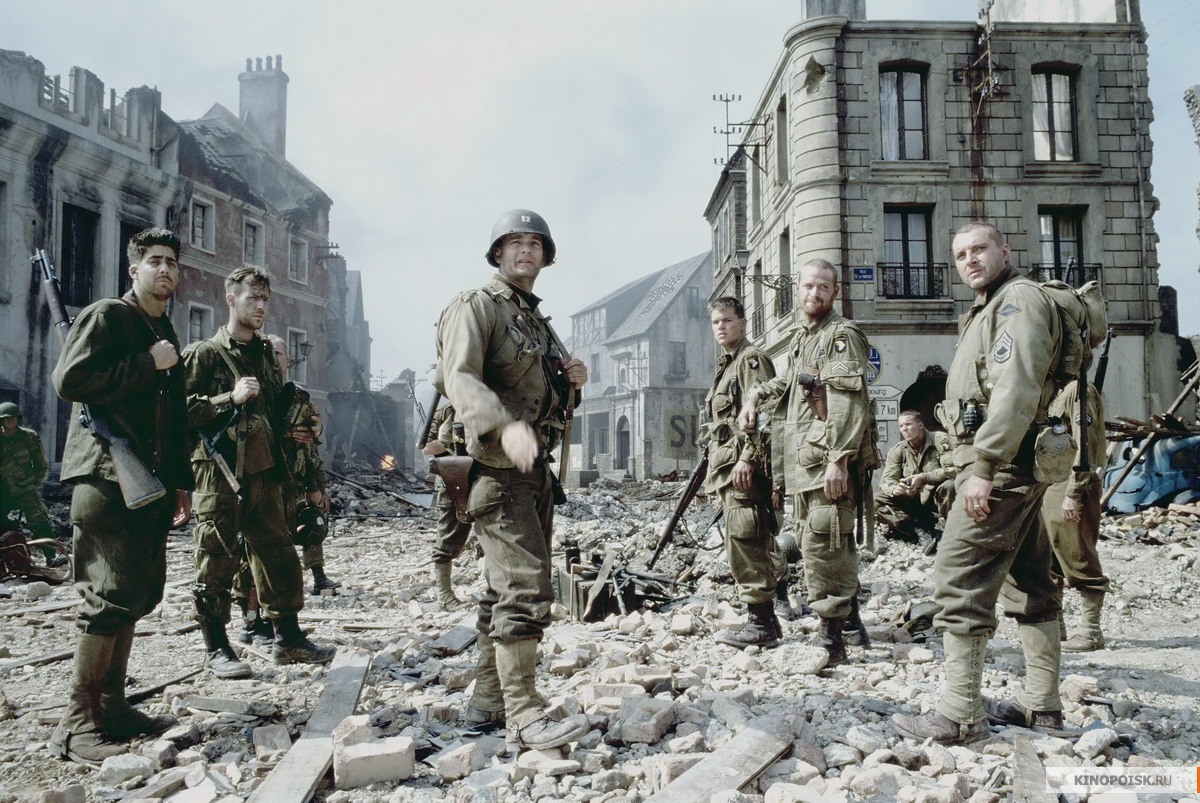
За основу была взята история семьи Ниландов, у которой война забрала трех сыновей, после чего четвертого нашли во Франции и отправили домой. Оттолкнувшись от нее, Родат примерно за год написал сценарий об отряде, которому после высадки в Нормандии поручают вернуть в семью последнего оставшегося в живых из братьев-солдат Райанов.
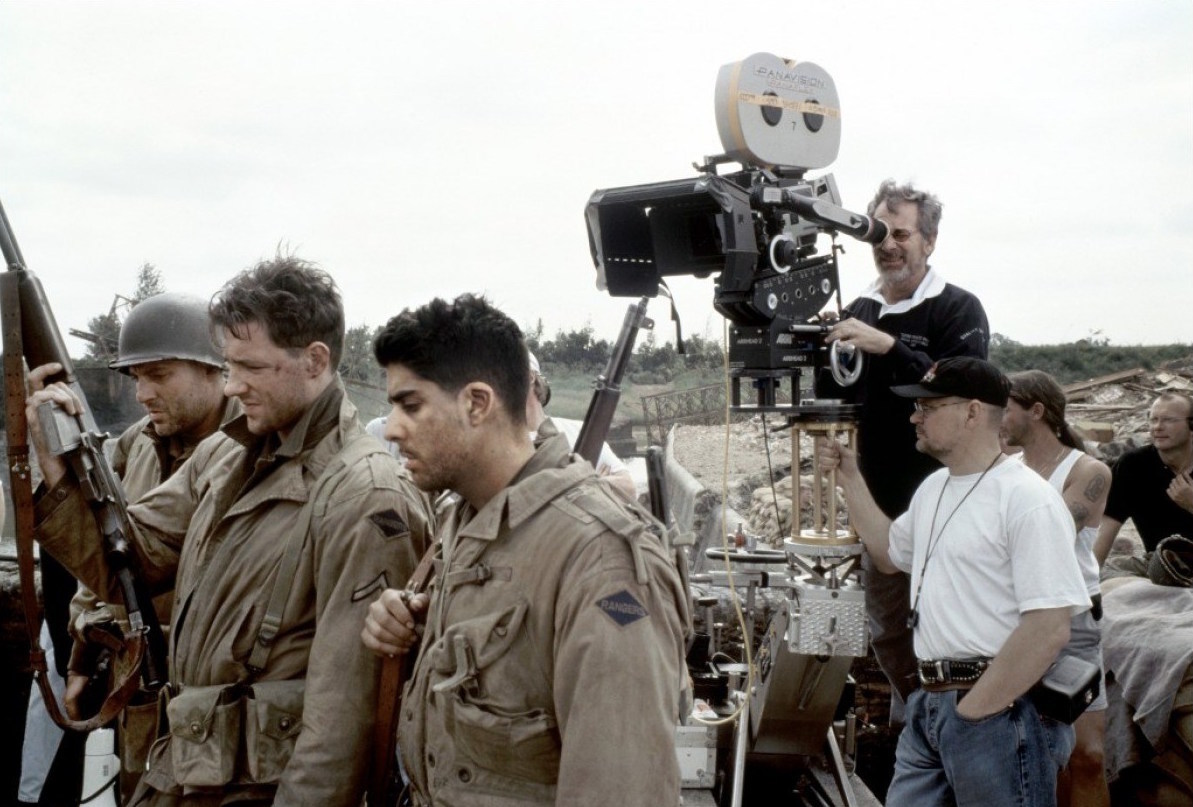
Материал привлек внимание продюсера Марка Гордона (в его фильмографии к тому моменту было два десятка картин, в том числе «Скорость»). Он стал рассылать сценарий Родата голливудским знаменитостям. Вскоре им почти одновременно заинтересовались Том Хэнкс, который после «Филадельфии» и «Форреста Гампа» хотел расширить перечень своих драматических ролей, и Стивен Спилберг, который всегда интересовался темой войны, а после «Списка Шиндлера» думал вновь к ней обратиться, но сделать больший упор на батальной составляющей.
С добавлением картине размаха Спилбергу помог автор «Побега из Шоушенка« Фрэнк Дарабонт, приглашенный в качестве скрипт-доктора. В частности ему принадлежит идея начать картину со сцены «Дня Д». Любопытно, что именно эпизод высадки в Нормандии часто становится предметом критики. По мнению некоторых, из-за того, что сцена очень сильная и впечатляющая, дальше фильм начинает проигрывать в динамике, то есть в драматургической схеме присутствует определенный дисбаланс. Впрочем, поправить его призвана финальная сцена обороны французского деревни.
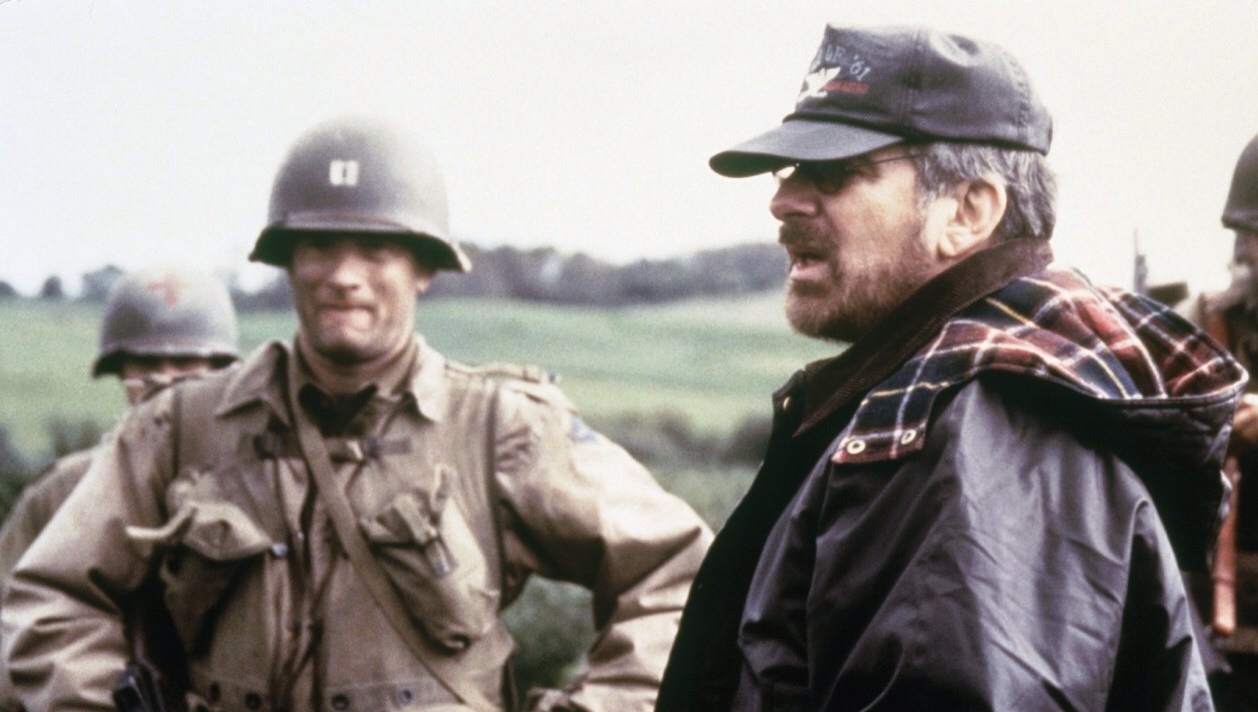
Как и полагается масштабному голливудскому проекту, «Спасти рядового Райана» укладывается в привычные драматургические схемы. При внимательном рассмотрении здесь обнаруживается соответствие и традиционной трехактовой структуре, и классической концепции мономифа.
В первом акте мы знакомимся с завязкой, — семья Райан теряет трех сыновей, и теперь необходимо вернуть матери четвертого, — и с главным героем, капитаном Джоном Миллером, которому вместе с отрядом поручают найти уцелевшего Райана. Также благодаря той самой сцене высадки союзников мы сразу окунаемся в пространство войны, узнаем ее истинное лицо.
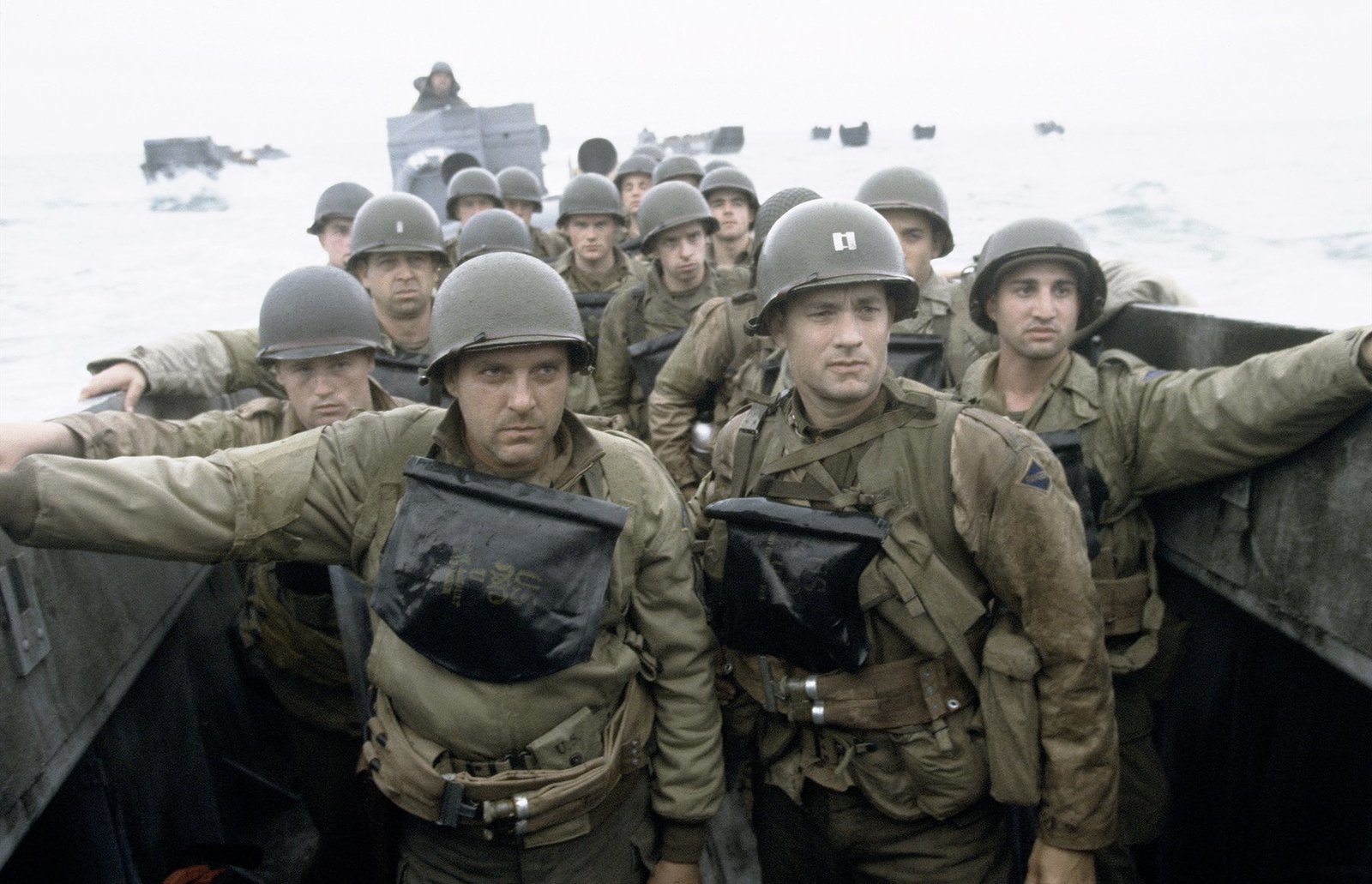
После того, как герой соглашается на «путешествие» (по терминологии мономифа), начинается второй акт. Персонажи оказываются в неизвестном им мире, раскрывающемся через дальнейшие перипетии. Среди них — безуспешные попытки выполнить задачу (например, найденный Райан оказывается лишь однофамильцем) и ухудшением ситуации (некоторые члены отряда гибнут). Завершается второй акт обнаружением Райана на передовой и его отказом возвращаться в тыл, потому что он не может бросить друзей перед лицом опасности.

Третий акт связан с масштабным батальным эпизодом обороны моста и французской деревни — сцена знаменует для героев финальное испытание, которое окончательно их меняет. При этом вся история, по сути, является флэшбеком, поскольку обрамляется современными кадрами, в которых мы видим пожилого Райана, вспоминающего войну.
Также заметим, что первый и третий акт примерно равны друг другу по хронометражу и длятся около сорока-пятидесяти минут, а вот второй акт — самый протяженный — около семидесяти минут. При этом значительную часть и первого акта, и третего занимают большие батальные эпизоды.
Подготовка и кастинг: «эталонные американцы» и курс молодого бойца
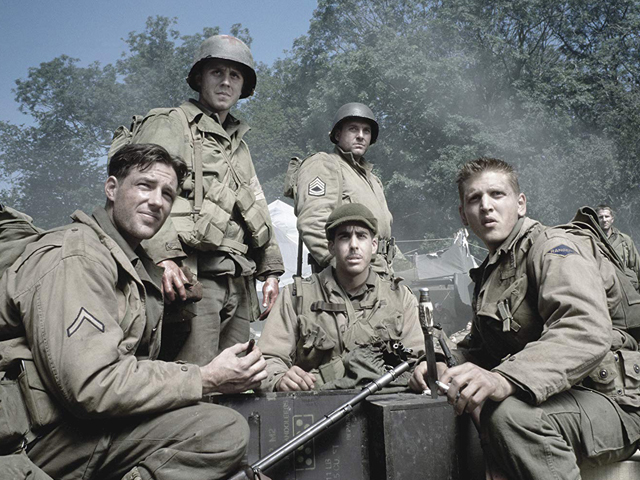
Подбирая актеров, Спилберг руководствовался тем, что, по его наблюдению, люди другой эпохи выглядели несколько иначе, чем сейчас. Поэтому режиссеру было важно найти исполнителей, которые бы были максимально близки к «лицам, которые можно увидеть в хронике». Вместе с тем тон актерского состава задавал Том Хэнкс, «эталонный провинциальный американец», столь же обаятельный, сколь далекий от образа бравого супергероя. Исходя из подобных установок, в фильм были подобраны актеры, не имевшие статуса крупных звезд, в том числе Эдвард Бернс, Том Сайзмор, Барри Пеппер, Адам Голдберг, Вин Дизель, Джованни Рибизи, а также Мэтт Дэймон, в тот момент только начинавший набирать широкую популярность.
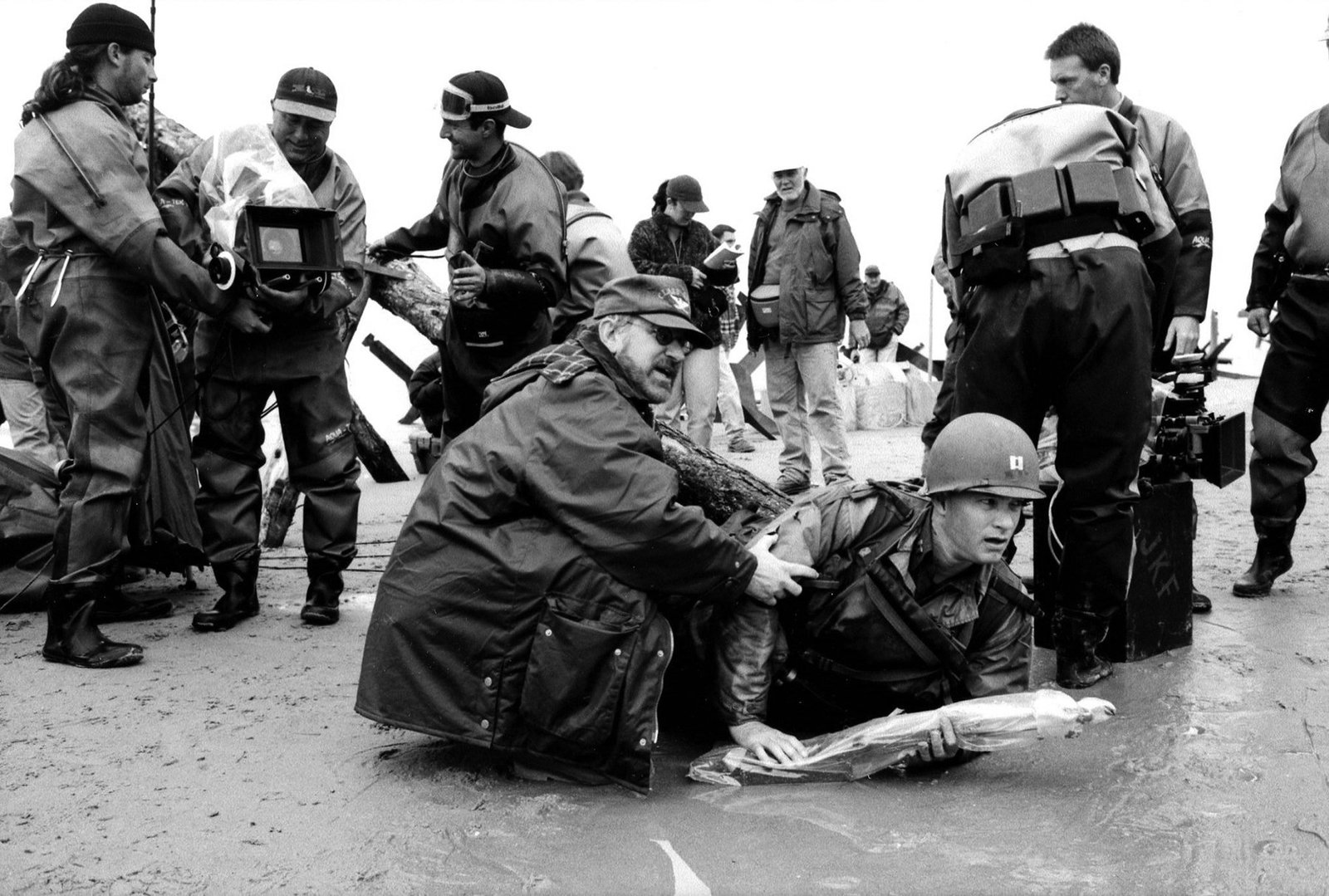
Основные актеры фильма перед съемками прошли десятидневный интенсивный курс молодого бойца, где освоили азы работы с оружием, приобрели навыки передвижения в боевом порядке, а также совершили несколько марш-бросков. Некоторым исполнителям такое испытание показалось излишне суровым и они даже порывались его бросить. Тем не менее Спилберг настоял на прохождении курса. Режиссеру было важно, чтобы таким образом актеры вжились в образ военных, а также приобрели «уважение к солдатскому опыту». Интересно, однако, что Дэймона к тренировкам не допустили — так Спилберг добивался большего отчуждения от остальных актеров, которое было необходимо в кадре между Райаном и пришедшим за ним отрядом.
Относительно вживания в образ солдата любопытную деталь подмечает оператор картины Януш Камински. По его словам, благодаря тому, что съемки были физически тяжелыми, а актеры играли в полном и подлинном военном обмундировании и с настоящим, довольно увесистым, оружием, через две недели съемок им можно было обходиться без грима — необходимые усталость и измотанность были видны и без него.
Локации и декорации: ирландский берег и Франция в Англии
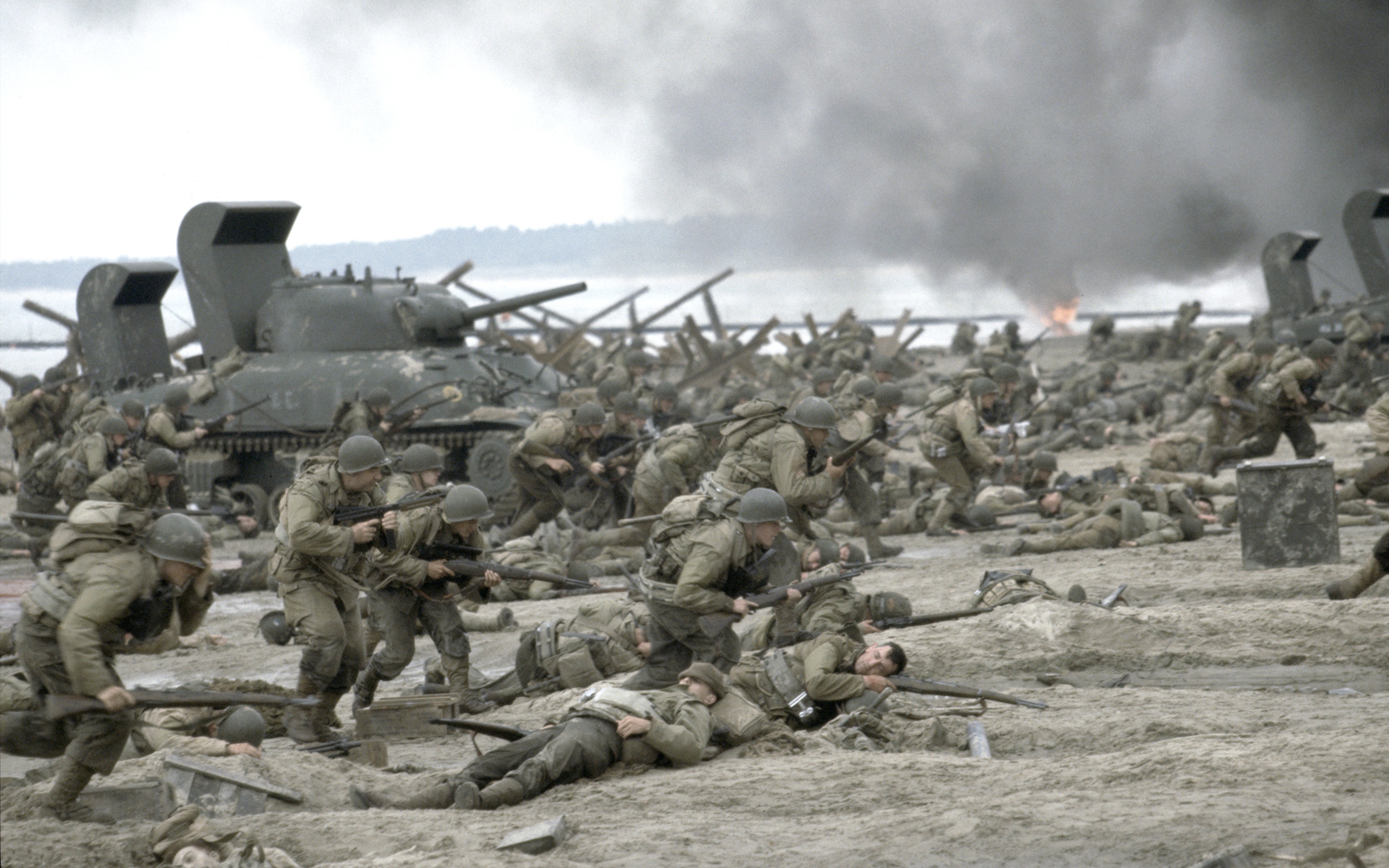
Съемки фильма проходили с июня по сентябрь 1997 года в Европе. Одной из важнейших задач Спилберг считал максимально точную реконструкцию высадки на пляже под кодовым названием «Омаха-бич». Ввиду различных обстоятельств снимать на берегу Нормандии было невозможно, но режиссер настаивал на схожем пейзаже, рельефе и даже таком же желтом песке. Подходящий берег нашелся в графстве Уэксфорд на юго-востоке Ирландии.
Для съемок там были установлены противотанковые ежи, протянута колючая проволока и возведены доты и бункеры. В основном же группа работала в различных местах в Англии: в Хатфилде, Оксфордшире, Уилтшире.
Масштабная декорация полуразрушенного французского города для финальных сцен потребовала особых усилий. Ее возводили четыре месяца на базе британских ВВС неподалеку от Лондона. Также часть съемок прошла в Нормандии, в том числе открывающая и закрывающая сцены были сделаны на Американском кладбище и мемориале в Кольвиль-сюр-Мер.
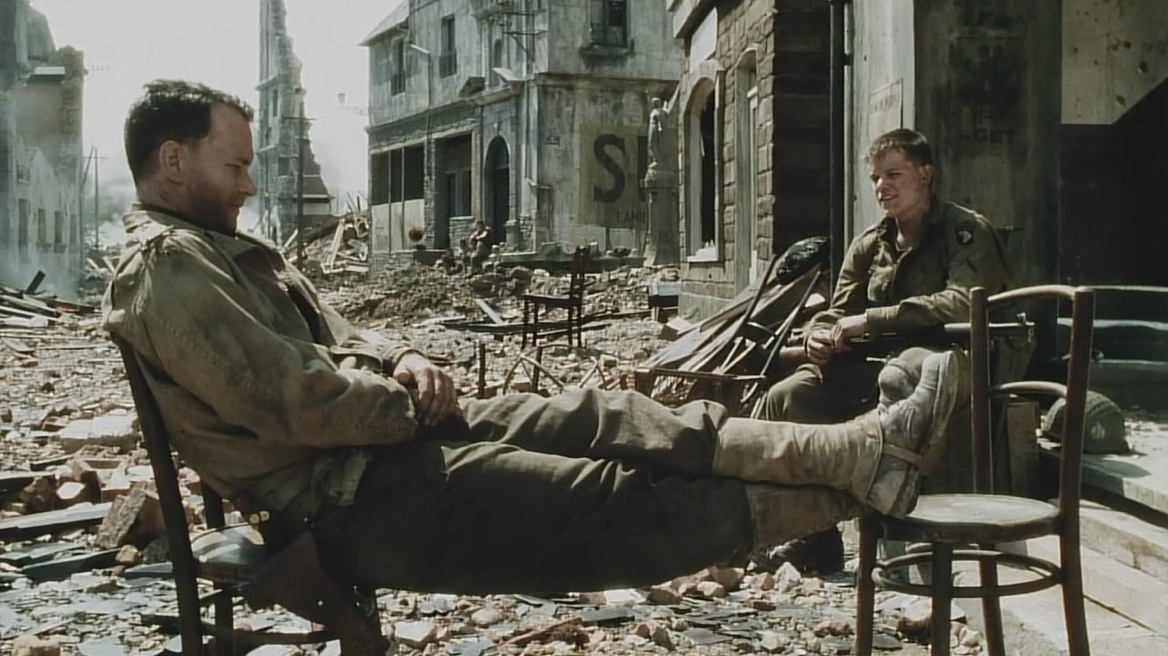
Всего для съемок фильма было пошито три с половиной тысячи аутентичных униформ и изготовлено две тысячи бутафорских экземпляров ручного оружия. В съемках использовались двенадцать военных судов и десантных катеров Хиггинса и несколько танков — советских T-34 и чешских 38(t). На их основе были сконструированы имитации немецких «Тигров» и «Мардер III».
Визуальное решение: влияние хроники, bleach bypass и ручная камера
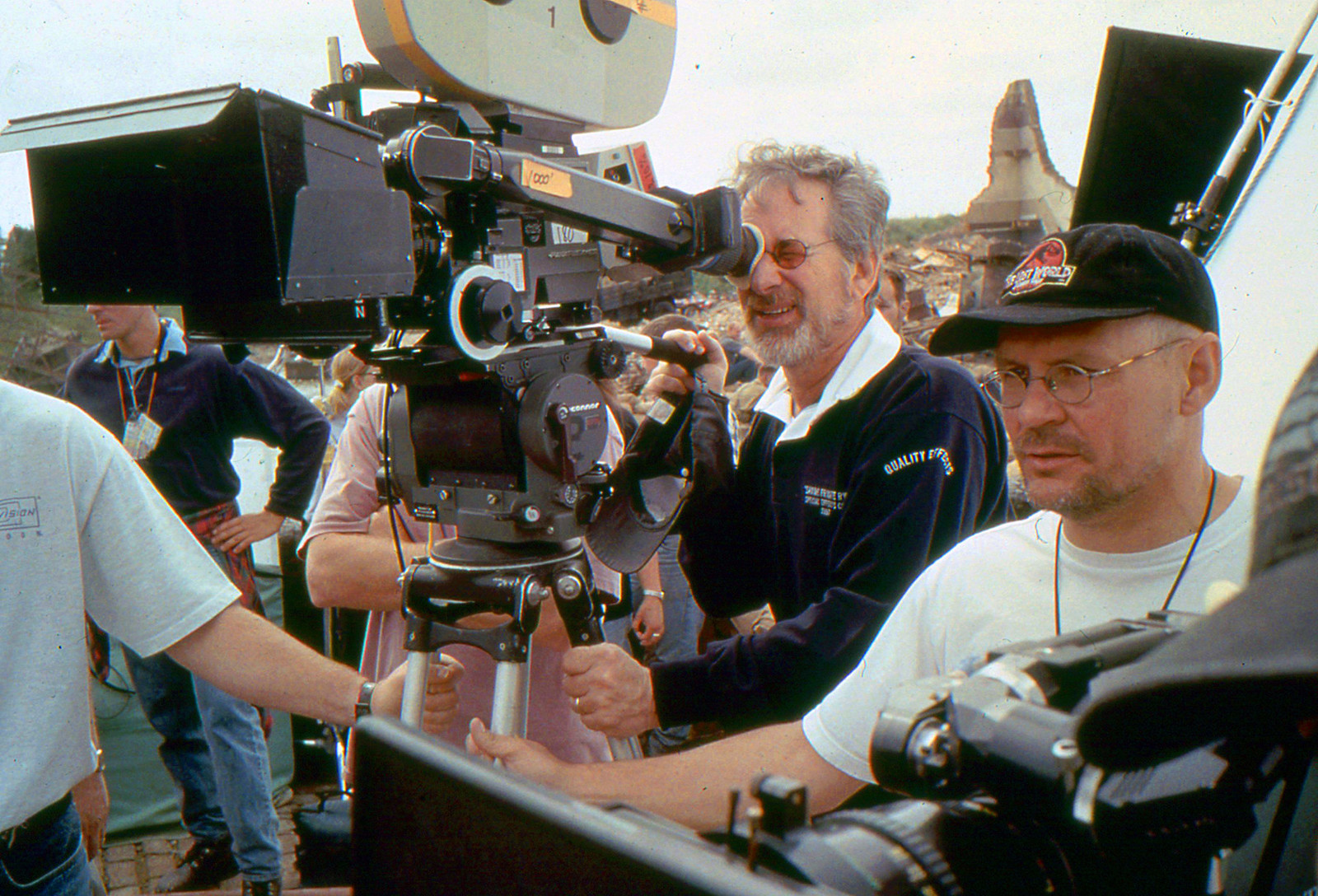
Стивен Спилберг и Януш Камински на съемках фильма «Спасти рядового Раиана» (1998)
Для оператора Януша Камински «Спасти рядового Райана» стал четвертой совместной работой со Спилбергом и второй после «Списка Шиндлера», принесшей ему «Оскар». Однако, в отличие от «Шиндлера», новую картину авторы сразу собирались делать в цвете, но при этом так, чтобы визуальный ряд соответствовал эпохе. Цвет должен был быть особым — не ярким техниколоровским, как цветное кино 40-х, а приближенным к цветной хронике того времени, с сухими ненасыщенными цветами. Достигалось это с помощью технологий «удержание серебра» (bleach bypass) и ДДЗ (дополнительная дозированная засветка). Процессы также позволили сделать изображение более резким и контрастным.
Из-за технологий авторам понадобилось отдельно озадачиться вопросом цвета крови. Чтобы она не казалась излишне блеклой, департамент спецэффектов добавлял в заменитель синий краситель, делая цвет более темным, чем обычно.
Особый эффект визуальной стороне фильма добавил и климат Англии и Ирландии. Частые дожди и туманы способствовали тому, чтобы свет в кадре был более рассеянный, а цвета — более пастельные. Кроме того, Камински активно прибегал к помощи дымовых машин.
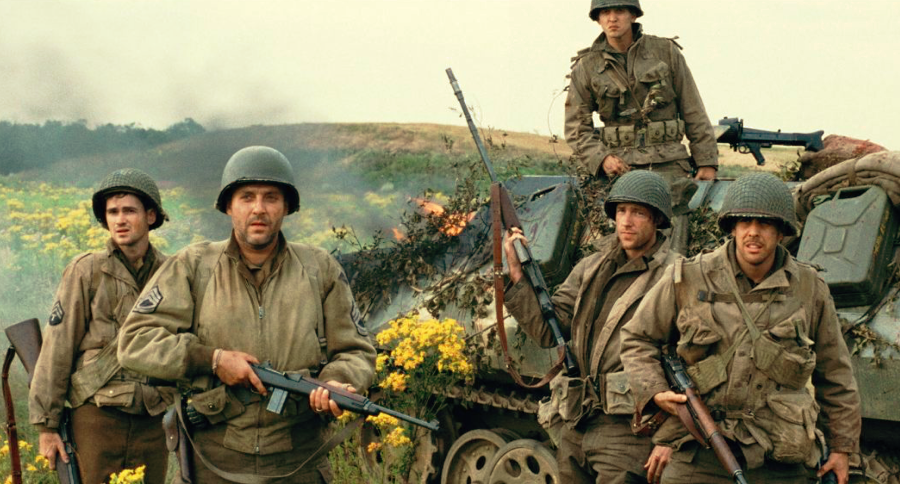
Камински и Спилберг хотели, чтобы камера в фильме была не сторонним наблюдателем, а участником действия. Оператор замечает, что по этой причине картина примерно на 90% была снята с рук (это при весе камер в шестнадцать килограмм и сопутствующего оборудования на девять килограмм). Причем в основном камера находилась не на уровне плеча, а ближе к земле. Это тоже соответствовало военным реалиям, когда даже при беге солдаты старались быть ниже, а значит — незаметнее. По той же причине «участия» камеры в действии, режиссер и оператор не останавливали съемку, если на объектив непреднамеренно попадала бутафорская кровь или земля — ведь у фронтового оператора не было времени чистить линзу, ему необходимо было продолжать снимать. Как говорит Камински: «Военный жанр прекрасен тем, что в нем все должно быть грязным и хмурым, поэтому мы не боролись с такими вещами».
Сцена высадки в Нормандии: три недели съемок, эксперименты с затвором, эффект контузии и 1,5-тысячная массовка
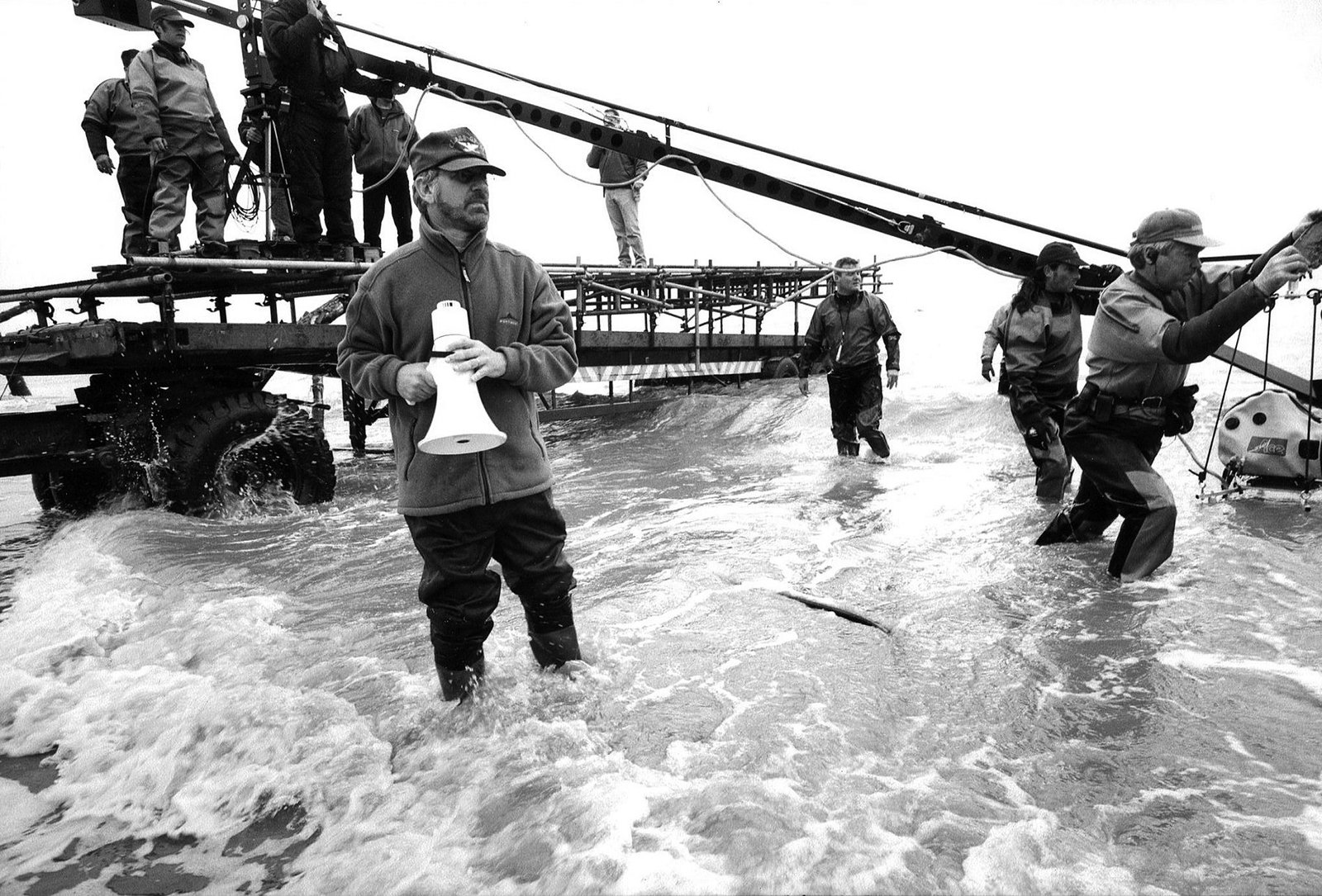
Отдельно разберем начальную 25-минутную сцену высадки в Нормандии, которую сегодня часто включают в число лучших батальных эпизодов мирового кино. Сцена, как изначально и планировали Спилберг и Камински, поражает высочайшим уровнем реализма. «Мы хотели создать иллюзию, будто несколько фронтовых операторов высадились вместе с солдатами», — рассказывает Камински.
Подготовку авторы начали с изучения военной хроники и прочих документальных материалов о тех событиях. Среди них была и знаменитая серия фотографий Роберта Капы, принимавшего участие в высадке. Надо полагать, в том же русле концепции реализма Спилберг отказался от раскадровывания сцены, что крайне необычно с учетом сложности ее постановки. Решения о месте расположения камеры и ее движении принимались непосредственно на площадке. «Я хотел, чтобы само действие подсказывало мне, куда поставить камеру», — рассказывает режиссер.
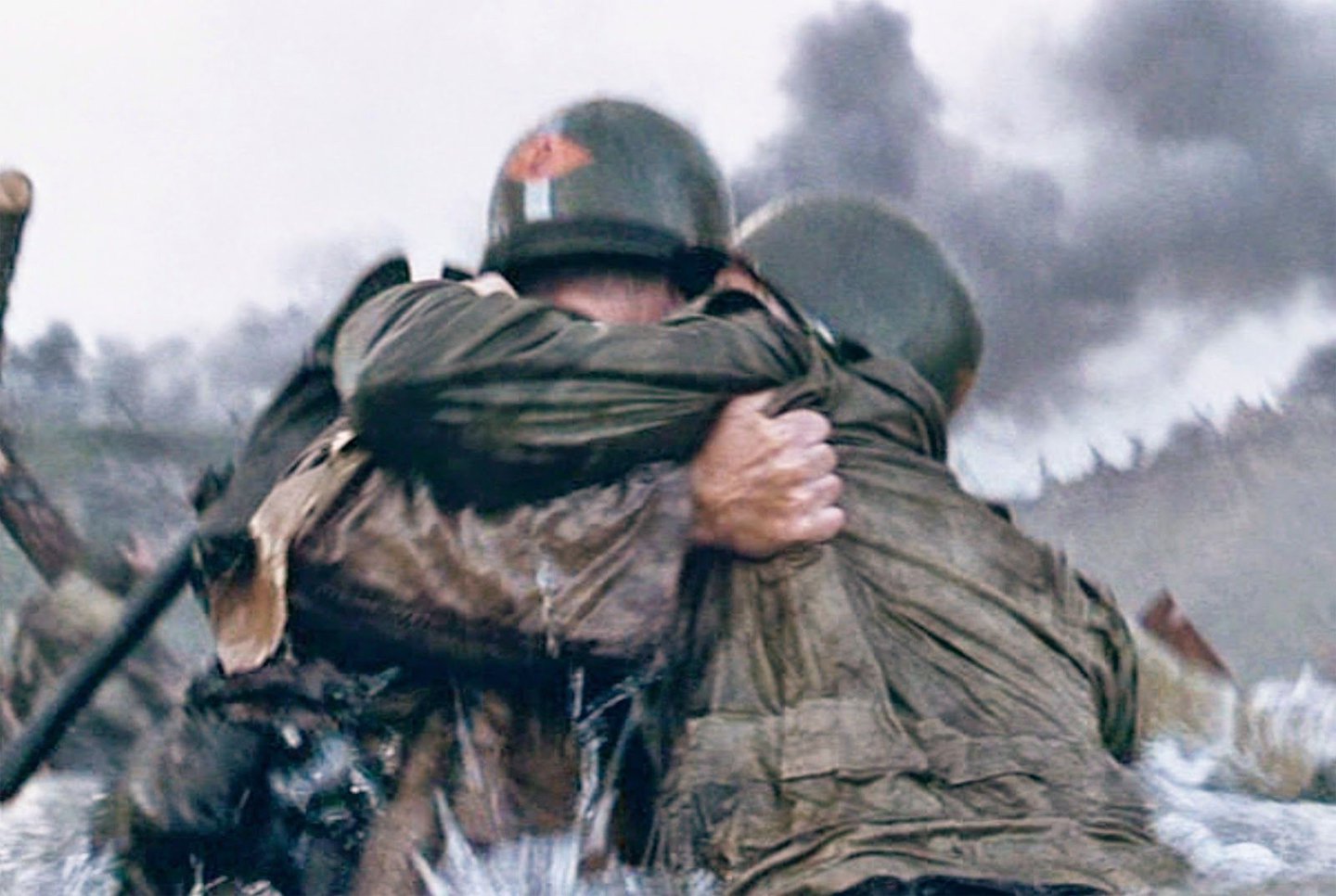
Желая приблизить качество изображения к тому, что было в 1940-е годы, Камински решил «ухудшить» старые линзы Panavision Ultra Speed, сняв с них защитное покрытие. Это дало эффект — контраст стал мягче, цвета несколько утратили яркость, а в целом изображение стало чуть более «туманным». Кроме того, оптика стала более чувствительной к световым бликам.
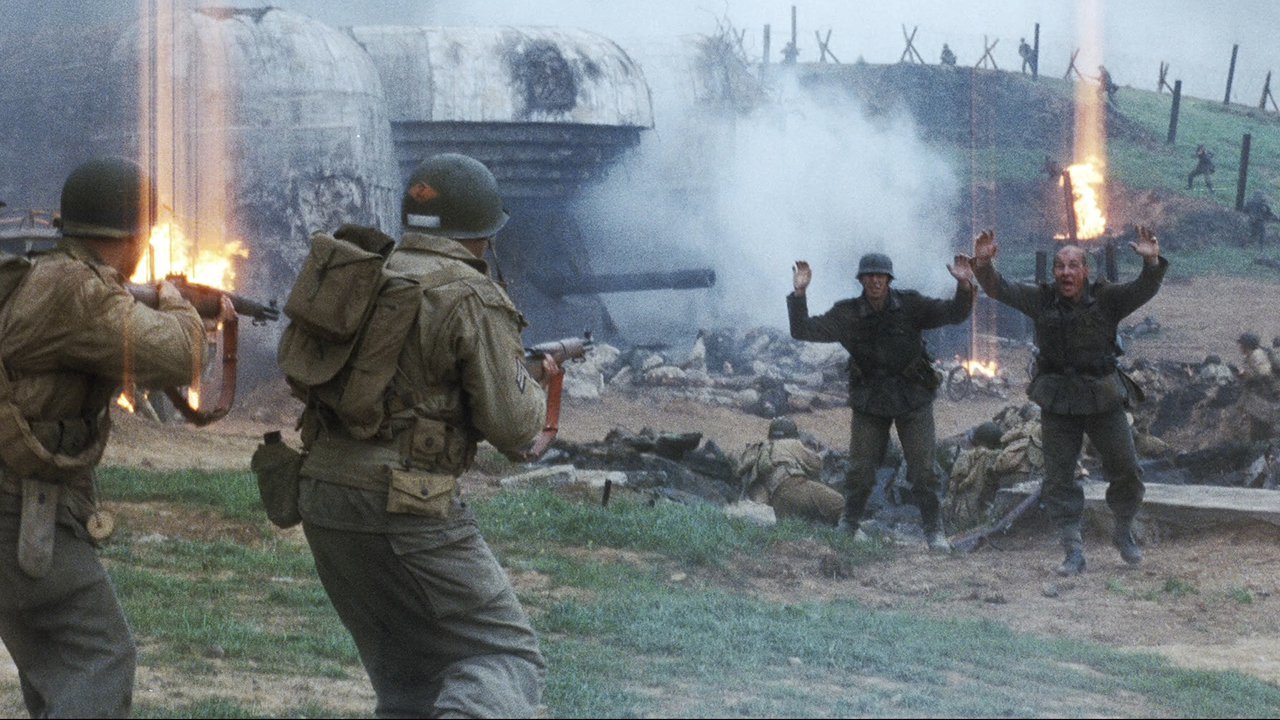
Далее Камински решил поэкспериментировать с углом затвора. Вместо более традиционных 180°, он снимал с углом затвора 45° или 90°, что давало эффект как бы спотыкающегося, прерывистого изображения. Вдохновившись примером «Цельнометаллической оболочки», Камински использовал еще один «прием» с затвором — нарушил его синхронизацию со скачковым механизмом. Это дало эффект вертикального шлейфа от источников света, вроде огня. В совокупности, по мнению авторов, такие приемы приближали изображение к тому, что давали ручные хроникальные камеры и подчеркивали ощущение потрясения, подобного тому, что мог испытывать человек на передовой. Словами Спилберга, такие операторские техники делали взрывы и остальное действие «еще более ужасающим».
Наряду с изобразительным рядом, огромное значение в сцене играет звук, над которым работала команда Гэри Райдстрома (к тому моменту обладателя четырех «Оскаров», а «Райан» принес ему еще два). Авторы добивались того, чтобы каждый военный шум был аутентичным и разборчивым. Это было необходимо в том числе потому, что консультанты из числа ветеранов подчеркивали, что по звуку легко могли определить оружие.

Шумовая аранжировка, наряду с изображением, была призвана поместить зрителя в центр событий и передать восприятие страшного действия героями. Для этого продумывались шумы, которые издавали отсутствующие в кадре люди, оружие и техника. Зрители не видели, но все равно понимали, что и где в данный момент происходит.
Райдстром подчеркивает важность для фильма системы объемного звука, дающего возможность позиционирования шумов. Самый известный звуковой эффект фильма был вдохновлен схожим решением в картине Элема Климова «Иди и смотри». Как и в советской ленте, герой, получив контузию после взрыва, частично глохнет и слышит шумы приглушенными и с сильным искажением. Авторы при этом передают его субъективное звуковосприятие. Примечательно, что в сцене отсутствует музыка, поскольку, по мнению Спилберга, она была бы неуместна и только мешала бы действию.
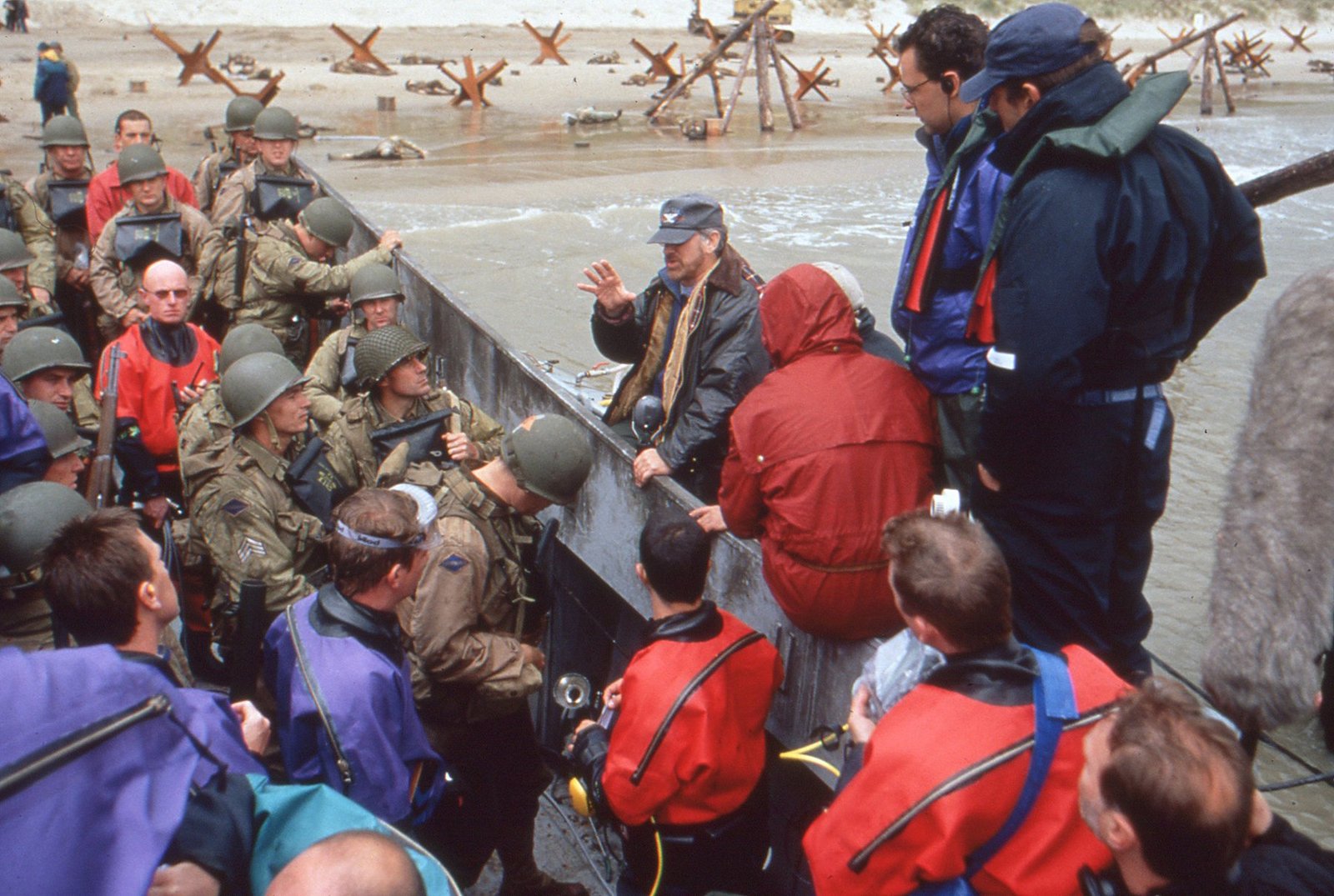
Вместе с актерами в высадке на пляж участвовало полторы тысячи статистов, половина из которых были ирландскими военными. Немецких солдат играли британские реконструкторы, специализирующиеся на изображении нацистов. Также среди членов массовки было несколько десятков человек с ампутированными конечностями — они играли солдат, лишившихся в бою рук или ног.
Из-за большого количества массовки, пиротехники и ригов каждый кадр снимался с первого, максимум второго дубля — у группы не было возможности несколько раз повторять один и тот же сложный процесс подготовки. Обычно на площадке одновременно работало две-три камеры. Всего на съемки сцены понадобилось три недели и $12 млн, то есть четвертая часть съемочного периода и шестая часть бюджета картины.
Источник
Если у вас есть производство или сервис, о котором вы хотите рассказать нашим читателям, пишите Аслану (shauey@yandex.ru) и мы сделаем самый лучший репортаж, который увидят не только читатели сообщества, но и сайта Как это сделано
Еще раз напомню, что посты теперь можно читать на канале в Яндекс.Дзене
и как обычно в инстаграме. Жмите на ссылки, подписывайтесь и комментируйте, если вопросы по делу, я всегда отвечаю.
Жми на кнопку, чтобы подписаться на «Как это сделано»!
| Спасение рядового Райана | |
|---|---|
|
Афиша театрального релиза |
|
| Режиссер | Стивен Спилберг |
| Произведено |
|
| Написано | Роберт Родат |
| В главных ролях |
|
| Музыка от | Джон Уильямс |
| Кинематография | Януш Камински |
| Отредактировано | Майкл Кан |
|
Производство |
|
| Распространяется |
|
|
Дата выхода |
|
|
Продолжительность |
169 минут |
| Страна | Соединенные Штаты |
| Язык |
|
| Бюджет | 70 миллионов долларов[1] |
| Театральная касса | 482,3 млн. Долл. США[1] |
Спасение рядового Райана американец 1998 года эпос Военный фильм режиссер Стивен Спилберг и написано Роберт Родат. Установить во время Вторжение в Нормандию в Вторая Мировая Война, фильм известен своим графическим изображением войны и яркостью второй сцены продолжительностью 23 минуты, изображающей Омаха Бич нападение во время Высадка в Нормандии. Фильм следует Рейнджеры армии США Капитан Джон Х. Миллер (Том Хэнкс ) и его отряд (Том Сайзмор, Эдвард Бернс, Барри Пеппер, Джованни Рибизи, Вин дизель, Адам Голдберг, и Джереми Дэвис ) в поисках десантник, Рядовой первого класса Джеймс Фрэнсис Райан (Мэтт Дэймон ), последний выживший брат семьи из четырех человек, а его три других брата были убиты в бою. Фильм был совместным производством DreamWorks Картинки, Paramount Pictures, Амблин Развлечения, и Компания взаимного кино, причем DreamWorks распространяла фильм в Северной Америке, а Paramount выпускала фильм на международном уровне.
В 1996 году продюсер Марк Гордон представил идею Родата, вдохновленную Братья Ниланд, в Paramount, которая в итоге начала разработку проекта.[2] Спилберг, который в то время формировал DreamWorks, стал руководить проектом, а Хэнкс присоединился к актерскому составу. После того, как актеры прошли обучение под руководством морской ветеран Краситель Дейла Основные съемки фильма начались в июне 1997 года и длились два месяца. Фильмы День Д сцены были сняты на пляже Баллинескер, Курракло-Странд, Баллинескер, к востоку от Curracloe, Графство Уэксфорд, Ирландия и использованные члены Ирландская армия в качестве пехоты для высадки десанта.
Выпущен 24 июля 1998 г. Спасение рядового Райана получил признание критиков и публики за свои выступления (особенно от Хэнкса), реализм, кинематографию, музыку, сценарий и режиссуру Спилберга и был помещен в десятку лучших кинокритиков 1998 года. Он также имел кассовый успех, став самым кассовым фильмом 1998 года в Соединенных Штатах, собрав 216,8 миллиона долларов на внутреннем рынке и второй самый кассовый фильм 1998 года в мире с 481,8 миллиона долларов по всему миру.[3] Кроме того, он собрал 44 миллиона долларов с момента его выпуска. домашнее видео в мае 1999 года. Фильм получил несколько наград, в том числе за лучший фильм и режиссерский приз. Золотой глобус, Гильдия продюсеров Америки, Гильдия режиссеров Америки, и Награды «Выбор критиков». Фильм был номинирован на одиннадцать раз. Оскар на 71-я награда Академии, где выиграли пять: Лучший режиссер (Секундант Спилберга), Лучший монтаж фильма, Лучшая операторская работа, Лучший звук, и Монтаж лучших звуковых эффектов, хотя он потерял Премия Оскар за лучший фильм к Шекспир в любви на неоднозначном Оскаре расстроен.
С момента его выпуска, Спасение рядового Райана считался одним из величайшие военные фильмы всех времен и считается влиятельным в жанре военных фильмов.[4][5][6] Ему приписывают возобновление интереса к СМИ Второй мировой войны. В 2007 г. Американский институт кино в рейтинге Спасение рядового Райана как 71-й по величине американский фильм в 100 лет AFI … 100 фильмов (выпуск к 10-летию) а в 2014 году фильм был отобран для сохранения в Национальный реестр фильмов посредством Библиотека Конгресса как «культурно, исторически или эстетически значимые».[7]
участок
В наши дни пожилой мужчина посещает Нормандское кладбище с его семьей. У надгробия он падает на колени от боли.
Утром 6 июня 1944 г. американские солдаты приземляются в Омаха Бич как часть Вторжение в нормандию. Они несут тяжелые потери при атаке укрепленных немецких оборонительных позиций. Капитан Джон Х. Миллер из 2-й батальон рейнджеров ведет побег с пляжа. В другом месте на пляже мертвый солдат лежит лицом вниз в окровавленном прибое; его рюкзак по трафарету Райан, S.
В Вашингтон, округ Колумбия., на Военное ведомство, Общий Джордж К. Маршалл узнает, что трое из четырех сыновей семьи Райанов были убит в бою в течение короткого времени друг с другом; Дэниел Райан в Новая Гвинея незадолго до День Д, Шон Райан на пляже Омаха и Питер Райан на Юта Бич; четвертый сын, Джеймс Райан, с 101-я воздушно-десантная дивизия где-то в Нормандии. После чтения Абрахам Линкольн с Письмо Биксби вслух Маршалл приказывает Райану найти и принес домой.
Через три дня после День Д, Миллер получает приказ найти Райана и вернуть его. Он выбирает семь человек из своей компании -T / Sgt. Майк Хорват, рядовые Ричард Рейбен и Адриан Капарзо первого класса, рядовые Стэнли Меллиш и Дэниел Джексон, Т / 4 медик Ирвин Уэйд — плюс Т / 5 Тимоти Апхэм, переводчик 29-й пехотной дивизии. Они переезжают в Невиль, где встречаются с отрядом 101-го полка, сражающимся с противником. Капарцо убивает немецкий снайпер, которого затем убивает Джексон. Они находят рядового Джеймса Райана только для того, чтобы узнать, что это Джеймс Фредерик Райан. От проходящих мимо солдат Миллер узнает, что Райан защищает важный мост в Рамелле.
Возле Рамеля Миллер решает нейтрализовать позицию немецких пулеметов на заброшенной радиолокационной станции, несмотря на опасения своих людей. Уэйд убит в процессе. По настоянию Апхэма Миллер освобождает выжившего немецкого солдата. Теряя уверенность в лидерстве Миллера, Рейбен заявляет о своем намерении дезертировать, что вызывает конфронтацию с Хорватом. Миллер разрядил противостояние, рассказав о своей гражданской карьере учителя английского языка в средней школе, на которую его люди создали пул ставок; Рейбен решает остаться.
В Рамелле они находят Райана среди небольшой группы десантников, готовящихся защитить ключевой мост от неминуемого нападения. Миллер сообщает Райану, что его братья мертвы, и что ему приказали отвести его домой. Райан обеспокоен своими братьями, но не желает покидать свой пост. Миллер объединяет свой отряд с десантниками для защиты моста. Он разрабатывает план устроить засаду врагу двумя Пулеметы .30 калибра, Коктейли Молотова, противотанковые мины и самодельные заряды для ранцев из носков.
Элементы 2-я танковая дивизия СС прибыть с двумя Тигр танки и два ПТ-САУ Marder, все защищено немецкой пехотой. Хотя они наносят немцам тяжелый урон, почти все десантники вместе с Джексоном, Меллишом и Хорватом убиты; Upham скован страхом. Миллер пытается разрушить мост, но его застрелил освобожденный немецкий пленник с радиолокационной станции, присоединившийся к боевой части. Миллер ползет за детонатором моста и безуспешно, но вызывающе стреляет из пистолета по приближающемуся танку. Когда танк подходит к мосту, американец P-51 Мустанг пролетает над головой и уничтожает танк, после чего прибывают американские бронетанковые части, чтобы разбить оставшихся немцев. Когда немцы полностью отступают, Апхэм выходит из укрытия и стреляет в немецкого пленного, став свидетелем того, как он стрелял в Миллера, но позволяет своим сослуживцам бежать.
Миллер говорит Райану «заработать это», прежде чем умереть от травм. По мере того, как сцена переходит в настоящее, Райан оказывается ветераном с самого начала фильма и стоит перед могилой Миллера, выражая свою благодарность за жертвы, которые Миллер и его подразделение принесли в прошлом. Райан спрашивает жену, достоин ли он такой жертвы, на что она отвечает, что он достоин. Финальная сцена показывает, как Райан салютует могиле Миллера и исчезает под звездно-полосатым светом, мягко машущим на ветру.
Бросать
- Том Хэнкс в качестве Капитан Джон Х. Миллер
- Эдвард Бернс в качестве Рядовой первого класса Ричард Райбен
- Мэтт Дэймон в качестве Рядовой первого класса Джеймс Фрэнсис Райан
- Харрисон Янг в роли старого Джеймса Райана
- Том Сайзмор в качестве Технический сержант Майк Хорват
- Джереми Дэвис в качестве Капрал Тимоти Апхэм
- Вин дизель в роли рядового первого класса Адриана Капарцо
- Адам Голдберг в роли рядового Стэнли «Фиш» Меллиш
- Барри Пеппер в роли рядового Дэниела Джексона
- Джованни Рибизи в роли медика Ирвина Уэйда
- Тед Дэнсон в роли капитана Фреда Хэмилла
- Пол Джаматти как сержант Уильям Хилл
- Деннис Фарина в роли подполковника Уолтера Андерсона
- Йорг Штадлер как Steamboat Willie
- Макс Мартини как капрал Хендерсон
- Натан Филлион в роли рядового Джеймса Фредерика Райана
- Рольф Саксон в роли лейтенанта Бриггса
- Леланд Орсер в роли лейтенанта Де Виндта
- Дилан Бруно как капрал Тойнбе
- Райан Херст как десантник Мандельсон
- Кори Джонсон как Radioman Mackey
- Гленн Рэйдж как Дойл
- Деметри Горицас как Паркер
- Джон Шариан в роли капрала Лёба
- Стефан Корникар как Жан
- Харв Преснелл как генерал Джордж Маршалл
- Краситель Дейла как полковник военного ведомства
- Брайан Крэнстон полковником военного ведомства
- Аманда Боксер в роли Маргарет Райан
- Кэтлин Байрон как старая миссис Райан
- Маркус Напье как Штурмбаннфюрер Hoess
- Леос Странски — немецкий снайпер
Производство
Разработка
В 1994 г. Роберт Родат жена подарила ему бестселлер День «Д»: 6 июня 1944 года: кульминационная битва Второй мировой войны. историком Стивен Амвросий. Читая книгу во время утренней прогулки по маленькой деревушке в Нью-Гэмпшире, Родат «был поражен памятником, посвященным тем, кто погиб в различных войнах, особенно из-за повторяющихся фамилий братьев, погибших в бою». Он был вдохновлен реальной семьей из книги Амвросия, названной Ниландс, который потерял двух сыновей на войне и, как считалось, потерял третьего, которого «вырвало» из Нормандии военное министерство.[8]
Родат предложил питч продюсеру Марк Гордон. Затем Гордон представил идею Родата Paramount Pictures, руководству которого понравилась идея, и они поручили Родату написать сценарий.[9][8] Карин Сейдж в Креативное агентство художников прочитал сценарий Родата и сделал Стивен Спилберг, который был одним из клиентов агентства, об этом знал. В то же время Спилберг, который в то время создавал DreamWorks Картинки, взял сценарий и заинтересовался фильмом.[10]
Спилберг уже продемонстрировал свой интерес к темам Второй мировой войны в фильмах. 1941, империя солнца, Список Шиндлера, а Индиана Джонс серии. Позже Спилберг был сопродюсером тематического телевидения Второй мировой войны. мини-сериал Братство и его аналог Тихоокеанский с Томом Хэнксом. На вопрос об этом Американский кинематографистСпилберг сказал: «Я думаю, что Вторая мировая война является самым значительным событием за последние 100 лет; судьба бэби-бумеры и даже Поколение X был связан с исходом. Кроме того, меня всегда интересовала Вторая мировая война. Мои самые ранние фильмы, которые я снял, когда мне было около 14 лет, были боевыми кадрами, которые снимались как на земле, так и в воздухе. В течение многих лет я искал подходящую историю Второй мировой войны для съемок, и когда Роберт Родат написал Спасение рядового Райана, Я нашел это.»[11]
После того, как Спилберг подписал контракт с режиссером фильма, Paramount и DreamWorks согласились профинансировать и продюсировать фильм вместе с Амблин Развлечения и Компания взаимного кино, оба заключили договор о распространении, по которому DreamWorks возьмет на себя внутреннее распространение фильма, а Paramount выпустит фильм на международном уровне. В обмен на права на распространение Спасение рядового Райана, Paramount сохранит права на внутреннее распространение Существенное воздействие, а DreamWorks получит международное распространение.[9]
Подготовка к производству
При кастинге фильма Спилберг стремился создать актерский состав, который «смотрел» на ту роль, заявив в интервью: «Вы знаете, люди во Второй мировой войне на самом деле выглядели иначе, чем люди сегодня», добавив к этому, что актерский состав частично основан на о желании составить актерский состав «в соответствии с лицами, которые я видел в кинохронике».[12]
Гордон и сопродюсер Гэри Левинсон были заинтересованы в том, чтобы Том Хэнкс появится в фильме как капитан Миллер. Гордон вспоминал: «Том был чрезвычайно взволнован этим и сказал:« Стивен и я всегда хотели работать вместе ».[13] Харрисон Форд и Мел Гибсон изначально рассматривались на роль Миллера.[14]
Перед началом съемок несколько звезд фильма, в том числе Эдвард Бернс, Том Сайзмор, Барри Пеппер, Вин дизель, Адам Голдберг, Джованни Рибизи, и Том Хэнкс, выдержал десять дней «учебный лагерь «обучение под руководством морской ветеран Краситель Дейла и Warriors, Inc., калифорнийская компания, специализирующаяся на обучении актеров реалистичным военным изображениям.[15] Мэтт Дэймон был обучен отдельно, поэтому остальная часть группы, персонажи которой должны испытывать негодование по отношению к персонажу Деймона, не связалась с ним.[16] Спилберг заявил, что его главное намерение принуждать актеров пройти учебный лагерь состояло не в том, чтобы научиться правильным приемам, а, скорее, «потому что я хотел, чтобы они уважали то, что значит быть солдатом».[12] Во время съемок Сайзмор боролся с наркозависимостью, и Спилберг требовал, чтобы он каждый день проходил тестирование на наркотики. Если он провалил тест, его уволили, а все его сцены пересняли бы с другим актером.[17]
Вторая сцена фильма — это 20-минутный эпизод, в котором рассказывается о высадке на пляжах Нормандии. Спилберг решил включить эту особенно жестокую сцену, чтобы «вывести публику на сцену вместе со мной», особо отметив, что он не хотел, чтобы «аудитория была зрителями», а скорее он хотел «потребовать, чтобы они были участниками с этими дети, которые никогда раньше не видели боев в реальной жизни, и достигли вершины Омаха Бич вместе».[12]
Экранизация

Съемки начались 27 июня 1997 года и длились два месяца.[18][19][20] Спилберг хотел получить почти точную копию пейзажа Омаха-Бич для фильма, включая песок и обрыв, аналогичный тому, где размещались немецкие войска, и близкое совпадение было найдено на пляже Баллинескер, Курракло-Стрэнд, Баллинескер, к востоку от Curracloe, Графство Уэксфорд, Ирландия.[21][22][23] Создание последовательности, изображающей Омаха Бич высадки стоимостью 12 миллионов долларов США и задействовало до 1500 статистов, некоторые из которых были членами ирландской Резервные силы обороны. Члены местных реконструкционных групп, таких как Вторая боевая группа, были задействованы в массовке на роль немецких солдат.[24] Кроме того, от двадцати до тридцати фактических инвалиды использовались для изображения американских солдат, искалеченных во время высадки.[25] Спилберг не раскадровка последовательность, поскольку он хотел спонтанной реакции и чтобы «действие вдохновляло меня относительно того, куда поставить камеру».[26] Хэнкс напомнил Роджер Эберт что, хотя он понял, что это был фильм, этот опыт все еще сильно ударил его, заявив: «В первый день съемок эпизодов Дня Д я был на задворках. десантные суда, и эта рампа обрушилась, и я увидел, что первые 1-2-3-4 ряды парней просто разлетелись на куски. В голове, конечно, я знал, что это спецэффекты, но все еще не был готов к тому, насколько это тактильно ».[27]
Некоторая стрельба велась в Нормандия, для Американское кладбище в Нормандии и мемориал в Кольвиль-сюр-Мер и кальвадос. Другие сцены были сняты в Англии, например, бывший British Aerospace завод в Hatfield, Хартфордшир, Thame Park, Оксфордшир и Уилтшир. Производство также должно было проходить в Seaham, Графство Дарем, но правительственные ограничения не допускали этого.[28] По словам Гордона и Левинсона, продюсеры практически не участвовали в производстве, поскольку Спилбергу было поручено полное творческое управление фильмом. Оба производителя были вовлечены только в привлечение внешнего финансирования и международное распространение. Гордон, однако, сказал, что Спилберг был «инклюзивным, любезным и чрезвычайно внимательным с точки зрения разработки сценария».[29]
Изображение истории

Спасение рядового Райана был известен своим воссозданием Омаха Бич высадки
Историческое изображение действий роты Чарли, возглавляемой ее командиром, капитаном Ральфом Э. Горансоном, было хорошо сохранено во вступительной части. Последовательность и подробности событий очень близки к историческим данным, включая морскую болезнь, которую испытали многие солдаты, когда десантный корабль приближался к береговой линии, значительные потери среди людей, когда они высадились с лодок, и трудности со связью. с соседними блоками на берегу.
Характерный «звон» солдат США М1 Гаранд винтовки, выбрасывающие патроны, слышны на протяжении всего боя. Точно отображены многие детали действий компании; например, были использованы правильные кодовые названия сектора, на который напала рота Чарли, и соседних секторов. В кинематографическое изображение высадки была включена следующая миссия по расчистке системы бункеров и траншей на вершине скал, которая не была частью первоначальных целей миссии компании Чарли, но была предпринята после штурма пляжа. .[30]
Используемые десантные корабли включали двенадцать реальных образцов Второй мировой войны, 10 LCVP и 2 LCM, заменяющий британцев LCA что роты рейнджеров прибыли на пляж во время операции «Оверлорд».[30][31] Создатели фильма использовали подводные камеры, чтобы лучше запечатлеть солдат, попавших под пули в воде. Было использовано сорок бочек с искусственной кровью, чтобы имитировать эффект крови в морской воде.[25] Этой степени реализма было труднее достичь при изображении немецкой бронетехники времен Второй мировой войны, поскольку в рабочем состоянии сохранилось очень мало экземпляров. В Тигр I танки в фильме были копиями, построенными на шасси старых, но исправных, Советский Т-34 танки.[32] Два автомобиля, описанные в фильме как Танки должны были изображать Мардер III истребители танков. Один был создан для фильма с использованием шасси Чешский -строенный Panzer 38 (т) бак[33] похож на конструкцию оригинального Marder III; другой был косметически модифицированный шведский SAV m / 43 штурмовое орудие, также использовавшее шасси 38 (t).[34]
Однако есть исторические неточности в изображении в фильме кампании за Нормандию. Во время миссии американские войска из двух американских пляжных зон, Юта и Омаха, еще не подключились.[35] На самом деле команде рейнджеров, действующей за пределами пляжной зоны Омахи, пришлось бы двигаться через сильно оккупированный врагами город Carentan, или плыть или плыть на лодке через устье, соединяющее Карентан с каналом, или пересесть на лодке в район высадки в Юте. С другой стороны, американские войска, выходящие из Юты, имели бы прямые и гораздо более короткие маршруты, относительно не обремененные вражескими позициями, и уже были в контакте с некоторыми командами из обеих американских воздушно-десантных дивизий, высадившихся в этом районе.[36]
На пляже посадки Юта, однако, были относительно неоспоримыми, с штурмовыми подразделениями посадки на основное незанятых пляжей и испытывают гораздо меньше действий, чем посадки в Омах.[37] Создатели фильма решили начать повествование с описания более драматической истории Омахи, несмотря на стратегическую неточность невыполнимой миссии, которую легко можно было выполнить с другого пляжа. Кроме того, одним из эксплуатационных недостатков является изображение 2-я танковая дивизия СС Дас Рейх как противник во время вымышленной битвы при Рамелле. 2-й СС не участвовал в Нормандии до июля, а затем в Кан против англичан и канадцев, в 100 милях к востоку (160 км).[38] Кроме того, Река Мердерет мосты не были целью 101-я воздушно-десантная дивизия но из 82-я воздушно-десантная дивизия, часть Миссия Бостон.[39]
Много было также сказано о различных «тактических ошибках», допущенных как немецкими, так и американскими войсками в решающей битве фильма. В ответ Спилберг сказал, что во многих сценах он решил заменить здравую военную тактику и строгую историческую точность драматическим эффектом.[40] Были также допущены некоторые другие технические ошибки, такие как обратная ориентация береговых барьеров и препятствия на треноге с миной на вершине.
Кинематография
Чтобы добиться тона и качества, которые соответствовали истории, а также отражали период ее действия, Спилберг снова сотрудничал с кинематографист Януш Камински, сказав: «Раньше мы оба знали, что не хотим, чтобы это выглядело как Разноцветный феерия про Вторую мировую войну, больше похожая на кадры цветной кинохроники 1940-х годов, очень ненасыщенные и низкотехнологичные ».
Камински снял защитное покрытие с линз фотоаппаратов, сделав их ближе к тем, что использовались в 1940-х годах. Он объясняет, что «без защитного покрытия свет проникает внутрь и начинает отражаться, что делает его немного более рассеянным и немного более мягким, но не расфокусированным». Оператор завершил общий эффект, пропустив негатив обход отбеливателя, процесс, снижающий яркость и насыщенность цвета. В ставня Для многих боевых сцен время было установлено на 90 или 45 градусов, в отличие от стандартного времени на 180 градусов. Камински поясняет: «Таким образом мы достигли определенного стаккато в движениях актеров и определенной четкости взрывов, что сделало их немного более реалистичными».[41]
Прием
Театральная касса
Спасение рядового Райана был выпущен в 2463 кинотеатрах 24 июля 1998 года и собрал 30,5 миллионов долларов в первые выходные, открыв номер один и оставаясь на вершине в течение четырех недель, пока Лезвие возглавил фильм на пятой неделе выпуска.[42] Фильм собрал 216,5 миллиона долларов в США и Канаде и 265,3 миллиона долларов на других территориях, в результате чего общая сумма проката по всему миру составила 481,8 миллиона долларов. Это был самый кассовый фильм США 1998 года и второй самый кассовый фильм 1998 года в мире, заканчивая позади Армагедон.[1] Box Office Mojo По оценкам, на фильм было продано более 45,74 миллиона билетов в США и Канаде.[43]
Критический ответ

Стивен Спилберг (показан здесь в 2016 году) заслужил признание критиков за свою режиссуру в фильме и позже выиграл свой второй Премия Оскар за лучшую режиссуру.
Спасение рядового Райана получил признание критиков и публики; большая часть похвалы досталась режиссуре Спилберга, реалистичным батальным сценам,[44] выступления актеров,[45] Музыка Джона Уильямса, операторская работа, монтаж и сценарий. Рейтинг фильма «сертифицированный свежий» составляет 93% на Гнилые помидоры На основе 139 отзывов со средней оценкой 8,64 / 10. Консенсус гласит: «Закрепленный еще одной победой Тома Хэнкса, неизменно реалистичный военный фильм Стивена Спилберга фактически переопределяет жанр».[46] Фильм также получил 91 балл из 100 на Metacritic на основе 35 критических отзывов, указывающих на «всеобщее признание».[47]
Многие ассоциации критиков, такие как Круг кинокритиков Нью-Йорка и Ассоциация кинокритиков Лос-Анджелеса, выбрал Спасение рядового Райана как фильм года.[48] Роджер Эберт дал ему четыре звезды из четырех и назвал его «мощным опытом».[45] Джанет Маслин из Нью-Йорк Таймс назвал его «лучшим военным фильмом нашего времени».[4] Джин Сискель, Соведущий Эберта и критик Чикаго Трибьюн, сказал, что фильм «выполняет то, чему меня учили, было самым трудным — создание наполненного боевиком антивоенного фильма или, по крайней мере, такого, который никоим образом не прославляет или не лжет о битве».[49] По их программе В кино, Сискель и Эберт назвали этот фильм четвертым и третьим лучшим фильмом 1998 года соответственно.[50][51] Написание для ВРЕМЯ, Ричард Шикель сказал, что это «военный фильм, который полностью осознает условности своего жанра, превосходит их, поскольку он выходит за рамки упрощенных моральных принципов, которыми руководствовались его предшественники, чтобы занять высокую, морально преследующую почву».[52] Оуэн Глейберман из Entertainment Weekly похвалил фильм, сказав, что «Спилберг уловил нестабильность современного боя».[53] Кеннет Туран из Лос-Анджелес Таймс также высоко оценил фильм, назвав его «мощным и впечатляющим этапом в реалистичном изображении боя», Спасение рядового Райана это такой же опыт, который мы переживаем, как фильм, который мы смотрим на экране «.[54]
Фильм получил негативные отзывы критиков. Написание для Читатель Чикаго, Джонатан Розенбаум дал фильму две звезды и почувствовал, что «в нем есть несколько довольно хороших моментов действия, много пролитой кишки, несколько моментов драмы, которые не кажутся фальшивыми или пустыми, довольно напряженная атмосфера того времени и немного сентиментального преобразования. это напоминает мне о Форрест Гамп.»[55] Эндрю Саррис из Наблюдатель написал, что фильм был «утомительно манипулятивным, несмотря на его титаническую энергию».[56]Фильм также заслужил некоторую критику за игнорирование вклада нескольких других стран в высадки в день высадки в целом и в Омаха-Бич в частности.[57] Самым прямым примером последнего является то, что во время фактической посадки 2-е рейнджеры высадились с британских кораблей и были доставлены на пляж Омаха. Королевский флот десантные суда (LCA ). В фильме они изображены как Береговая охрана США -водное судно (LCVP и LCM ) с американского корабля, USSТомас Джеферсон (АПА-30).[30][58][59] Эта критика была далеко не универсальной, так как другие критики признавали намерение режиссера снять «американский» фильм.[60] Фильм не был выпущен в Малайзия после того, как Спилберг отказался вырезать сцены насилия;[61] однако фильм был наконец выпущен там на DVD с сертификатом 18SG в 2005 году.
Многие ветераны Великой Отечественной войны заявили, что этот фильм был самым реалистичным изображением сражения, которое они когда-либо видели.[62] Фильм получился настолько реалистичным, что некоторые ветераны боевых действий Дня Д и Вьетнам покинул кинотеатры, а не досмотрел первую сцену, изображающую вторжение в Нормандию. Их посещения пост-травматическое стрессовое растройство Число консультантов увеличилось после выхода фильма, и многие консультанты советовали «более психологически уязвимым» ветеранам избегать его просмотра.[63] В Управление по делам ветеранов открыла общенациональную горячую линию для ветеранов, пострадавших от фильма, и менее чем через две недели после выхода фильма на экраны поступило более 170 звонков.[64]
Фильм вызвал критику со стороны некоторых ветеранов войны. Кинорежиссер и военный ветеран Оливер Стоун обвинил фильм в пропаганде «поклонения Второй мировой войне как хорошей войне» и поместил его рядом с такими фильмами, как Гладиатор и Падение черного ястреба которые, по его мнению, были сделаны хорошо, но, возможно, непреднамеренно способствовали готовности американцев к 2003 вторжение в Ирак.[65] В защиту портрета войны в фильме, Брайан Де Пальма прокомментировал: «Уровень насилия в чем-то вроде Спасение рядового Райана имеет смысл, потому что Спилберг пытается показать кое-что о жестокости произошедшего ».[66] Актер Ричард Тодд, выступавшие в Самый длинный день и был одним из первых солдат союзников, высадившихся в Нормандии (Операция Тонга ), сказал, что фильм был «Мусор.[67] Американский академик Пол Фасселл, который участвовал в боевых действиях во Франции во время Второй мировой войны, возражал против того, что он описал как «способ, которым Спилберг Спасение рядового Райана, после честного, мучительного, 15-минутного открытия, визуализирующего детали невыносимого кровавого беспорядка в Омаха-Бич, выродился в безобидный, некритичный патриотический спектакль, явно рассчитанный на то, чтобы взволновать 12-летних мальчиков во время летнего сезона плохих фильмов. Его жанр — чистые ковбои и индейцы, а добродетельные ковбои, конечно же, побеждают ».[68] Историк Джим ДиЭудженио обратил внимание на то, что фильм на самом деле был «90% вымыслом» и что Том Хэнкс знал это, и его цель состояла в том, чтобы «… отметить Вторую мировую войну как Хорошую войну и изобразить роль Америки в ней как решающую». .[69][70]
Награды
Фильм был номинирован на одиннадцать раз. Оскар на 71-я награда Академии, включая Лучшая картина, Лучший актер для Тома Хэнкса и Лучший оригинальный сценарий. Позже фильм выиграл пять, в том числе Лучшая операторская работа, Лучший звук, Монтаж лучших звуковых эффектов, Лучший монтаж фильма, и Лучший режиссер для Спилберга; его вторая победа в этой категории. Из-за неоднозначного расстройства фильм потерял Лучшая картина награда Шекспир в любви, будучи одним из немногих, кто получил награду за лучшую режиссуру, но не получил при этом награду за лучший фильм.[71][72] Решение Академии не присуждать фильму «Оскар» за лучший фильм в последние годы вызвало много критики, и многие считают его одним из самых больших пренебрежений в истории церемонии.[73][74] В опросе, проведенном в 2015 году, члены Академии указали, что при втором шансе они вручат Оскар за лучший фильм. Спасение рядового Райана.[75] По состоянию на 2020 год это один из трех фильмов, когда-либо выигрывавших PGA, DGA, Золотой глобус, и Лучший режиссер Оскар не выиграть Лучшая картина на церемонии вручения премии Оскар, остальные Горбатая гора и La La Land.
Фильм также выиграл Золотой глобус за Лучший фильм — драма и Директор, то Премия BAFTA за Спецэффекты и Звук, то Премия Гильдии режиссеров Америки, а награда Грэмми за Лучший саундтрек к фильму, то Премия Гильдии продюсеров Америки «Золотая лавра», а Премия Сатурна за Лучший боевик, приключенческий фильм или триллер.[48]
Наследие
Сегодня, Спасение рядового Райана широко считается одним из величайшие фильмы когда-либо сделал.[4][5][6] Фильм часто хвалили как влиятельную работу в жанре военных фильмов и приписывают возрождение интереса Америки ко Второй мировой войне. Старые и новые фильмы, видеоигры и романы о войне вновь стали популярны после выхода в свет.[76] Многие сцены из фильма были напрямую переведены в сценарии в Electronic Arts Игры 2002 года Почетная медаль: Нападение союзников и Почетная медаль: Передовая.[77] Использование в фильме ненасыщенных цветов, портативные камеры, а острые ракурсы глубоко повлияли на последующие фильмы и видеоигры.[78][79]
В Американский институт кино включил Спасение рядового Райана во многих своих списках, занимая 71-е место среди лучших американских фильмов в 100 лет AFI … 100 фильмов (выпуск к 10-летию),[80] а также 45-й самый захватывающий фильм в 100 лет AFI … 100 острых ощущений,[81] 10-е место в рейтинге самых вдохновляющих 100 лет AFI … 100 ура,[82] и восьмое место эпический фильм в «ТОП-10 AFI «.[83] В 2014 году фильм был отобран для сохранения в Национальный реестр фильмов посредством Библиотека Конгресса, считающихся «культурно, исторически или эстетически значимыми».[7] Спасение рядового Райана был признан лучшим фильмом о войне в 2008 году. Канал 4 опрос 100 лучших фильмов о войне. В опросе читателей Катящийся камень, он был признан 18-м лучшим фильмом 1990-х годов.[84] Империя назвал фильм 39-м лучшим фильмом всех времен.[85]
Спасение рядового Райана также получил признание критиков за реалистичное изображение сражений Второй мировой войны. В частности, последовательность, изображающая Омаха Бич высадки был назван «лучшей батальной сценой всех времен» Империя журнал и занял первое место в Телепрограмма с список «50 величайших моментов кино».[86] Режиссер Роберт Альтман написал письмо Спилбергу о том, что «Рядовой Райан было потрясающе — лучшее, что я видел «.[87] Режиссер Квентин Тарантино выразил восхищение фильмом и упомянул, что он повлиял на его фильм 2009 года, Бесславные ублюдки.[88] До изготовления Дюнкерк, режиссер Кристофер Нолан советовался со Спилбергом о том, как изображать военные сцены.[89]
Телетрансляции
На День ветеранов 2001 и 2004 гг., ABC транслировал фильм без сокращений и с ограниченным коммерческим перерывом. Сетевые трансляции получили Рейтинг ТВ-МА, поскольку сцены жестоких боев и ненормативная лексика остались нетронутыми. Выход в эфир 2004 года был омрачен упреждения на многих рынках из-за языка, в ответ на Суперкубок XXXVIII с полемика шоу.[90] Однако критики и группы ветеранов, такие как Американский Легион и Ветераны зарубежных войн атаковали эти станции и их владельцев, в том числе Sinclair Broadcast Group (которой в то время принадлежало четырнадцать филиалов ABC), Hearst-Argyle Television (которой принадлежало двенадцать); Scripps Howard Broadcasting (которой принадлежало шесть); Белу (которой принадлежало четыре); и Cox Enterprises (которой принадлежало три) за то, что якобы ставили прибыль выше программирования и чествования солдат Второй мировой войны, заявив, что станции зарабатывали больше денег на собственных программах вместо того, чтобы получать деньги от сети за показ фильма, особенно во время подметает период.[нужна цитата ]
В общей сложности 65 филиалов ABC — 28% сети — не очистили доступный временной интервал для фильма, даже с Компания Уолта Диснея, Родитель ABC, предлагают заплатить все свои штрафы за показ ненормативной лексики фильма Федеральная комиссия связи.[91] В конце концов, однако, не было подано никаких жалоб на филиалы ABC, которые показали Райанвозможно потому, что даже консервативные сторожевые собаки словно Родительский телевизионный совет поддержала неотредактированную ретрансляцию фильма.[92] Кроме того, некоторые филиалы ABC на других рынках, которые были близки к затронутым рынкам, например Янгстаун, Огайо, Филиал ABC WYTV (который можно просмотреть в некоторых Колумбус, Кливленд, и Питтсбург рынки, на которых фильм не транслировался), Гейнсвилл, Флорида, Филиал ABC WCJB-TV (который можно просмотреть в некоторых Орландо и Тампа рынки), а также филиалы сети в Хартфорд, Коннектикут и Провиденс, Род-Айленд (которые можно просмотреть в некоторых Бостон и Springfield рынки) по-прежнему транслировали фильм и давали возможность посмотреть фильм на близлежащих рынках.[93] TNT и Классические фильмы Тернера также транслировали фильм. AMC также имеет права на трансляцию фильма по состоянию на декабрь 2019 года.[94][95]
Домашнее видео
Фильм вышел на экраны домашнее видео в мае 1999 г. VHS релиз, который заработал более 44 миллионов долларов.[96] В DVD релиз стал доступен в ноябре того же года,[97] и была одной из самых продаваемых игр года, было продано более 1,5 миллиона копий.[98] DVD был выпущен в двух отдельных версиях: одна с Dolby Digital а другой с DTS 5.1 объемный звук. Помимо различных дорожек 5.1, два DVD идентичны. Фильм также был выпущен ограниченным тиражом в 2 диска. LaserDisc в ноябре 1999 года, что сделало его одним из последних художественных фильмов, выпущенных в этом формате, поскольку производство и распространение лазерных дисков прекратилось к концу года.[99]
В 2004 г. Спасение рядового Райана Специальное издание DVD было выпущено в ознаменование 60-летия Дня высадки. Это двухдисковое издание также было включено в бокс-сет названный Коллекция Второй мировой войны, а также два документальных фильма, снятых Спилбергом, Цена за мир (о Тихоокеанская война ) и Стрельба войны (о военные фотографы, рассказанный Томом Хэнксом).[100] Фильм вышел на экраны Блю рей Диск 26 апреля 2010 г. в Великобритании и 4 мая 2010 г. в США в рамках Paramount Home Video премиальная серия Sapphire.[101] Однако всего через несколько недель после выпуска Paramount отозвала продукт из-за проблем с синхронизацией звука. Студия опубликовала официальное заявление, в котором признала проблему, которую они приписали ошибке авторинга. Разноцветный которые избежали процесса контроля качества, и что они уже начали процесс замены дефектных дисков.[102]
8 мая 2018 г. Paramount Home Media Distribution вышел Спасение рядового Райана на Ультра HD Blu-ray отметить 20-летие выхода фильма.[103]
Смотрите также
- Мой мальчик Джек
- Список фильмов о Второй мировой войне
- Медаль за отвагу
- Политика единственного выжившего
- Спасение рядового Райана (саундтрек)
- Братство и Тихоокеанский, два исполнительных продюсера мини-сериала Стивен Спилберг и Том Хэнкс
- Список фильмов, признанных лучшими
Рекомендации
- ^ а б c «Спасение рядового Райана». Box Office Mojo. Получено 5 сентября, 2008.
- ^ Вайнрауб, Бернар. «‘Райан оказывает влияние в кинотеатрах США » Нью-Йорк Таймс.
- ^ «Мировые сборы за 1998 год». Box Office Mojo. Получено 1 мая, 2014.
- ^ а б c Маслин, Джанет (24 июля 1998 г.). «ОБЗОР ФИЛЬМА; Панорамные и личные видения страданий войны». Нью-Йорк Таймс. Получено 25 июля, 2018.
- ^ а б Рубин, Стивен Джей (24 июля 2018 г.). «‘Спасти рядового Райана в 20 лет: как яркая история Дня Д Спилберга навсегда изменила фильмы о войне ». Лос-Анджелес Таймс. Получено 25 июля, 2018.
- ^ а б «Десять лучших фильмов о войне: Спасти рядового Райана заняли первое место». Телеграф. 19 августа 2009 г.. Получено 25 июля, 2018.
- ^ а б Расти, Кори (17 декабря 2014 г.). «‘Большой Лебовски, «Выходной день Ферриса Бьюллера» добавлен в Национальный реестр фильмов «. Катящийся камень.
- ^ а б ЭЛЛЕР, КЛАУДИЯ (24 июля 1998 г.). «Партнеры-продюсеры уступают Спилбергу« спасительную »благодать». Лос-Анджелес Таймс. ISSN 0458-3035. Получено 24 декабря, 2018.
- ^ а б Вайнрауб, Бернар. «‘Райан оказывает влияние в кинотеатрах США » Получено 2 сентября, 2018.
- ^ Вайнрауб, Бернар. «‘Райан оказывает влияние в кинотеатрах США » nytimes.com. Получено 5 сентября, 2018.
- ^ «Пятизвездочный генерал». Интернет-журнал американских кинематографистов. Август 1998 г.. Получено 5 сентября, 2008.
- ^ а б c Эберт, Роджер (19 июля 1998 г.). «Рядовой Спилберг». Rogerebert.com. Получено 3 сентября, 2016.
- ^ ЭЛЛЕР, КЛАУДИЯ (24 июля 1998 г.). «Партнеры-продюсеры уступают Спилбергу« спасительную »благодать». Лос-Анджелес Таймс. ISSN 0458-3035. Получено 24 декабря, 2018.
- ^ Премьер-министр, Шон Биллингс, 23.07.18 в 16.09 (23 июля 2018 г.). «Вот пять вещей, которые вы, вероятно, не знали о» Спасти рядового Райана «‘«. Newsweek. Получено 24 декабря, 2018.
- ^ «Учебный лагерь». За кулисами. Получено 5 сентября, 2008.
- ^ «Исключено полевое обучение». WarriorsInc.
- ^ «Факты о спасении рядового Райана, которые поразят вас». НовостиComAu. Получено 2 сентября, 2018.
- ^ «Частная выставка Райана». Wexford People. 6 июня 2007 г.. Получено 5 сентября, 2008.
- ^ «Резня Райана». Независимый. 3 августа 1998 г.. Получено 5 сентября, 2008.
- ^ «Спасение рядового Райана». Киноархив Британии. Получено 5 сентября, 2008.
- ^ «Омаха Бич». Онлайн-энциклопедия Спасти Частного Райана. Получено 5 сентября, 2008.
- ^ «Собака Один». Онлайн-энциклопедия Спасти Частного Райана. Получено 5 сентября, 2008.
- ^ «Спасение рядового Райана». Ирландская сеть кино и телевидения. Получено 5 сентября, 2008.
- ^ «Ревущие в сороковые годы». Мэтлок Меркьюри. 6 августа 2008 г.. Получено 5 сентября, 2008.
- ^ а б «Как мы сделали лучшую сцену битвы в фильме». Независимый. 7 июня 2006 г.. Получено 5 сентября, 2008.
- ^ «Стивен Спилберг идет на войну». Империя. Получено 17 января, 2010.
- ^ Эберт, Роджер. «ТОМ ХЭНКС ОТЗЫВАЕТ» ЧАСТНЫЙ РАЙАН «. Rogerebert.com. Получено 3 сентября, 2016.
- ^ «Спасение рядового Райана». Сандерленд Эхо. 2 ноября 1999 г.
- ^ ЭЛЛЕР, КЛАУДИЯ (24 июля 1998 г.). «Партнеры-продюсеры уступают Спилбергу« спасительную »благодать». Получено 19 октября, 2018 — через LA Times.
- ^ а б c Спасти рядового Райана: рота C, 2-й батальон рейнджеров. Sproe.com. Проверено 8 сентября 2011 года.
- ^ Спасти рядового Райана: LCM (3). Sproe.com (11 апреля 2009 г.). Проверено 8 сентября 2011 года.
- ^ «Райан Тайгерс». Вторая боевая группа. Получено 5 сентября, 2008.
- ^ «Мардерс». Вторая боевая группа. Получено 5 сентября, 2008.
- ^ Репродукции танков на базе современных танков.shadock.free.fr. Последнее изменение: 9 марта 2010 г.
- ^ 12 июня 1944 года, через три дня после начала вымышленной миссии Райана, Карентан был наконец схвачен после тяжелых боев, и силы США, действовавшие с двух пляжей, наконец соединились. Посланник, Чарльз, Хронологический атлас Второй мировой войны (Нью-Йорк: Macmillan Publishing, 1989), 182.
- ^ Райан, Корнелиус, Самый длинный день: 6 июня 1944 г. (Нью-Йорк: Popular Library, 1959), 286-8.
- ^ Из 23 000 человек, высадившихся в Юте, только 197 человек пострадали в первый день, в то время как 55 000 человек высадились в Омахе с 4649 жертвами. См. Messenger, 181.
- ^ «Нормандия и Фалез — апрель-август 1944 года». Das Reich. Архивировано из оригинал 8 декабря 2010 г.. Получено 5 сентября, 2008.
- ^ «США в воздухе на полуострове Котантен». День Д: Etats des Lieux. Получено 5 сентября, 2008.
- ^ Саншайн, Линда (24 июля 1998 г.). Спасти рядового Райана, Люди, Миссия, Фильм: Фильм Стивена Спилберга. Ньюмаркет Пресс. ISBN 1-55704-371-X.
- ^ «Боевые кадры». Онлайн-энциклопедия Спасти Частного Райана. Получено 8 сентября, 2008.
- ^ «Спасти рядового Райана (1998) — Результаты кассовых сборов на выходных — Моджо кассовых сборов». www.boxofficemojo.com. Получено 13 декабря, 2018.
- ^ «Спасти рядового Райана (1998)». Box Office Mojo. Получено 13 июля, 2016.
- ^ Туран, Кеннет (24 июля 1998 г.). «Спасти рядового Райана». Лос-Анджелес Таймс. Архивировано из оригинал 29 сентября 2007 г.
- ^ а б «Спасение рядового Райана». Роджер Эберт. Получено 5 сентября, 2008.
- ^ «Спасение рядового Райана». Гнилые помидоры. 24 июля 1998 г.. Получено 13 декабря, 2019.
- ^ «Спасение рядового Райана». Metacritic. Получено 15 декабря, 2015.
- ^ а б «Награды за спасение рядового Райана». База данных фильмов в Интернете. Получено 6 сентября, 2008.
- ^ Сискель, Джин. «HEROIC` RYAN ‘RINGS TRUE «. chicagotribune.com. Получено 13 декабря, 2018.
- ^ «Десять лучших списков Сискела и Эберта (1969–1998)». www.innermind.com. Получено 13 декабря, 2018.
- ^ Эберт, Роджер. «10 лучших фильмов 1998 года | Журнал Роджера Эберта | Роджер Эберт». www.rogerebert.com. Получено 13 декабря, 2018.
- ^ «Развлекательная программа». Время. Получено 13 декабря, 2018.
- ^ «‘Спасти рядового Райана: обзор EW «. EW.com. Получено 13 декабря, 2018.
- ^ ТУРАН, КЕННЕТ (24 июля 1998 г.). «Солдаты несчастья». Лос-Анджелес Таймс. ISSN 0458-3035. Получено 13 декабря, 2018.
- ^ Розенбаум, Джонатан. «Спасение рядового Райана». Читатель Чикаго. Получено 13 декабря, 2018.
- ^ «Кто такой Спилберг, чтобы утверждать, что это настоящая война?». Наблюдатель. 27 июля 1998 г.. Получено 13 декабря, 2018.
- ^ «Спасти рядового Райана — Обзор фильма». Всего Фильм. Получено 5 сентября, 2008.
- ^ «Ветераны возмущены Райаном». BBC. 19 марта 1999 г.. Получено 5 сентября, 2008.
- ^ «LCM». Онлайн-энциклопедия Спасти Частного Райана. Получено 5 сентября, 2008.
- ^ Рейнольдс, Мэтью. «Спасение рядового Райана». Канал 4. Архивировано из оригинал 6 января 2007 г.. Получено 6 сентября, 2008.
- ^ «Малайзия запрещает принца Спилберга». BBC. 27 января 1999 г.. Получено 5 сентября, 2008.
- ^ Бейсингер, Жанин (октябрь 1998 г.). «Перевод войны: жанр боевого фильма и спасение рядового Райана». Перспективы, новостной журнал Американской исторической ассоциации.
- ^ Халтон, Бо (15 августа 1998 г.). «‘Для некоторых спасти рядового Райана слишком реально «. The Florida Times-Union. Джексонвилл, Флорида. Получено 12 июня, 2011.
- ^ МакКрари, Лейси (6 августа 1998 г.). «Наблюдая за« Рядовым Райаном », ветераны переживают годы ужасов из Омахи-Бич, боль не проходит». Philadelphia Inquirer. Филадельфия, Пенсильвания. Получено 30 июля, 2016.
- ^ Д’Арси, Дэвид (25 мая 2010 г.). «Мир по мнению Оливера Стоуна». Национальный. Абу Даби. Получено 11 мая, 2012.
- ^ «Интервью скаутов фильмов». Filmscouts.com. Получено 1 февраля, 2013.
- ^ Мик, Киран. «Интервью за 60 секунд: Ричард Тодд». метро. Получено 24 апреля, 2011.
- ^ Пол, Фасселл. «Непростая компания». Шифер. Получено 21 декабря, 2015.
- ^ ДиЭудженио, Джеймс (20 сентября 2016 г.). Восстановление парковой зоны: Том Хэнкс, Винсент Буглиози и убийство Джона Кеннеди в Новом Голливуде. Нью-Йорк: Skyhorse Publishing, Inc., стр. 251. ISBN 9781510707771.
- ^ ДиЭудженио, Джим (29 октября 2013 г.). «Джеймс ДиЭудженио, Возвращение Паркленда». Кеннеди и Кинг (ранее CTKA).
- ^ «Оскар 1999». AMPAS. Получено 5 сентября, 2008.
- ^ Янг, Джош (9 апреля 1999 г.). «Почему Рядовой Райан колебаться? «. Entertainment Weekly. Архивировано из оригинал 10 февраля 2015 г.. Получено 21 мая, 2015.
- ^ Сусман, Гэри (20 февраля 2013 г.). «Оскар ограбления: 10 спорных гонок за лучший фильм». Время. Получено 21 мая, 2015.
- ^ Хайман, Ник (22 февраля 2011 г.). «Наименее достойные победители за лучшую картину с 1990 года». Metacritic. Получено 21 мая, 2015.
- ^ Сегодняшние избиратели «Оскара» сделали бы «Горбатую гору» лучшим фильмом после аварии‘«. Голливудский репортер. Получено 3 января, 2020.
- ^ Десовиц, Билл (20 мая 2001 г.). «История с обложки; это вторжение фильмов о Второй мировой войне». Лос-Анджелес Таймс.
- ^ «Переоценка Medal of Honor: Allied Assault, один из наших лучших стрелков за всю историю». ПК-геймер. 4 июля 2017 г.. Получено 16 мая, 2019.
- ^ Никс (25 мая 2002 г.). Обзор фильма «Спасти рядового Райана (1998)». За пределами Голливуда. Архивировано из оригинал 19 сентября 2008 г.. Получено 5 сентября, 2008.
- ^ Цыпленок, Том (8 декабря 2008 г.). «Близкая встреча со Стивеном Спилбергом». Yahoo!. Архивировано из оригинал 11 декабря 2008 г.. Получено 11 декабря, 2008.
- ^ «100 лет AFI … 100 фильмов (выпуск к 10-летию)». Американский институт кино. 2007. Получено 23 октября, 2010.
- ^ «100 лет AFI … 100 острых ощущений». Американский институт кино. 2001. Получено 5 сентября, 2010.
- ^ «100 лет AFI … 100 ура». Американский институт кино. Проверено 5 сентября 2010 года.
- ^ «10 лучших AFI: 10 самых эпических». Американский институт кино. 2008. Получено 23 октября, 2010.
- ^ «Опрос читателей: 25 лучших фильмов 1990-х». Катящийся камень. 30 апреля 2014 г.. Получено 18 декабря, 2018.
- ^ «100 величайших фильмов». Империя. 20 марта 2018 г.. Получено 18 декабря, 2018.
- ^ «50 величайших моментов кино». Телепрограмма. 24 марта 2001 г.. Получено 5 сентября, 2008.
- ^ «Письмо Роберта Альтмана Стивену Спилбергу, 1998. — Онлайн-выставки — MLibrary». Получено 15 марта, 2017.
- ^ Любимые фильмы Квентина Тарантино о Второй мировой войне — Фильм — Time Out New York. Тайм-аут. (18 августа 2009 г.). Проверено 8 сентября 2011 года.
- ^ Редис, Кристина (8 февраля 2018 г.). «Кристофер Нолан о» Дюнкерке «, консультирующий Стивена Спилберга и рассказывающий о его детях» Призрачной нити «‘«. Коллайдер. Получено 29 декабря, 2018.
- ^ Ольденбург, Энн (11 ноября 2004 г.). «Некоторые станции отложили ‘Private Ryan’ из-за опасений FCC». USA Today. Получено 5 сентября, 2008.
- ^ Мартин, Эд (17 ноября 2004 г.). «Возвращение груди Джанет Джексон;» Спор о спасении рядового Райана «. mediaVillage. Архивировано из оригинал 26 марта 2008 г.. Получено 17 апреля, 2010.
- ^ Суссман, Гэри (11 ноября 2004 г.). «Война на истощение». Entertainment Weekly. Получено 7 июня, 2009.
- ^ Вуд, Андреа (12 ноября 2004 г.). «Напугать рядового Райана: 20 фильмов с участием ABC Affiliates Nix». Деловой журнал. Получено 15 декабря, 2015.
- ^ Скотт, Майк (5 сентября 2008 г.). «TNT покажет» Спасти рядового Райана «в HD». The Times-Picayune. Получено 15 декабря, 2015.
- ^ Топорщик, Шон. «Спасение рядового Райана». Классические фильмы Тернера. Получено 15 декабря, 2015.
- ^ Грейзер, Марк (29 июля 1999 г.). «‘Следующая атака Райана: рынок сквозных продаж ». Разнообразие. Получено 6 сентября, 2008.
- ^ «Dreamworks» Спасение рядового Райана Пресс-релиз на DVD «. 13 сентября 1999 г. Архивировано с оригинал 24 июля 2008 г.. Получено 6 сентября, 2008.
- ^ «Диск Matrix превышает отметку в 3 миллиона». 8 января 2000 г. Архивировано с оригинал 10 августа 2007 г.. Получено 6 сентября, 2008.
- ^ Келли III, Билл (22 июля 1999 г.). «‘Рядовой Райан не показывается в формате DVD ». Вирджиния-пилот.
- ^ «Спасти рядового Райана: обзор памятного издания 60-й годовщины Дня» «. IGN. 26 мая 2004 г.. Получено 6 сентября, 2008.
- ^ «Объявлено о спасении рядового Райана Blu-ray». Blu-ray.com. 8 февраля 2010 г.. Получено 10 февраля, 2010.
- ^ Лоулер, Ричард (14 мая 2010 г.). «Сохранение дисков Private Ryan Blu-ray, отозванных из-за сбоя звука». Engadget. Получено 1 февраля, 2013.
- ^ «Фильм Стивена Спилберга« Спасение рядового Райана »выйдет на Blu-ray 4K Ultra HD 8 мая к 20-летнему юбилею — Новости Media Play». www.mediaplaynews.com. Получено 27 марта, 2018.
дальнейшее чтение
- Кершоу, Алекс (11 мая 2004 г.). Бедфордские парни: величайшая жертва дня высадки в американском городе. Da Capo Press. ISBN 0-306-81355-6.
- Лефевр, Лоран (сентябрь 2008 г.). 29-я дивизия … дивизия героев. Американский день Д. ISBN 2-9519963-9-X.
- Лефевр, Лоран (1 июня 2004 г.). Они были на пляже Омаха. Американский день Д. ISBN 2-9519963-5-7.
внешняя ссылка
- Спасение рядового Райана на IMDb
- Спасение рядового Райана в AllMovie
- Спасение рядового Райана в Box Office Mojo
- Спасение рядового Райана в Гнилые помидоры
- Американский день Д информационный сайт
- Paramount Movies
В 1998 году на экраны мира вышла картина Стивена Спилберга «Спасти рядового Райана». Фильм потряс воображение зрителей. Особенно зрителей молодого поколения. Он наполнил сердца американских граждан гордостью за чистоту нравов дедов и отцов, а также заставил людей скорбеть о жертвах, которые понесли американцы, спасая человечество от фашистской нечисти. Все критики признали фильм одним из лучших фильмов о войне ХХ века.
Хочу сказать какие чувства вызвал фильм лично у меня. Противоречивые. С одной стороны у меня не было никаких доказательств о неправдивости самой истории. А с другой стороны, зная голливудский размах, была твёрдая уверенность, что американцы сделали из мухи слона. Ведь ни для кого в мире ни секрет, что в порыве национальной гордости за свою «демократическую» страну янки слишком часто перегибают палку, преувеличивая свои заслуги. В одном же я был твёрдо уверен, что таких больших потерь, как при высадке в Нормандии американцы не несли ни в одном сражении ни до неё, ни после. Ну а на счёт гуманности, проявленной в отношении матери, у которой остался единственный сын, особый вопрос, на котором хотелось бы остановиться подробнее.
Больше всего меня возмутили комментарии наших граждан в адрес этой истории. Мол смотрите, как в цивилизованной Америке относятся к своим гражданам. А у нас во все времена людей не жалели. А при советской власти тем более. Меня глубоко оскорбляли подобные заявления. И повинуясь какому-то инстинкту, я попытался выяснить суть этой истории. И вот смотрите, что из этого вышло.
В первую очередь было интересно, а что думают о сюжете фильма западные историки? Ведь по законам США не нужно было призывать всех сыновей, потому что у американцев не было проблем с нехваткой людей для призыва в армию. Что послужило толчком к написанию подобного сюжета? Неужели всё чистой воды вымысел, красивый рассказ на военную тематику? Оказывается прототип рядового Райана был. Вот только он не был американцем…
Вот что говорит о фильме профессор из Великобритании Марк Харрисон: «Я специально сделал подсчёты и выяснил, что Красная Армия каждый день теряла больше людей, чем войска союзников в самый кровавый день во время высадки в Нормандии. Масштабы потерь союзников не идут ни в какое сравнение с потерями сторон на Восточном фронте».
Джон Барбер, профессор из Кембриджа: «Я считаю, что это сказка…»
Дитер Поль, профессор из университета имени Людвига Максимилиана (Мюнжен): «Нет, таких случаев не было зафиксировано, несмотря на то, что на войне бывает всякое. И хотя полностью я отрицать этот факт не могу, вся история сильно похожа на сказку..»
Сказка сказкой, но не совсем. Некоторое время никто у нас в стране не знал какая потрясающая по своей сути история лежит в основе сюжета американского фильма. А самое невероятное то, что произошла эта история в… России…
В начале 80-х годов прошлого столетия состоялась встреча двух людей. В одном самолёте случайно рядом оказались молодой историк и спортивный комментатор Николай Озеров. Летели из Москвы в Свердловск и как водится, разговорились. Собеседника знаменитого советского комментатора звали Сергей Кудряшов. Он высказал во время беседы своё мнение о киноэпопее «Освобождение», сказав, что слишком много в ней спорных моментов, не похожих на правду, есть много преувеличений. И вот тогда Николай Озеров рассказал молодому человеку сюжет, который, по его словам не вошёл в сценарий фильма. В нём шла речь о том, как у одинокой матери были призваны на фронт четыре сына. Когда на троих сыновей пришли похоронки, то третий сын был отпущен с фронта домой. Этот случай произошёл на 1-м Украинском фронте, которым командовал Николай Ватутин.
Эта история очень понравилась Кудряшову и он даже намеривался написать об этом, но осуществить на деле ему это как-то не представилось возможным. Когда же он увидел фильм «Спасти рядового Райана», то сразу же вспомнил рассказ Озерова. В голову даже пришла мысль: — « Надо же какое совпадение!» Ему даже и в голову не могло прийти, что сюжет как-то может быть связан с реальной историей на советском фронте. Будучи в США, он прочитал в американских газетах, что сюжет фильма был заимствован у русских кинематографистов. Возникла мысль выяснить подробности, но к этому моменту братья Озеровы умерли, а Юрий Бондарев ничего об этом не смог вспомнить.
Дочь генерала Ватутина, Елена, не была удивлена, когда к ней обратились с просьбой разъяснить эту загадку. Она сообщила, что история со «спасением рядового» является семейной. В роли «спасённого Райана» оказался её дядя Павел, родной брат генерала Ватутина.
У Веры Ефимовны Ватутиной на фронте было четыре сына: Афанасий, Семён, Павел и Николай. Первыми погибли Афанасий и Семён. После того как умер после ранения Николай, остался в живых только Павел.

Генерал Ватутин
Похороны Николая Ватутина
Мать Ватутина обратилась лично к Хрущёву – нельзя ли сделать так, чтобы хотя бы один из её сыновей остался жив. И вот её старшему сыну Павлу было разрешено вернуться домой – его война закончилась в день похорон брата Николая.
Павел Ватутин прототип рядового Райана.
Для опыта Красной Армии, когда призывали на фронт всех и вся, этот случай оказался неординарным. Да и для армий других стран тоже. Во всяком случае, до сих пор не обнародовано ни одного подобного факта из истории армий мира. Пальма первенства принадлежит Красной Армии…
А вот как эта история дошла до Америки?
Оказалось всё очень просто. Супруга генерала Ватутина, Татьяна Романовна, дружила с тёщей режиссёра Юрия Озерова. В конце 80-х Озеров совместно с Warner Brothers снимал фильм «Сталинград». И вот эта неординарная история о спасении советского солдата, рассказанная кому-то за чашкой чая, возбудила воображение заокеанских режиссеров и те раскрутили её с полным голливудским размахом спроецировав на американскую действительность…
А что же у нас? А у нас американский плагиат был принят за торжество демократических ценностей…
Знаете, что я почувствовал, когда узнал правду о «спасении рядового Райана»?
У меня возникло ощущение, что меня обокрали. А что думаете Вы по этому поводу?