
Заповедь отделения халы
Хала — у этого слова есть 2 значения. Наиболее распространенное — так называют традиционный еврейский плетеный хлеб, который выпекают для субботних или праздничных трапез. Обычно еврейские хозяйки готовили хлеб-халу из сдобной пшеничной муки, в последнее время стали популярны также халы из ржаной, «цельной» муки и т.д. Однако, изначально словом «хала» называется часть (кусочек) теста, которую заповедано отделять в качестве возношения («трумы») Вс-вышнему. Во времена Храма отделенная от теста хала передавалась священникам-коэнам.
Оглавление
Заповедь отделения Халы [↑]
Заповедь отделения халы была дана евреям в пустыне и вступала в силу, когда они войдут в Землю Израиля.
Сказано в Торе (Бамидбар, 16:17-21): «И говорил Г-сподь Моше так. Говори сынам Исраэля и скажи им: когда придете на землю, на которую Я веду вас, То, когда будете есть от хлеба той земли, возносите возношение (труму) Г-споду. (От) начатка вашего теста халу (хлебный пирог) возносите в возношение. Как возношение с гумна, так возносите его. От начатка вашего теста давайте Г-споду возношение в поколениях ваших».
Слова «от начатка» выражают мысль о том, что первое, что мы делает с тестом — это даем труму в знак благодарности Вс-вышнему за Землю и за пропитание, которое Он дает нам. Эта заповедь подобна заповеди отделения десятин от плодов Земли Израиля (также см. «Трумот и маасрот»). В обоих случаях продукты можно есть только после отделения от них положенных частей.
Когда существовал Храм, отделенный кусочек теста отдавали коэну-священнослужителю, как сказано выше. В настоящее время коэны (как и все остальные евреи) находятся в состоянии ритуальной нечистоты — нечистоты от прямого или опосредованного соприкосновения с мертвым (очиститься от нее можно будет только во времена Машиаха) — и не могут есть «халу». Ее необходимо уничтожить — сжечь или выбросить, завернув таким образом, чтобы никто не мог ею воспользоваться.
Хала — заповедь из Торы и от мудрецов [↑]
Заповедь отделения халы — повелительная заповедь из Торы. Однако, в Письменной Торе она дана только в отношении Земли Израиля и только при условии, что там находятся все евреи. Мудрецы же постановили исполнять эту заповедь всегда и в любом месте, чтобы она не забылась.
В Торе также не указан минимальный размер отделяемого теста (по объяснению Раши, на это указывают слова «как возношение с гумна, так возносите его» — относительно этого вида трумы также не было указано количество). Однако, наши мудрецы установили количество в размере 1/24 (ок.4%) для частного лица и 1/48 (ок.2%) для профессионального пекаря (см.Раши к Бамидбар, 16:20).
Мудрецы указали также, из какого минимального количества муки должно быть приготовлено тесто, чтобы можно было отделить от него халу, и когда выполнить заповедь отделения халы можно с благословением, а когда это делается без него (см. об этом ниже).
Существует отличие в выполнении заповеди отделения халы в Земле Израиля и вне ее. Если вне Земли Израиля перед субботой или праздником сделали выпечку и забыли отделить халу, то можно есть то, что испекли. Необходимо только оставить небольшой кусок, от которого нужно отделить халу уже в будний день (в субботу и праздник отделить ее нельзя).
В Земле Израиля, напротив, запрещено есть такую выпечку. Надо подождать до конца субботы (праздника), отделить халу, и только тогда разрешено будет есть выпечку.
Законы отделения халы [↑]
Заповедь отделения халы распространяется на тесто, сделанное из пяти видов злаков: пшеницы, ячменя, ржи, полбы и овса. При этом тесто не должно быть жидким.
Если количество используемой муки составляет примерно 1600 г (по мнению Хазон Иша — 2250 г), то перед отделением говорится благословение: «…Который освятил нас Своими заповедями и заповедал отделять халу». При количестве муки от 1200 до 1600 г хала отделяется без благословения.
Не нужно произносить благословение, если из теста собираются не печь что-либо, а варить или жарить. Отделив кусок теста (обычно размером в кулак), произносят: «Вот хала!» («Иней хала!»).
Если не отделили халу от теста, можно отделить ее от готовой выпечки. Этим правилом, в частности, пользуются при изготовлении мацы на праздник Песах. Весь процесс выпечки мацы, начиная от добавления воды в муку и кончая помещением теста в печь, должен занять не больше 18 минут, иначе тесто заквасится и не будет пригодно для употребления в Песах. Поэтому замешивают небольшие порции теста и сразу же выпекают, а халу отделяют от готовых изделий.
Если пекут несколько видов выпечки, и среди них есть такие, для которых использовано недостаточное для отделения халы количество муки, разные куски теста (или готовую выпечку) можно объединять. Тогда от всего количества можно отделить один кусочек халы. Чтобы объединить разные порции теста или выпечки, достаточно положить их в одну миску или на одну скатерть и прикрыть сверху той же скатертью. Этим опять-таки пользуются при в отношении пасхальной мацы.
Не все виды теста или выпечки можно объединять. Эти законы достаточно сложны, и в конкретной ситуации нужно посоветоваться с раввином.
Заповедь отделения халы возложена на женщину, хозяйку дома. Только в случае ее отсутствия по ее поручению это может сделать кто-нибудь другой. (Законы отделения халы см. также на сайте —Кицур шульхан арух и книгуХлеб, огонь и вода).
Женщина и отделение халы [↑]
Отделение халы — одна из трех заповедей, возложенных именно на женщину, наряду с зажиганием субботних свечей и соблюдением законов чистоты семейной жизни. Более того, эти заповеди настолько важны, что, по мнению мудрецов Талмуда, за пренебрежение ими женщины умирают при родах (трактат Шабат, 32А).
Значение этих заповедей состоит в том, что они призваны исправить грех Первой женщины — Хавы. До греха (т.н. «первородный грех») Первый человек считался как бы «Халой мира»— святой его частью, которую отделил сам Вс-вышний. После греха Адам и Хава стали смертными, а смерть и приносит с собой «туму» — ритуальную нечистоту. Таким образом, оставаться «халой мира» было уже невозможно (ведь «хала» связана с понятием «ритуальной чистоты»). Первая женщина вмешалась в структуру мироздания и нарушила ее. Поэтому отделение халы служит напоминанием о поступке Хавы и его исправлением: женщина отдает лучшее («начаток») от созданного ее руками, причем изначально, во времена Храма, она отдавала «чистую» халу коэну, т.к. такая хала имела статус «святыни» (подробнее об этом см. на сайте).
Отделение халы — источник благополучия [↑]
Сказано в книге Йехезкель (44:30): «…Тесто отдавайте коэну, чтоб покоилось благословение на доме вашем».
Мудрецы говорят, что выполнение этой заповеди приносит в дом благословение и достаток, является сгулой на крепкое здоровье в этом мире и на жизнь в Будущем мире, помогает одинокому человеку найти себе пару, а также является верным средством для облегчения родов.
Существуют специальные молитвы, которые произносятся на разных стадиях приготовления теста. Особый смысл имеет совместное отделение халы, когда женщины, выполняя эту заповедь, молятся за тех, кому необходимо исцеление, кто не может найти себе пару, за тех, у кого нет детей и т.д.
Что такое Хала? Смешной вопрос, не правда ли?
Даже малые дети знают, что хала — это особый белый хлеб, который едят в Шаббат. Те, кто ближе к иудаизму могут добавить, что на стол кладут две халы — в память о том, что Б-г посылал двойную долю мана на Шаббат во время странствий евреев по пустыне. Этого хватало на всю Субботу.

Из серии «Еврейское счастье», Владимир Любаров
Все правильно? Нет!
ХАЛА- это кусочек который отделяют от теста, в котором есть 1700 г муки, и при этом произносят благословение: «Благословен Ты, Г-сподь, Б-г наш, Царь Вселенной, освятивший нас Своими заповедями и повелевший нам отделять халу».

Из серии «Еврейское счастье», Владимир Любаров
По закону Торы хала принадлежит Коhену – как один из полагающихся ему «даров коhенам». Но поскольку Kоhен для того, чтобы есть халу, должен быть ритуально чист, а в наше время все мы находимся в состоянии ритуальной нечистоты, халу не отдают коhенам, а сжигают на огне.
Халу отделяют от теста после того, как оно уже готово. Если забыли это сделать – необходимо отделить халу от уже испеченных изделий. Отделение халы – одна из специфических заповедей еврейской женщины. Одна из трех. Две другие –
это нида и зажигание субботних свечей. Для тех, кто хочет познакомиться более глубоко с этой темой блестящая статья Сары-Йохевед Риглер «Хлебное приношение».
Мы же называем халой особый белый хлеб, который едят в Шаббат и на праздники.
ВОТ О РЕЦЕПТАХ ХАЛЫ МЫ И ПОГОВОРИМ.
Ибо настоящий еврейский дом должен пахнуть халой- особенно в Шаббат!
РЕЦЕПТ №1 на 2 халы.
Смешать дрожжи, сахар и воду. Посыпать смесь немного мукой, накрыть и оставить на 10-15 мин, пока пузырьки не поднимутся на поверхность.
Отдельно взбить масла и яйца с 1 ч. л. соли, добавить в смесь. Затем добавить муку и замесить тесто. Если тесто липкое, добавить еще муки и снова замесить. Накрыть чистым полотенцем и оставить на 1 — 2 часа, пока оно не увеличится вдвое. Затем присыпать мукой, и замесить еще раз.
Накрыть полотенцем и поставить в холодильник на ночь.
Утром переложить тесто на поверхность, посыпанную мукой, ударить тесто и замесить, пока оно не будет блестящим и гладким. Разделить на два равных куска. Затем разделить каждый кусок на три. Раскатать каждый в длинную колбаску. Заплести тесто (способы плетения в видео). Снова накрыть полотенцем и дать подняться, пока не увеличится вдвое.
Разогреть духовку до 190 гр С. Смешать оставшееся яйцо, сахар и соль и смазать халы, посыпать маком или кунжутом, или и тем и другим. Запекать 40 мин. или до коричневой корочки. Дать остыть на решетке.
Ингредиенты:
1 ст л сухих дрожжей
1 ст л сахара
150 мл (1 чашка) теплой воды
500 г белой муки (больше, если понадобится)
2 ст л растительного масла
2 яйца, + 1 для глазури
щепотка сахара, соль
мак или кунжутные семечки
РЕЦЕПТ №2
Растительное масло смешать с солью и сахаром, влить кипяток, размешать, влить холодную воду — размешать. Дрожжи развести в теплой воде, отдельно взбить 2 яйца и смешать с дрожжами, после добавить смесь из масла, сахара и соли. Всыпать муку и замесить тесто на доске, пока оно не перестанет прилипать к рукам и доске. Прикрыть его салфеткой и поставить
на 1 минуту в не горячую духовку, а затем поставить в теплое место для подъема (примерно на 1 час).
После того, как тесто увеличится в 2 раза, выложить его на доску и снова вымесить. Готовое тесто разделить
на 4 части, затем каждую часть еще на 3-4 куска. Из каждой части скатать длинный жгут и сплести из 3-4 таких жгутов халу в виде косы. Подержать халы на смазанном противне 40 — 45 минут, чтобы подошли, смазать их яйцом, посыпать маком или семенами кунжута. Поставить в разогретую до 190 гр С духовку на 30-40 минут, печь на среднем огне.
Готовые халы выложить на блюдо, накрыть салфеткой, а сверху положить легкую плотную ткань. Через 15 минут ткань снять, оставить халы под салфеткой. В сдобное дрожжевое тесто можно добавить мягкий изюм и ванильный сахар, а сверху посыпать грецкими орехами.
Ингредиенты:
мука — 4-5 стаканов
растительное масло — 1/2 стакан
яйца — 3 шт.
сахар — 1 ст.л.
соль — 2 ч.л.
дрожжи — 50г
вода (кипяток) — 1 стакан
вода (теплая) — 1/3 стакана
вода (холодная) — 1/2 стакана
мак — 2 ст.л.
РЕЦЕПТ №3 Классика жанра
В чашку наливаем тeплую воду, разводим в ней сахар, засыпаем дрожжи, хорошенько перемешиваем, накрываем и крышкой и оставляем на 15-20 минут. Смешиваем в отдельной посуде тeплое молоко, яйцо, сахар, растопленное масло.
Отдельно просеять муку с солью. Вылить подошедшую опару в молочную смесь и, постепенно всыпая муку, замесить тесто.
Поставить тесто в тeплое место на 1,5 -2 часа.
Подошедшее тесто разделить на четыре равные части, каждую из которых отдельно раскатать скалкой в прямоугольник и туго скатать рулетом по длине.
На противень, застеленный пергаментной бумагой, выложить все четыре рулета, защипнуть края и заплести плетeнкой (как косу).
Оставить расстояться на 40-60 минут в тeплое место (лучше накрыть полотенчиком, чтобы тесто не заветрилось).
Расстоявшуюся халу смазать желтково-молочной смесью и посыпать маком.
Поставить противень с халой в предварительно нагретую до 190 градусов духовку на 35-40 минут.
Ингредиенты:
Вода — 50 мл
Дрожжи (стандартный пакетик) — 11 г
Сахар для опары — 1 ч. л.; для теста — 2 ст. л.
Молоко (для теста + 1 ст. л. для смазывания) — 200 мл
Яйцо куриное — 1 шт
Масло сливочное (растопленное) — 50 г
Мука пшеничная — 3,5 стак.
Соль
Желток яичный (для смазывания) — 1 шт
Мак для присыпки.
РЕЦЕПТ №4 Хала популярная.
Разведите дрожжи в теплой воде, добавьте сахар, соль и половину муки. Хорошенько перемешайте.
Добавьте яйца и масло, затем постепенно подмешивайте оставшуюся муку. Тесто должно стать плотным.
Когда тесто начинает вываливаться из таза, выложите его на посыпанную мукой доску и месит минут десять.
Можно добавить еще муки, чтобы тесто стало податливым. Месите тесто, пока оно не станет «живым», мягким и эластичным.
Положите тесто в большой промасленный таз. Переверните, чтобы и обратная сторона пропиталась маслом.
Накройте влажным полотенцем и поставьте в теплое место на 2 часа, бейте его в четыре-пять мест каждые 20 минут.
Отделите халу. Слепите хлеб и поместите его на противень, хорошо смазанный
маслом. Пусть поднимается еще вдвое. Смажьте сверху взбитыми яйцами, посыпьте маком или кунжутом.
Пеките при 190° примерно 20 минут — пока не зарумянится.
Ингредиенты:
13-14 чашек муки
60 г свежих дрожжей или 4 упаковки сухих дрожжей
2 взбитых яйца
1 чашка масла растопленного или растительного
2 столовых ложки соли
1 чашка сахара
4 чашки теплой воды
РЕЦЕПТ №5 Медовая Хала
Высыпьте дрожжи в теплую воду и подождите около минуты, пока они не разойдутся в воде. Добавьте четыре яйца .Добавьте растительное масло, мед и ванильный экстракт и слегка взбейте. Добавьте муку и соль. Замесите тесто. Оставьте постоять пять минут затем помесите еще пару минут.
Выложите тесто на присыпанную мукой поверхность. Посыпьте тесто мукой (около 1 ст.л.) и вымесите, при необходимости подсыпая муку, пока не получится мягкое, податливое, но упругое, чуть липкое тесто.
Переложите тесто в смазанную растительным маслом миску, затяните пленкой и сразу же уберите в холодильник на ночь.
На следующий день достаньте тесто из холодильника и выложите его на слегка посыпанную мукой доску. Разделите тесто на несколько частей по количеству жгутов в хале. Прихлопните каждый кусок теста рукой в лепешку толщиной полтора-два сантиметра чтобы выбить крупные пузыри, сложите лепешку пополам и скатайте жгут длиной 35-40 см. Заплетите плетенку и
переложите ее на противень, покрытый листом пергамента.
Смажьте халу яичной болтушкой и оставьте расстаиваться на час. Смажьте еще раз и посыпьте маком и кунжутом. Оставьте расстаиваться еще на час. Разогрейте духовку до 190 гр C и убавьте температуру до 175 гр С. Выпекайте 40- 45 минут при 175 ºC.
Дайте хале остыть перед тем, как разрезать.
Ингредиенты:
130 г. теплой воды
2 ч.л. дрожжей
4 яйца
40 г. растительного масла
45 г. меда
500 г. муки
7 г. соли
½ ст.л. (10 г.) ванильного экстракта
Для смазки:
1 яйцо
мак и кунжут для присыпки
И еще один рецепт от Эстер Сегал.
А это способы плетения халы.
From Wikipedia, the free encyclopedia
This article is about the type of bread. For the separation tithe of challah, see Dough offering. For the Mishnaic tractate, see Challah (tractate). For more meanings of the word, see Challa.
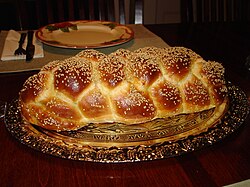
Challah sprinkled with sesame seeds |
|
| Alternative names | Hallah, khala, khale, chałka, kitke, berkhes, barches, bukhte, dacher, koylatch, koilitsh, shtritsl |
|---|---|
| Type | Bread |
| Main ingredients | Eggs, fine white flour, water, yeast, sugar and salt |
|
 Media: Challah
Challah (,[1] Hebrew: חַלָּה ḥallā [χa’la] or [ħal’lɑ]; plural: challot, Challoth or challos) is a special bread of Ashkenazi Jewish origin, usually braided and typically eaten on ceremonial occasions such as Shabbat and major Jewish holidays (other than Passover). Ritually acceptable challah is made of dough from which a small portion has been set aside as an offering. Challah may also refer to the dough offering. The word is biblical in origin, though originally referred only to the dough offering.[2] Similar braided breads such as kalach and vánočka are found across Central and Eastern Europe.
Name and origins[edit]
The term challah in Biblical Hebrew meant a kind of loaf or cake.[3] The Aramaic word given for its translation is גריצא (pl. גריצן), and which word (var. Classical Syriac: ܓܪܝܨܐ / ܓܪܝܣܐ) Payne Smith defines as «a cake or loaf,» or «morsel of bread.»[4] In Hebrew, the word challah is derived from the root chet-lamed-lamed (hallal) which means “hollow,” “space” or “pierced.” [5]
In Rabbinic terminology, challah often refers to the portion of dough which must be separated before baking, and set aside as a tithe for the Kohen,[6] since the biblical verse which commands this practice refers to the separated dough as a «challah«.[2] The practice of separating this dough sometimes became known as separating challah (הפרשת חלה) or taking challah.[7] The food made from the balance of the dough is also called challah.[8] The obligation applies to any loaf of bread, not only to the Shabbat bread. Nevertheless, separating challah may have been more common when baking the Shabbat bread than at other times, because separating challah is only required for large batches of dough (using over 10 cups of flour),[7] such as might be prepared for special occasions.[citation needed]
Variant names[edit]

Challah may also be referred to as cholla bread.[9][10] In Poland it is commonly known as chałka (diminutive of chała, pronounced ha-wa), in Ukraine as ‘kolach’ or ‘khala’ and khala (хала) in Belarus, Russia.[11][12]
Yiddish communities in different regions of Europe called the bread khale, berkhes or barches, bukhte, dacher, kitke, koylatch or koilitsh, or shtritsl.[13][14] Some of these names are still in use today, such as kitke in South Africa.[14]
The term koylatch is cognate with the names of similar braided breads which are consumed on special occasions by other cultures outside the Jewish tradition in a number of European cuisines. These are the Russian kalach, the Serbian kolač, the Ukrainian kolach the Hungarian kalács, and the Romanian colac. These names originated from Proto-Slavic kolo meaning «circle», or «wheel», and refer to the circular form of the loaf.[15][16]
In the Middle East, regional Shabbat breads were simply referred to by the local word for bread, such as noon in Farsi or khubz in Arabic.
Ingredients and preparation[edit]

Preparing braided challah
Most traditional Ashkenazi challah recipes use numerous eggs, fine white flour, water, sugar, yeast, oil (such as vegetable or canola), and salt, but «water challah» made without eggs and having a texture like French baguette also exists, which is typically suitable for those following vegan diets. Modern recipes may replace white flour with whole wheat, oat, or spelt flour or sugar with honey or molasses.
According to Sephardic Jewish observance of halachah, a bread with too much sugar changes the status of the bread to cake. This would change the blessing used over the bread from Hamotzi (bread) to Mezonot (cake, dessert breads, etc.) which would invalidate it for use during the Kiddush for Shabbat.[17] While braided breads are sometimes found in Sephardic cuisine, they are typically not challah but are variants of regional breads like çörek, eaten by Jews and non-Jews alike.
Egg challah sometimes also contains raisins and/or saffron. After the first rising, the dough is rolled into rope-shaped pieces which are braided, though local (hands in Lithuania, fish or hands in Tunisia) and seasonal (round, sometimes with a bird’s head in the centre) varieties also exist. Poppy or sesame (Ashkenazi) and anise or sesame (Sephardi) seeds may be added to the dough or sprinkled on top. Both egg and water challah are usually brushed with an egg wash before baking to add a golden sheen.
Challah is usually pareve (containing neither dairy nor meat—important in the laws of Kashrut), unlike brioche and other enriched European breads, which contain butter or milk.
Israeli breads for shabbat are very diverse, reflecting the traditions of Persian, Iraqi, Moroccan, Russian, Polish, Yemeni, and other Jewish communities who live in the State of Israel. They may contain eggs or olive oil in the dough as well as water, sugar, yeast, salt, honey and raisins. It may be topped with sesame or other seeds according to various Minhagim.
Rituals and religious significance[edit]
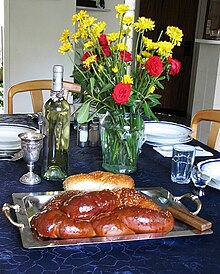
Prepared shabbat table, with challah in the foreground
According to Jewish tradition, the three Sabbath meals (Friday night, Saturday lunch, and Saturday late afternoon) and two holiday meals (one at night and lunch the following day) each begin with two complete loaves of bread.[18] This «double loaf» (in Hebrew: lechem mishneh) commemorates the manna that fell from the heavens when the Israelites wandered in the desert after the Exodus. The manna did not fall on Sabbath or holidays; instead, a double portion would fall the day before the holiday or sabbath to last for both days.[19]
In some Ashkenazi customs, each loaf is woven with six strands of dough. Together, the loaves have twelve strands, alluding to the twelve loaves of the showbread offering in the Temple. Other numbers of strands commonly used are three, five and seven. Occasionally twelve are used, referred to as a «Twelve Tribes» challah.
Traditional Sabbath meal procedure[edit]


It is customary to begin the evening and day Sabbath and holiday meals with the following sequence of rituals:
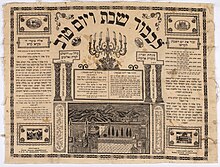
- The challah is covered, customarily with a dedicated challah cover cloth. (Normally, in the order of saying blessings, bread would precede wine. Covering the challah allows the Kiddush blessing to come first.)
- Kiddush is recited over a cup of wine.
- Each attendee ritually washes their hands in preparation for eating bread. (It is customary not to talk between this washing and consumption of the bread.[20])
- The challah cover is removed.
- The two loaves are held up together.
- The head of the household recites the blessing over bread: «Baruch atah Adonai, eloheinu melech ha’olam, hamotzi lechem min ha’aretz» (Translation: «Blessed are you LORD our God, King of the Universe, who brings forth bread from the earth»).
- The bread is sliced (or torn, depending on minhag) and salted, and the pieces are distributed to each person at the meal to eat.
The specific practice varies. Some dip the bread into salt before the blessing on bread.[21] Others say the blessing, cut or tear the challah into pieces, and only then dip the pieces in salt, or sprinkle them with salt, before they are eaten.[22] Some communities may make a nick in the bread with a cutting knife.
Normally, the custom is not to talk between washing hands and eating bread. However, according to some, if salt was not placed on the table, it is permitted to ask for someone to bring salt, before the blessing on bread is recited.[23]
Salting[edit]
Salting challah is considered a critical component of the meal. Customs vary whether the challah is dipped in salt, salt is sprinkled on it, or salt is merely present on the table.
The Torah requires that Temple sacrifices to God be offered with salt.[24] Following the destruction of the Second Temple, Rabbinic literature suggested that a table set for a meal symbolically replaces the Temple altar; therefore, the blessing over food should only be recited with salt present on the table.[20] Should one eat a meal without performing a commandment, the covenant of salt protects him.[25]
To the rabbis, a meal without salt was considered no meal.[26] Furthermore, in the Torah, salt symbolizes the eternal covenant between God and Israel.[27] As a preservative, salt never spoils or decays, signifying the immortality of this bond.[28]
Special challah[edit]
Rosh Hashanah[edit]
On Rosh Hashanah, the Jewish New Year, the challah may be rolled into a circular shape (sometimes referred to as a «turban challah»), symbolizing the cycle of the year, and is sometimes baked with raisins in the dough. Some have the custom of continuing to eat circular challah from Rosh Hashana through the holiday of Sukkot. In the Maghreb (Morocco, Tunisia, Algeria) many Jews will simply bake their challah in the shape of «turban challah» year-round.
Sometimes the top is brushed with honey to symbolize the «sweet new year.» According to some traditions, challah eaten on Rosh Hashana is not dipped in or sprinkled with salt but instead is dipped in or sprinkled with honey. As above, some continue to use honey instead of salt through the Sukkot holiday.[29]
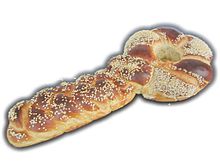
Shlissel challah[edit]
For the Shabbat Mevarchim preceding Rosh Chodesh Iyar (i.e., the first Shabbat after the end of Passover), some Ashkenazi Jews have the custom of baking shlissel[30] challah («key challah») as a segula (propitious sign) for parnassa (livelihood). Some make an impression of a key on top of the challah before baking, some place a key-shaped piece of dough on top of the challah before baking, and some bake an actual key inside the challah.[31]
The earliest written source for this custom is the sefer Ohev Yisrael by Rabbi Avraham Yehoshua Heshel, written in the 1800s. He calls schlissel challah «an ancient custom,»[dubious – discuss] and offers several kabbalistic interpretations. He writes that after spending forty years in the desert, the Israelites continued to eat the manna until they brought the Omer offering on the second day of Passover. From that day on, they no longer ate manna, but food that had grown in the Land of Israel. Since they now had to start worrying about their sustenance rather than having it handed to them each morning, the key on the challah is a form of prayer to God to open up the gates of livelihood.[31]
The custom has been criticized for allegedly having its source in Christian or pagan practices.[32]
Challah rolls[edit]
Challah rolls, known as a bilkele or bulkele or bilkel or bulkel (plural: bilkelekh; Yiddish: בילקעלע) or baigiel (Polish) is a bread roll made with eggs, similar to a challah bun. It is often used as the bread for Shabbat or holiday meals.
Similar breads[edit]
Similar braided, egg-enriched breads are made in other traditions. The Polish chałka is similar, though sweeter than challah. The Czech and Slovak vánočka is very similar and traditionally eaten at Christmas. In Bulgarian and Romanian cuisine there is a similar bread called cozonac (Bulgarian: козунак), while tsoureki bread (also known as choreg or çörek) is popular in Armenian,[33] Greek and Turkish cuisines. A sweet bread called milibrod (Macedonian: милиброд), similarly braided as the challah, is part of the dinner table during Orthodox Easter in Macedonia. Zopf is a similar bread from Germany, Austria and Switzerland, with a sweeter variant known as Hefezopf or Hefekranz. In Finnish cuisine, pulla (also known as cardamom bread in English) is a small braided pastry seasoned with cardamom that is very popular in Finnish cafés. Brioche is an egg-enriched bread, but it is not braided.
Unlike challah, which by convention is pareve, many of these breads also contain butter and milk.
See also[edit]

Wikimedia Commons has media related to Challah.
- Challa (disambiguation page)
- Pain petri
- Kubaneh
- Mouna
- Israeli cuisine
- Jewish cuisine
- Prosphora
- Kolach
- Korovai
References[edit]
- ^ «challah». Merriam-Webster Dictionary. Retrieved 10 April 2020.
- ^ a b Numbers 15:20
- ^ «Strong’s Concordance».
- ^ Payne Smith, J. (1903). A compendious Syriac Dictionary: founded upon the Thesaurus Syriacus of R. Payne Smith (in Syriac and English). Oxford: Clarendon Press. p. 78. OCLC 251355373.
- ^ Johnson, George (9 March 2020). «Jewish Word:Challah». Moment Magazine.
- ^ Jastrow, חַלָּה (meaning 2)
- ^ a b «Ask the Expert: Taking Challah». MyJewishLearning.com.
What does it mean to take challah
- ^ «AlHatorah Concordance-Dictionary, s.v. חַלָּה».
- ^ Arnold E. Bender (1975). Dictionary of Nutrition and Food Technology (4th ed.). London: Newnes-Butterworths. p. 54. ISBN 0-408-001437.
- ^ «Loaves For Jewish Festivals «Not Bread»«. The London Times. No. 55124. London. 4 July 1961. p. 8.
- ^ Леонид Беловинский (2015). «Хала». Энциклопедический словарь истории советской повседневной жизни (in Russian). Новое Литературное Обозрение. ISBN 978-5444803783.
- ^ Barbara Rolek. Polish Egg-Twist Bread Chalka Recipe. The Spruce, 2017.
- ^ Come ’Round. Forward.com, 2004.
- ^ a b South African Challah?. Forward.com, 2005. The etymology of kittke is given as Kitt + -ke: Kitt in German means «putty» [1]; «-ke» is the Slavic diminutive suffix found in many Yiddish words and names. Kitke referred not to the whole challah but simply to the braids or decorations that were attached to the challah like putty before baking, and the word must have originally referred to these.
- ^ Colac (in Romanian). DEXOnline: Dictionar Explicativ al Limbii Romane (Romanian online dictionary). References: Miklosich, Slaw. Elem., 25; Cihac, II, 67; Conev 66
- ^ Колач (in Russian). Max Vasmer. Russisches etymologisches Wörterbuch. Winter, Heidelberg 1953–1958 (in German). Russian translation by Oleg Trubachyov: Этимологический словарь русского языка. Progress, Moscow, 1964–1973.
- ^ Spolter, Rabbi Yair; Simmons, Rabbi Shraga (7 September 2015). «10. Three Mezonot Categories». aishcom. Retrieved 1 March 2021.
- ^ Maimonides (d. 1204), Mishneh Torah Hilchot Shabbos, Chapter 30, Law 9. (Hebrew)
- ^ Sol Scharfstein, Understanding Jewish Holidays and Customs, page 16 (1999)
- ^ a b «Salt». Jewish Encyclopedia. Retrieved 7 March 2013.
- ^ Isserles, in Shulcḥan ‘Aruch, l.c.
- ^ Both practices are based on different parts of the same verse in Leviticus
- ^ Shulchan Aruch, Oraḥ Ḥayyim 167:5; Jacob Zausmer, «Bet Ya’aḳob,» No. 168; comp. Berachot 40a.
- ^ Leviticus 2:13
- ^ Tosafot, Berachot 40a
- ^ Berachot 44a
- ^ Silberberg, Naftali. «Why is the Challah dipped in Salt». Chabad.org. Retrieved 7 March 2013.
- ^ Rabinowitz, Louis Isaac. «Salt». Encyclopedia Judaica.
- ^ some keep the salt on the table, to not «withhold» salt from being present, per Lev. 2:13
- ^ or schlissel
- ^ a b «Second Thoughts: The Key to Parnassah.» Hamodia, Feature Section, p. C3. 23 April 2009.
- ^ Shelomo Alfassa, Shlissel Challah – “The Loaf of Idolatry?”
- ^ «Adventures in Armenian Cooking». St. Sarkis. Archived from the original on 21 May 2008.
External links[edit]
- Schlissel Challah – An Analysis BY Rabbi Yair Hoffman
From Wikipedia, the free encyclopedia
This article is about the type of bread. For the separation tithe of challah, see Dough offering. For the Mishnaic tractate, see Challah (tractate). For more meanings of the word, see Challa.
|
Challah sprinkled with sesame seeds |
|
| Alternative names | Hallah, khala, khale, chałka, kitke, berkhes, barches, bukhte, dacher, koylatch, koilitsh, shtritsl |
|---|---|
| Type | Bread |
| Main ingredients | Eggs, fine white flour, water, yeast, sugar and salt |
|
Challah (,[1] Hebrew: חַלָּה ḥallā [χa’la] or [ħal’lɑ]; plural: challot, Challoth or challos) is a special bread of Ashkenazi Jewish origin, usually braided and typically eaten on ceremonial occasions such as Shabbat and major Jewish holidays (other than Passover). Ritually acceptable challah is made of dough from which a small portion has been set aside as an offering. Challah may also refer to the dough offering. The word is biblical in origin, though originally referred only to the dough offering.[2] Similar braided breads such as kalach and vánočka are found across Central and Eastern Europe.
Name and origins[edit]
The term challah in Biblical Hebrew meant a kind of loaf or cake.[3] The Aramaic word given for its translation is גריצא (pl. גריצן), and which word (var. Classical Syriac: ܓܪܝܨܐ / ܓܪܝܣܐ) Payne Smith defines as «a cake or loaf,» or «morsel of bread.»[4] In Hebrew, the word challah is derived from the root chet-lamed-lamed (hallal) which means “hollow,” “space” or “pierced.” [5]
In Rabbinic terminology, challah often refers to the portion of dough which must be separated before baking, and set aside as a tithe for the Kohen,[6] since the biblical verse which commands this practice refers to the separated dough as a «challah«.[2] The practice of separating this dough sometimes became known as separating challah (הפרשת חלה) or taking challah.[7] The food made from the balance of the dough is also called challah.[8] The obligation applies to any loaf of bread, not only to the Shabbat bread. Nevertheless, separating challah may have been more common when baking the Shabbat bread than at other times, because separating challah is only required for large batches of dough (using over 10 cups of flour),[7] such as might be prepared for special occasions.[citation needed]
Variant names[edit]
Challah may also be referred to as cholla bread.[9][10] In Poland it is commonly known as chałka (diminutive of chała, pronounced ha-wa), in Ukraine as ‘kolach’ or ‘khala’ and khala (хала) in Belarus, Russia.[11][12]
Yiddish communities in different regions of Europe called the bread khale, berkhes or barches, bukhte, dacher, kitke, koylatch or koilitsh, or shtritsl.[13][14] Some of these names are still in use today, such as kitke in South Africa.[14]
The term koylatch is cognate with the names of similar braided breads which are consumed on special occasions by other cultures outside the Jewish tradition in a number of European cuisines. These are the Russian kalach, the Serbian kolač, the Ukrainian kolach the Hungarian kalács, and the Romanian colac. These names originated from Proto-Slavic kolo meaning «circle», or «wheel», and refer to the circular form of the loaf.[15][16]
In the Middle East, regional Shabbat breads were simply referred to by the local word for bread, such as noon in Farsi or khubz in Arabic.
Ingredients and preparation[edit]
Preparing braided challah
Most traditional Ashkenazi challah recipes use numerous eggs, fine white flour, water, sugar, yeast, oil (such as vegetable or canola), and salt, but «water challah» made without eggs and having a texture like French baguette also exists, which is typically suitable for those following vegan diets. Modern recipes may replace white flour with whole wheat, oat, or spelt flour or sugar with honey or molasses.
According to Sephardic Jewish observance of halachah, a bread with too much sugar changes the status of the bread to cake. This would change the blessing used over the bread from Hamotzi (bread) to Mezonot (cake, dessert breads, etc.) which would invalidate it for use during the Kiddush for Shabbat.[17] While braided breads are sometimes found in Sephardic cuisine, they are typically not challah but are variants of regional breads like çörek, eaten by Jews and non-Jews alike.
Egg challah sometimes also contains raisins and/or saffron. After the first rising, the dough is rolled into rope-shaped pieces which are braided, though local (hands in Lithuania, fish or hands in Tunisia) and seasonal (round, sometimes with a bird’s head in the centre) varieties also exist. Poppy or sesame (Ashkenazi) and anise or sesame (Sephardi) seeds may be added to the dough or sprinkled on top. Both egg and water challah are usually brushed with an egg wash before baking to add a golden sheen.
Challah is usually pareve (containing neither dairy nor meat—important in the laws of Kashrut), unlike brioche and other enriched European breads, which contain butter or milk.
Israeli breads for shabbat are very diverse, reflecting the traditions of Persian, Iraqi, Moroccan, Russian, Polish, Yemeni, and other Jewish communities who live in the State of Israel. They may contain eggs or olive oil in the dough as well as water, sugar, yeast, salt, honey and raisins. It may be topped with sesame or other seeds according to various Minhagim.
Rituals and religious significance[edit]
Prepared shabbat table, with challah in the foreground
According to Jewish tradition, the three Sabbath meals (Friday night, Saturday lunch, and Saturday late afternoon) and two holiday meals (one at night and lunch the following day) each begin with two complete loaves of bread.[18] This «double loaf» (in Hebrew: lechem mishneh) commemorates the manna that fell from the heavens when the Israelites wandered in the desert after the Exodus. The manna did not fall on Sabbath or holidays; instead, a double portion would fall the day before the holiday or sabbath to last for both days.[19]
In some Ashkenazi customs, each loaf is woven with six strands of dough. Together, the loaves have twelve strands, alluding to the twelve loaves of the showbread offering in the Temple. Other numbers of strands commonly used are three, five and seven. Occasionally twelve are used, referred to as a «Twelve Tribes» challah.
Traditional Sabbath meal procedure[edit]
It is customary to begin the evening and day Sabbath and holiday meals with the following sequence of rituals:
- The challah is covered, customarily with a dedicated challah cover cloth. (Normally, in the order of saying blessings, bread would precede wine. Covering the challah allows the Kiddush blessing to come first.)
- Kiddush is recited over a cup of wine.
- Each attendee ritually washes their hands in preparation for eating bread. (It is customary not to talk between this washing and consumption of the bread.[20])
- The challah cover is removed.
- The two loaves are held up together.
- The head of the household recites the blessing over bread: «Baruch atah Adonai, eloheinu melech ha’olam, hamotzi lechem min ha’aretz» (Translation: «Blessed are you LORD our God, King of the Universe, who brings forth bread from the earth»).
- The bread is sliced (or torn, depending on minhag) and salted, and the pieces are distributed to each person at the meal to eat.
The specific practice varies. Some dip the bread into salt before the blessing on bread.[21] Others say the blessing, cut or tear the challah into pieces, and only then dip the pieces in salt, or sprinkle them with salt, before they are eaten.[22] Some communities may make a nick in the bread with a cutting knife.
Normally, the custom is not to talk between washing hands and eating bread. However, according to some, if salt was not placed on the table, it is permitted to ask for someone to bring salt, before the blessing on bread is recited.[23]
Salting[edit]
Salting challah is considered a critical component of the meal. Customs vary whether the challah is dipped in salt, salt is sprinkled on it, or salt is merely present on the table.
The Torah requires that Temple sacrifices to God be offered with salt.[24] Following the destruction of the Second Temple, Rabbinic literature suggested that a table set for a meal symbolically replaces the Temple altar; therefore, the blessing over food should only be recited with salt present on the table.[20] Should one eat a meal without performing a commandment, the covenant of salt protects him.[25]
To the rabbis, a meal without salt was considered no meal.[26] Furthermore, in the Torah, salt symbolizes the eternal covenant between God and Israel.[27] As a preservative, salt never spoils or decays, signifying the immortality of this bond.[28]
Special challah[edit]
Rosh Hashanah[edit]
On Rosh Hashanah, the Jewish New Year, the challah may be rolled into a circular shape (sometimes referred to as a «turban challah»), symbolizing the cycle of the year, and is sometimes baked with raisins in the dough. Some have the custom of continuing to eat circular challah from Rosh Hashana through the holiday of Sukkot. In the Maghreb (Morocco, Tunisia, Algeria) many Jews will simply bake their challah in the shape of «turban challah» year-round.
Sometimes the top is brushed with honey to symbolize the «sweet new year.» According to some traditions, challah eaten on Rosh Hashana is not dipped in or sprinkled with salt but instead is dipped in or sprinkled with honey. As above, some continue to use honey instead of salt through the Sukkot holiday.[29]
Shlissel challah[edit]
For the Shabbat Mevarchim preceding Rosh Chodesh Iyar (i.e., the first Shabbat after the end of Passover), some Ashkenazi Jews have the custom of baking shlissel[30] challah («key challah») as a segula (propitious sign) for parnassa (livelihood). Some make an impression of a key on top of the challah before baking, some place a key-shaped piece of dough on top of the challah before baking, and some bake an actual key inside the challah.[31]
The earliest written source for this custom is the sefer Ohev Yisrael by Rabbi Avraham Yehoshua Heshel, written in the 1800s. He calls schlissel challah «an ancient custom,»[dubious – discuss] and offers several kabbalistic interpretations. He writes that after spending forty years in the desert, the Israelites continued to eat the manna until they brought the Omer offering on the second day of Passover. From that day on, they no longer ate manna, but food that had grown in the Land of Israel. Since they now had to start worrying about their sustenance rather than having it handed to them each morning, the key on the challah is a form of prayer to God to open up the gates of livelihood.[31]
The custom has been criticized for allegedly having its source in Christian or pagan practices.[32]
Challah rolls[edit]
Challah rolls, known as a bilkele or bulkele or bilkel or bulkel (plural: bilkelekh; Yiddish: בילקעלע) or baigiel (Polish) is a bread roll made with eggs, similar to a challah bun. It is often used as the bread for Shabbat or holiday meals.
Similar breads[edit]
Similar braided, egg-enriched breads are made in other traditions. The Polish chałka is similar, though sweeter than challah. The Czech and Slovak vánočka is very similar and traditionally eaten at Christmas. In Bulgarian and Romanian cuisine there is a similar bread called cozonac (Bulgarian: козунак), while tsoureki bread (also known as choreg or çörek) is popular in Armenian,[33] Greek and Turkish cuisines. A sweet bread called milibrod (Macedonian: милиброд), similarly braided as the challah, is part of the dinner table during Orthodox Easter in Macedonia. Zopf is a similar bread from Germany, Austria and Switzerland, with a sweeter variant known as Hefezopf or Hefekranz. In Finnish cuisine, pulla (also known as cardamom bread in English) is a small braided pastry seasoned with cardamom that is very popular in Finnish cafés. Brioche is an egg-enriched bread, but it is not braided.
Unlike challah, which by convention is pareve, many of these breads also contain butter and milk.
See also[edit]
Wikimedia Commons has media related to Challah.
- Challa (disambiguation page)
- Pain petri
- Kubaneh
- Mouna
- Israeli cuisine
- Jewish cuisine
- Prosphora
- Kolach
- Korovai
References[edit]
- ^ «challah». Merriam-Webster Dictionary. Retrieved 10 April 2020.
- ^ a b Numbers 15:20
- ^ «Strong’s Concordance».
- ^ Payne Smith, J. (1903). A compendious Syriac Dictionary: founded upon the Thesaurus Syriacus of R. Payne Smith (in Syriac and English). Oxford: Clarendon Press. p. 78. OCLC 251355373.
- ^ Johnson, George (9 March 2020). «Jewish Word:Challah». Moment Magazine.
- ^ Jastrow, חַלָּה (meaning 2)
- ^ a b «Ask the Expert: Taking Challah». MyJewishLearning.com.
What does it mean to take challah
- ^ «AlHatorah Concordance-Dictionary, s.v. חַלָּה».
- ^ Arnold E. Bender (1975). Dictionary of Nutrition and Food Technology (4th ed.). London: Newnes-Butterworths. p. 54. ISBN 0-408-001437.
- ^ «Loaves For Jewish Festivals «Not Bread»«. The London Times. No. 55124. London. 4 July 1961. p. 8.
- ^ Леонид Беловинский (2015). «Хала». Энциклопедический словарь истории советской повседневной жизни (in Russian). Новое Литературное Обозрение. ISBN 978-5444803783.
- ^ Barbara Rolek. Polish Egg-Twist Bread Chalka Recipe. The Spruce, 2017.
- ^ Come ’Round. Forward.com, 2004.
- ^ a b South African Challah?. Forward.com, 2005. The etymology of kittke is given as Kitt + -ke: Kitt in German means «putty» [1]; «-ke» is the Slavic diminutive suffix found in many Yiddish words and names. Kitke referred not to the whole challah but simply to the braids or decorations that were attached to the challah like putty before baking, and the word must have originally referred to these.
- ^ Colac (in Romanian). DEXOnline: Dictionar Explicativ al Limbii Romane (Romanian online dictionary). References: Miklosich, Slaw. Elem., 25; Cihac, II, 67; Conev 66
- ^ Колач (in Russian). Max Vasmer. Russisches etymologisches Wörterbuch. Winter, Heidelberg 1953–1958 (in German). Russian translation by Oleg Trubachyov: Этимологический словарь русского языка. Progress, Moscow, 1964–1973.
- ^ Spolter, Rabbi Yair; Simmons, Rabbi Shraga (7 September 2015). «10. Three Mezonot Categories». aishcom. Retrieved 1 March 2021.
- ^ Maimonides (d. 1204), Mishneh Torah Hilchot Shabbos, Chapter 30, Law 9. (Hebrew)
- ^ Sol Scharfstein, Understanding Jewish Holidays and Customs, page 16 (1999)
- ^ a b «Salt». Jewish Encyclopedia. Retrieved 7 March 2013.
- ^ Isserles, in Shulcḥan ‘Aruch, l.c.
- ^ Both practices are based on different parts of the same verse in Leviticus
- ^ Shulchan Aruch, Oraḥ Ḥayyim 167:5; Jacob Zausmer, «Bet Ya’aḳob,» No. 168; comp. Berachot 40a.
- ^ Leviticus 2:13
- ^ Tosafot, Berachot 40a
- ^ Berachot 44a
- ^ Silberberg, Naftali. «Why is the Challah dipped in Salt». Chabad.org. Retrieved 7 March 2013.
- ^ Rabinowitz, Louis Isaac. «Salt». Encyclopedia Judaica.
- ^ some keep the salt on the table, to not «withhold» salt from being present, per Lev. 2:13
- ^ or schlissel
- ^ a b «Second Thoughts: The Key to Parnassah.» Hamodia, Feature Section, p. C3. 23 April 2009.
- ^ Shelomo Alfassa, Shlissel Challah – “The Loaf of Idolatry?”
- ^ «Adventures in Armenian Cooking». St. Sarkis. Archived from the original on 21 May 2008.
External links[edit]
- Schlissel Challah – An Analysis BY Rabbi Yair Hoffman