
Через пару дней бизнесмен вернулся очень довольным и попросил записать еще несколько песен. В тот момент Дайсукэ пришла идея Juke 8: машины с микрофоном, динамиком и усилителем, которая играет нужную песню в обмен на деньги.
Знакомый, который разбирается в электронике, собрал 11 таких аппаратов с отверстием для монет и кассетной автомагнитолой Stereo 8. Сборка всех машин заняла около 2 месяцев, а себестоимость каждой — $425. Это было в 1969 году в городе Кобе. Но популярным изобретение стало только к 1971 году.
Тогда два предпринимателя увезли пару этих машин в Осаку. Уже через год Дайсукэ продавал машины по всей стране. Вскоре караоке-мания охватила и весь мир.
“Я думаю, караоке помогло преобразовать японский народ. Японцы стесняются и плохо выражают себя на публике. Но дайте парню микрофон, и человек, которому сложно произнести свадебную речь, уже не захочет останавливаться!”, — говорил Дайсукэ журналисту TIME.
Он продавал свои машины на $100 млн в год. Но не запатентовал изобретение. Идею подхватили крупные компании, создавшие в итоге рынок на миллиарды долларов. А фирма Дайсукэ обанкротилась.

Сегодня,17 октября, отмечают Всемирный день пения. Поздравляем тех, кто сделал свой голос инструментом профессии. Поздравляем и вас, любители попеть в душе или в караоке.
Всемирный день пения — это глобальный праздник песни, который проводится ежегодно в третью субботу октября. Это событие призывает к человечности, используя силу пения для объединения и содействия благополучию. Уделяя особое внимание позитивному взаимодействию между людьми, День пения направлен на борьбу с изоляцией и преодоление локальных и глобальных конфликтов.
Забыть обиды и отречься от конфликта предлагает Международный день второго шанса или День Маллигана. История Дня связанна с канадским гольфистом Дэвидом Маллиганом. Он допустил ошибку во время игры, но все же совершил удар. С тех пор «Маллиган» означает шанс, возможность попробовать еще раз. День часто ассоциируется с получением халявы, но на самом деле Маллиган — это для тех, кто полон решимости бороться с невзгодами жизни.
Во многих странах это событие ассоциируется с днем прощения бывшего. Этот праздник посвящен поиску озарения, которое необходимо, чтобы преодолеть психическую травму разорванных отношений. Этот праздник можно использовать как начало пути к прощению или как время окончательного решения простить бывшего возлюбленного.
Бывает такое, сил на прощение пока нет.Значит надо пойти поесть.
Объявляем блюдом дня — пасту. Тем более сегодня Всемирный день пасты!
Эту дату выбрали в 1995 году на конгрессе, посвященному распространению пасты во всем мире и проходившему в Риме.Кстати, говорят, что слово “макароны” произошло от «макариа» – «счастье».
Празднуют этот день во многих странах мира. Но, конечно, наиболее активно в Италии. Ведь именно Италию считают родиной пасты.
В рамках праздника проводятся конференции для профессионалов и вкусные конкурсы и мастер-классы для обычных горожан. Многие заведения предлагают в этот день скидки на пасту.В мире сотни видов макарон. Говорят, что их уже более 600. Какую только форму не изобретают, чтобы привлечь внимание любителей лапши.
Так,что приготовьте вечерком себе тарелочку любимых макарошек и отпразднуйте этот день вместе со всем миром!
Если вы нашли опечатку или ошибку в наших новостях, пожалуйста, сообщите нам об этом. Выделите ошибку и нажмите одновременно клавиши «Ctrl» и «Enter».
Уважаемый посетитель, Вы зашли на сайт как незарегистрированный пользователь. Мы рекомендуем Вам зарегистрироваться либо зайти на сайт под своим именем.

Karaoke (;[1] Japanese: [kaɾaoke] ( listen); カラオケ, clipped compound of Japanese kara 空 «empty» and ōkesutora オーケストラ «orchestra») is a type of interactive entertainment usually offered in clubs and bars, where people sing along to recorded music using a microphone. The music is an instrumental version of a well-known popular song. Lyrics are usually displayed on a video screen, along with a moving symbol, changing colour, or music video images, to guide the singer. In Chinese-speaking countries and regions such as mainland China, Hong Kong, Taiwan and Singapore, a karaoke box is called a KTV. The global karaoke market has been estimated to be worth nearly $10 billion.[2]
History[edit]

1960s: Development of audio-visual-recording devices[edit]
From 1961 to 1966, the American TV network NBC carried a karaoke-like series, Sing Along with Mitch, featuring host Mitch Miller and a chorus, which superimposed the lyrics to their songs near the bottom of the TV screen for home audience participation.[3] The primary difference between Karaoke and sing-along songs is the absence of the lead vocalist.
Sing-alongs (present since the beginning of singing) fundamentally changed with the introduction of new technology. In the late 1960s and into the 1970s, stored audible materials began to dominate the music recording industry and revolutionized the portability and ease of use of band and instrumental music by musicians and entertainers as the demand for entertainers increased globally. This may have been attributable to the introduction of music cassette tapes, technology that arose from the need to customize music recordings and the desire for a «handy» format that would allow fast and convenient duplication of music and thereby meet the requirements of the entertainers’ lifestyles and the ‘footloose’ character of the entertainment industry.
1970s: Development of the karaoke machine[edit]
The karaoke-styled machine was developed in various places in Japan. Even before the Invention of the first machines, the word “karaoke” had long been used in Japan’s entertainment industry to refer to the use of instrumental recordings as backing tracks in situations when a live band could not be arranged for a singer.[4] Japanese engineer Shigeichi Negishi, who ran a consumer electronics assembly business in Tokyo, made the first prototype in 1967.[5][6][7] He subsequently began mass producing coin-operated versions under the brand name «Sparko Box,» making it the first commercially available karaoke machine. For media, it used 8-track cassette tapes of commercially available instrumental recordings. Lyrics were provided in a paper booklet.[8] However, he ran into distribution troubles and ceased production of the Sparko Box shortly thereafter.[9] Another early pioneer was Toshiharu Yamashita, who worked as a singing coach, and in 1970 sold an 8-track playback deck with microphone for sing-alongs.[7]
In 1971, nightclub musician Daisuke Inoue[10] independently invented his own karaoke machine in the city of Kobe.[11][12] His biggest contribution was understanding the difficulty amateurs had in singing pop songs, recording his own versions of popular songs in keys that made them easier for casual singers. As such he also included a rudimentary reverb function to help mask singers’ deficiencies. For these reasons, he is often considered to be the inventor of the modern business model for karaoke, even though he was not the first to create a machine and did not, like Negishi or Yamashita, file a patent.[13] Music has long been part of Japan’s nightlife, and particularly so in the postwar era, when a variety of establishments such as cabarets and hostess clubs emerged to serve the needs of salarymen unwinding and entertaining clients. Music, whether performed for listening or singing along, played a key role. [14] Inoue, a bandleader, drummer, and Electone keyboardist, specialized in leading sing-alongs at nightclubs in Sannomiya, the entertainment district of the city of Kobe. He grew so popular that he became overbooked, and began recording instrumentals for clients when he could not personally perform for them. Realizing the potential for the market, he commissioned a coin-operated machine that metered out several minutes of singing time. Like Negishi’s, it was based on an 8-Track cassette deck, and Inoue called it the “8 Juke.”[15] Inoue loaned the machines to establishments for free in exchange for a portion of the monthly earnings from the machines.[16] He placed the first 8 Jukes in Sannomiya’s “snack bars,” but they initially failed to take off. Inoue then hired hostesses to ostentatiously sing on them, which successfully sparked interest. This also caused a great deal of friction with Inoue’s fellow musicians, who saw it as drawing customers away from them. Nevertheless karaoke spread throughout Kobe, then, over the course of the Seventies, all of Japan as major manufacturers such as JVC began producing their own versions of the singing machine.[17] Karaoke was long performed mainly in bars and hostess clubs in front of other patrons, but in the Eighties, a new style with private rooms emerged, called karaoke boxes. This became the dominant form of karaoke performance in Japan. In 2004, Daisuke Inoue was awarded the tongue-in-cheek Ig Nobel Peace Prize for inventing karaoke, «thereby providing an entirely new way for people to learn to tolerate each other.»[18]
The patent holder of the karaoke machine is Roberto del Rosario, who is from the Philippines. He developed the karaoke’s sing-along system in 1975 and is recognized as the sole holder of a patent for a karaoke system in the world.[19]
Later developments[edit]
Shortly after the development of the LaserDisc, Pioneer started to offer Video Karaoke machines in the 1980s. These are capable of displaying lyrics over a video that accompanies the music.[20][21]
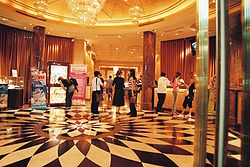
Entrance Hall of a karaoke box in Taipei, Taiwan
In 1992, a scientist named Yuichi Yasutomo created a networked karaoke system for Brother Industries. Called «tsushin karaoke» («communications karaoke») it served up songs in MIDI format via phone lines to modem-equipped karaoke machines. This new technology swept Japan; by 1998, 94% of karaoke was being sung on networked karaoke machines.[22] As an early form of music on demand, it could be called the first successful audio streaming service. It also allowed for big data analysis of songs popularity in realtime.[23]
Karaoke soon spread to the rest of Asia and other countries all over the world. In-home karaoke machines soon followed but lacked success in the American and Canadian markets. When creators became aware of this problem, karaoke machines were no longer being sold strictly for the purpose of karaoke but as home theater systems to enhance television watching to «movie theater like quality». Home theater systems took off, and karaoke went from being the main purpose of the stereo system to a side feature.
As more music became available for karaoke machines, more people within the industry saw karaoke as a profitable form of lounge and nightclub entertainment. It is not uncommon for some bars to have karaoke performances seven nights a week.[24] commonly with high-end sound equipment superior to the small, stand-alone consumer versions. Dance floors and lighting effects are also becoming common sights in karaoke bars. Lyrics are often displayed on multiple television screens around the bar.
Technology[edit]

A basic karaoke machine consists of a music player, microphone inputs, a means of altering the pitch of the played music, and an audio output. Some low-end machines attempt to provide vocal suppression so that one can feed regular songs into the machine and remove the voice of the original singer; however this was, historically, rarely effective. Most common machines are CD+G, Laser Disc, VCD or DVD players with microphone inputs and an audio mixer built in.[25] CD+G players use a special track called subcode to encode the lyrics and pictures displayed on the screen while other formats natively display both audio and video.
Most karaoke machines have technology[26] that electronically changes the pitch of the music so that amateur singers can choose a key that is appropriate for their vocal range, while maintaining the original tempo of the song. (Old systems which used cassettes changed the pitch by altering playback speed, but none are still on the market, and their commercial use is virtually nonexistent.)
A popular game using karaoke is to type in a random number and call up a song, which participants attempt to sing. In some machines, this game is pre-programmed and may be limited to a genre so that they cannot call up an obscure national anthem that none of the participants can sing. This game has come to be called «Kamikaze Karaoke» or «Karaoke Roulette» in some parts of the United States and Canada.[27]
Many low-end entertainment systems have a karaoke mode that attempts to remove the vocal track from regular audio CDs, using an Out Of Phase Stereo (OOPS) technique. This is done by center channel extraction, which exploits the fact that in most stereo recordings the vocals are in the center. This means that the voice, as part of the music, has equal volume on both stereo channels and no phase difference. To get the quasi-karaoke (mono) track, the left channel of the original audio is subtracted from the right channel. The Sega Saturn also has a «mute vocals» feature that is based on the same principle and is also able to adjust the pitch of the song to match the singer’s vocal range.

This crude approach results in the often-poor performance of voice removal. Common effects are hearing the reverb effects on the voice track (due to stereo reverb on the vocals not being in the center); also, other instruments (snare/bass drum, bass guitar and solo instruments) that happen to be mixed into the center get removed, degrading this approach to hardly more than a gimmick in those devices. Recent years have seen the development of new techniques based on the fast Fourier transform. Although still not perfect, the results are usually much better than the old technique, because the stereo left-right comparison can be done on individual frequencies.[citation needed]
Early age[edit]
Early karaoke machines used 8-track cartridges (The Singing Machine) and cassette tapes, with printed lyric sheets, but technological advances replaced this with CDs, VCDs, laserdiscs and, currently, DVDs. In the late 1980s and 1990s, Pioneer Electronics dominated the international karaoke music video market, producing high quality karaoke music videos (inspired by the music videos such as those on MTV).[28]
In 1992, Taito introduced the X2000, which fetched music via a dial-up telephone network. Its repertoire of music and graphics was limited, but its smaller size and the advantage of continuous updates saw it gradually replace traditional machines. Karaoke machines which are connected via fiber-optic links enabling them to provide instant high-quality music and video are becoming increasingly popular.[citation needed]
Karaoke direct is an Internet division established in 1997 been serving the public online since 1998. They released the first karaoke player that supports MP3+G and now[when?] the KDX2000 model supporting karaoke in DIVX, Format.[29]
One of long-running karaoke device is the DVD, HDD karaoke system, that comes with thousands of songs which popular in business such as karaoke machine rentals and KTV bars, and became popular in asia, especially the Philippines. This device also provides MIDI format with on-screen lyrics on a background video and scoring after you sing, the score will appear from 60 (lowest) to 100 (highest) based on timing and pitch.
Video games[edit]
The earliest karaoke-based music video game, called Karaoke Studio, was released for the Nintendo Famicom in 1985, but its limited computing ability made for a short catalog of songs and therefore reduced replay value. As a result, karaoke games were considered little more than collector’s items until they saw release in higher-capacity DVD formats.[citation needed]
Karaoke Revolution, created for the PlayStation 2 by Harmonix and released by Konami in North America in 2003, is a console game in which a single player sings along with on-screen guidance and receives a score based on pitch, timing, and rhythm. The game soon spawned several follow-ups including Karaoke Revolution Vol. 2, Karaoke Revolution Vol. 3, Karaoke Revolution Party Edition, CMT Presents Karaoke Revolution: Country and Karaoke Revolution Presents: American Idol. While the original Karaoke Revolution was also eventually released for the Microsoft Xbox console in late 2004, the new online-enabled version included the ability to download additional song packs through the console’s exclusive Xbox Live service.[citation needed]
A similar series, SingStar, published by Sony Computer Entertainment Europe, is particularly popular in the European and Australasian markets. Other music video game titles that involve singing by the player include Boogie and its sequel Boogie Superstar, Disney Sing It, Get On Da Mic, the Guitar Hero series starting with World Tour, High School Musical: Sing It!, Lips, the Rock Band series, SingSong, UltraStar, and Xbox Music Mixer.[30]
An Xbox Live App with the same name created by iNiS and powered by The Karaoke Channel/Stingray Karaoke was released on 12 December 2012.[31] The app uses Unreal Engine 3.
VCDs[edit]
Many VCD players in Southeast Asia have a built-in karaoke function. On stereo recordings, one speaker will play the music with the vocal track, and the other speaker will play the music without the vocal track. So, to sing karaoke, users play the music-only track through both speakers. In the past, there were only pop-song karaoke VCDs. Nowadays, different types of karaoke VCDs are available. Cantonese opera karaoke VCD is now a big hit among the elderly in China.[32]
On mobile phones[edit]
In 2003, several companies started offering a karaoke service on mobile phones, using a Java MIDlet that runs with a text file containing the words and a MIDI file with the music. More usual is to contain the lyrics within the same MIDI file. Often the file extension is then changed from .mid to .kar, both are compatible with the standard for MIDI files.
Researchers have also developed karaoke games for cell phones to boost music database training. In 2006, the Interactive Audio Lab at Northwestern University released a game called Karaoke Callout for the Nokia Series 60 phone. The project has since then expanded into a web-based game and will be released soon as an iPhone application.
Karaoke is now available for the Android, iPhone and other playback devices at many internet storefronts.
On computers and the Internet[edit]
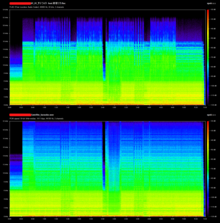
Electronic music production has made distribution of instrumental ‘stems’ simple
Since 2003, much software has been released for hosting karaoke shows and playing karaoke songs on a personal computer. Instead of having to carry around hundreds of CD-Gs or laserdiscs, KJs[who?] can «rip» their entire libraries onto their hard drives and play the songs and lyrics from the computer.
Additionally, new software permits singers to sing and listen to one another over the Internet.
Karaoke devices in the 2000s saw a shift towards the use of hard drives to store large collections of karaoke tracks and touch screen devices that allows users to select their songs. This trend was driven by the declining cost of hard drive storage[33] and improvement in touchscreen technology in the consumer space.
In 2010, a new concept of home karaoke system through the use of live streaming from a cloud server emerged. The earliest cloud based streaming device, KaraOK!, was released by StarHub on 14 January 2010,[34] licensing songs from RIMMS.[35] The use of cloud streaming allows for smaller devices with over the air updates compared to costly and bulky hard drive-based systems.
In August 2017, ROXI home music system launched in the UK, and later that year in the US, providing on-demand music streaming and a karaoke singalong feature called Sing with the Stars. ROXI matches songs in its cloud based licensed music streaming catalogue to a lyrics database to provide real time scrolling on-screen lyrics. The music system also uses a hand-held Wii style point and click controller with built-in microphone allowing users to select and sing along to thousands of songs from its catalogue.[36]
In July 2019, YouTube channel Sing King Karaoke reached 6 million subscribers, making it the largest karaoke channel on the platform.
In automobiles[edit]
Taxicabs equipped with sound systems and a microphone appeared in South Korea in the 1990s.[37]
Chinese automobile maker Geely Automobile received much press in 2003 for being the first to equip a car, their Beauty Leopard, with a karaoke machine as standard equipment. Europe’s first commercial «karaokecab» which was a London TX4 taxi with a karaoke machine inside for occupants of the cab to use to sing whilst in the cab. The idea and installation were made by Richard Harfield of karaokeshop.com and was featured on Channel 4’s Big Breakfast and several German TV stations featured the karaokecab. Granada TV also featured the cab, which is now in its 4th vehicle and operates in Bolton, Greater Manchester as Clint’s Karaoke Cab. Karaoke is often also found as a feature in aftermarket in-car DVD players.
In 2010, karaoke taxis were available in London, England in the ‘Kabeoke’ fleet of private hire vehicles.[38]
Tesla’s newer cars have an infotainment system that features a «Car-a-oke» app.
Alternative playback devices[edit]
The CD+G format of a karaoke disc, which contains the lyrics on a specially encoded subcode track, has heretofore required special—and expensive—equipment to play. Commercial players have come down in price, though, and some unexpected devices (including the Sega Saturn video game console and XBMC Media Center on the first Xbox) can decode the graphics; in fact, karaoke machines, including video and sometimes recording capability, are often popular electronics items for sale in toy stores and electronics stores.
Additionally, there is software for Windows, Pocket PC, Linux, and Macintosh PCs that can decode and display karaoke song tracks, though usually these must be ripped from the CD first, and possibly compressed.
In addition to CD+G and software-based karaoke, microphone-based karaoke players enjoy popularity mainly in North America and some Asian countries such as the Philippines. Microphone-based karaoke players only need to be connected to a TV—and in some cases to a power outlet; in other cases they run on batteries. These devices often support advanced features, such as pitch correction and special sound effects. Some companies offer karaoke content for paid download to extend the song library in microphone-based karaoke systems.
CD+G, DVD, VCD and microphone-based players are most popular for home use. Due to song selection and quality of recordings, CD+G is the most popular format for English and Spanish. It is also important to note that CD+G has limited graphical capabilities, whereas VCD and DVD usually have a moving picture or video background. VCD and DVD are the most common format for Asian singers due to music availability and largely due to the moving picture/video background.[citation needed]
Silent karaoke[edit]
Silent karaoke is a noiseless singing exercise microphone.[39]
Terms[edit]
- Jūhachiban
- (十八番. also ohako). Many karaoke singers have one song which they are especially good at and which they use to show off their singing abilities. In Japan, this is called jūhachiban in reference to Kabuki Jūhachiban, the 18 best kabuki plays. 十八番 means eighteen in Japanese as well.
- Karamovie or Movioke
- Karaoke using scenes from movies. Amateur actors replace their favorite movie stars in popular movies. Usually facilitated by software or remote control muting and screen blanking/freezing. Karamovie originated in 2003.
- Karaoke jockey or KJ
- A karaoke jockey plays and manages the music for a venue. The role of the KJ often includes announcing song titles and whose turn it is to use the microphone.
- Hitokara
- Singing karaoke alone is called hitokara (ヒトカラ, abbreviation for ひとりカラオケ; ひとり hitori, «one person» or «alone» + カラオケ karaoke) in Japan. Recently this trend has become very popular amongst amateur singers in Japan, India and China, though mostly Japan.
In culture[edit]
Public places[edit]

Lobby of a karaoke box in Japan

Entrance to a karaoke box in China

Karaoke in an Irish pub in Hamburg
Asia[edit]
In Asia, a karaoke box is the most popular type of karaoke venue. A karaoke box is a small or medium-sized room containing karaoke equipment rented by the hour or half-hour, providing a more intimate atmosphere. Karaoke venues of this type are often dedicated businesses, some with multiple floors and a variety of amenities including food service, but hotels and business facilities sometimes provide karaoke boxes as well. In South Korea, karaoke boxes are called norebangs.[40] In mainland China and Taiwan, a karaoke establishment is called a KTV.
In some traditional Chinese restaurants, there are so-called «mahjong-karaoke rooms» where the elderly play mahjong while teenagers sing karaoke. The result is fewer complaints about boredom, but more noise. Noise regulations can be an issue, especially when karaoke is brought into residential areas.
Violent reactions to karaoke singing have made headlines in Malaysia, Thailand and the Philippines, with reports of killings by listeners disturbed by the singing. In the Philippines, at least half a dozen killings of people singing «My Way» caused newspapers there to label the phenomenon «My Way killings»; some bars refuse to allow the song, and some singers refrain from vocalizing it among strangers.[41]
Prostitution has been an issue in certain karaoke boxes in Cambodia, Sri Lanka, Thailand and other parts of Southeast Asia despite being illegal in these countries.[42][43][44] In Thailand, «karaoke girls» are brought in not only from Thailand but from neighboring countries and are sent to other parts of the world.[45]
Asian karaoke establishments are often fronts for gentlemen’s clubs, where men pay for female hosts to drink, sing, and dance with them.[citation needed] In Japan, such a business is called a piano bar.[46]
After the COVID-19 outbreak, karaoke bars in Japan reopened with rules such as mask wearing, mic covers, and singer must face same direction as onlookers.[47]
Taiwan[edit]
![[icon]](https://upload.wikimedia.org/wikipedia/commons/thumb/1/1c/Wiki_letter_w_cropped.svg/20px-Wiki_letter_w_cropped.svg.png) |
This section needs expansion. You can help by adding to it. (June 2013) |
In Taiwan, karaoke bars similar to those in Japan and South Korea are called KTVs, which stands for karaoke television. Karaoke is a highly popular form of recreation in Taiwan. The biggest KTV chains in Taiwan are Partyworld Cashbox, Holiday KTV and NewCBParty.
South Korea[edit]
A noraebang (Hangul: 노래방) refers to a singing venue in South Korea where private sound-proof rooms are available for rent, equipped for singing – typically microphones, remote controls, a large video screen, couches, and mood décor such as disco lights and tambourines. The term noraebang is a Korean compound word, blending norae (Hangul: 노래, English: song) and bang (Hangul: 방, English: room). It is the regional equivalent to the Karaoke box in Japan.[48]
Singing is an important part of social life in Korea, where people will perform, and be persuaded to perform, an impromptu song at virtually any social occasion.[49] As such, noraebangs are popular and widespread, often identifiable by bright neon signs with musical notes or microphones.[50]
Often the last stop after a night of alcohol-lined entertainment for youths and businesspeople alike,[51][52] noraebangs are also a favorite family pastime, and many are surprisingly dry venues.[53] People also frequent noraebangs as a form of stress relief, and some noraebangs cater to those who seek to sing alone.[54]
Philippines[edit]
Karaoke (Filipino: videoke) has become a pastime activity in the Philippines especially when entertaining friends at home. Instrumental music (also widely called minus-one) on tapes during the late 1960s particularly with the dominance of pop hits from the Beatles had become favorites. Singing contests during town or barangay festivals and fiestas would attract contestants who carry with them cassette tapes with these instrumentals to perform in their own rendition.
Videoke in the Philippines is also known for the My Way killings, a number of fatal disputes which arose due to the singing of the song «My Way», popularized by Frank Sinatra, in karaoke or «videoke» bars. A The New York Times article estimated the number of killings to be about six up to 2010.[41] Another source estimated at least 12 between 2002 and 2012.[55] Opinions differ over whether the possible connection is due to the coincidence that the song was simply frequently sung amid the nation’s videoke bars where violence is common or to the aggressive lyrics of the song itself.[citation needed]
North America and Europe[edit]

A karaoke bar, restaurant, club or lounge is a bar or restaurant that provides karaoke equipment so that people can sing publicly, sometimes on a small stage. Most of these establishments allow patrons to sing for free, with the expectation that sufficient revenue will be made selling food and drink to the singers. Less commonly, the patron wishing to sing must pay a small fee for each song they sing. Both are financially beneficial for the establishment by not having to pay a professional singer or a cabaret tax which is usually applied to any entertainment of more than one person.
Many establishments offer karaoke on a weekly schedule, while some have shows every night. Such establishments commonly invest more in both equipment and song discs, and are often extremely popular, with an hour or more wait between a singer’s opportunities to take the stage (called the rotation).
Private karaoke rooms, similar to Asia’s karaoke boxes, are commonplace in communities such as Toronto, Los Angeles, Chicago, New York City, Houston, TX, San Francisco and now New Jersey. Toronto’s Koreatown is one example of an area where popularity is growing to the point that private karaoke rooms require reservations on the weekends.
Karaoke is very popular in Scotland with dedicated karaoke venues in most reasonably large towns. Aberdeen is home to a number of notable karaoke bars including Weagleys, The Spirit Level, Bardot’s Karaoke Bar, Sing City. In North America, the Tri State area is known to have many lounges that participate in weekly karaoke shows. New Jersey has many establishments that are frequented by people of different backgrounds who also participate in karaoke. Hugo’s Lounge and Love Lounge located in Plainfield, New Jersey are just a couple of the many establishments with weekly karaoke schedules.
Throughout much of North America, live band karaoke is also popular. With live band karaoke, singers sing with a live band instead of the prerecorded backing track.
Rock critic Rob Sheffield claims that the 1986 music video for the song «Wild Wild Life» by the Talking Heads was the first depiction of karaoke in American popular culture. The video features a variety of characters taking turns singing portions of the song to an audience at a bar.[56] However a karaoke bar in Honolulu called «Sing Sing» is depicted in an episode of the American TV series Magnum, P.I. entitled «The Man from Marseilles» first broadcast on March 14, 1985.
In Italy, karaoke had become popular by early 1994, popularized by television personality Rosario Fiorello who had a karaoke program that appeared weekly on national television.[57]

The karaoke box at Karaoke Kan (Tokyo) where Bill Murray and Scarlett Johansson sang in Lost in Translation
Karaoke made a brief appearance in Sofia Coppola’s 2003 movie Lost in Translation, and it was, three years before, the primary focus of Bruce Paltrow’s 2000 film Duets, written by John Bynum and starring Paltrow’s daughter Gwyneth and Huey Lewis, «anchor-man» of Huey Lewis and the News.
Also popular among the international performing arts community in Europe, a group of Finnish producers organized an international karaoke competition called KWC (Karaoke World Championships). Their 2011 international karaoke competition has attracted ABC producers to help host America’s karaoke competition in Las Vegas Nevada called Karaoke Battle USA. The competition is promised to select 1 male and 1 female contestant to represent the U.S. in the international arena. Largely supported by the Broadway community in Times Square, Pulse Karaoke Lounge sponsored 2011’s New York state karaoke finals to select individuals representing New York in the eastern finals.
According to The New York Times, the dozens of karaoke bars in Portland, Oregon make it not just «the capital of karaoke» in the United States, but «one of the most exciting music scenes in America.»[58]
Australia[edit]
In Australia, karaoke was gradually popularized in the late 1980s. A number of Filipino migrants brought with them their own ‘minus-one’ music from cassette music tapes and video tapes purchased mainly in the Philippines. A number of Philippine-imported karaoke units with two cassette drives were used in private households. Video TV tapes, mainly consisted of popular and contemporary songs rendered by Filipino artists, and with a mix of English and Tagalog songs were soon used. Projected lyrics on TV screens became very common as the main source of karaoke renditions. These tapes were soon replaced by CD+Gs, but a plug-n-play karaoke microphone that housed a factory built-in songchip loaded with hundreds of karaoke songs quickly became a favourite. This unit would usually be purchased in the Philippines and brought into Australia, becoming a common household item and is popularly used during gatherings.
Commercially, karaoke was first introduced into Australia in 1989 by Robin Hemmings who had seen karaoke operating in Fiji. Prior to this, karaoke was generally unknown to the broader population. Hemmings, of Adelaide, South Australia, offered systems manufactured by Pioneer which used 12in (30 cm) double-sided laser discs containing a maximum of 24 songs with accompanying video track and subtitled lyrics.
Despite some initial resistance, Adelaide hoteliers The Booze Brothers offered limited access to their hotels and the karaoke phenomenon was born. Hemmings business, Karaoke Hire Systems, operated seven machines on a casual rental basis to numerous hotels, clubs and private parties in and around Adelaide with an additional machine on snow-season lease at Jindabyne, NSW. Each system came complete with up to 24 discs containing a maximum of 576 music video tracks. In Adelaide, karaoke reached its zenith in 1991 with virtually every hotel offering at least one karaoke night per week with many having undertaken alterations to their premises with the addition of purpose built stages and sound systems. Karaoke rental suppliers had proliferated during this period and Hemmings is known to have sold his business in late 1991 as a going concern.
Karaoke’s popularity in Adelaide waned from mid 1992 and was virtually extinguished by early 1993. Despite periodic attempts by hoteliers and clubs to revitalise karaoke, it has never managed to re-establish its former popularity.
In the mid-2000s, a number of karaoke bars sprouted in Sydney with karaoke boxes frequented by Japanese students and tourists and a few locals, especially on Thursday nights and weekends. A number of clubs such as RSL, League Clubs and restaurants and bars mainly feature karaoke nights to entice more customers and to entertain guests. Sunfly Karaoke is probably the major karaoke brand in Australia as well as the UK.[59]
Production methods[edit]

Karaoke is very popular in Asian countries, and many artists distribute a karaoke track at the same time the song is released. The most common form of karaoke nowadays[when?] is released in MIDI format with on-screen lyrics on a DVD background video.
In Europe and North America, karaoke tracks are almost never done by the original artist, but are re-recorded by other musicians.
South Korean firms T.J. Media, Magic Sing, Kumyoung produce digital music content in MIDI format and manufacture computer music players for the Asian market.
Contests[edit]
Since the rise of karaoke around the world, karaoke contests have become a phenomenon of mainstream culture, giving non-professional singers opportunity to showcase their talent, win prizes, and at times, travel the world. Contest participants are usually rated 50% by customer votes and 50% by judges’ votes, but this may vary, depending on the venue and the level of competition.
Karaoke World Championship is one of the most popular karaoke contests and has been around since 2003. In September 2011, Karaoke World Championships took place in Killarney, Ireland.
World records[edit]
As of 2009, the world record for the most people singing karaoke was at Bristol Motor Speedway in the United States. Over 160,000 people began to sing Garth Brooks’ song «Friends in Low Places» before the NASCAR Sharpie 500 race began.[60]
Hungary holds the record for the longest Karaoke marathon with multiple participants for an event organized in the Honey Grill Restaurant by Gabor Dániel Szabó (REVVOX Music). It lasted for 1,011 hours, 1 minute, between 20 July 2011, and 31 August 2011. Each song was over 3 minutes long and the gap between songs was no longer than 30 seconds. No song was repeated in any two-hour period.[61]
The record for the longest Karaoke solo marathon is held by the Italian Leonardo Polverelli, who sang 1,295 songs in 101 hours, 59 minutes, and 15 seconds.[62]
See also[edit]
- Closed captioning
- Fansub
- List of English words of Japanese origin
- Music Minus One
- PowerPoint karaoke
- Same language subtitling
- Subtitling
- Surtitles
- Utagoe Kissa
References[edit]
- ^ Jones, Daniel (2011). Roach, Peter; Setter, Jane; Esling, John (eds.). Cambridge English Pronouncing Dictionary (18th ed.). Cambridge University Press. ISBN 978-0-521-15255-6.
- ^ UK Police and PRS Shutdown Karaoke Torrent Site. Torrentfreak. 13 March 2015
- ^ Brooks, Tim; Marsh, Earle (1992), The Complete Directory to Prime Time Network TV Shows, Ballantine Books, ISBN 978-0-345-37792-0
- ^ Alt, Matt (2021). Pure Invention: How Japan Made the Modern World. Crown. p. 88. ISBN 978-1-9848-2671-8.
- ^ «A History of KARAOKE». All-Japan Karaoke Industrialist Association.
- ^ Ugaya, Hiromichi (2008). Karaoke Secret History – world revolution of ingenuity. Shinchosha Publishing. pp. 49–53. ISBN 978-4106102929.
- ^ a b «Selection from TOP 100 Japanese Innovations of «Karaoke»» (PDF). IP Friends Connections. December 2015 No. 11: 53. Archived from the original (PDF) on 9 January 2019. Retrieved 19 February 2019.
- ^ «The Man Who Invented Karaoke Is 95 And His Machine Still Works». kotaku.com. 26 June 2020.
- ^ Alt, Matt (2021). Pure Invention: How Japan Made the Modern World. Crown. pp. 89–90. ISBN 978-1-9848-2671-8.
- ^ Who Invented the Karaoke Machine? Archived 5 March 2008 at the Wayback Machine Events-in-Music.com
- ^ 井上大祐【カラオケ発明者】 J-ONE/INOUE Archived 21 March 2009 at the Wayback Machine Events-in-Music.com
- ^ Time 100:Daisuke Inoue, 23–30 August 1999 VOL. 154 NO. 7/8
- ^ Alt, Matt (2021). Pure Invention: How Japan Made the Modern World. Crown. pp. 90–93. ISBN 978-1-9848-2671-8.
- ^ Alt, Matt (2021). Pure Invention: How Japan Made the Modern World. Crown. pp. 84–90. ISBN 978-1-9848-2671-8.
- ^ Alt, Matt (2021). Pure Invention: How Japan Made the Modern World. Crown. pp. 90–91. ISBN 978-1-9848-2671-8.
- ^ Alt, Matt (2021). Pure Invention: How Japan Made the Modern World. Crown. p. 92. ISBN 978-1-9848-2671-8.
- ^ Alt, Matt (2021). Pure Invention: How Japan Made the Modern World. Crown. p. 82. ISBN 978-1-9848-2671-8.
- ^ «The 2004 Ig Nobel Prize Winners». Winners of the Ig Nobel Prize. Improbable Research. August 2006. Retrieved 17 October 2009.
- ^ «BBC – Travel – Karaoke in the Philippines».
- ^ «Billboard – Karaoke Japan». 30 May 1992.
- ^ «U.S. Dealers Set To Chime In On Karaoke Sing-A-Long Profits / Japanese Karaoke Craze Ready To Roll Into Lucrative American Music Market». Vending Times. Vol. 29, no. 10. August 1989. pp. 100, 107.
- ^ «Karoke History Chart».
- ^ Alt, Matt (2021). Pure Invention: How Japan Made the Modern World. Crown. pp. 177–178. ISBN 978-1-9848-2671-8.
- ^ Zhou, Xun; Tarocco, Francesca (1 June 2013). Karaoke: The Global Phenomenon. Reaktion Books. ISBN 9781780232409.
- ^ «The History of Karaoke in America». Karaoke Cloud. 12 April 2013. Retrieved 15 January 2014.
- ^ Clickblue «Best technology Karaoke systems from a renowned karaoke manufacturing company», 30 November 2014, International Business Times. Retrieved 30 November 2014
- ^ One Baltimore variation involves limiting the songs to titles written by participants into a sombrero for the KJ (karaoke jockey) to pick from; Xun Zhou and Francesca Tarocco, Karaoke: The Global Phenomenon (Reaktion, 2013), 131-32. ISBN 9781780232409 Portraits of kamikaze/roulette karaoke appear in recent fiction, highlighting the features of social challenge and anxiety involved, e.g. Eileen Shapiro, Precious Little Devils (2016) and Mike Donald, Louisiana Blood (2017).
- ^ «Retro Blue — A Brief History of Karaoke». retroblueentertainment.com. Retrieved 20 October 2021.
- ^ «RhymeZone: Use Divx in a sentence». rhymezone.com. Retrieved 14 March 2020.
- ^ «Search results : learn». xbox.com. Retrieved 14 March 2020.
- ^ «Microsoft’s upcoming XBOX 360 Karaoke App will charge you by the hour». EuroGamer. 19 November 2012. Retrieved 19 November 2012.
- ^ China’s Elderly Sing The Praises Of Daytime Karaoke | NBC News, retrieved 4 June 2021
- ^ Coughlin, Tom. «Digital Storage Projections For 2018, Part 1». Forbes. Retrieved 6 June 2018.
- ^ «Sing Your Hearts Out With StarHub», StarHub, retrieved 16 October 2018
- ^ «24/7 SINGALONG FUN FOR THE FAMILY», RIMMSS, retrieved 16 October 2018
- ^ Landridge, Max. «What is the ROXI Entertainment device, how much is it and what can it do?», Pocket-Lint.com, London, 29 November 2017. Retrieved 30 October 2018.
- ^ Shin, Paul (14 June 1992). « Karoake Taxicabs Are Latest Fad for South Koreans Who Love to Belt Out a Song». Los Angeles Times.
- ^ «Photoshoot for The Kabeoke – Karaoke Taxi- London».
- ^ «Utaet Voice Training Silent Karaoke Mic». Japan Trend Shop (in Spanish). Retrieved 17 March 2022.
- ^ «Karaoke in Korea – Exploring Korea». Exploring Korea. 11 July 2011. Archived from the original on 19 November 2016. Retrieved 22 November 2016.
- ^ a b Onishi, Norimitsu, «Sinatra Song Often Strikes Deadly Chord», 7 February 2010, The New York Times. Retrieved 7 February 2010
- ^ Sorvino, Mira (9 December 2013). «Inside Cambodia’s hidden child brothels». CNN. Retrieved 10 August 2017.
- ^ «Prostitution Rings in Colombo – The Sunday Leader». Retrieved 10 August 2017.
- ^ Iaccino, Ludovica (6 October 2014). «Thailand: 13 Girls Forced into Prostitution in Karaoke Bar Rescued». Retrieved 10 August 2017.
- ^ Zhou, Xun; Tarocco, Francesca (1 June 2013). Karaoke: The Global Phenomenon. Reaktion Books. ISBN 9781780232409. Retrieved 10 August 2017 – via Google Books.
- ^ Coy, Peter (29 March 1988). «Japanese make working relationships work in Piano bars». The Washington post. Archived from the original on 7 June 2019. Retrieved 7 June 2019.
- ^ Fulton, Wil. «The Future of Karaoke Bars Is Filled With Uncertainty and Hope». Thrillist. Retrieved 23 November 2020.
- ^ «Noraebang: The Korean Karaoke Box». Musicaroo. 13 February 2017.
- ^ Clark, Donald (2000). Culture and Customs of Korea.
- ^ ««Things to See & Do in Seoul, Korea»«. USA Today
- ^ «How to Karaoke Like a Boss in Seoul» HuffPost 29 October 2013
- ^ «Doing Business in Korea» Korean New Zealand Business Council
- ^ «Singin’ in the room noraebang nights» Korea.net 16 July 2014
- ^ «Uniquely Korean – Noraebang: Singing relieves stress, smoothes relationships» The Korea Herald, 2 December 2014
- ^ Palash, Ghosh, «Karaoke Killings: A Bizarre Phenomenon In East Asia», 10 September 2012, International Business Times. Retrieved 5 March 2015
- ^ Sheffield, Rob (2013). Turn Around Bright Eyes: The Rituals of Love and Karaoke. New York: HarperCollins. pp. 288. ISBN 978-0062207623.
- ^ «International News: Italy». Play Meter. Vol. 20, no. 1. January 1994. p. 26.
- ^ How Good Does Karaoke Have to Be to Qualify as Art?, Dan Kois, The New York Times, 17 January 2013
- ^ «About Sunfly Karaoke». www.sunflykaraoke.com. Retrieved 21 January 2021.
- ^ «Karaoke – most participants». Guinness World Records. Retrieved 26 June 2018.
- ^ «Longest karaoke marathon by multiple participants». Archived from the original on 11 December 2013. Retrieved 10 August 2017.
- ^ «Longest marathon karaoke». Guinness World Records.
External links[edit]
Karaoke (;[1] Japanese: [kaɾaoke] (listen); カラオケ, clipped compound of Japanese kara 空 «empty» and ōkesutora オーケストラ «orchestra») is a type of interactive entertainment usually offered in clubs and bars, where people sing along to recorded music using a microphone. The music is an instrumental version of a well-known popular song. Lyrics are usually displayed on a video screen, along with a moving symbol, changing colour, or music video images, to guide the singer. In Chinese-speaking countries and regions such as mainland China, Hong Kong, Taiwan and Singapore, a karaoke box is called a KTV. The global karaoke market has been estimated to be worth nearly $10 billion.[2]
History[edit]
1960s: Development of audio-visual-recording devices[edit]
From 1961 to 1966, the American TV network NBC carried a karaoke-like series, Sing Along with Mitch, featuring host Mitch Miller and a chorus, which superimposed the lyrics to their songs near the bottom of the TV screen for home audience participation.[3] The primary difference between Karaoke and sing-along songs is the absence of the lead vocalist.
Sing-alongs (present since the beginning of singing) fundamentally changed with the introduction of new technology. In the late 1960s and into the 1970s, stored audible materials began to dominate the music recording industry and revolutionized the portability and ease of use of band and instrumental music by musicians and entertainers as the demand for entertainers increased globally. This may have been attributable to the introduction of music cassette tapes, technology that arose from the need to customize music recordings and the desire for a «handy» format that would allow fast and convenient duplication of music and thereby meet the requirements of the entertainers’ lifestyles and the ‘footloose’ character of the entertainment industry.
1970s: Development of the karaoke machine[edit]
The karaoke-styled machine was developed in various places in Japan. Even before the Invention of the first machines, the word “karaoke” had long been used in Japan’s entertainment industry to refer to the use of instrumental recordings as backing tracks in situations when a live band could not be arranged for a singer.[4] Japanese engineer Shigeichi Negishi, who ran a consumer electronics assembly business in Tokyo, made the first prototype in 1967.[5][6][7] He subsequently began mass producing coin-operated versions under the brand name «Sparko Box,» making it the first commercially available karaoke machine. For media, it used 8-track cassette tapes of commercially available instrumental recordings. Lyrics were provided in a paper booklet.[8] However, he ran into distribution troubles and ceased production of the Sparko Box shortly thereafter.[9] Another early pioneer was Toshiharu Yamashita, who worked as a singing coach, and in 1970 sold an 8-track playback deck with microphone for sing-alongs.[7]
In 1971, nightclub musician Daisuke Inoue[10] independently invented his own karaoke machine in the city of Kobe.[11][12] His biggest contribution was understanding the difficulty amateurs had in singing pop songs, recording his own versions of popular songs in keys that made them easier for casual singers. As such he also included a rudimentary reverb function to help mask singers’ deficiencies. For these reasons, he is often considered to be the inventor of the modern business model for karaoke, even though he was not the first to create a machine and did not, like Negishi or Yamashita, file a patent.[13] Music has long been part of Japan’s nightlife, and particularly so in the postwar era, when a variety of establishments such as cabarets and hostess clubs emerged to serve the needs of salarymen unwinding and entertaining clients. Music, whether performed for listening or singing along, played a key role. [14] Inoue, a bandleader, drummer, and Electone keyboardist, specialized in leading sing-alongs at nightclubs in Sannomiya, the entertainment district of the city of Kobe. He grew so popular that he became overbooked, and began recording instrumentals for clients when he could not personally perform for them. Realizing the potential for the market, he commissioned a coin-operated machine that metered out several minutes of singing time. Like Negishi’s, it was based on an 8-Track cassette deck, and Inoue called it the “8 Juke.”[15] Inoue loaned the machines to establishments for free in exchange for a portion of the monthly earnings from the machines.[16] He placed the first 8 Jukes in Sannomiya’s “snack bars,” but they initially failed to take off. Inoue then hired hostesses to ostentatiously sing on them, which successfully sparked interest. This also caused a great deal of friction with Inoue’s fellow musicians, who saw it as drawing customers away from them. Nevertheless karaoke spread throughout Kobe, then, over the course of the Seventies, all of Japan as major manufacturers such as JVC began producing their own versions of the singing machine.[17] Karaoke was long performed mainly in bars and hostess clubs in front of other patrons, but in the Eighties, a new style with private rooms emerged, called karaoke boxes. This became the dominant form of karaoke performance in Japan. In 2004, Daisuke Inoue was awarded the tongue-in-cheek Ig Nobel Peace Prize for inventing karaoke, «thereby providing an entirely new way for people to learn to tolerate each other.»[18]
The patent holder of the karaoke machine is Roberto del Rosario, who is from the Philippines. He developed the karaoke’s sing-along system in 1975 and is recognized as the sole holder of a patent for a karaoke system in the world.[19]
Later developments[edit]
Shortly after the development of the LaserDisc, Pioneer started to offer Video Karaoke machines in the 1980s. These are capable of displaying lyrics over a video that accompanies the music.[20][21]
Entrance Hall of a karaoke box in Taipei, Taiwan
In 1992, a scientist named Yuichi Yasutomo created a networked karaoke system for Brother Industries. Called «tsushin karaoke» («communications karaoke») it served up songs in MIDI format via phone lines to modem-equipped karaoke machines. This new technology swept Japan; by 1998, 94% of karaoke was being sung on networked karaoke machines.[22] As an early form of music on demand, it could be called the first successful audio streaming service. It also allowed for big data analysis of songs popularity in realtime.[23]
Karaoke soon spread to the rest of Asia and other countries all over the world. In-home karaoke machines soon followed but lacked success in the American and Canadian markets. When creators became aware of this problem, karaoke machines were no longer being sold strictly for the purpose of karaoke but as home theater systems to enhance television watching to «movie theater like quality». Home theater systems took off, and karaoke went from being the main purpose of the stereo system to a side feature.
As more music became available for karaoke machines, more people within the industry saw karaoke as a profitable form of lounge and nightclub entertainment. It is not uncommon for some bars to have karaoke performances seven nights a week.[24] commonly with high-end sound equipment superior to the small, stand-alone consumer versions. Dance floors and lighting effects are also becoming common sights in karaoke bars. Lyrics are often displayed on multiple television screens around the bar.
Technology[edit]
A basic karaoke machine consists of a music player, microphone inputs, a means of altering the pitch of the played music, and an audio output. Some low-end machines attempt to provide vocal suppression so that one can feed regular songs into the machine and remove the voice of the original singer; however this was, historically, rarely effective. Most common machines are CD+G, Laser Disc, VCD or DVD players with microphone inputs and an audio mixer built in.[25] CD+G players use a special track called subcode to encode the lyrics and pictures displayed on the screen while other formats natively display both audio and video.
Most karaoke machines have technology[26] that electronically changes the pitch of the music so that amateur singers can choose a key that is appropriate for their vocal range, while maintaining the original tempo of the song. (Old systems which used cassettes changed the pitch by altering playback speed, but none are still on the market, and their commercial use is virtually nonexistent.)
A popular game using karaoke is to type in a random number and call up a song, which participants attempt to sing. In some machines, this game is pre-programmed and may be limited to a genre so that they cannot call up an obscure national anthem that none of the participants can sing. This game has come to be called «Kamikaze Karaoke» or «Karaoke Roulette» in some parts of the United States and Canada.[27]
Many low-end entertainment systems have a karaoke mode that attempts to remove the vocal track from regular audio CDs, using an Out Of Phase Stereo (OOPS) technique. This is done by center channel extraction, which exploits the fact that in most stereo recordings the vocals are in the center. This means that the voice, as part of the music, has equal volume on both stereo channels and no phase difference. To get the quasi-karaoke (mono) track, the left channel of the original audio is subtracted from the right channel. The Sega Saturn also has a «mute vocals» feature that is based on the same principle and is also able to adjust the pitch of the song to match the singer’s vocal range.
This crude approach results in the often-poor performance of voice removal. Common effects are hearing the reverb effects on the voice track (due to stereo reverb on the vocals not being in the center); also, other instruments (snare/bass drum, bass guitar and solo instruments) that happen to be mixed into the center get removed, degrading this approach to hardly more than a gimmick in those devices. Recent years have seen the development of new techniques based on the fast Fourier transform. Although still not perfect, the results are usually much better than the old technique, because the stereo left-right comparison can be done on individual frequencies.[citation needed]
Early age[edit]
Early karaoke machines used 8-track cartridges (The Singing Machine) and cassette tapes, with printed lyric sheets, but technological advances replaced this with CDs, VCDs, laserdiscs and, currently, DVDs. In the late 1980s and 1990s, Pioneer Electronics dominated the international karaoke music video market, producing high quality karaoke music videos (inspired by the music videos such as those on MTV).[28]
In 1992, Taito introduced the X2000, which fetched music via a dial-up telephone network. Its repertoire of music and graphics was limited, but its smaller size and the advantage of continuous updates saw it gradually replace traditional machines. Karaoke machines which are connected via fiber-optic links enabling them to provide instant high-quality music and video are becoming increasingly popular.[citation needed]
Karaoke direct is an Internet division established in 1997 been serving the public online since 1998. They released the first karaoke player that supports MP3+G and now[when?] the KDX2000 model supporting karaoke in DIVX, Format.[29]
One of long-running karaoke device is the DVD, HDD karaoke system, that comes with thousands of songs which popular in business such as karaoke machine rentals and KTV bars, and became popular in asia, especially the Philippines. This device also provides MIDI format with on-screen lyrics on a background video and scoring after you sing, the score will appear from 60 (lowest) to 100 (highest) based on timing and pitch.
Video games[edit]
The earliest karaoke-based music video game, called Karaoke Studio, was released for the Nintendo Famicom in 1985, but its limited computing ability made for a short catalog of songs and therefore reduced replay value. As a result, karaoke games were considered little more than collector’s items until they saw release in higher-capacity DVD formats.[citation needed]
Karaoke Revolution, created for the PlayStation 2 by Harmonix and released by Konami in North America in 2003, is a console game in which a single player sings along with on-screen guidance and receives a score based on pitch, timing, and rhythm. The game soon spawned several follow-ups including Karaoke Revolution Vol. 2, Karaoke Revolution Vol. 3, Karaoke Revolution Party Edition, CMT Presents Karaoke Revolution: Country and Karaoke Revolution Presents: American Idol. While the original Karaoke Revolution was also eventually released for the Microsoft Xbox console in late 2004, the new online-enabled version included the ability to download additional song packs through the console’s exclusive Xbox Live service.[citation needed]
A similar series, SingStar, published by Sony Computer Entertainment Europe, is particularly popular in the European and Australasian markets. Other music video game titles that involve singing by the player include Boogie and its sequel Boogie Superstar, Disney Sing It, Get On Da Mic, the Guitar Hero series starting with World Tour, High School Musical: Sing It!, Lips, the Rock Band series, SingSong, UltraStar, and Xbox Music Mixer.[30]
An Xbox Live App with the same name created by iNiS and powered by The Karaoke Channel/Stingray Karaoke was released on 12 December 2012.[31] The app uses Unreal Engine 3.
VCDs[edit]
Many VCD players in Southeast Asia have a built-in karaoke function. On stereo recordings, one speaker will play the music with the vocal track, and the other speaker will play the music without the vocal track. So, to sing karaoke, users play the music-only track through both speakers. In the past, there were only pop-song karaoke VCDs. Nowadays, different types of karaoke VCDs are available. Cantonese opera karaoke VCD is now a big hit among the elderly in China.[32]
On mobile phones[edit]
In 2003, several companies started offering a karaoke service on mobile phones, using a Java MIDlet that runs with a text file containing the words and a MIDI file with the music. More usual is to contain the lyrics within the same MIDI file. Often the file extension is then changed from .mid to .kar, both are compatible with the standard for MIDI files.
Researchers have also developed karaoke games for cell phones to boost music database training. In 2006, the Interactive Audio Lab at Northwestern University released a game called Karaoke Callout for the Nokia Series 60 phone. The project has since then expanded into a web-based game and will be released soon as an iPhone application.
Karaoke is now available for the Android, iPhone and other playback devices at many internet storefronts.
On computers and the Internet[edit]
Electronic music production has made distribution of instrumental ‘stems’ simple
Since 2003, much software has been released for hosting karaoke shows and playing karaoke songs on a personal computer. Instead of having to carry around hundreds of CD-Gs or laserdiscs, KJs[who?] can «rip» their entire libraries onto their hard drives and play the songs and lyrics from the computer.
Additionally, new software permits singers to sing and listen to one another over the Internet.
Karaoke devices in the 2000s saw a shift towards the use of hard drives to store large collections of karaoke tracks and touch screen devices that allows users to select their songs. This trend was driven by the declining cost of hard drive storage[33] and improvement in touchscreen technology in the consumer space.
In 2010, a new concept of home karaoke system through the use of live streaming from a cloud server emerged. The earliest cloud based streaming device, KaraOK!, was released by StarHub on 14 January 2010,[34] licensing songs from RIMMS.[35] The use of cloud streaming allows for smaller devices with over the air updates compared to costly and bulky hard drive-based systems.
In August 2017, ROXI home music system launched in the UK, and later that year in the US, providing on-demand music streaming and a karaoke singalong feature called Sing with the Stars. ROXI matches songs in its cloud based licensed music streaming catalogue to a lyrics database to provide real time scrolling on-screen lyrics. The music system also uses a hand-held Wii style point and click controller with built-in microphone allowing users to select and sing along to thousands of songs from its catalogue.[36]
In July 2019, YouTube channel Sing King Karaoke reached 6 million subscribers, making it the largest karaoke channel on the platform.
In automobiles[edit]
Taxicabs equipped with sound systems and a microphone appeared in South Korea in the 1990s.[37]
Chinese automobile maker Geely Automobile received much press in 2003 for being the first to equip a car, their Beauty Leopard, with a karaoke machine as standard equipment. Europe’s first commercial «karaokecab» which was a London TX4 taxi with a karaoke machine inside for occupants of the cab to use to sing whilst in the cab. The idea and installation were made by Richard Harfield of karaokeshop.com and was featured on Channel 4’s Big Breakfast and several German TV stations featured the karaokecab. Granada TV also featured the cab, which is now in its 4th vehicle and operates in Bolton, Greater Manchester as Clint’s Karaoke Cab. Karaoke is often also found as a feature in aftermarket in-car DVD players.
In 2010, karaoke taxis were available in London, England in the ‘Kabeoke’ fleet of private hire vehicles.[38]
Tesla’s newer cars have an infotainment system that features a «Car-a-oke» app.
Alternative playback devices[edit]
The CD+G format of a karaoke disc, which contains the lyrics on a specially encoded subcode track, has heretofore required special—and expensive—equipment to play. Commercial players have come down in price, though, and some unexpected devices (including the Sega Saturn video game console and XBMC Media Center on the first Xbox) can decode the graphics; in fact, karaoke machines, including video and sometimes recording capability, are often popular electronics items for sale in toy stores and electronics stores.
Additionally, there is software for Windows, Pocket PC, Linux, and Macintosh PCs that can decode and display karaoke song tracks, though usually these must be ripped from the CD first, and possibly compressed.
In addition to CD+G and software-based karaoke, microphone-based karaoke players enjoy popularity mainly in North America and some Asian countries such as the Philippines. Microphone-based karaoke players only need to be connected to a TV—and in some cases to a power outlet; in other cases they run on batteries. These devices often support advanced features, such as pitch correction and special sound effects. Some companies offer karaoke content for paid download to extend the song library in microphone-based karaoke systems.
CD+G, DVD, VCD and microphone-based players are most popular for home use. Due to song selection and quality of recordings, CD+G is the most popular format for English and Spanish. It is also important to note that CD+G has limited graphical capabilities, whereas VCD and DVD usually have a moving picture or video background. VCD and DVD are the most common format for Asian singers due to music availability and largely due to the moving picture/video background.[citation needed]
Silent karaoke[edit]
Silent karaoke is a noiseless singing exercise microphone.[39]
Terms[edit]
- Jūhachiban
- (十八番. also ohako). Many karaoke singers have one song which they are especially good at and which they use to show off their singing abilities. In Japan, this is called jūhachiban in reference to Kabuki Jūhachiban, the 18 best kabuki plays. 十八番 means eighteen in Japanese as well.
- Karamovie or Movioke
- Karaoke using scenes from movies. Amateur actors replace their favorite movie stars in popular movies. Usually facilitated by software or remote control muting and screen blanking/freezing. Karamovie originated in 2003.
- Karaoke jockey or KJ
- A karaoke jockey plays and manages the music for a venue. The role of the KJ often includes announcing song titles and whose turn it is to use the microphone.
- Hitokara
- Singing karaoke alone is called hitokara (ヒトカラ, abbreviation for ひとりカラオケ; ひとり hitori, «one person» or «alone» + カラオケ karaoke) in Japan. Recently this trend has become very popular amongst amateur singers in Japan, India and China, though mostly Japan.
In culture[edit]
Public places[edit]
Lobby of a karaoke box in Japan
Entrance to a karaoke box in China
Karaoke in an Irish pub in Hamburg
Asia[edit]
In Asia, a karaoke box is the most popular type of karaoke venue. A karaoke box is a small or medium-sized room containing karaoke equipment rented by the hour or half-hour, providing a more intimate atmosphere. Karaoke venues of this type are often dedicated businesses, some with multiple floors and a variety of amenities including food service, but hotels and business facilities sometimes provide karaoke boxes as well. In South Korea, karaoke boxes are called norebangs.[40] In mainland China and Taiwan, a karaoke establishment is called a KTV.
In some traditional Chinese restaurants, there are so-called «mahjong-karaoke rooms» where the elderly play mahjong while teenagers sing karaoke. The result is fewer complaints about boredom, but more noise. Noise regulations can be an issue, especially when karaoke is brought into residential areas.
Violent reactions to karaoke singing have made headlines in Malaysia, Thailand and the Philippines, with reports of killings by listeners disturbed by the singing. In the Philippines, at least half a dozen killings of people singing «My Way» caused newspapers there to label the phenomenon «My Way killings»; some bars refuse to allow the song, and some singers refrain from vocalizing it among strangers.[41]
Prostitution has been an issue in certain karaoke boxes in Cambodia, Sri Lanka, Thailand and other parts of Southeast Asia despite being illegal in these countries.[42][43][44] In Thailand, «karaoke girls» are brought in not only from Thailand but from neighboring countries and are sent to other parts of the world.[45]
Asian karaoke establishments are often fronts for gentlemen’s clubs, where men pay for female hosts to drink, sing, and dance with them.[citation needed] In Japan, such a business is called a piano bar.[46]
After the COVID-19 outbreak, karaoke bars in Japan reopened with rules such as mask wearing, mic covers, and singer must face same direction as onlookers.[47]
Taiwan[edit]
|
This section needs expansion. You can help by adding to it. (June 2013) |
In Taiwan, karaoke bars similar to those in Japan and South Korea are called KTVs, which stands for karaoke television. Karaoke is a highly popular form of recreation in Taiwan. The biggest KTV chains in Taiwan are Partyworld Cashbox, Holiday KTV and NewCBParty.
South Korea[edit]
A noraebang (Hangul: 노래방) refers to a singing venue in South Korea where private sound-proof rooms are available for rent, equipped for singing – typically microphones, remote controls, a large video screen, couches, and mood décor such as disco lights and tambourines. The term noraebang is a Korean compound word, blending norae (Hangul: 노래, English: song) and bang (Hangul: 방, English: room). It is the regional equivalent to the Karaoke box in Japan.[48]
Singing is an important part of social life in Korea, where people will perform, and be persuaded to perform, an impromptu song at virtually any social occasion.[49] As such, noraebangs are popular and widespread, often identifiable by bright neon signs with musical notes or microphones.[50]
Often the last stop after a night of alcohol-lined entertainment for youths and businesspeople alike,[51][52] noraebangs are also a favorite family pastime, and many are surprisingly dry venues.[53] People also frequent noraebangs as a form of stress relief, and some noraebangs cater to those who seek to sing alone.[54]
Philippines[edit]
Karaoke (Filipino: videoke) has become a pastime activity in the Philippines especially when entertaining friends at home. Instrumental music (also widely called minus-one) on tapes during the late 1960s particularly with the dominance of pop hits from the Beatles had become favorites. Singing contests during town or barangay festivals and fiestas would attract contestants who carry with them cassette tapes with these instrumentals to perform in their own rendition.
Videoke in the Philippines is also known for the My Way killings, a number of fatal disputes which arose due to the singing of the song «My Way», popularized by Frank Sinatra, in karaoke or «videoke» bars. A The New York Times article estimated the number of killings to be about six up to 2010.[41] Another source estimated at least 12 between 2002 and 2012.[55] Opinions differ over whether the possible connection is due to the coincidence that the song was simply frequently sung amid the nation’s videoke bars where violence is common or to the aggressive lyrics of the song itself.[citation needed]
North America and Europe[edit]
A karaoke bar, restaurant, club or lounge is a bar or restaurant that provides karaoke equipment so that people can sing publicly, sometimes on a small stage. Most of these establishments allow patrons to sing for free, with the expectation that sufficient revenue will be made selling food and drink to the singers. Less commonly, the patron wishing to sing must pay a small fee for each song they sing. Both are financially beneficial for the establishment by not having to pay a professional singer or a cabaret tax which is usually applied to any entertainment of more than one person.
Many establishments offer karaoke on a weekly schedule, while some have shows every night. Such establishments commonly invest more in both equipment and song discs, and are often extremely popular, with an hour or more wait between a singer’s opportunities to take the stage (called the rotation).
Private karaoke rooms, similar to Asia’s karaoke boxes, are commonplace in communities such as Toronto, Los Angeles, Chicago, New York City, Houston, TX, San Francisco and now New Jersey. Toronto’s Koreatown is one example of an area where popularity is growing to the point that private karaoke rooms require reservations on the weekends.
Karaoke is very popular in Scotland with dedicated karaoke venues in most reasonably large towns. Aberdeen is home to a number of notable karaoke bars including Weagleys, The Spirit Level, Bardot’s Karaoke Bar, Sing City. In North America, the Tri State area is known to have many lounges that participate in weekly karaoke shows. New Jersey has many establishments that are frequented by people of different backgrounds who also participate in karaoke. Hugo’s Lounge and Love Lounge located in Plainfield, New Jersey are just a couple of the many establishments with weekly karaoke schedules.
Throughout much of North America, live band karaoke is also popular. With live band karaoke, singers sing with a live band instead of the prerecorded backing track.
Rock critic Rob Sheffield claims that the 1986 music video for the song «Wild Wild Life» by the Talking Heads was the first depiction of karaoke in American popular culture. The video features a variety of characters taking turns singing portions of the song to an audience at a bar.[56] However a karaoke bar in Honolulu called «Sing Sing» is depicted in an episode of the American TV series Magnum, P.I. entitled «The Man from Marseilles» first broadcast on March 14, 1985.
In Italy, karaoke had become popular by early 1994, popularized by television personality Rosario Fiorello who had a karaoke program that appeared weekly on national television.[57]
The karaoke box at Karaoke Kan (Tokyo) where Bill Murray and Scarlett Johansson sang in Lost in Translation
Karaoke made a brief appearance in Sofia Coppola’s 2003 movie Lost in Translation, and it was, three years before, the primary focus of Bruce Paltrow’s 2000 film Duets, written by John Bynum and starring Paltrow’s daughter Gwyneth and Huey Lewis, «anchor-man» of Huey Lewis and the News.
Also popular among the international performing arts community in Europe, a group of Finnish producers organized an international karaoke competition called KWC (Karaoke World Championships). Their 2011 international karaoke competition has attracted ABC producers to help host America’s karaoke competition in Las Vegas Nevada called Karaoke Battle USA. The competition is promised to select 1 male and 1 female contestant to represent the U.S. in the international arena. Largely supported by the Broadway community in Times Square, Pulse Karaoke Lounge sponsored 2011’s New York state karaoke finals to select individuals representing New York in the eastern finals.
According to The New York Times, the dozens of karaoke bars in Portland, Oregon make it not just «the capital of karaoke» in the United States, but «one of the most exciting music scenes in America.»[58]
Australia[edit]
In Australia, karaoke was gradually popularized in the late 1980s. A number of Filipino migrants brought with them their own ‘minus-one’ music from cassette music tapes and video tapes purchased mainly in the Philippines. A number of Philippine-imported karaoke units with two cassette drives were used in private households. Video TV tapes, mainly consisted of popular and contemporary songs rendered by Filipino artists, and with a mix of English and Tagalog songs were soon used. Projected lyrics on TV screens became very common as the main source of karaoke renditions. These tapes were soon replaced by CD+Gs, but a plug-n-play karaoke microphone that housed a factory built-in songchip loaded with hundreds of karaoke songs quickly became a favourite. This unit would usually be purchased in the Philippines and brought into Australia, becoming a common household item and is popularly used during gatherings.
Commercially, karaoke was first introduced into Australia in 1989 by Robin Hemmings who had seen karaoke operating in Fiji. Prior to this, karaoke was generally unknown to the broader population. Hemmings, of Adelaide, South Australia, offered systems manufactured by Pioneer which used 12in (30 cm) double-sided laser discs containing a maximum of 24 songs with accompanying video track and subtitled lyrics.
Despite some initial resistance, Adelaide hoteliers The Booze Brothers offered limited access to their hotels and the karaoke phenomenon was born. Hemmings business, Karaoke Hire Systems, operated seven machines on a casual rental basis to numerous hotels, clubs and private parties in and around Adelaide with an additional machine on snow-season lease at Jindabyne, NSW. Each system came complete with up to 24 discs containing a maximum of 576 music video tracks. In Adelaide, karaoke reached its zenith in 1991 with virtually every hotel offering at least one karaoke night per week with many having undertaken alterations to their premises with the addition of purpose built stages and sound systems. Karaoke rental suppliers had proliferated during this period and Hemmings is known to have sold his business in late 1991 as a going concern.
Karaoke’s popularity in Adelaide waned from mid 1992 and was virtually extinguished by early 1993. Despite periodic attempts by hoteliers and clubs to revitalise karaoke, it has never managed to re-establish its former popularity.
In the mid-2000s, a number of karaoke bars sprouted in Sydney with karaoke boxes frequented by Japanese students and tourists and a few locals, especially on Thursday nights and weekends. A number of clubs such as RSL, League Clubs and restaurants and bars mainly feature karaoke nights to entice more customers and to entertain guests. Sunfly Karaoke is probably the major karaoke brand in Australia as well as the UK.[59]
Production methods[edit]
Karaoke is very popular in Asian countries, and many artists distribute a karaoke track at the same time the song is released. The most common form of karaoke nowadays[when?] is released in MIDI format with on-screen lyrics on a DVD background video.
In Europe and North America, karaoke tracks are almost never done by the original artist, but are re-recorded by other musicians.
South Korean firms T.J. Media, Magic Sing, Kumyoung produce digital music content in MIDI format and manufacture computer music players for the Asian market.
Contests[edit]
Since the rise of karaoke around the world, karaoke contests have become a phenomenon of mainstream culture, giving non-professional singers opportunity to showcase their talent, win prizes, and at times, travel the world. Contest participants are usually rated 50% by customer votes and 50% by judges’ votes, but this may vary, depending on the venue and the level of competition.
Karaoke World Championship is one of the most popular karaoke contests and has been around since 2003. In September 2011, Karaoke World Championships took place in Killarney, Ireland.
World records[edit]
As of 2009, the world record for the most people singing karaoke was at Bristol Motor Speedway in the United States. Over 160,000 people began to sing Garth Brooks’ song «Friends in Low Places» before the NASCAR Sharpie 500 race began.[60]
Hungary holds the record for the longest Karaoke marathon with multiple participants for an event organized in the Honey Grill Restaurant by Gabor Dániel Szabó (REVVOX Music). It lasted for 1,011 hours, 1 minute, between 20 July 2011, and 31 August 2011. Each song was over 3 minutes long and the gap between songs was no longer than 30 seconds. No song was repeated in any two-hour period.[61]
The record for the longest Karaoke solo marathon is held by the Italian Leonardo Polverelli, who sang 1,295 songs in 101 hours, 59 minutes, and 15 seconds.[62]
See also[edit]
- Closed captioning
- Fansub
- List of English words of Japanese origin
- Music Minus One
- PowerPoint karaoke
- Same language subtitling
- Subtitling
- Surtitles
- Utagoe Kissa
References[edit]
- ^ Jones, Daniel (2011). Roach, Peter; Setter, Jane; Esling, John (eds.). Cambridge English Pronouncing Dictionary (18th ed.). Cambridge University Press. ISBN 978-0-521-15255-6.
- ^ UK Police and PRS Shutdown Karaoke Torrent Site. Torrentfreak. 13 March 2015
- ^ Brooks, Tim; Marsh, Earle (1992), The Complete Directory to Prime Time Network TV Shows, Ballantine Books, ISBN 978-0-345-37792-0
- ^ Alt, Matt (2021). Pure Invention: How Japan Made the Modern World. Crown. p. 88. ISBN 978-1-9848-2671-8.
- ^ «A History of KARAOKE». All-Japan Karaoke Industrialist Association.
- ^ Ugaya, Hiromichi (2008). Karaoke Secret History – world revolution of ingenuity. Shinchosha Publishing. pp. 49–53. ISBN 978-4106102929.
- ^ a b «Selection from TOP 100 Japanese Innovations of «Karaoke»» (PDF). IP Friends Connections. December 2015 No. 11: 53. Archived from the original (PDF) on 9 January 2019. Retrieved 19 February 2019.
- ^ «The Man Who Invented Karaoke Is 95 And His Machine Still Works». kotaku.com. 26 June 2020.
- ^ Alt, Matt (2021). Pure Invention: How Japan Made the Modern World. Crown. pp. 89–90. ISBN 978-1-9848-2671-8.
- ^ Who Invented the Karaoke Machine? Archived 5 March 2008 at the Wayback Machine Events-in-Music.com
- ^ 井上大祐【カラオケ発明者】 J-ONE/INOUE Archived 21 March 2009 at the Wayback Machine Events-in-Music.com
- ^ Time 100:Daisuke Inoue, 23–30 August 1999 VOL. 154 NO. 7/8
- ^ Alt, Matt (2021). Pure Invention: How Japan Made the Modern World. Crown. pp. 90–93. ISBN 978-1-9848-2671-8.
- ^ Alt, Matt (2021). Pure Invention: How Japan Made the Modern World. Crown. pp. 84–90. ISBN 978-1-9848-2671-8.
- ^ Alt, Matt (2021). Pure Invention: How Japan Made the Modern World. Crown. pp. 90–91. ISBN 978-1-9848-2671-8.
- ^ Alt, Matt (2021). Pure Invention: How Japan Made the Modern World. Crown. p. 92. ISBN 978-1-9848-2671-8.
- ^ Alt, Matt (2021). Pure Invention: How Japan Made the Modern World. Crown. p. 82. ISBN 978-1-9848-2671-8.
- ^ «The 2004 Ig Nobel Prize Winners». Winners of the Ig Nobel Prize. Improbable Research. August 2006. Retrieved 17 October 2009.
- ^ «BBC – Travel – Karaoke in the Philippines».
- ^ «Billboard – Karaoke Japan». 30 May 1992.
- ^ «U.S. Dealers Set To Chime In On Karaoke Sing-A-Long Profits / Japanese Karaoke Craze Ready To Roll Into Lucrative American Music Market». Vending Times. Vol. 29, no. 10. August 1989. pp. 100, 107.
- ^ «Karoke History Chart».
- ^ Alt, Matt (2021). Pure Invention: How Japan Made the Modern World. Crown. pp. 177–178. ISBN 978-1-9848-2671-8.
- ^ Zhou, Xun; Tarocco, Francesca (1 June 2013). Karaoke: The Global Phenomenon. Reaktion Books. ISBN 9781780232409.
- ^ «The History of Karaoke in America». Karaoke Cloud. 12 April 2013. Retrieved 15 January 2014.
- ^ Clickblue «Best technology Karaoke systems from a renowned karaoke manufacturing company», 30 November 2014, International Business Times. Retrieved 30 November 2014
- ^ One Baltimore variation involves limiting the songs to titles written by participants into a sombrero for the KJ (karaoke jockey) to pick from; Xun Zhou and Francesca Tarocco, Karaoke: The Global Phenomenon (Reaktion, 2013), 131-32. ISBN 9781780232409 Portraits of kamikaze/roulette karaoke appear in recent fiction, highlighting the features of social challenge and anxiety involved, e.g. Eileen Shapiro, Precious Little Devils (2016) and Mike Donald, Louisiana Blood (2017).
- ^ «Retro Blue — A Brief History of Karaoke». retroblueentertainment.com. Retrieved 20 October 2021.
- ^ «RhymeZone: Use Divx in a sentence». rhymezone.com. Retrieved 14 March 2020.
- ^ «Search results : learn». xbox.com. Retrieved 14 March 2020.
- ^ «Microsoft’s upcoming XBOX 360 Karaoke App will charge you by the hour». EuroGamer. 19 November 2012. Retrieved 19 November 2012.
- ^ China’s Elderly Sing The Praises Of Daytime Karaoke | NBC News, retrieved 4 June 2021
- ^ Coughlin, Tom. «Digital Storage Projections For 2018, Part 1». Forbes. Retrieved 6 June 2018.
- ^ «Sing Your Hearts Out With StarHub», StarHub, retrieved 16 October 2018
- ^ «24/7 SINGALONG FUN FOR THE FAMILY», RIMMSS, retrieved 16 October 2018
- ^ Landridge, Max. «What is the ROXI Entertainment device, how much is it and what can it do?», Pocket-Lint.com, London, 29 November 2017. Retrieved 30 October 2018.
- ^ Shin, Paul (14 June 1992). « Karoake Taxicabs Are Latest Fad for South Koreans Who Love to Belt Out a Song». Los Angeles Times.
- ^ «Photoshoot for The Kabeoke – Karaoke Taxi- London».
- ^ «Utaet Voice Training Silent Karaoke Mic». Japan Trend Shop (in Spanish). Retrieved 17 March 2022.
- ^ «Karaoke in Korea – Exploring Korea». Exploring Korea. 11 July 2011. Archived from the original on 19 November 2016. Retrieved 22 November 2016.
- ^ a b Onishi, Norimitsu, «Sinatra Song Often Strikes Deadly Chord», 7 February 2010, The New York Times. Retrieved 7 February 2010
- ^ Sorvino, Mira (9 December 2013). «Inside Cambodia’s hidden child brothels». CNN. Retrieved 10 August 2017.
- ^ «Prostitution Rings in Colombo – The Sunday Leader». Retrieved 10 August 2017.
- ^ Iaccino, Ludovica (6 October 2014). «Thailand: 13 Girls Forced into Prostitution in Karaoke Bar Rescued». Retrieved 10 August 2017.
- ^ Zhou, Xun; Tarocco, Francesca (1 June 2013). Karaoke: The Global Phenomenon. Reaktion Books. ISBN 9781780232409. Retrieved 10 August 2017 – via Google Books.
- ^ Coy, Peter (29 March 1988). «Japanese make working relationships work in Piano bars». The Washington post. Archived from the original on 7 June 2019. Retrieved 7 June 2019.
- ^ Fulton, Wil. «The Future of Karaoke Bars Is Filled With Uncertainty and Hope». Thrillist. Retrieved 23 November 2020.
- ^ «Noraebang: The Korean Karaoke Box». Musicaroo. 13 February 2017.
- ^ Clark, Donald (2000). Culture and Customs of Korea.
- ^ ««Things to See & Do in Seoul, Korea»«. USA Today
- ^ «How to Karaoke Like a Boss in Seoul» HuffPost 29 October 2013
- ^ «Doing Business in Korea» Korean New Zealand Business Council
- ^ «Singin’ in the room noraebang nights» Korea.net 16 July 2014
- ^ «Uniquely Korean – Noraebang: Singing relieves stress, smoothes relationships» The Korea Herald, 2 December 2014
- ^ Palash, Ghosh, «Karaoke Killings: A Bizarre Phenomenon In East Asia», 10 September 2012, International Business Times. Retrieved 5 March 2015
- ^ Sheffield, Rob (2013). Turn Around Bright Eyes: The Rituals of Love and Karaoke. New York: HarperCollins. pp. 288. ISBN 978-0062207623.
- ^ «International News: Italy». Play Meter. Vol. 20, no. 1. January 1994. p. 26.
- ^ How Good Does Karaoke Have to Be to Qualify as Art?, Dan Kois, The New York Times, 17 January 2013
- ^ «About Sunfly Karaoke». www.sunflykaraoke.com. Retrieved 21 January 2021.
- ^ «Karaoke – most participants». Guinness World Records. Retrieved 26 June 2018.
- ^ «Longest karaoke marathon by multiple participants». Archived from the original on 11 December 2013. Retrieved 10 August 2017.
- ^ «Longest marathon karaoke». Guinness World Records.
External links[edit]
История караоке
Дайсуке Инуе рассказывает, как пьяные жители японского города Кобе привели его к одному из главных изобретений XX века — караоке.
РЕКЛАМА – ПРОДОЛЖЕНИЕ НИЖЕ
Дайсуке Инуе. Изобретатель караоке. Конец 1970-х.
By Daisuke Inoue. This story appeared in The Appendix. It was translated into English by Robert Scott Field and first published in Topic Magazine.
Когда мне было три с половиной года, я упал со второго этажа и ударился головой. Две недели не приходил в сознание. Врачи сказали родителям, что, если я выживу, мозг может остаться поврежденным. Тогда ко мне пришел буддистский монах, благословил и вместо имени Юсукэ дал мне новое — Дайсуке. Это значит «большая помощь». А она мне была очень нужна. Позднее я узнал, что тот буддистский монах еще добавил, что благодаря этому имени я стану помогать другим.
Я всегда любил слушать музыку. Слушал все подряд — до тех пор, пока в первый же день в новой школе не услышал духовой ансамбль. Я сразу понял: это то, что нужно. Попросился к ним, но мне разрешили играть только на барабане. Заметьте, не на барабанах, а именно на барабане. Мои партии обычно были очень маленькими, и играть по нотам я так и не научился. Я запоминал песни и тренировался, пока руки не начинали болеть. Мог отбивать ритм даже во сне.
В старших классах одна девочка услышала, как я играю, а у ее брата была группа, которая выступала в местном танцзале, и им был нужен барабанщик. Всю следующую неделю я разучивал вальс, мамбо и другие танцы, пока не выучил семь разновидностей. Так я стал играть на ударных — во множественном числе.
РЕКЛАМА – ПРОДОЛЖЕНИЕ НИЖЕ
РЕКЛАМА – ПРОДОЛЖЕНИЕ НИЖЕ
Дайсуке Инуе. Ударник. Начало 1960-х.
Мне надо было скрывать, что я ударник. В Японии в 1950-е школьникам было запрещено подрабатывать. И сегодня-то косо на такое смотрят. Короткая стрижка мгновенно выдала бы меня, так что я отрастил волосы на пару сантиметров, из-за чего в школе меня стали считать нонконформистом. Почти каждый вечер я играл в кабаре и за год сильно вырос как музыкант. Я часто засыпал на занятиях, но школу не прогулял ни разу за три года. Так или иначе, мне удалось доучиться. Проработав восемь несчастливых месяцев в фирме — я был единственным бизнесменом с длинными волосами, в расклешенных брюках, рубашке в цветочек и ботинках на платформе, — я сообщил родителям, что ухожу из дома, чтобы стать барабанщиком. Отец, как ни странно, сказал: «Давай. Удачи». Путь оказался тернистым. В кабаре я зарабатывал в четыре раза больше, чем в фирме, но деньги кончились очень быстро. В Японии интересная философия: старшие всегда забирают половину твоего заработка. Кроме того, в моей компании каждый вечер были пьянки и вечеринки. Однажды вечером я осознал, что сколько бы я ни занимался, я никогда не сравняюсь с людьми, талантливыми от Бога. Этой мысли оказалось достаточно, чтобы изменить мою жизнь. Проведя 9 лет в пути, оставив позади множество приключений и ни о чем не жалея, я вернулся домой. Мне было 28 лет.
РЕКЛАМА – ПРОДОЛЖЕНИЕ НИЖЕ
В то время среди жителей Кобе распространилась привычка петь в кабаках под живую музыку. Пространства для ударных в таких местах не было, так что я начал заниматься на синтезаторе и выучил 300 песен. Я учил новое и дальше, стараясь не забывать старое, но компьютер, установленный в моих мозгах, был сделан в 1940 году, и место в нем было ограничено. Я начал путаться, а иногда играть совсем мимо.
РЕКЛАМА – ПРОДОЛЖЕНИЕ НИЖЕ
Однажды в клуб, где я работал, пришел президент небольшой компании и попросил меня об одолжении. Он ехал на переговоры с клиентом. Встреча наверняка закончилась бы в каком-нибудь кабаке, и его наверняка попросили бы спеть: «Дайсуке, единственная музыка, под которую я могу петь, — та, которую ты играешь на своем синтезаторе. Ты знаешь, что надо делать, чтобы мой голос хорошо звучал».
Я записал на магнитофон пару песен в тех тональностях, которые лучше всего ему подходили. Через пару дней знакомый вернулся, сияя, и спросил, не могу ли я записать еще песен. И тут меня осенило: ты бросаешь деньги в машину с микрофоном, колонкой и усилителем, и она играет то, что ты хочешь спеть.
У школы, которую я окончил, была специализация — электропромышленность. Так что можно было бы предположить, что первый автомат я собрал сам. Но я всегда дико боялся электричества, да и в школе так ничему толком и не научился. Знакомый держал магазин электроники, и он собрал по моим описаниям одиннадцать автоматов Juke 8. Каждый состоял из усилителя, микрофона, монетоприемника и магнитолы с восемью дорожками. Это заняло около двух месяцев и стоило порядка $425 за аппарат.
РЕКЛАМА – ПРОДОЛЖЕНИЕ НИЖЕ
Теперь нужны были песни. Первые записи сделала моя группа — правда, мне они вскоре играть запретили. Всего за год мы записали и свели 300 песен. Где-то на четвертый год к нам потекли деньги. Я нанял настоящий ансамбль, музыкантов из двадцати, и арендовал профессиональную студию.
Сам я впервые спел под караоке в 1969 году. Тогда мне казалось, что кроме меня это никого не заинтересует. Но в 1971 году автомат произвел на рынке фурор. Живи я где-нибудь еще, ничего бы не вышло. В Токио и Осаке люди слушали живую музыку или музыкальные автоматы, привезенные из Америки. А в Кобе люди, напившись, пели сами — под живой ансамбль, гитару или какие-нибудь клавиши.
Я поставил десять автоматов в клубы к знакомым, но когда через неделю объехал их, везде было одно и то же: посетители спрашивали, что за штуковины стоят в углу, но никто до них не дотрагивался. Денег не было ни в одной из машин.
РЕКЛАМА – ПРОДОЛЖЕНИЕ НИЖЕ
Тогда я попросил одну свою знакомую поработать приманкой: пройтись по нескольким клубам и спеть под Juke 8 по паре песен. Я подумал, что симпатичная, сексуально одетая девушка привлечет внимание. И это сработало. Машины мгновенно превратились в золотую жилу. Автоматы были настроены так, что за сто иен — по тем временам где-то треть доллара — играли по пять минут. Средняя песня продолжалась три минуты, и чтобы доиграть вторую песню, нужно было добавить еще сотню. Это работало как современные карты предварительной оплаты.
РЕКЛАМА – ПРОДОЛЖЕНИЕ НИЖЕ
Через год мои машины стояли в двух сотнях питейных заведений Кобе. А затем случилось кое-что важное. Два человека из Кобе решили открыть клубы в Осаке — и отвезли туда Juke 8. Год спустя мы рассылали машины по всей Японии. Выпустили 25 тысяч штук. Все они были выкрашены белой краской и выглядели как игровые автоматы. После Осаки автоматы захватили Токио, и вскоре вся страна, континент, а затем и мир были захвачены эпидемией.
Когда я сделал первые автоматы Juke 8, зять посоветовал мне оформить патент. Но тогда я не думал, что из этого что-то получится. Думаю, караоке бы так не поднялось, если бы первая машина была запатентована. Не говоря уж о том, что я не придумал все это с нуля. Мне принадлежала только бизнес-модель. Усилитель, микрофон, даже приемник монет — все это уже было запатентовано. Даже слово «караоке» придумал не я. В 1952 году в Осаке каждый вечер давала концерты знаменитая труппа Takarazuka Kageki. Они выступали с оркестром, который однажды объявил забастовку. Компания-учредитель не хотела идти на уступки, но и найти замену не могла. Тогда она заказала компании Matsuda Electronics машину, которая могла бы играть вместо оркестра. Говорят, кто-то из Matsuda тогда сказал: «Музыка играет, а оркестровая яма пуста!» На японском словосочетание «пустой оркестр» звучит как «кара окесутура», что при сокращении и дало «караоке».
Мне с трудом удалось уговорить крупнейшие компании подписать контракты, по которым песни их исполнителей можно было включать в сборники и библиотеки для Juke 8. Теперь решительно все хотят попасть в базы караоке. Многие японские певцы и композиторы, даже такие, у которых всего один хит, живут на роялти от исполнения этой самой единственной песни. В Японии на караоке ежегодно зарабатываются миллиарды долларов.
РЕКЛАМА – ПРОДОЛЖЕНИЕ НИЖЕ
РЕКЛАМА – ПРОДОЛЖЕНИЕ НИЖЕ
После того как появились лазерные диски и моя компания перестала производить устройства для караоке, я занялся торговлей. У меня была неплохо развита сеть распространения, так что вскоре мы продавали автоматов на $100 млн в год. Через некоторое время музыка стала распространяться по почте или по телефонным линиям. Песни отправлялись прямо в компании или в питейные заведения. Больше не нужно было никуда ходить, поддерживать связи. Я мог расслабиться, ничего не делать и получать по полмиллиона ежегодно. У меня было все, кроме дел. И тогда у меня началась страшная депрессия. Я передал компанию брату, а сам ушел.
Любовь к жизни и изобретениям мне вернула моя собака Донбэй. Мне приятно сознавать, что для многих то же самое сделало караоке. В Японии 1970-е годы были не лучшим временем. Компании банкротились, люди теряли работу. Многие бизнесмены покончили с собой. В 1971 году в Японии было 35 тысяч случаев суицида. В тот же год мы начали поставлять по всей стране машины для караоке. И по мере того как караоке захватывало Кобе, Осаку, Токио и, наконец, всю Японию, казалось, что люди начинают получать все больше удовольствия от жизни и все легче забывают постигшие их неприятности.
Я много раз слышал о людях, которые страдали нервными расстройствами, пока не появилось караоке. Я получил много писем, в которых описывалось, как машины для караоке, установленные в больницах и реабилитационных центрах, помогали пациентам выздоравливать. Мой близкий друг вылечился от депрессии, начав петь караоке. Даже сегодня караоке можно найти во множестве клиник (думаю, врачи и доктора тоже ими пользуются).
РЕКЛАМА – ПРОДОЛЖЕНИЕ НИЖЕ
В 1999 году журнал Time включил меня в список двадцати людей, больше других повлиявших на XX век. Я был потрясен. Они сказали, что благодаря Ганди люди стали иначе проживать свои дни, а благодаря мне — ночи. Можете себе представить, что ваше достижение упоминается в одном ряду с Ганди? А в 2004-м мне пришло письмо из Гарварда: оказалось, мне присудили Игнобелевскую премию мира — за то, что я изобрел устройство, которое учит нас всех смиряться с чудовищным пением простых людей и даже получать от него удовольствие.
РЕКЛАМА – ПРОДОЛЖЕНИЕ НИЖЕ
Что я сделал с тех пор, как изобрел автомат для караоке? Очень простым изобретением был личный альбом для караоке, в котором были разделы для любимых песен всей семьи, включая домашних животных. Книга была бестселлером — и вот ее я запатентовал! Еще я сделал репеллент, позволяющий избавиться от жуков, которые забирались в машины для караоке и сжирали провода. Это тоже был хит. Теперь я живу на вершине горы в Кобе, с женой, дочерью, тремя ее дочерьми и восемью собаками. Каждый вечер я купаю троих внучек, мы поем песни и брызгаемся водой. А раз в неделю достаем альбомы караоке и соревнуемся, кто споет больше песен и не охрипнет. Для меня это способ воздать должное караоке и передать традицию следующим поколениям. Может, у меня и нет патента — некоторые говорят, что за один не самый удачный год я бы получал $80 млн, — но у меня есть любимые друзья и семья, и что бы ни происходило, я каждый день улыбаюсь.
Интернет Гипермаркет Статьи Электроника История возникновения караоке
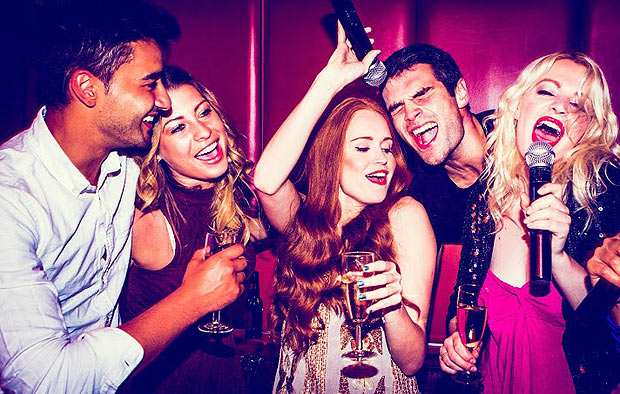 Одно из самых популярных развлечений нашего времени — караоке. Шумные вечеринки в караоке-барах или дружественные посиделки дома редко обходятся без музыки и песен в собственном исполнении. Сейчас это вполне доступное развлечение, а ведь когда-то на заре своего появления караоке было удовольствием не из дешевых.
История появления караоке берет свое начало из Японии. Дело происходило в далеком тысяча девятьсот семидесятом году в одном элитном ресторане, когда двое предпринимателей из Японии попросили Дайсуке Иноуэ, являющегося главным диск-жокеем клуба, записать пару песен в собственном исполнении, что бы была возможность подпевать любимым хитам. Дайсуке не растерялся и помимо записи песни с вокалом предпринимателей, записал трек без слов. С участием своих товарищей он совсем скоро соорудил первое караоке-устройство, внешне похожее на усовершенствованный магнитофон.
Несмотря на такую прекрасную идею, посетители клуба не спешили проявлять свои таланты, поскольку стоимость такого удовольствия была велика. Позже Иноуэ придумал еще одну систему, при которой каждый желающий сможет услышать любимое произведение, в случае если опустит в тот самый магнитофон-караоке монету размером в сто йен. Дороговизна процесса не смогло сдержать темпы нарастающей популярности нового изобретения, именно поэтому караоке распространено по всему миру.
Между прочим, занятие это весьма полезное не только с точки зрения положительных эмоций, но и физиологически. Исполнение песен помогает выработать более четкую и структурированную речь, это прекрасная гимнастика для голосовых связок и отличная вентиляция легких. Более того, исполнение любимых песен расслабляет участника, раскрепощает его, а это верный путь победить стеснительность, стать более смелым и уверенным в себе. Поделиться шикарным настроением и радостными эмоциями, получая удовольствие всей компанией – бесценный вклад караоке в повседневную жизнь человека.
Особо радостно то, что увлечение это теперь доступно и дома. С появлением DVD-плееров с функцией караоке теперь можно наслаждаться музыкой и пением в домашних условиях. Ни одна вечеринка не пройдет скучно, если в доме имеется такая модель плеера, которая поддерживает данную функцию.
В интернет-магазине Равта хороший выбор DVD-плееров по выгодной цене. К тому же устройство это может иметь и массу других полезных функций, что не даст Вам заскучать долгими зимними вечерами.
Собственность Ravta.ru. При перепечатывании обязательно указывать первоисточник Ravta.ru.

Компания Microsoft сообщила, что продала более миллиона экземпляров своей последней консоли Xbox One в прошлую пятницу, в день ее выпуска в продажу. Это рекорд для американской группы, который свидетельствует о самом удачном выпуске консолей в истории Xbox. Подробности — в статье интернет-гипермаркета «РАВТА».

После первого провала в 2011 планшета 3D, LG пробует снова вернуться в строй. Интернет-гипермаркет «РАВТА» подробнее о новинке LG G Pad.
.
«Караоке» образовано слиянием двух японских слов: «кара» (пустота) и сокращения от «окесутора» (оркестр). Это молодое и модное развлечение за пару десятилетий успело прочно войти в нашу жизнь: с ним можно столкнуться в кафе и барах, саунах и турбазах, в телепрограммах или прямо у нас дома (как же не спеть караоке в новогоднюю ночь?) Но знакомы ли вы с историей появления этой «золотой» идеи, так и не озолотившей её создателя?
История изобретения
Караоке было изобретено в Японии во второй половине XX века. В частности, датой создания первого автомата для певцов-любителей можно считать 1971 год. Отцом караоке считается японский барабанщик Иноуэ Дайсукэ. Он подрабатывал то там, то здесь, и считался очень талантливым аккомпаниатором, но сам не пел, те есть фактически служил своего рода «человеком-караоке». Годом ранее один из знакомых попросил Иноуэ сопровождать его в командировке и аккомпанировать ему. Однако наш герой был слишком занят и не мог поехать, а потому просто записал свое музыкальное сопровождение на плёнку и отдал её своему первому «клиенту».
«Тот парень был похуже, чем просто никудышный певец. Он ни ноту взять правильно не мог, ни даже выдержать ритм. Поэтому специально для него я записал песню с более чем оригинальной аранжировкой. И знаете что? Ему понравилось! Что до меня, то хорошо играть, не глядя в ноты, я не мог, а новые песни приносили одну за другой. Вот я и подумал: может, какая-нибудь машина в силах мне помочь. В известном смысле мое изобретение обязано своим появлением на свет моей лени: уж очень не хотелось разучивать новые песни!» — вспоминает Иноуэ Дайсукэ.
И вот настало время перемен. На выступлениях рок-группы в городе Кобэ, в которой играл тогда Иноуэ, нечем было занять публику во время перерывов. Тогда барабанщик и смастерил аппарат, который мог воспроизводить песенную музыку без слов. Музыканты раздавали зрителям тексты и отдыхали, пока публика с удовольствием пела. Правда, в то время никто, помимо посетителей концерта, новинку не оценил. Только через 15 лет люди «распробовали» новое развлечение, и через некоторое время караоке уже било все мыслимые и немыслимые рекорды популярности — как в самой Японии, так и по всему миру.
Многие крупные компании подхватили идею развития караоке, которое изобретатель не догадался или попросту не пожелал запатентовывать. Таким образом Иноуэ Дайсукэ не заработал на своём творении практически ничего (за иключением доходов от продажи самых первых автоматов). Единственное, чем отметили Дайсукэ, — так это вручением в 2004 году «Шнобелевской премии» (Ig Nobel Prizes) за самые дурацкие, смешные и бесполезные изобретения. Бывший барабанщик был признан человеком, «открывшим людям новый способ учиться терпимости по отношению друг к другу».
Принцип работы караоке
Существуют так называемые караоке-машины, смысл работы которых заключается в воспроизведении фонограмм с одновременным транслированием на видеоэкране бегущей строки текста песен. На многих носителях титры переключаются с каждой новой строчки и меняют свой цвет в зависимости от исполненного фрагмента песни. Это сделано для удобства — чтобы человек знал, где вступить и как правильно петь.
Как правило, эти устройства имеют функцию регулировки уровня громкости с микрофона, подавитель эха и ревербератор. Многие из них имеют фильтр, вырезающий диапазон частот голоса с фонограммы (необходим в случае использования оригинальных, не подготовленных специально для караоке, аудиодорожек) — так удаляется либо приглушается голос оригинального исполнителя.
Такие системы используются как в караоке-клубах или VIP кафе, так и дома. В последнее время возможности этих систем значительно расширились. Помимо фонового звукового сопровождения и видеоряда, появились диски с функциями изменения темпа и тональности мелодии, автоматического включения-выключения голоса солиста, программирования и сортировки композиций, проведения командных соревнований, выставления оценки за пение.
Некоторая бытовая музыкальная аппаратура (музыкальные центры, проигрыватели, домашние кинотеатры и т. п.) также имеет функцию караоке — встроенный микрофонный вход и микшер для наложения голоса на фонограмму. Кстати, вопрос законности публичного (коммерческого) использования последних по сей день остаётся спорным – многие считают, что это является прямым нарушение авторского права.
О пользе пения
Психологи убеждены, что возможность непрофессионального пения вполне можно внести в список положений руководства по здоровому образу жизни. Секрет полезности данного хобби максимально прост: оно дарит тонус нашему организму, поднимает настроение, снимает стресс и раздражение, обогащает гормонами радости и приносит сплошное удовольствие.
Согласно результатам исследований, проведённых во Франкфуртском университете, регулярное пение нормализует сердцебиение и артериальное давление, помогает в профилактике инфекционных заболеваний верхних дыхательных путей и увеличивает количество антител в организме человека (то есть, повышает иммунитет). Свободное долгое пропевание гласных дает улучшенное снабжение внутренних органов кислородом, психологическую разрядку и внутреннюю гармонизацию ничем не хуже той, которую получают люди, увлечённые медитацией. Пение караоке в своё удовольствие может выступать даже в качестве вспомогательного обезболивающего — последнее давно используется в практике Нью-Йоркских больниц.
Но помимо лечебных свойств пение выполняет роль «социального клея» — оно сближает людей, помогает проникнуться доверием друг другу или без особых усилий «влиться» в новую компанию. Если же вы стесняетесь или просто не хотите демонстрировать окружающим оттоптанные медведем уши, пойте в своё удовольствие без посторонних – дома, в машине, на природе… Кстати, есть даже специальная аппаратура для ванных комнат – никогда не пробовали петь под душем?
Источник
Москва, 31.01.2023, 21:43:33, редакция FTimes.ru, автор Ксения Кирпик.
Во многих странах мира принято отмечать праздник с необычным названием — “День сурка”. В России впервые о данном торжестве заговорили после американского фильма с одноименным названием, в котором главный герой проживает один и тот же день. Во всем мире 2-го числа последнего зимнего месяца следят за поведением сурка, ведь оно может рассказать о том, какой будет весна. О том, когда празднуют День сурка в 2023 году и какие есть приметы и традиции в этот день, в нашем сегодняшнем материале.
- Когда День сурка в 2023 году в России
- Традиции празднования Дня сурка
- Народные приметы на 2 февраля 2023 года
- Что запрещено в День сурка

День сурка считается народным праздником на территории Канады и США. Торжество отмечается ежегодно 2 февраля, 2023 год не стал исключением. В России данный праздник с каждым годом становится более популярным.
Считается, если сурок в пасмурную погоду 2 февраля выберется из своей норы и не увидит тень, тогда зима в ближайшее время закончится, а весна будет ранней. Если же зверек увидел свою тень и испугался, то зима продлится еще 6 недель. Люди привыкли к этим предсказаниям и регулярно следят за поведением сурка, особенно в этот день.
Традиции празднования Дня сурка
В Америке данная традиция появилась в XIX веке, когда голландские переселенцы поделились с местным населением тем, как они предсказывают погоду у себя на родине при помощи барсуков. И если до 80-х годов XIX века это была всего лишь обычная традиция, то спустя некоторое время ее подхватили в разных странах мира.
Каждый год в разных государствах 2 февраля выпускают сурка, чтобы внимательно проследить за его действиями. Часто складывается так, что его прогнозы оказываются достоверными.
Народные приметы на 2 февраля 2023 года
Наши предки в давние времена тоже следили за поведением животных. Согласно народным приметам:
- если куры дергают хвостом на протяжении дня, а кошка усиленно скребет пол, то в ближайшие дни следует ждать метель;
- если на улице метель и снег, то плохая погода продлится на протяжении недели;
- если лисица на снегу кувыркается, то в ближайшие дни ожидается сильный ветер;
- если день солнечный в праздник, то весна будет ранней;
- если идет сильный дождь, то лето будет мокрым.
Что запрещено в День сурка

Наши предки были суеверными людьми, поэтому, помимо примет, существовало много запретов. Так, 2 февраля ни в коем случае нельзя пользоваться ножом, так как это приведет к появлению серьезного недуга в семье. Нельзя поднимать с земли мелочь, так как есть большая вероятность столкнуться с финансовыми неприятностями.
Нельзя терять вещи, особенно перчатки, так как в будущем можно остаться без наследства или имущества. После захода солнца запрещалось выходить из дома, так как на улице разгуливала нечисть.

Подпишись на канал FTimes в Яндекс.Дзен

Прототип караоке (с японского – «пустой оркестр») появился в Японии в 1950-х. В стране тогда были популярны «поющие кафе»: музыку исполнял живой оркестр или музыкальный автомат, а пели сами посетители, которые получали брошюры с текстами песен.
Конкретно караоке изобрел Дайскэ Иноуэ – музыкант ночных клубов. В 70-х Япония переживала их бум, и Иноуэ не успевал везде играть. Тогда он придумал музыкальную машину со своим инструменталом, которая выводила на экран текст песен. Иноуэ не запатентовал изобретение и официально не считается изобретателем караоке. Патент быстрее оформил другой изобретатель из Филиппин.
В 2004 году Иноуэ все же был признан, но своеобразно. Он получил развлекательный аналог нобелевки Шнобелевскую премию – «за изобретение совершенно нового способа общения, которое учит людей выносить друг друга».
Караоке в Японии – способ уединиться, открыть душу незнакомцам и получить работу
В большинстве стран караоке-бары – публичные места: всем слышно, как поет незнакомец. В Японии распространен другой формат – караоке-бокс. Вы заранее заказываете комнату, где с друзьями споете в караоке – и никого рядом не будет. Еду и напитки можно заказывать из караоке-зала по телефону.
Но это отражает только одну сторону культуры – одиночества и уединения с близкими. Еще в Японии до сих пор популярны закусочные, где десяток незнакомцев поют песни все вместе. Это уже – способ узнавать других людей, в чем признаются японцы.

«Вы найдете молодые, буйные толпы, которые смешиваются с седыми тетями и дядями, которые выглядят так, как будто они не покидали своего песенного кресла годами. В этих закусочных люди обнажают душу», – говорит Кай Якушиджи, 29-й летний специалист по продажам.
Исполняемая песня свидетельствует о том, как человек говорит о своей жизни. Я вижу жизни многих людей уже по их манере петь в караоке».
26-летний копирайтер Айа рассказывает, что на второе собеседование в компанию ее позвали в караоке-клуб. Всем было неловко: «Но я думаю, что в этом красота караоке. Это такое общее унижение. Караоке немного похоже на секс: если мы не знакомы, я хотел бы сначала выпить. Но если все получится, я бы предпочел, чтобы мы сделали что-то еще».
Караоке в России: появились в 90-е, забылись из-за дороговизны, но скоро стали классикой отдыха
Караоке в России появляется с развалом Союза. Первое время оно доступно только в дорогих клубах, а сами системы покупают богатые бизнесмены для загородных дач. Сразу караоке не прижилось – слишком дорогая аппаратура и всего 20 песен в одной системе. Но чуть позже технологии стали доступнее, а на русском тв их впервые раскрутил Леонид Парфенов. Он объяснил, как работает караоке, а потом в него пели звезды русской эстрады.
Тот же Парфенов включил караоке как важное для России явление 1997 года: «Первые картриджи и диски содержали почти сплошь эмигрантский репертуар. После нескольких скандалов с «очисткой прав» косяком пошли сборники, где есть и фольклор, и советская классика, и «шансон», и свежие шлягеры. Известно, что под караоке поют дома даже Пугачева с Киркоровым.
Драть глотки всю ночь с пятницы на субботу, меняя мелодии и бокалы, быстро полюбят малый бизнес и офисные клерки. На юге распространены палатки на набережных и аллеях — окрестности оглашает голос нетрезвого отдыхающего».
В 2021-м бизнесмен Армен Погосян дальше продвинул японскую караоке-культуру в России: он вложил $1,5 млн в стартап караоке-боксов – «для тех, кто стесняется петь в караоке-клубах». Исполнение одной песни стоит сто рублей. В Москве и Санкт-Петербурге чаще всего выбирают Моргенштерна и Клаву Коку. В регионах (например, в Новосибирске) чаще поют Успенскую, Басту и Лепса. «Батарейка» группы «Жуки» – главный хит курортов Краснодарского края.
Караоке – причина насилия. На Филиппинах была даже серия убийств из-за плохого исполнения песни Синатры
На Филиппинах караоке тоже быстро прижилось и стало частью культуры (помните: филиппинец даже оформил патент на эту технологию). И развлечение в барах отразило страну необычно. Оказывается, на Филиппинах было несколько убийств людей, которые плохо пели песню My Way Фрэнка Синатры. Об этом явлении есть даже статья на википедии. Возможно, в нулевые из-за этого было убито до 12 человек.
Специалисты по культуре Филиппин объясняют все насильственной криминальной средой, у которой популярно караоке. Почему именно из-за песни «My Way»? Тут есть только догадки, но песня и правда была популярной на Филиппинах. Сейчас в большинстве караоке-барах страны она запрещена.
Фестиваль косплей-караоке на Филиппинах
Но и в других странах тоже убивают из-за плохого пения в караоке. Несколько подобных историй было в США и Таиланде. В 2008 году один таец застрелил в караоке-баре восемь человек – так закончился спор о том, надо ли еще раз спеть в караоке песню «Take Me Home, Country Roads».
Как караоке считает баллы? Как набрать максимальные 100 баллов?
У некоторых караоке-систем есть система с баллами. И всем всегда интересен вопрос: как машина подсчитывает степень качества пения? Какие вообще критерии?
Тут все зависит от караоке-системы. Но у нее всегда есть идеал исполнения с показателями лучшей тональности, темпа и ритма. Чем ближе вы к идеалу, тем выше балл.
Старые караоке-системы были не слишком требовательны: если вы громко поете, то получаете высокий балл. Современные системы умнее и обещают, что обмануть алгоритм громкостью не получится. Но при этом система не занизит балл, если вы, допустим, пели не с тональностью оригинала, но попадали в ноты.
В истории караоке есть более впечатляющие рекорды, чем сто баллов. Они внесены в Книгу рекордов Гиннесса.
- Итальянец Леонардо Полверелли спел подряд 1295 песен за 101 час 59 минут и 15 секунд.
- Самый массовый караоке-марафон проходил в 2009 году в США. Более 160 тысяч человек пели песню Гарта Брукса «Friends in Low Places» перед началом гонки NASCAR.
- Самый длинный караоке-марафон с участием нескольких человек проходил в Венгрии. Он длился 1011 часов 1 минуту с 20 июля 31 августа 2011 года. Каждая песня длилась более трех минут, а промежуток между песнями не превышал 30 секунд.
История Дня сурка
Как изменилось отношение к празднику со временем
«Зачем нам этот День сурка?». Примерно так многие реагируют на новость, что в США или Канаде этот праздник. И реакция вполне понятна. В России такая североамериканская традиция так и не прижилась. Поэтому, будем честными, первое, что приходит нам в голову при упоминании этого праздника — одноименный фильм с Биллом Мюрреем, где его герой застрял во временной петле и 38 дней начинал свое утро со Дня сурка.
Но! Несмотря на общий скептический настрой, День сурка, или сурков день — относительно популярный запрос в поисковиках. Его «гуглят» в 100 раз чаще, чем ту же Масленицу. Причем речь именно о празднике — не о фильме. Это значит, что любопытство такая традиция все же вызывает.
Из нашей статьи ты узнаешь, когда отмечают День сурка в 2023 году, почему именно этого грызуна сделали символом праздника и откуда вообще пошла традиция.
Когда День сурка в 2023 году: история праздника и традиции
День сурка (на англ. Groundhog Day) не только американский праздник. Его также отмечают в Канаде. История праздника берет начало от суеверия пенсильванских голландцев — так называли немецких иммигрантов, которые основались в штате Пенсильвания в 17-18 веках. Они переезжали в основном из Нидерландов и немецкоязычных территорий Европы. Так вот, эти переселенцы верили, что сурок может предсказать, какой будет весна и как скоро она придет на смену холодам. В Пенсильвании не такая приятная погода как на юге США — здесь есть полноценные зимы и переходные периоды, — поэтому для землевладельцев тех времен жизненно важно было понимать, когда начнется «год фермера». В отдельной статье мы писали о народных приметах на урожай в России.
Первое упоминание о Дне сурка в США датировано 1840 годом. Некий Джеймс Л. Моррисон, житель Пенсильвании, записал в своем дневнике, как его новые соседи-немцы устраивали подобный праздник.
День сурка отмечают ежегодно 2 февраля. Эта дата выбрана не просто так — в этот день католики празднуют Сретение Господне — один из старшейших христианских праздников. У православных он 15 февраля. Среди католических традиций на Сретение была и такая, как ориентир на поведение барсука после зимней спячки. Считалось, что:
- если животное выйдет из норы в солнечный день, увидит свою тень, испугается и вернется обратно, то зима продлится еще четыре-шесть недель;
- если же барсук увидит тень в облачную погоду, то весна наступит быстро. В общем, условия звучат довольно странно, но как есть.
На новом месте барсука сменил сурок, который визуально его напоминал.
Существует версия, что суеверие связанное с барсуком (сурком) основано на предании, что ясная погода в праздник Сретения — символ затяжной зимы. Интересно, что в Пенсильвании будят не абы каких сурков, а только тех, что живут в Грундсоу — в голландской провинции штата. Сурка, которого избрали для столь почетной миссии, нарекают Панксатони Фил. Первая часто имени — это название города, который в США считают родиной Дня сурка. Там праздник отмечают с особым размахом.
Интересные факты
Так выглядит памятник сурку в Иркутской области. Внеся зверька в историю города, ему отдали дань, ведь именно из шкурок сурков в перестроечные годы, когда в городе Ангарск остановилось производство, шили шапки.
- Первым о том, что традицию отмечать День сурка привезли именно католики из Германии, сказал ученый Рис Карпентер. Исследователь аргументировал свои слова тем, что на Британских островах подобного торжества не было. Было похожее, но вместо барсука (сурка) там был еж. Поэтому, если праздник привезли иммигранты из тех мест, символ точно был бы другой.
- В Нью-Йорке и Нью-Джерси решили отличиться. Их сурков зовут не Фил. Нью-Йоркцы ждут пробуждения Чака, жителя Статен-айлендского зоопарка. В Нью-Джерси приход весны зависит от сурка Мэла. В прошлом году праздник пришлось отменить из-за смерти постоянного амбассадора. Мэл умер из-за старости — в среднем такие грызуны живут 3-4 года. По словам организаторов мероприятия, найти замену не так-то просто. Видимо, не каждый сурок подойдет на роль «предсказателя».
- В России сурки, кстати, тоже на особо счету. В городах Ангарск (Иркутская область) и Азнакаево (Татарстан) даже есть статуи этих зверьков.
Как изменилось отношение к празднику со временем
Если раньше День сурка был местечковым праздником, то с ростом любви и интереса к нему, традицию подхватили маркетологи. Сейчас этот известный праздник — такой же символ США, как Статуя Свободы. В конце января туристов завлекают на масштабные мероприятия, где главный герой — милый заспанный грызун. В честь этого события устраивают фестивали и продают огромное количество разных вещиц с соответствующей символикой.
В общем, современный День сурка — сезонный коммерческий проект. Современные американцы понимают, что от того, когда животное испугается своей тени — в солнечную или облачную погоду — ничего не зависит, но продолжают поддерживать жизнеспособность праздника, потому что это весело. В День сурка практически все телеканалы ведут трансляции с площадей, где в их городе показывают зверька. Процесс выглядит довольно театрально — задействованные мужчины одеты в костюмы конца 18 века — черные плащи и шляпы-цилиндры.
Вживую посмотреть на это действие собираются сотни людей. Столько же или больше наблюдают за церемонией, сидя дома.

Автор
Редактор рубрики «Стиль жизни».